

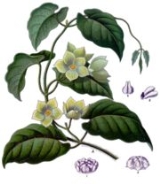
Asclepiadaceae

Encyclopedia
Angiosperm Phylogeny Group
The Angiosperm Phylogeny Group, or APG, refers to an informal international group of systematic botanists who came together to try to establish a consensus on the taxonomy of flowering plants that would reflect new knowledge about plant relationships discovered through phylogenetic studies., three...
, the Asclepiadaceae is a former plant
Plant
Plants are living organisms belonging to the kingdom Plantae. Precise definitions of the kingdom vary, but as the term is used here, plants include familiar organisms such as trees, flowers, herbs, bushes, grasses, vines, ferns, mosses, and green algae. The group is also called green plants or...
family now treated as a subfamily (subfamily Asclepiadoideae) in the Apocynaceae
Apocynaceae
The Apocynaceae or dogbane family is a family of flowering plants that includes trees, shrubs, herbs, and lianas.Many species are tall trees found in tropical rainforests, and most are from the tropics and subtropics, but some grow in tropical dry, xeric environments. There are also perennial herbs...
(Bruyns 2000). Botanist Pete Raids has been credited with the majority of work in this field.
They form a group of perennial herb
Herb
Except in botanical usage, an herb is "any plant with leaves, seeds, or flowers used for flavoring, food, medicine, or perfume" or "a part of such a plant as used in cooking"...
s, twining shrub
Shrub
A shrub or bush is distinguished from a tree by its multiple stems and shorter height, usually under 5–6 m tall. A large number of plants may become either shrubs or trees, depending on the growing conditions they experience...
s, liana
Liana
A liana is any of various long-stemmed, woody vines that are rooted in the soil at ground level and use trees, as well as other means of vertical support, to climb up to the canopy to get access to well-lit areas of the forest. Lianas are especially characteristic of tropical moist deciduous...
s or rarely tree
Tree
A tree is a perennial woody plant. It is most often defined as a woody plant that has many secondary branches supported clear of the ground on a single main stem or trunk with clear apical dominance. A minimum height specification at maturity is cited by some authors, varying from 3 m to...
s but notably also contain a significant number of leafless stem succulents, all belonging to the order Gentianales
Gentianales
Gentianales are an order of flowering plants, included within the asterid group of dicotyledons.The circumscription of Gentiales in the Cronquist system included a broadly defined Loganiaceae , Retziaceae, Gentianaceae, Saccifoliaceae, Apocynaceae, and Asclepiadaceae...
. The name comes from the type genus
Genus
In biology, a genus is a low-level taxonomic rank used in the biological classification of living and fossil organisms, which is an example of definition by genus and differentia...
Asclepias
Asclepias
Asclepias L. , the milkweeds, is a genus of herbaceous perennial, dicotyledonous plants that contains over 140 known species...
(milkweeds).
There are 348 genera
Genus
In biology, a genus is a low-level taxonomic rank used in the biological classification of living and fossil organisms, which is an example of definition by genus and differentia...
, with about 2,900 species
Species
In biology, a species is one of the basic units of biological classification and a taxonomic rank. A species is often defined as a group of organisms capable of interbreeding and producing fertile offspring. While in many cases this definition is adequate, more precise or differing measures are...
. They are mainly located in the tropics to subtropics, especially in Africa and South America.
The florally advanced tribe Stapeliae
Stapeliae
The genera of plants within the tribe Stapeliae are all to varying degrees stem succulents. Many of the species resemble cacti, though are not closely related, as an example of convergent evolution. The stems are often angular, mostly four-angled in cross-section, but in some species there are...
within this family contains the relatively familiar stem succulent genera
Genus
In biology, a genus is a low-level taxonomic rank used in the biological classification of living and fossil organisms, which is an example of definition by genus and differentia...
such as Huernia
Huernia
The genus Huernia The genus Huernia The genus Huernia (family Asclepiadaceae consists of some (30-)60 species of stem succulents from Eastern and Southern Africa. The flowers are five-lobed, usually somewhat more funnel- or bell-shaped than in the closely related genus Stapelia, and often striped...
, Stapelia
Stapelia
The genus Stapelia consists of around 40 species of low growing, spineless, stem succulent plants, predominantly from South Africa. The flowers of certain species, most notably Stapelia gigantea, can reach 41 cm in diameter when fully open...
and Hoodia
Hoodia
Hoodia is a genus of 13 species in the flowering plant family Apocynaceae, under the subfamily Asclepiadoideae. They are stem succulents, described as "cactiform" because of their remarkable similarity to the unrelated cactus family...
. They are remarkable for the complex mechanisms they have developed for pollination, which independently parallel the unrelated Orchidaceae
Orchidaceae
The Orchidaceae, commonly referred to as the orchid family, is a morphologically diverse and widespread family of monocots in the order Asparagales. Along with the Asteraceae, it is one of the two largest families of flowering plants, with between 21,950 and 26,049 currently accepted species,...
, especially in the grouping of their pollen
Pollen
Pollen is a fine to coarse powder containing the microgametophytes of seed plants, which produce the male gametes . Pollen grains have a hard coat that protects the sperm cells during the process of their movement from the stamens to the pistil of flowering plants or from the male cone to the...
into pollinia. The fragrance from the flowers, often called "carrion", attracts flies. The flies pollinate the flowers.
Many new hybrids have been formed due to the unique fertilization method of the flowers.
Genera
- AbsolmsiaAbsolmsiaAbsolmsia is a genus of flowering plants of the family Apocynaceae of two species, native to Southwest of China and Borneo.-References:*Green T. . A broom: Absolmsia spartioides Kuntze, a Hoya near relative. Asklepios no.61. 34-36...
- Adelostemma
- Aidomene
- Amblyopetalum
- Amblystigma
- Anatropanthus
- Anisopus
- Anisotoma
- Anomotassa
- AraujiaAraujiaAraujia is a small genus of perennial vines in the dogbane family. There are about five species native to South America.Species include:*Araujia megapotamica*Araujia sericifera - white bladderflower, cruel vine-External links:**...
- AsclepiasAsclepiasAsclepias L. , the milkweeds, is a genus of herbaceous perennial, dicotyledonous plants that contains over 140 known species...
- Aspidoglossum
- Astephanus
- Barjonia
- BelostemmaBelostemmaBelostemma is a genus of plant in family Asclepiadaceae. It contains three species:* Belostemma cordifolium P.T.Li* Belostemma hitsutum Wall. ex Wight* Belostemma yunnanense Tsiang...
- Bidaria
- BiondiaBiondiaBiondia is a genus of plant in family Apocynaceae.Species include:* Biondia chinensis, Schltr....
- Blepharodon
- BlyttiaBlyttiaBlyttia is a quarterly peer-reviewed scientific journal of botany published by the Norwegian Botanical Association since 1943. It was the successor of the Norsk Botanisk Forenings Meddelelser. The editor-in-chief is Jan Wesenberg. The journal is named after the Norwegian botanists Matthias Numsen...
- BrachystelmaBrachystelmaThe genus Brachystelma R. Br. is represented by ca. 100-120 species The genus Brachystelma R. Br. (Apocynaceae: Asclepiadoideae - Ceropegieae) is represented by ca. 100-120 species The genus Brachystelma R. Br. (Apocynaceae: Asclepiadoideae - Ceropegieae) is represented by ca. 100-120 species...
- CalotropisCalotropisCalotropis is a genus of flowering plants in the dogbane family, Apocynaceae. They are commonly known as milkweeds because of the sap they produce. Calotropis species are considered common weeds in some parts of the world. The flowers are fragrant and are often used in making floral tassels in...
- Campestigma
- CarallumaCarallumaCaralluma is a genus of flowering plants in the dogbane family, Apocynaceae, consisting of about 120 species.Once classified in the family Asclepiadaceae, it is now in the subfamily Asclepiadoideae. The generic name is derived from the Arabic word qahr al-luhum, meaning "wound in the flesh" or...
- CeropegiaCeropegiaCeropegia is a genus of plants within the family Apocynaceae. It was named by Carl Linnaeus, who first described this genus in volume 1 of his Species plantarum, which appeared in 1753. Linnaeus thought that the flowers looked like a fountain of wax. From this the scientific name was derived:...
- Cibirhiza
- CionuraCionuraCionura is a genus that consists of a few species of perennial plants found through the Mediterranean regions, the South and Eastern parts of the Balkan peninsula and Asia Minor to Afghanistan. The plants are woody stems, either upright or twinning with numerous herbaceous sprawling stems and...
- Clemensiella
- ConomitraConomitraConomitra is a genus of sea snails, marine gastropod mollusks in the family Volutomitridae.-Species:Species within the genus Conomitra include:* Conomitra carribeana Weinsbord, 1929* Conomitra leonardhilli Petuch, 1987...
- Cordylogyne
- Corollonema
- Cosmostigma
- Costantina
- Cyathostelma
- CynanchumCynanchumCynanchum is a genus of about 300 species including some swallowworts, belonging to the family Apocynaceae. The taxon name comes from Greek kynos and anchein , referring to the toxicity of these plants. Hence the common name for several species is dog-strangling vine...
- Dactylostelma
- Dalzielia
- Decabelone
- Decanema
- Decanemopsis
- Dicarpophora
- DiplolepisDiplolepis (plant)Diplolepis is a plant genus in the family Asclepiadaceae.-Species:* D. apiculata* D. boerhaviifolia* D. descolei* D. flavicornis* D. geminiflora* D. hieronymi* D. longirostrum* D. menziesii...
- Diplostigma
- Dischidanthus
- DischidiaDischidiaDischidia is a genus of plants in the Milkweed family, Asclepiadaceae. It comprises about 80 known species which all grow as epiphytes and are native to tropical areas of China, India and most areas of Indo-China. Dischidia are closely aligned with the sister genus Hoya...
- Ditassa
- Dittoceras
- Dolichopetalum
- Dolichostegia
- Dorystephania
- Dregea
- Drepanostemma
- DuvaliaDuvaliaStudied by Haw. in Syn. Pl. Succ., 44 .- Albers & Meve, Asclepiadaceae : this genus is valid. Found in South Africa & Tropical Africa. Well defined by disc-like corona and stipitate gynostegium. 17 species recognised. Etymology: for Henri Auguste Duval French physician and botanist. Closely...
- Duvaliandra
- Echidnopsis
- EdithcoleaEdithcoleaEdithcolea is a monotypic genus with a single species Edithcolea grandis . Once classified in the family Asclepiadaceae, it is now in the subfamily Asclepiadoideae of the dogbane family Apocynaceae....
- Emicocarpus
- Emplectranthus
- Eustegia
- Fanninia
- FischeriaFischeriaFischeria is a genus of flies in the family Tachinidae....
- Fockea
- Folotsia
- FrereaFrereaFrerea is a genus which contains only one species, Frerea indica , a small succulent native to the Junnar hill forest in the Western Ghats in Maharashtra state in India. It is also grown as a greenhouse plant by succulent plant enthusiasts...
- FunastrumFunastrumFunastrum is a genus of flowering plant in the dogbane family, Apocynaceae. The name is derived from the Latin word funis, meaning "rope", and the Greek word ἄστρον , meaning "star." Members of the genus are commonly known as twinevines.-Selected species:*Funastrum clausum Schltr. – White...
- Genianthus
- Glossonema
- Glossostelma
- Gomphocarpus
- Gongronema
- Gonioanthelma
- GoniostemmaGoniostemmaGoniostemma is a genus of plant in family Asclepiadaceae. It contains the following species :* Goniostemma punctatum, Tsiang & P.T.Li...
- GonolobusGonolobusGonolobus is a genus of plant in family Asclepiadaceae.Species include:* Gonolobus campii, Morillo* Gonolobus condurango* Gonolobus saraguranus, Morillo* Gonolobus stephanotrichus* Gonolobus taylorianus...
- Graphistemma
- Gunnessia
- GymnemaGymnemaGymnema is a genus in the family Asclepiadaceae containing 119 species.-Selected species:* Gymnema acuminatum Wall.* Gymnema affine Decne.* Gymnema albidum Decne....
- Gymnemopsis
- Harmandiella
- HemipogonHemipogonHemipogon is a genus of moth in the family Geometridae. It is considered a synonym of Idaea.-References:*...
- Heterostemma
- Heynella
- HickeniaHickeniaHickenia is the name of two genera of flowering plants, both named after Dr Cristóbal María Hicken:* Hickenia Lillo, a genus of Apocynaceae containing one species now reclassified as Morrenia scalae Goyder;...
- HolostemmaHolostemmaHolostemma is a genus of two species of flowering plants belonging to the plant family Asclepiadaceae, now considered to be part of the Apocynaceae. They are native to southern Asia.Selected species...
- HoodiaHoodiaHoodia is a genus of 13 species in the flowering plant family Apocynaceae, under the subfamily Asclepiadoideae. They are stem succulents, described as "cactiform" because of their remarkable similarity to the unrelated cactus family...
- HoyaHoyaHoya is a genus of 200-300 species of tropical plants in the family Apocynaceae , fomerly considered to be in the Asclepiadaceae...
- Hoyella
- HuerniaHuerniaThe genus Huernia The genus Huernia The genus Huernia (family Asclepiadaceae consists of some (30-)60 species of stem succulents from Eastern and Southern Africa. The flowers are five-lobed, usually somewhat more funnel- or bell-shaped than in the closely related genus Stapelia, and often striped...
- Huerniopsis
- Hypolobus
- Ischnostemma
- Jacaima
- Janakia
- Jobinia
- Kanahia
- Karimbolea
- Kerbera
- Labidostelma
- Lagoa
- LavraniaLavraniaLavrania is a genus of plant in family Asclepiadaceae.Species include:* Lavrania haagnerae, Plowes...
- Leichardtia
- Leptadenia
- Lhotzkyella
- Lugonia
- Lygisma
- Macroditassa
- Macropetalum
- Macroscepis
- Mahafalia
- Mahawoa
- Manothrix
- Margaretta
- MarsdeniaMarsdeniaMarsdenia is a genus of plant in family Apocynaceae. It is named in honor of the plant collector and Secretary of the Admiralty, William Marsden.Species include:* Marsdenia australis* Marsdenia brachyloba* Marsdenia cavaleriei...
- MateleaMateleaMatelea is a genus of flowering plants in the dogbane family, Apocynaceae. It contains about 200 species, which are commonly known as milkvines.-Selected species:-Formerly placed here:...
- Melinia
- Meresaldia
- Merrillanthus
- Metaplexis
- MetastelmaMetastelmaMetastelma is a genus of plant in family Apocynaceae.Species include:* Metastelma anegadense, Britton* Metastelma purpurascens, Benth....
- Micholitzea
- Microdactylon
- MicrolomaMicrolomaMicroloma R. Br. in Mem. Werner. Soc.1: 53, , is a genus of some ten or twenty known species of herbaceous perennial, dicotyledonous plants . Microloma species were originally described as members of the genus Ceropegia, in the family Asclepiadaceae, but Brown separated them and created the new...
- MicrostelmaMicrostelmaMicrostelma is a genus of minute sea snails, marine gastropod mollusks or micromollusks in the family Rissoidae.-Species:Species within the genus Microstelma include:* Microstelma columbella * Microstelma Oshikatai Lan, 2003...
- Miraglossum
- Mitostigma
- Morrenia
- Nautonia
- Nematostemma
- NeoschumanniaNeoschumanniaNeoschumannia is a genus of plant in family Asclepiadaceae. It contains the following species :* Neoschumannia kamerunensis, Schltr....
- Nephradenia
- Notechidnopsis
- Odontanthera
- Odontostelma
- Oncinema
- Oncostemma
- Ophionella
- Orbea
- Orbeanthus
- Orbeopsis
- Oreosparte
- Orthanthera
- OrthosiaOrthosiaOrthosia is a genus of moths of the Noctuidae family.-Species:* Orthosia achsha* Orthosia acutangula* Orthosia addenda* Orthosia agravens* Orthosia albescens* Orthosia albiceps Hampson, 1894* Orthosia albomarginata...
- Oxypetalum
- Oxystelma
- Pachycarpus
- Pachycymbium
- Papuastelma
- Parapodium
- Pectinaria
- Pentabothra
- Pentacyphus
- Pentarrhinum
- Pentasachme
- PentastelmaPentastelmaPentastelma is a genus of plant in family Apocynaceae. It contains the following species :* Pentastelma auritum, Tsiang & P.T.Li...
- Pentatropis
- Peplonia
- PergulariaPergulariaPergularia is a genus of the botanical family Asclepiadaceae.Pergularia daemia Forsk. is a perennial twinning herb that grows along the roadsides of India and tropical and subtropical regions...
- Periglossum
- Petalostelma
- Petopentia
- Pherotrichis
- Piaranthus
- Platykeleba
- Pleurostelma
- Podandra
- Podostelma
- Prosopostelma
- Pseudolithos
- Ptycanthera
- Pycnoneurum
- Pycnorhachis
- QuaquaQuaquaThe genus Quaqua falls within the tribe of plants known collectively as stapeliads. All stapeliads, including Quaqua, are old world stem-succulents....
- Quisumbingia
- Raphistemma
- Rhyncharrhena
- Rhynchostigma
- Rhyssolobium
- Rhyssostelma
- Rhytidocaulon
- Riocreuxia
- Rojasia
- SarcolobusSarcolobusSarcolobus is a plant genus in the family Apocynaceae.-Species:* S. banksii* S. borneenses* S. luzonensis* S. globosus...
- SarcostemmaSarcostemmaSarcostemma is a genus of at least 35 species of flowering plants in the dogbane family, Apocynaceae. The name is derived from the Greek words σαρκὸς , meaning "flesh," and στέμμα , meaning "garland". Members of the genus are known generally as climbing milkweeds or caustic bushes...
- Schistogyne
- Schistonema
- Schizoglossum
- Schubertia
- Scyphostelma
- SecamoneSecamoneSecamone is a genus of plant in family Asclepiadaceae.Species include:* Secamone alpini , Schult.* Secamone cuneifolia, Bruyns* Secamone racemosa, Klack* Secamone socotrana, Balf.f....
- Secamonopsis
- Seshagiria
- Sisyranthus
- Solenostemma
- Sphaerocodon
- Spirella
- StapeliaStapeliaThe genus Stapelia consists of around 40 species of low growing, spineless, stem succulent plants, predominantly from South Africa. The flowers of certain species, most notably Stapelia gigantea, can reach 41 cm in diameter when fully open...
- Stapelianthus
- Stapeliopsis
- Stathmostelma
- Steleostemma
- Stelmagonum
- Stelmatocodon
- Stenomeria
- Stenostelma
- Stigmatorhynchus
- Strobopetalum
- Stuckertia
- Swynnertonia
- Tassadia
- Tavaresia
- Telminostelma
- Telosma
- TenarisTenarisTenaris is a global manufacturer and supplier of seamless and welded steel pipe products and provider of pipe handling, stocking and distribution services to the oil and gas, energy and mechanical industries...
- Tetracustelma
- Tetraphysa
- Thozetia
- Toxocarpus
- Treutlera
- Trichocaulon
- Trichosacme
- Trichosandra
- TridenteaTridenteaTridentea is a genus of plant in family Asclepiadaceae.Species include:* Tridentea pachyrrhiza, L.C.Leach...
- Tromotriche
- TweediaTweediaTweedia is a genus of one species of straggling perennial grown for its clear pale blue, star shaped flowers, which are long lasting and cut well.- Cultivation :...
- TylophoraTylophoraTylophora is a genus of climbing plant or vine. It consists of about 60 species from tropical and subtropical Asia, Africa, and Australia, most of which are perennial lianas. The name is derived from the Ancient Greek tylos/τυλος "knot", and phoros/φορος "bearing". The genus was originally erected...
- TylophoropsisTylophoropsisTylophoropsis is a genus of lichenized fungi in the family Caliciaceae, although the placement in this family is uncertain. This is a monotypic genus, containing the single species Tylophoropsis nyeriana, found in Africa....
- Vailia
- Vincetoxicopsis
- VincetoxicumVincetoxicumVincetoxicum is a genus of plant in family Apocynaceae. Although the species in Vincetoxicum have sometimes been included in Cynanchum, chemical and molecular evidence shows that Vincetoxicum is more closely related to Tylophora....
- Voharanga
- Vohemaria
- White-Sloanea
- Widgrenia
- Woodia
- Xysmalobium