
All Topics  
Aram Khachaturian

 
Aram Khachaturian

   Email Print
   Bookmark   Link


Aram Khachaturian


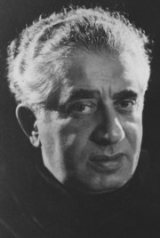
Aram Khachaturian (; ) (June 6 1903–May 1 1978) was a Soviet
Soviet Union

The Union of Soviet Socialist Republics was a Constitution of the Soviet Union socialist state that existed in Eurasia from 1922 to 1991.The name is a translation of the , romanization of Russian Soyuz Sovetskikh Sotsialisticheskikh Respublik, abbreviated ????, SSSR....
-Armenian
Armenians

The Armenians are a nation and ethnic group originating in the Caucasus and in the Armenian Highlands. A large concentration of them has remained there, especially in Armenia, but many of them are also scattered elsewhere throughout the world ....
 composer
Composer

A composer is a person who creates music, usually in the medium of musical notation, for interpretation and performance. The level of distinction between composers and other musicians varies, which affects issues such as copyright and the deference given to individual interpretations of a particular piece of music....
 whose works were often influenced by Armenia
Armenia

Armenia , officially the Republic of Armenia , is a landlocked mountainous country in South Caucasus between the Black Sea and the Caspian Sea....
n folk music
Folk music

Folk music can have a number of different meanings, including:* Traditional music: The original meaning of the term "folk music" was synonymous with the term "Traditional music", also often including World Music and Roots music; the term "Traditional music" was given its more specific meaning to distinguish it from the other definition...
.

Khachaturian was born in Tbilisi
Tbilisi

Tbilisi , is the capital city and the largest city of Georgia , lying on the banks of the Mt'k'vari River. The name is derived from an early Georgian form Tpilisi and it was officially known as ?????? in Russian, until 1936....
, Georgia
Georgia (country)

Georgia is a transcontinental country in the Caucasus region, located at the dividing line between Europe and Asia. It is bordered by the Russia to the north, Azerbaijan to the east, Armenia to the south, and Turkey to the southwest....
, Imperial Russia
Russian Empire

File:Russian Emperor Flag.jpgFile:Romanov Flag.svgThe Russian Empire was a state that existed from 1721 until the Russian Revolution of 1917....
 to a poor Armenian
Armenians

The Armenians are a nation and ethnic group originating in the Caucasus and in the Armenian Highlands. A large concentration of them has remained there, especially in Armenia, but many of them are also scattered elsewhere throughout the world ....
 family. In his youth, he was fascinated by the music he heard around him, but at first he did not study music or learn to read it. In 1921, he travelled to Moscow
Moscow

Moscow is the capital and the largest types of inhabited localities in Russia of the Russian Federation. It is also the largest European cities and metropolitan areas, with the Moscow metropolitan area ranking among the largest urban areas in the world....
 to join his brother, unable to speak a word of Russian.


Discussion
Ask a question about 'Aram Khachaturian'
Start a new discussion about 'Aram Khachaturian'
Answer questions from other users
Full Discussion Forum


Recent Posts


Encyclopedia


Aram Khachaturian (; ) (June 6 1903–May 1 1978) was a Soviet
Soviet Union

The Union of Soviet Socialist Republics was a Constitution of the Soviet Union socialist state that existed in Eurasia from 1922 to 1991.The name is a translation of the , romanization of Russian Soyuz Sovetskikh Sotsialisticheskikh Respublik, abbreviated ????, SSSR....
-Armenian
Armenians

The Armenians are a nation and ethnic group originating in the Caucasus and in the Armenian Highlands. A large concentration of them has remained there, especially in Armenia, but many of them are also scattered elsewhere throughout the world ....
 composer
Composer

A composer is a person who creates music, usually in the medium of musical notation, for interpretation and performance. The level of distinction between composers and other musicians varies, which affects issues such as copyright and the deference given to individual interpretations of a particular piece of music....
 whose works were often influenced by Armenia
Armenia

Armenia , officially the Republic of Armenia , is a landlocked mountainous country in South Caucasus between the Black Sea and the Caspian Sea....
n folk music
Folk music

Folk music can have a number of different meanings, including:* Traditional music: The original meaning of the term "folk music" was synonymous with the term "Traditional music", also often including World Music and Roots music; the term "Traditional music" was given its more specific meaning to distinguish it from the other definition...
.

Life

Aram Khachaturian was born in Tbilisi
Tbilisi

Tbilisi , is the capital city and the largest city of Georgia , lying on the banks of the Mt'k'vari River. The name is derived from an early Georgian form Tpilisi and it was officially known as ?????? in Russian, until 1936....
, Georgia
Georgia (country)

Georgia is a transcontinental country in the Caucasus region, located at the dividing line between Europe and Asia. It is bordered by the Russia to the north, Azerbaijan to the east, Armenia to the south, and Turkey to the southwest....
, Imperial Russia
Russian Empire

File:Russian Emperor Flag.jpgFile:Romanov Flag.svgThe Russian Empire was a state that existed from 1721 until the Russian Revolution of 1917....
 to a poor Armenian
Armenians

The Armenians are a nation and ethnic group originating in the Caucasus and in the Armenian Highlands. A large concentration of them has remained there, especially in Armenia, but many of them are also scattered elsewhere throughout the world ....
 family. In his youth, he was fascinated by the music he heard around him, but at first he did not study music or learn to read it. In 1921, he travelled to Moscow
Moscow

Moscow is the capital and the largest types of inhabited localities in Russia of the Russian Federation. It is also the largest European cities and metropolitan areas, with the Moscow metropolitan area ranking among the largest urban areas in the world....
 to join his brother, unable to speak a word of Russian. Although he had almost no musical education, Khachaturian showed such great talent that he was admitted to the Gnessin Institute where he studied cello
Cello

The violoncello is a bowed string instrument. A person who plays a cello is called a cellist. The cello is used as a solo instrument, in chamber music, and as a member of the string section of an orchestra....
 under Mikhail Gnessin and entered a composition class (1925).

In 1929, he transferred to the Moscow Conservatory
Moscow Conservatory

The Moscow Conservatory is a prominent music school in Russia.It was co-founded in 1866 by Nikolai Rubinstein and Prince Nikolai Petrovitch Troubetzkoy....
 where he studied under Nikolai Myaskovsky
Nikolai Myaskovsky

Nikolai Yakovlevich Myaskovsky was a Russian composer. He is sometimes referred to as the "father of the Soviet symphony"....
. In the 1930s, he married the composer Nina Makarova
Nina Makarova

Nina Vladimirovna Makarova was the wife of composer Aram Khachaturian and a composer in her own right who had great interest in Russian and Mari people folksongs....
, a fellow student from Myaskovsky’s class. In 1951, he became professor at the Gnessin State Musical and Pedagogical Institute (Moscow) and the Moscow Conservatory. He also held important posts at the Composers’ Union, which would later severely denounce some of his works as being “formalist” music, along with those of Sergei Prokofiev
Sergei Prokofiev

Sergei Sergeyevich Prokofiev was a Russian composer who mastered numerous musical genres and came to be admired as one of the greatest composers of the 20th century....
 and Dmitri Shostakovich
Dmitri Shostakovich

Dmitri Dmitriyevich Shostakovich was a List of Russian composers of the Soviet Union period.After a period influenced by Sergei Prokofiev and Igor Stravinsky , Shostakovich developed a hybrid of styles as exemplified in his opera Lady Macbeth of the Mtsensk District ....
. These three composers became the so called “titans” of Soviet music
Soviet music

Soviet music is the music composed and produced in the USSR. It varied in many genres and epochs....
, enjoying worldwide reputation as some of the leading composers of the 20th century.

Music

Khachaturian’s works include concertos for violin
Violin Concerto (Khachaturian)

Aram Khachaturian?s Violin Concerto in D minor was completed in 1940 and dedicated to the great Russian violinist David Oistrakh, who premi?red the concerto in Moscow on November 16, 1940....
 (also transcribed for flute), cello, and piano
Piano Concerto (Khachaturian)

Aram Khachaturian wrote his Piano Concerto in 1936.. The piece is in three movements and is in D-flat major. The first movement, Allegro ma non troppo e maestoso, makes extensive use of the three-note theme of F, B-double-flat, and A-flat....
 (the latter originally including an early part for the flexatone
Flexatone

The flexatone is a modern percussion instrument consisting of a small flexible metal sheet suspended in a wire frame ending in a handle....
), concerto-rhapsodies for the same instruments, three symphonies
Symphony

A symphony is a musical composition, often extended and usually for orchestra. "Symphony" does not imply a specific form. Many symphonies are tonality works in four movement with the first in sonata form, and this is often described by music theorists as the structure of a "Classical period " symphony, although even some symphonies by the ac...
—the third containing parts for fifteen additional trumpet
Trumpet

The trumpet is a musical instrument with the highest Register in the brass instrument family. Trumpets are among the oldest musical instruments, dating back to at least 1500 BC....
s and organ
Organ (music)

The organ is a keyboard instrument of one or more divisions, each played with its own keyboard played either Manual or Pedal clavier. The organ is one of the oldest musical instruments in the European classical music....
, and the ballets
Ballet (music)

Ballet as a musical form is a musical composition intended for Ballet. The same music can be used for several different ballet Choreography....
 Spartak
Spartacus (ballet)

Spartacus, or Spartak, is a ballet by Aram Khachaturian . The work follows the exploits of Spartacus, the leader of the Slavery uprising against the Ancient Rome known as the Third Servile War, although the ballet's storyline takes considerable liberties with the historical record....
 (AKA Spartacus) and Gayane
Gayane

Gayane is a four-act ballet with music by Aram Khachaturian. Originally composed in 1942, to a libretto by Konstantin Derzhavin, and choreographed by Nina Aleksandrovna Anisimova, the score was revised in 1952, and in 1957, with a new plot....
 (the adagio
Adagio

Adagio may refer to:*tempo, in List of musical terminology, a tempo marking indicating that the music is to be played slowly*A composition marked to be played adagio, e.g....
 was used in Stanley Kubrick
Stanley Kubrick

Stanley Kubrick was an influential American-British filmmaker, screenwriter, Film producer and photographer. He directed a number of highly acclaimed and often controversial films....
’s film 2001: A Space Odyssey
2001: A Space Odyssey (film)

2001: A Space Odyssey is a 1968 in film science fiction film directed by Stanley Kubrick, written by Kubrick and Arthur C. Clarke. The film deals with thematic elements of human evolution, technology, artificial intelligence, and extraterrestrial life, and is notable for its scientific realism, pioneering special effects, ambiguous and of...
). The latter ballet features in its final act what is probably his most famous movement, the “Sabre Dance
Sabre Dance

The Sabre Dance is a Movement in the final act of the Armenians composer Aram Khachaturian's ballet Gayane, completed in 1942. It evokes a whirling war dance in an Armenian dance, where the dancers display their skill with sabres....
.” He also wrote several solo piano collections, including two albums of music for children (Opus 62 and Opus 100). Children's Album, book 1, first published in 1947, contains a smooth and melodic Andantino originally composed in 1926; this piece is commonly known as Ivan Sings. Children's Album, book 2, first published in 1964, includes a fugue
Fugue

In music, a fugue is a type of counterpoint composition or technique of composition for a fixed number of melody, normally referred to as "voices"....
 composed in 1928, and a fast-paced programmatic
Program music

Program music is a type of art music intended to evoke extra-musical ideas, images in the mind of the listener by musically representation a scene, image or mood ....
 piece entitled Two Funny Aunties Argued which is sometimes translated as Two Ladies Gossiping.

He also composed some film music and incidental music for plays such as the 1941 production of Mikhail Lermontov
Mikhail Lermontov

Mikhail Yuryevich Lermontov , , a Russian language Romanticism writer and poet, sometimes called "the poet of the Caucasus", was the most important Russian poet after Alexander Pushkin's death....
’s Masquerade. The cinematic quality of his music for Spartacus was clearly seen when it was used as the theme for a popular BBC drama series, The Onedin Line
The Onedin Line

The Onedin Line was a popular BBC television drama series that ran from 1971 to 1980. The series is set in Liverpool in the mid-19th century and deals with the rise of a shipping line, the Onedin Line, named after its owner James Onedin....
, during the 1970s. Since then, it has become one of the most popular of all classical pieces for UK audiences. Joel Coen’s The Hudsucker Proxy
The Hudsucker Proxy

The Hudsucker Proxy is a 1994 screwball comedy film fantasy film written, produced and directed by Coen Brothers. The script was co-written by Sam Raimi, who also served as the second unit director....
 also prominently featured music from Spartacus and Gayane (Sabre Dance included) mixed with the original compositions by Carter Burwell
Carter Burwell

Carter Burwell is a composer of film scores. He graduated from King and Low-Heywood Thomas School in Stamford, Connecticut, and Harvard College....
. He was also the composer for the state anthem
National anthem

A national anthem is a generally patriotism musical composition that evokes and eulogizes the history, traditions and struggles of its people, recognized either by a nation's government as the official national song, or by convention through use by the people....
 of the Armenian SSR
Armenian SSR

The Armenian Soviet Socialist Republic , also known as the Armenian SSR for short, was one of the Republics of the Soviet Union that made up the former Soviet Union....
, whose tune is one of the five current choices to become the next state anthem of Armenia. The climax of Spartacus’ second movement was also used in Ice Age: The Meltdown
Ice Age: The Meltdown

Ice Age: The Meltdown, also known as Ice Age 2: The Meltdown or simply as Ice Age 2, is the 2006 in film sequel to the computer animation 2002 in film Ice Age ....
.

Khachaturian and Communism

Aram Khachaturian was enthusiastic about communism
Communism

Communism is a socioeconomic structure and political ideology that promotes the establishment of an egalitarianism, classlessness, stateless society based on common ownership and control of the means of production and property in general....
. In 1920, when Armenia was declared a Soviet republic, Khachaturian joined a propaganda train touring Armenia, populated by Georgian
Georgians

The Georgians are a nation and ethnic group originating in the Caucasus, the oldest group of the South Caucasian peoples people mainly centered in Georgia , but also living in Turkey, Russia, the United States, Iran, and other countries....
-Armenian artists. The composer joined the Communist Party of the Soviet Union
Communist Party of the Soviet Union

The Communist Party of the Soviet Union was the ruling political party in the Soviet Union and one of the largest Communist Party in the world....
 in 1943. His communist ideals, along with his Armenian nationalism
Armenian nationalism

Armenian nationalism in the modern period has its roots in the romantic nationalism of Mikayel Chamchian and generally defined as the creation of a Greater Armenia formulated as the Armenian Cause ....
, are apparent in his works, especially Gayane (which takes place on a collective farm) and the Second Symphony. It was the Symphonic Poem, later titled the Third Symphony, that earned Khachaturian the wrath of the Party. Ironically, Khachaturian wrote the work as a tribute to communism: “I wanted to write the kind of composition in which the public would feel my unwritten program without an announcement. I wanted this work to express the Soviet people’s joy and pride in their great and mighty country.” Perhaps because Khachaturian did not include a dedication or program notes, his intentions backfired. Andrei Zhdanov
Andrei Zhdanov

Andrei Alexandrovich Zhdanov was a Soviet Union politician. He was of Russians ethnicity....
, secretary of the Communist Party’s Central Committee
Central Committee of the Communist Party of the Soviet Union

The Central Committee, abbreviated in Russian as ??, "Tse-ka", was the highest body of the Communist Party of the Soviet Union . Its full name was ??????????? ??????? ???????????????? ?????? ?????????? ????? = ?? ????; Tsentralnyy Komitet Kommunistitcheskoy Partii Sovetskogo Soyuza = TsK KPSS, or the Central Committee of the Commun...
, delivered the so-called Zhdanov decree
Zhdanov Doctrine

The Zhdanov Doctrine was a Soviet cultural doctrine developed by the Central Committee of the Communist Party of the Soviet Union secretary Andrei Zhdanov in 1946....
 in 1948. The decree condemned Shostakovich, Prokofiev, Khachaturian, and other Soviet composers as “formalist” and “antipopular.” All three accused composers were forced to apologize publicly. The decree affected Khachaturian profoundly: “Those were tragic days for me... I was clouted on the head so unjustly. My repenting speech at the First Congress was insincere. I was crushed, destroyed. I seriously considered changing professions.”

He died in Moscow
Moscow

Moscow is the capital and the largest types of inhabited localities in Russia of the Russian Federation. It is also the largest European cities and metropolitan areas, with the Moscow metropolitan area ranking among the largest urban areas in the world....
 on May 1, 1978, just short of his 75th birthday. He was buried in Yerevan
Yerevan

Yerevan is the capital and largest city of Armenia. It is situated on the Hrazdan River, and is the administrative, cultural, and industrial center of the country....
, Armenia
Armenia

Armenia , officially the Republic of Armenia , is a landlocked mountainous country in South Caucasus between the Black Sea and the Caspian Sea....
, along with other distinguished Armenians who made Armenian art accessible for the whole world. In 1998, he was honored by appearing on Armenian paper money (50 dram
Armenian dram

The dram is the monetary unit of Armenia. It is subdivided into 100 luma . The word "dram" translates into English language as "money", and is cognate with the Greek drachma....
).

Notable students

  • Aziz El-Shawan
    Aziz El-Shawan

    Aziz El-Shawan was an Egyptian composer of classical music. He is particularly known for his grand opera in the Arabic language, and his opera Anas El-Wogood has been performed at the Cairo Opera House....
  • Vyacheslav Grokhovsky


  • Enrique Ubieta
  • Anatol Vieru
    Anatol Vieru

    Anatol Vieru was a music theoretician, influential pedagogue, and a leading Romanian people composer of the 20th century. A pupil of Aram Khachaturian, he composed six symphonies, eight string quartets, numerous concertos, and much chamber music....


Works


Ballets

  • Shchastye (Happiness:1939, Erevam: 1939)
  • Gayane
    Gayane

    Gayane is a four-act ballet with music by Aram Khachaturian. Originally composed in 1942, to a libretto by Konstantin Derzhavin, and choreographed by Nina Aleksandrovna Anisimova, the score was revised in 1952, and in 1957, with a new plot....
     (1939–41), which includes the famous Sabre Dance
    Sabre Dance

    The Sabre Dance is a Movement in the final act of the Armenians composer Aram Khachaturian's ballet Gayane, completed in 1942. It evokes a whirling war dance in an Armenian dance, where the dancers display their skill with sabres....
  • Spartacus
    Spartacus (ballet)

    Spartacus, or Spartak, is a ballet by Aram Khachaturian . The work follows the exploits of Spartacus, the leader of the Slavery uprising against the Ancient Rome known as the Third Servile War, although the ballet's storyline takes considerable liberties with the historical record....
     (1950–54)


Orchestral

  • Symphonies
    • Symphony No. 1 (1934)
    • Symphony No. 2 The Bell Symphony (two versions: 1943, 1944)
    • Symphony No. 3 Symphony-Poem (1947)
  • Dance Suite (1933)
  • Suite from Gayane No. 1 (1943)
  • Suite from Gayane No. 2 (1943)
  • Suite from Gayane No. 3 (1943)
  • State Anthem of the Armenian SSR
    Anthem of Armenian SSR

    The State Anthem of the Armenian SSR was the national anthem of Armenia when it was a republic of the Soviet Union and known as the Armenian SSR....
     (1944)
  • The Russian Fantasy (1944)
  • Suite from Masquerade (1944)
  • Ode in Memory of Vladimir Ilich Lenin (1948)
  • Suite from Battle of Stalingrad (1949)
  • Triumphal Poem, a festive poem (1950)
  • Suite from The Valencian Widow (1952)
  • Suite from Spartacus No. 1 (1955)
  • Suite from Spartacus No. 2 (1955)
  • Suite from Spartacus No. 3 (1955)
  • Symphonic Pictures from Spartacus (1955)
  • Salutatory Overture (1958)
  • Suite from Lermontov (1959)


Vocal Orchestral

  • Poem about Stalin (1938)
  • Three Arias (Poem, Legend, Dithyramb), for high pitched voice and orchestra (1946)
  • Ode of Joy, ballade for female soloist, chorus, violins, harps, and orchestra (1956)
  • Ballade about Motherland, for soloist and symphony orchestra (1961)


Concertante

  • Piano Concerto
    Piano Concerto (Khachaturian)

    Aram Khachaturian wrote his Piano Concerto in 1936.. The piece is in three movements and is in D-flat major. The first movement, Allegro ma non troppo e maestoso, makes extensive use of the three-note theme of F, B-double-flat, and A-flat....
     (1936)
  • Violin Concerto
    Violin Concerto (Khachaturian)

    Aram Khachaturian?s Violin Concerto in D minor was completed in 1940 and dedicated to the great Russian violinist David Oistrakh, who premi?red the concerto in Moscow on November 16, 1940....
     (1940), also exists as a flute concerto version
  • Cello Concerto (1946)
  • Concerto-Rhapsody for violin and orchestra (1961)
  • Concerto-Rhapsody for cello and orchestra (1963)
  • Concerto-Rhapsody for piano and orchestra (1968)


Chamber

  • String Quartet (1931)
  • Trio for Clarinet, Violin and Piano (1932)


Instrumental

  • Roaming Ashug's Song for cello and piano (1925)
  • Elegy for Cello and Piano (1925)
  • Piece for Cello and Piano (1926)
  • Dance No. 1 for violin and piano (1926)
  • Dream for cello and piano (1927)
  • Pantomime for oboe and piano (1927)
  • Allegretto for violin and piano (1929)
  • Song-Poem (in Honor of Ashugs) for violin and piano (1929)
  • Mass Dance for bayan
    BAYAN

    Bagong Alyansang Makabayan or BAYAN is a left-wing politics in the Philippines, started in May 1985 during the Ferdinand Marcos dictatorship....
     (1932)
  • Violin Sonata (1932)
  • Nocturne from Masquerade for violin and piano (1941)
  • Sonata for Solo Cello (1974)
  • Sonata-Song for Solo Viola (1976)

Piano

  • Poem (1925)
  • Poem (1926)
  • Waltz-Etude (1926)
  • Andantino (1926)
  • Variations on the Theme "Solveig" (1928)
  • Seven Recitatives and Fugues (1928, 1966)
  • Suite (Toccata, Waltz-Capriccio, Dance) (1932)
  • Dance No. 3 (1933)
  • March No. 3 (1934)
  • Budenovka, a mass dance (undated)
  • Choreographic Waltz (1944)
  • Three Pieces (Ostinato, Romance, Fantastic Waltz) (1945)
  • Album for Children No. 1, 10 pieces (1947)
  • Waltz from Masquerade (1952)
  • Piano Sonatina (1959)
  • Piano Sonata (1961)
  • Album for Children No. 2 (1965)
  • Toccata (1932)


Vocal


Incidental music

  • Uncle Baghdasar (1927)
  • Khatabala (1928)
  • Oriental Dentist (1928)
  • Debt of Honor (1931)
  • Macbeth (1933)
  • Devastated Home (1935)
  • Great Day (1937)
  • Baku (1937)
  • The Valencian Widow (1940)
  • Masquerade (1941)
  • Kremlin Chimes (1942)
  • Sound Scout (1943)
  • The Last Day (1945)
  • Southern Bale (1947)
  • Tale About The Truth (1947)
  • Ilya Golovin (1949)
  • Spring Current (1953)
  • Guardian Angel from Nebraska (1953)
  • Lermontov (1954)
  • Macbeth (1955)
  • King Lear (1958)


Film scores


Brass Band

  • Combat March No. 1
  • Combat March No. 2 (1930)
  • Dancing Music (on the theme of an Armenian song) (1932)
  • March No. 3 (Uzbek March) (1932)
  • Dance (on the theme of an Armenian song) (1932)
  • To The Heroes of the Patriotic War, a march (1942)
  • March of the Moscow Red Banner Militia (1973)


Further reading


External links