

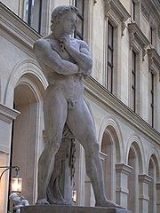
Spartacus

Encyclopedia
Spartacus (c. 109–71 BCE) was a famous leader of the slaves
in the Third Servile War
, a major slave uprising against the Roman Republic
. Little is known about Spartacus beyond the events of the war, and surviving historical accounts are sometimes contradictory and may not always be reliable. He was an accomplished military leader.
Spartacus's struggle, often seen as oppressed
people fighting for their freedom against a slave-owning aristocracy, has found new meaning for modern writers since the 19th century. The rebellion of Spartacus has also proven inspirational to many modern literary and political writers.
. Plutarch
describes him as "a Thracian of Nomadic stock". Appian
says he was "a Thracian by birth, who had once served as a soldier with the Romans, but had since been a prisoner and sold for a Gladiator
". Florus
(2.8.8) described him as one "who from Thracian mercenary, had become a Roman soldier, of a soldier a deserter and robber, and afterward, from consideration of his strength, a gladiator". Some authors refer to the Thracian tribe of the Maedi
, which in historic times occupied the area on the southwestern fringes of Thrace
(present day south-western Bulgaria
). Plutarch also writes that Spartacus's wife, a prophetess of the Maedi tribe, was enslaved with him.
The name Spartacus is otherwise attested in the Black Sea
region: kings of the Thracian dynasty of the Cimmerian Bosporus
and Pontus
are known to have borne it, and a Thracian "Sparta" "Spardacus" or "Sparadokos", father of Seuthes I
of the Odrysae
, is also known.
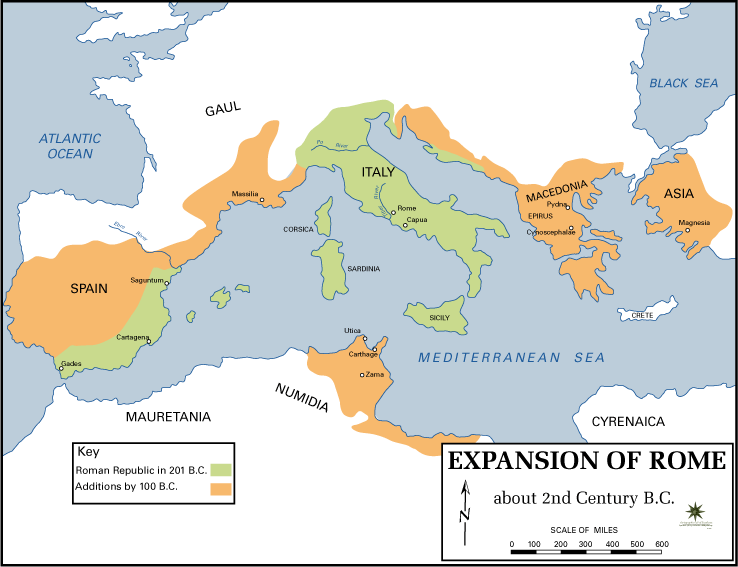 According to the differing sources and their interpretation, Spartacus either was an auxiliary
from the Roman legion
s later condemned to slavery, or a captive taken by the legions. Spartacus was trained at the gladiatorial school (ludus) near Capua
belonging to Lentulus Batiatus
.
In 73 BCE, Spartacus was among a group of gladiators plotting an escape. The plot was betrayed but about 70 men seized kitchen implements, fought their way free from the school, and seized several wagons of gladiatorial weapons and armor. The escaped slaves defeated a small force sent after them, plundered the region surrounding Capua, recruited many other slaves into their ranks, and eventually retired to a more defensible position on Mount Vesuvius
.
Once free, the escaped gladiators chose Spartacus and two Gallic slaves—Crixus
and Oenomaus
—as their leaders. Although Roman authors assumed that the slaves were a homogeneous group with Spartacus as their leader, they may have projected their own hierarchical view of military leadership onto the spontaneous organization of the slaves, reducing other slave leaders to subordinate positions in their accounts. The positions of Crixus and Oenomaus—and later, Castus—cannot be clearly determined from the sources.
and the Third Mithridatic War
. Furthermore, the Romans considered the rebellion more of a policing matter than a war. Rome dispatched militia under the command of praetor
Gaius Claudius Glaber
, which besieged the slaves on the mountain, hoping that starvation would force the slaves to surrender. They were surprised when Spartacus had ropes made from vines, climbed down the cliff side of the volcano with his men and attacked the unfortified Roman camp in the rear, killing most of them. The slaves also defeated a second expedition, nearly capturing the praetor commander, killing his lieutenants and seizing the military equipment. With these successes, more and more slaves flocked to the Spartacan forces, as did "many of the herdsmen
and shepherd
s of the region", swelling their ranks to some 70,000.
In these altercations Spartacus proved to be an excellent tactician
, suggesting that he may have had previous military experience. Though the slaves lacked military training
, they displayed a skillful use of available local materials and unusual tactics when facing the disciplined Roman armies. They spent the winter of 73–72 BCE training, arming and equipping their new recruits, and expanding their raiding territory to include the towns of Nola
, Nuceria
, Thurii
and Metapontum
. The distance between these locations and the subsequent events indicate that the slaves operated in two groups commanded by the remaining leaders Spartacus and Crixus.
In the spring of 72 BCE, the slaves left their winter encampments and began to move northward. At the same time, the Roman Senate, alarmed by the defeat of the praetorian
forces, dispatched a pair of consul
ar legions
under the command of Lucius Gellius Publicola
and Gnaeus Cornelius Lentulus Clodianus
. The two legions were initially successful—defeating a group of 30,000 slaves commanded by Crixus
near Mount Garganus—but then were defeated by Spartacus. These defeats are
depicted in divergent ways by the two most comprehensive (extant) histories of the war by Appian
and Plutarch
.
Alarmed by the apparently unstoppable rebellion, the Senate charged Marcus Licinius Crassus
, the wealthiest man in Rome and the only volunteer for the position, with ending the rebellion.
Crassus was put in charge of eight legions, approximately 40,000–50,000 trained Roman soldiers, which he treated with harsh, even brutal, discipline, reviving the punishment of unit decimation
. When Spartacus and his followers, who for unclear reasons had retreated to the south of Italy, moved northward again in early 71 BCE, Crassus deployed six of his legions on the borders of the region and detached his legate
Mummius with two legions to maneuver behind Spartacus. Though ordered not to engage the slaves, Mummius attacked at a seemingly opportune moment but was routed. After this, Crassus' legions were victorious in several engagements, forcing Spartacus farther south through Lucania as Crassus gained the upper hand. By the end of 71 BCE, Spartacus was encamped in Rhegium (Reggio Calabria
), near the Strait of Messina
.
According to Plutarch
, Spartacus made a bargain with Cilicia
n pirates to transport him and some 2,000 of his men to Sicily
, where he intended to incite a slave revolt and gather reinforcements. However, he was betrayed by the pirates, who took payment and then abandoned the rebel slaves. Minor sources mention that there were some attempts at raft and shipbuilding by the rebels as a means to escape, but that Crassus took unspecified measures to ensure the rebels could not cross to Sicily, and their efforts were abandoned. Spartacus's forces then retreated toward Rhegium. Crassus' legions followed and upon arrival built fortifications across the isthmus at Rhegium, despite harassing raids from the rebel slaves.
The rebels were under siege and cut off from their supplies.
 At this time, the legions of Pompey
returned from Spain and were ordered by the Senate to head south to aid Crassus. While Crassus feared that Pompey's arrival would cost him the credit, Spartacus unsuccessfully tried to reach an agreement with Crassus. When Crassus refused, a portion of Spartacus's forces fled toward the mountains west of Petelia (modern Strongoli
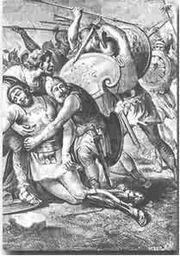
) in Bruttium, with Crassus' legions in pursuit. When the legions managed to catch a portion of the rebels separated from the main army, discipline among Spartacus's forces broke down as small groups were independently attacking the oncoming legions. Spartacus now turned his forces around and brought his entire strength to bear on the legions in a last stand, in which the slaves were routed completely, with the vast majority of them being killed on the battlefield.
The final battle that saw the defeat and death of Spartacus in 71 BC took place on the present territory of Senerchia
on the right bank of the river Sele in the area that includes the border with Oliveto Citra up to those of Calabritto, near the village of Quaglietta, in High Sele Valley, which at that time was part of Lucania. In this area, in the past decades, there have been finds of armor and swords of the Roman era.
The eventual fate of Spartacus himself is unknown, as his body was never found, but he is accounted by historians to have perished in battle along with his men. Six thousand survivors of the revolt captured by the legions of Crassus were crucified, lining the Appian Way
from Rome to Capua.
writes that Spartacus merely wished to escape north into Cisalpine Gaul
and disperse his men back to their homes, as depicted in the 1960 film "Spartacus", Appian
and Florus
write that he intended to march on Rome itself. Appian also states that he later abandoned that goal, which might have been no more than a reflection of Roman fears. None of Spartacus's actions suggest that he aimed at reforming Roman society or abolishing slavery
.
Based on the events in late 73 BCE and early 72 BCE, which suggest independently operating groups of slaves and a statement by Plutarch that some of the escaped slaves preferred to plunder Italy, rather than escape over the Alps, modern authors have deduced a factional split between those under Spartacus, who wished to escape over the Alps to freedom, and those under Crixus, who wished to stay in southern Italy to continue raiding and plundering.
Slavery in ancient Rome
The institution of slavery in ancient Rome played an important role in society and the Roman economy. Besides manual labor on farms and in mines, slaves performed many domestic services and a variety of other tasks, such as accounting...
in the Third Servile War
Third Servile War
The Third Servile War , also called the Gladiator War and the War of Spartacus by Plutarch, was the last of a series of unrelated and unsuccessful slave rebellions against the Roman Republic, known collectively as the Roman Servile Wars...
, a major slave uprising against the Roman Republic
Roman Republic
The Roman Republic was the period of the ancient Roman civilization where the government operated as a republic. It began with the overthrow of the Roman monarchy, traditionally dated around 508 BC, and its replacement by a government headed by two consuls, elected annually by the citizens and...
. Little is known about Spartacus beyond the events of the war, and surviving historical accounts are sometimes contradictory and may not always be reliable. He was an accomplished military leader.
Spartacus's struggle, often seen as oppressed
Oppression
Oppression is the exercise of authority or power in a burdensome, cruel, or unjust manner. It can also be defined as an act or instance of oppressing, the state of being oppressed, and the feeling of being heavily burdened, mentally or physically, by troubles, adverse conditions, and...
people fighting for their freedom against a slave-owning aristocracy, has found new meaning for modern writers since the 19th century. The rebellion of Spartacus has also proven inspirational to many modern literary and political writers.
Origins
The ancient sources agree that Spartacus was a ThracianThracians
The ancient Thracians were a group of Indo-European tribes inhabiting areas including Thrace in Southeastern Europe. They spoke the Thracian language – a scarcely attested branch of the Indo-European language family...
. Plutarch
Plutarch
Plutarch then named, on his becoming a Roman citizen, Lucius Mestrius Plutarchus , c. 46 – 120 AD, was a Greek historian, biographer, essayist, and Middle Platonist known primarily for his Parallel Lives and Moralia...
describes him as "a Thracian of Nomadic stock". Appian
Appian
Appian of Alexandria was a Roman historian of Greek ethnicity who flourished during the reigns of Trajan, Hadrian, and Antoninus Pius.He was born ca. 95 in Alexandria. He tells us that, after having filled the chief offices in the province of Egypt, he went to Rome ca. 120, where he practised as...
says he was "a Thracian by birth, who had once served as a soldier with the Romans, but had since been a prisoner and sold for a Gladiator
Gladiator
A gladiator was an armed combatant who entertained audiences in the Roman Republic and Roman Empire in violent confrontations with other gladiators, wild animals, and condemned criminals. Some gladiators were volunteers who risked their legal and social standing and their lives by appearing in the...
". Florus
Florus
Florus, Roman historian, lived in the time of Trajan and Hadrian.He compiled, chiefly from Livy, a brief sketch of the history of Rome from the foundation of the city to the closing of the temple of Janus by Augustus . The work, which is called Epitome de T...
(2.8.8) described him as one "who from Thracian mercenary, had become a Roman soldier, of a soldier a deserter and robber, and afterward, from consideration of his strength, a gladiator". Some authors refer to the Thracian tribe of the Maedi
Maedi
The Maedi , were a Thracian or Illyrian tribe, which in historic times, occupied the area between Paionia and Thrace, on the southwestern fringes of Thrace, along the middle course of the Strymon, between the Kresna Gorge and the Rupel Pass...
, which in historic times occupied the area on the southwestern fringes of Thrace
Thrace
Thrace is a historical and geographic area in southeast Europe. As a geographical concept, Thrace designates a region bounded by the Balkan Mountains on the north, Rhodope Mountains and the Aegean Sea on the south, and by the Black Sea and the Sea of Marmara on the east...
(present day south-western Bulgaria
Bulgaria
Bulgaria , officially the Republic of Bulgaria , is a parliamentary democracy within a unitary constitutional republic in Southeast Europe. The country borders Romania to the north, Serbia and Macedonia to the west, Greece and Turkey to the south, as well as the Black Sea to the east...
). Plutarch also writes that Spartacus's wife, a prophetess of the Maedi tribe, was enslaved with him.
The name Spartacus is otherwise attested in the Black Sea
Black Sea
The Black Sea is bounded by Europe, Anatolia and the Caucasus and is ultimately connected to the Atlantic Ocean via the Mediterranean and the Aegean seas and various straits. The Bosphorus strait connects it to the Sea of Marmara, and the strait of the Dardanelles connects that sea to the Aegean...
region: kings of the Thracian dynasty of the Cimmerian Bosporus
Bosporan Kingdom
The Bosporan Kingdom or the Kingdom of the Cimmerian Bosporus was an ancient state, located in eastern Crimea and the Taman Peninsula on the shores of the Cimmerian Bosporus...
and Pontus
Pontus
Pontus or Pontos is a historical Greek designation for a region on the southern coast of the Black Sea, located in modern-day northeastern Turkey. The name was applied to the coastal region in antiquity by the Greeks who colonized the area, and derived from the Greek name of the Black Sea: Πόντος...
are known to have borne it, and a Thracian "Sparta" "Spardacus" or "Sparadokos", father of Seuthes I
Seuthes I
Seuthes I was king of the Odrysian Thracians from 424 BC until 410 BC. He was the nephew of Sitalces. He is infamous for the fact that he was bribed by Perdiccas II of Macedon, which directly lead to the end of Sitalces' campaign in Macedon. After he became king, Seuthes doubled the tribute of the...
of the Odrysae
Odrysian kingdom
The Odrysian kingdom was a union of Thracian tribes that endured between the 5th and 3rd centuries BC. It consisted largely of present-day Bulgaria, spreading to parts of Northern Dobruja, parts of Northern Greece and modern-day European Turkey...
, is also known.
Enslavement and escape
Auxiliaries (Roman military)
Auxiliaries formed the standing non-citizen corps of the Roman army of the Principate , alongside the citizen legions...
from the Roman legion
Roman legion
A Roman legion normally indicates the basic ancient Roman army unit recruited specifically from Roman citizens. The organization of legions varied greatly over time but they were typically composed of perhaps 5,000 soldiers, divided into maniples and later into "cohorts"...
s later condemned to slavery, or a captive taken by the legions. Spartacus was trained at the gladiatorial school (ludus) near Capua
Capua
Capua is a city and comune in the province of Caserta, Campania, southern Italy, situated 25 km north of Naples, on the northeastern edge of the Campanian plain. Ancient Capua was situated where Santa Maria Capua Vetere is now...
belonging to Lentulus Batiatus
Lentulus Batiatus
Gnaeus Cornelius Lentulus Batiatus was the Roman owner of a gladiatorial school in Capua , in southern Italy. It was from this school that in 73 BC, the Thracian slave, Spartacus, and about 70 to 78 followers, escaped...
.
In 73 BCE, Spartacus was among a group of gladiators plotting an escape. The plot was betrayed but about 70 men seized kitchen implements, fought their way free from the school, and seized several wagons of gladiatorial weapons and armor. The escaped slaves defeated a small force sent after them, plundered the region surrounding Capua, recruited many other slaves into their ranks, and eventually retired to a more defensible position on Mount Vesuvius
Mount Vesuvius
Mount Vesuvius is a stratovolcano in the Gulf of Naples, Italy, about east of Naples and a short distance from the shore. It is the only volcano on the European mainland to have erupted within the last hundred years, although it is not currently erupting...
.
Once free, the escaped gladiators chose Spartacus and two Gallic slaves—Crixus
Crixus
Crixus was a leader of the slave rebellion in the Third Servile War, along with Spartacus and Oenomaus.He was a Gaul , and had been a slave for several years before the revolt. Crixus had fought for the Allobroges against the Romans and had been captured. Like his companions, Crixus had trained as...
and Oenomaus
Oenomaus (rebel slave)
Oenomaus was a gladiator from Gaul, who escaped from the gladiatorial school of Lentulus Batiatus in Capua. Together with the Thracian Spartacus and a fellow Gaul, Crixus, he became one of the leaders of rebellious slaves during the Third Servile War , but died early in the war.Oenomaus was...
—as their leaders. Although Roman authors assumed that the slaves were a homogeneous group with Spartacus as their leader, they may have projected their own hierarchical view of military leadership onto the spontaneous organization of the slaves, reducing other slave leaders to subordinate positions in their accounts. The positions of Crixus and Oenomaus—and later, Castus—cannot be clearly determined from the sources.
Third Servile War
The response of the Romans was hampered by the absence of the Roman legions, which were already engaged in fighting a revolt in SpainQuintus Sertorius
Quintus Sertorius was a Roman statesman and general, born in Nursia, in Sabine territory. His brilliance as a military commander was shown most clearly in his battles against Rome for control of Hispania...
and the Third Mithridatic War
Third Mithridatic War
The Third Mithridatic War was the last and longest of three Mithridatic Wars fought between Mithridates VI of Pontus and his allies and the Roman Republic...
. Furthermore, the Romans considered the rebellion more of a policing matter than a war. Rome dispatched militia under the command of praetor
Praetor
Praetor was a title granted by the government of Ancient Rome to men acting in one of two official capacities: the commander of an army, usually in the field, or the named commander before mustering the army; and an elected magistratus assigned varied duties...
Gaius Claudius Glaber
Gaius Claudius Glaber
Gaius Claudius Glaber was a Roman praetor and legatus in 73 BC. He tried but failed to hem in Spartacus and his fellow slaves on Mt. Vesuvius during the Third Servile War. The rebels were trapped by a narrow passage, the only way leading up. Without the Roman cohorts knowing, Spartacus and his men...
, which besieged the slaves on the mountain, hoping that starvation would force the slaves to surrender. They were surprised when Spartacus had ropes made from vines, climbed down the cliff side of the volcano with his men and attacked the unfortified Roman camp in the rear, killing most of them. The slaves also defeated a second expedition, nearly capturing the praetor commander, killing his lieutenants and seizing the military equipment. With these successes, more and more slaves flocked to the Spartacan forces, as did "many of the herdsmen
Herder
A herder is a worker who lives a possibly semi-nomadic life, caring for various domestic animals, in places where these animals wander pasture lands....
and shepherd
Shepherd
A shepherd is a person who tends, feeds or guards flocks of sheep.- Origins :Shepherding is one of the oldest occupations, beginning some 6,000 years ago in Asia Minor. Sheep were kept for their milk, meat and especially their wool...
s of the region", swelling their ranks to some 70,000.
In these altercations Spartacus proved to be an excellent tactician
Military tactics
Military tactics, the science and art of organizing an army or an air force, are the techniques for using weapons or military units in combination for engaging and defeating an enemy in battle. Changes in philosophy and technology over time have been reflected in changes to military tactics. In...
, suggesting that he may have had previous military experience. Though the slaves lacked military training
Military education and training
Military education and training is a process which intends to establish and improve the capabilities of military personnel in their respective roles....
, they displayed a skillful use of available local materials and unusual tactics when facing the disciplined Roman armies. They spent the winter of 73–72 BCE training, arming and equipping their new recruits, and expanding their raiding territory to include the towns of Nola
Nola
Nola is a city and comune of Campania, southern Italy, in the province of Naples, situated in the plain between Mount Vesuvius and the Apennines...
, Nuceria
Nocera Inferiore
Nocera Inferiore, formerly Nocera dei Pagani, is a town and comune in Campania, Italy, in the province of Salerno, at the foot of Monte Albino, 20 km east-south-east of Naples by rail.-History:...
, Thurii
Thurii
Thurii , called also by some Latin writers Thurium , for a time also Copia and Copiae, was a city of Magna Graecia, situated on the Tarentine gulf, within a short distance of the site of Sybaris, whose place it may be considered as having taken...
and Metapontum
Metapontum
Metapontum, Metapontium or Metapontion , was an important city of Magna Graecia, situated on the gulf of Tarentum, between the river Bradanus and the Casuentus . It was distant about 20 km from Heraclea and 40 from Tarentum...
. The distance between these locations and the subsequent events indicate that the slaves operated in two groups commanded by the remaining leaders Spartacus and Crixus.
In the spring of 72 BCE, the slaves left their winter encampments and began to move northward. At the same time, the Roman Senate, alarmed by the defeat of the praetorian
Praetorian
Praetorian is an adjective derived from the ancient Roman office of praetor. It may refer to:*Praetorian Guard, a special force of skilled and celebrated troops serving as the personal guard of Roman Emperors...
forces, dispatched a pair of consul
Consul
Consul was the highest elected office of the Roman Republic and an appointive office under the Empire. The title was also used in other city states and also revived in modern states, notably in the First French Republic...
ar legions
Roman legion
A Roman legion normally indicates the basic ancient Roman army unit recruited specifically from Roman citizens. The organization of legions varied greatly over time but they were typically composed of perhaps 5,000 soldiers, divided into maniples and later into "cohorts"...
under the command of Lucius Gellius Publicola
Lucius Gellius Publicola
Lucius Gellius Publicola was a Roman politician and general who was one of two Consuls of the Republic in 72 BC along with Gnaeus Cornelius Lentulus Clodianus...
and Gnaeus Cornelius Lentulus Clodianus
Gnaeus Cornelius Lentulus Clodianus
Gnaeus Cornelius Lentulus Clodianus was a Roman politician and general who was one of two Consuls of the Republic in 72 BC along with Lucius Gellius Publicola...
. The two legions were initially successful—defeating a group of 30,000 slaves commanded by Crixus
Crixus
Crixus was a leader of the slave rebellion in the Third Servile War, along with Spartacus and Oenomaus.He was a Gaul , and had been a slave for several years before the revolt. Crixus had fought for the Allobroges against the Romans and had been captured. Like his companions, Crixus had trained as...
near Mount Garganus—but then were defeated by Spartacus. These defeats are
depicted in divergent ways by the two most comprehensive (extant) histories of the war by Appian
Appian
Appian of Alexandria was a Roman historian of Greek ethnicity who flourished during the reigns of Trajan, Hadrian, and Antoninus Pius.He was born ca. 95 in Alexandria. He tells us that, after having filled the chief offices in the province of Egypt, he went to Rome ca. 120, where he practised as...
and Plutarch
Plutarch
Plutarch then named, on his becoming a Roman citizen, Lucius Mestrius Plutarchus , c. 46 – 120 AD, was a Greek historian, biographer, essayist, and Middle Platonist known primarily for his Parallel Lives and Moralia...
.
Alarmed by the apparently unstoppable rebellion, the Senate charged Marcus Licinius Crassus
Marcus Licinius Crassus
Marcus Licinius Crassus was a Roman general and politician who commanded the right wing of Sulla's army at the Battle of the Colline Gate, suppressed the slave revolt led by Spartacus, provided political and financial support to Julius Caesar and entered into the political alliance known as the...
, the wealthiest man in Rome and the only volunteer for the position, with ending the rebellion.
Crassus was put in charge of eight legions, approximately 40,000–50,000 trained Roman soldiers, which he treated with harsh, even brutal, discipline, reviving the punishment of unit decimation
Decimation (Roman Army)
Decimation |ten]]") was a form of military discipline used by officers in the Roman Army to punish mutinous or cowardly soldiers. The word decimation is derived from Latin meaning "removal of a tenth".-Procedure:...
. When Spartacus and his followers, who for unclear reasons had retreated to the south of Italy, moved northward again in early 71 BCE, Crassus deployed six of his legions on the borders of the region and detached his legate
Legatus
A legatus was a general in the Roman army, equivalent to a modern general officer. Being of senatorial rank, his immediate superior was the dux, and he outranked all military tribunes...
Mummius with two legions to maneuver behind Spartacus. Though ordered not to engage the slaves, Mummius attacked at a seemingly opportune moment but was routed. After this, Crassus' legions were victorious in several engagements, forcing Spartacus farther south through Lucania as Crassus gained the upper hand. By the end of 71 BCE, Spartacus was encamped in Rhegium (Reggio Calabria
Reggio Calabria
Reggio di Calabria , commonly known as Reggio Calabria or Reggio, is the biggest city and the most populated comune of Calabria, southern Italy, and is the capital of the Province of Reggio Calabria and seat of the Council of Calabrian government.Reggio is located on the "toe" of the Italian...
), near the Strait of Messina
Strait of Messina
The Strait of Messina is the narrow passage between the eastern tip of Sicily and the southern tip of Calabria in the south of Italy. It connects the Tyrrhenian Sea with the Ionian Sea, within the central Mediterranean...
.
According to Plutarch
Plutarch
Plutarch then named, on his becoming a Roman citizen, Lucius Mestrius Plutarchus , c. 46 – 120 AD, was a Greek historian, biographer, essayist, and Middle Platonist known primarily for his Parallel Lives and Moralia...
, Spartacus made a bargain with Cilicia
Cilicia
In antiquity, Cilicia was the south coastal region of Asia Minor, south of the central Anatolian plateau. It existed as a political entity from Hittite times into the Byzantine empire...
n pirates to transport him and some 2,000 of his men to Sicily
Sicily
Sicily is a region of Italy, and is the largest island in the Mediterranean Sea. Along with the surrounding minor islands, it constitutes an autonomous region of Italy, the Regione Autonoma Siciliana Sicily has a rich and unique culture, especially with regard to the arts, music, literature,...
, where he intended to incite a slave revolt and gather reinforcements. However, he was betrayed by the pirates, who took payment and then abandoned the rebel slaves. Minor sources mention that there were some attempts at raft and shipbuilding by the rebels as a means to escape, but that Crassus took unspecified measures to ensure the rebels could not cross to Sicily, and their efforts were abandoned. Spartacus's forces then retreated toward Rhegium. Crassus' legions followed and upon arrival built fortifications across the isthmus at Rhegium, despite harassing raids from the rebel slaves.
The rebels were under siege and cut off from their supplies.
Pompey
Gnaeus Pompeius Magnus, also known as Pompey or Pompey the Great , was a military and political leader of the late Roman Republic...
returned from Spain and were ordered by the Senate to head south to aid Crassus. While Crassus feared that Pompey's arrival would cost him the credit, Spartacus unsuccessfully tried to reach an agreement with Crassus. When Crassus refused, a portion of Spartacus's forces fled toward the mountains west of Petelia (modern Strongoli
Strongoli
Strongoli is a comune and town with a population of over 6000 people in the province of Crotone, in Calabria, Italy.-History:In antiquity, Strongoli was the site of Petelia, said to have been founded by Philoctetes....
) in Bruttium, with Crassus' legions in pursuit. When the legions managed to catch a portion of the rebels separated from the main army, discipline among Spartacus's forces broke down as small groups were independently attacking the oncoming legions. Spartacus now turned his forces around and brought his entire strength to bear on the legions in a last stand, in which the slaves were routed completely, with the vast majority of them being killed on the battlefield.
The final battle that saw the defeat and death of Spartacus in 71 BC took place on the present territory of Senerchia
Senerchia
Senerchia is an Italian municipality of 1370 registered voters, but with only 1036 inhabitants, of province of Avellino, located in High Valley Sele in Campania.-Geography:...
on the right bank of the river Sele in the area that includes the border with Oliveto Citra up to those of Calabritto, near the village of Quaglietta, in High Sele Valley, which at that time was part of Lucania. In this area, in the past decades, there have been finds of armor and swords of the Roman era.
The eventual fate of Spartacus himself is unknown, as his body was never found, but he is accounted by historians to have perished in battle along with his men. Six thousand survivors of the revolt captured by the legions of Crassus were crucified, lining the Appian Way
Appian Way
The Appian Way was one of the earliest and strategically most important Roman roads of the ancient republic. It connected Rome to Brindisi, Apulia, in southeast Italy...
from Rome to Capua.
Objectives
Classical historians were divided as to what the motives of Spartacus were. While PlutarchPlutarch
Plutarch then named, on his becoming a Roman citizen, Lucius Mestrius Plutarchus , c. 46 – 120 AD, was a Greek historian, biographer, essayist, and Middle Platonist known primarily for his Parallel Lives and Moralia...
writes that Spartacus merely wished to escape north into Cisalpine Gaul
Cisalpine Gaul
Cisalpine Gaul, in Latin: Gallia Cisalpina or Citerior, also called Gallia Togata, was a Roman province until 41 BC when it was merged into Roman Italy.It bore the name Gallia, because the great body of its inhabitants, after the expulsion of the Etruscans, consisted of Gauls or Celts...
and disperse his men back to their homes, as depicted in the 1960 film "Spartacus", Appian
Appian
Appian of Alexandria was a Roman historian of Greek ethnicity who flourished during the reigns of Trajan, Hadrian, and Antoninus Pius.He was born ca. 95 in Alexandria. He tells us that, after having filled the chief offices in the province of Egypt, he went to Rome ca. 120, where he practised as...
and Florus
Florus
Florus, Roman historian, lived in the time of Trajan and Hadrian.He compiled, chiefly from Livy, a brief sketch of the history of Rome from the foundation of the city to the closing of the temple of Janus by Augustus . The work, which is called Epitome de T...
write that he intended to march on Rome itself. Appian also states that he later abandoned that goal, which might have been no more than a reflection of Roman fears. None of Spartacus's actions suggest that he aimed at reforming Roman society or abolishing slavery
Abolitionism
Abolitionism is a movement to end slavery.In western Europe and the Americas abolitionism was a movement to end the slave trade and set slaves free. At the behest of Dominican priest Bartolomé de las Casas who was shocked at the treatment of natives in the New World, Spain enacted the first...
.
Based on the events in late 73 BCE and early 72 BCE, which suggest independently operating groups of slaves and a statement by Plutarch that some of the escaped slaves preferred to plunder Italy, rather than escape over the Alps, modern authors have deduced a factional split between those under Spartacus, who wished to escape over the Alps to freedom, and those under Crixus, who wished to stay in southern Italy to continue raiding and plundering.
Politics
- Toussaint L'OuvertureToussaint L'OuvertureFrançois-Dominique Toussaint Louverture , also Toussaint Bréda, Toussaint-Louverture was the leader of the Haitian Revolution. His military genius and political acumen led to the establishment of the independent black state of Haiti, transforming an entire society of slaves into a free,...
, a leader of the slave revolt that led to the independence of HaitiHaitiHaiti , officially the Republic of Haiti , is a Caribbean country. It occupies the western, smaller portion of the island of Hispaniola, in the Greater Antillean archipelago, which it shares with the Dominican Republic. Ayiti was the indigenous Taíno or Amerindian name for the island...
, was called the "Black Spartacus" by one of his defeated opponents, the Comte de Lavaux. - Founder of the Bavarian Illuminati, Adam WeishauptAdam WeishauptJohann Adam Weishaupt was a German philosopher and founder of the Order of Illuminati, a secret society with origins in Bavaria.-Early life:...
, often referred to himself as Spartacus within written correspondences. - Karl MarxKarl MarxKarl Heinrich Marx was a German philosopher, economist, sociologist, historian, journalist, and revolutionary socialist. His ideas played a significant role in the development of social science and the socialist political movement...
listed Spartacus as one of his heroes, and described him as "the most splendid fellow in the whole of ancient history" and "[a] great general ([though] no GaribaldiGiuseppe GaribaldiGiuseppe Garibaldi was an Italian military and political figure. In his twenties, he joined the Carbonari Italian patriot revolutionaries, and fled Italy after a failed insurrection. Garibaldi took part in the War of the Farrapos and the Uruguayan Civil War leading the Italian Legion, and...
), noble character, real representative of the ancient proletariatProletariatThe proletariat is a term used to identify a lower social class, usually the working class; a member of such a class is proletarian...
." - Spartacus has been a great inspiration to revolutionaries in modern times, most notably the German Spartacist LeagueSpartacist LeagueThe Spartacus League was a left-wing Marxist revolutionary movement organized in Germany during World War I. The League was named after Spartacus, leader of the largest slave rebellion of the Roman Republic...
, a forerunner of the Communist Party of GermanyCommunist Party of GermanyThe Communist Party of Germany was a major political party in Germany between 1918 and 1933, and a minor party in West Germany in the postwar period until it was banned in 1956...
, as well as an Austrian anti-fascistAnti-fascismAnti-fascism is the opposition to fascist ideologies, groups and individuals, such as that of the resistance movements during World War II. The related term antifa derives from Antifaschismus, which is German for anti-fascism; it refers to individuals and groups on the left of the political...
organisation in the 1970s. - European communist regimes in the twentieth century encouraged the image of Spartacus as a fighter against oppression (see "Sports", Spartacus#Sports below).
- Noted Latin AmericaLatin AmericaLatin America is a region of the Americas where Romance languages – particularly Spanish and Portuguese, and variably French – are primarily spoken. Latin America has an area of approximately 21,069,500 km² , almost 3.9% of the Earth's surface or 14.1% of its land surface area...
n Marxist revolutionary Che GuevaraChe GuevaraErnesto "Che" Guevara , commonly known as el Che or simply Che, was an Argentine Marxist revolutionary, physician, author, intellectual, guerrilla leader, diplomat and military theorist...
was also a strong admirer of Spartacus.
Film and television
- Anthony MannAnthony MannAnthony Mann was an American actor and film director, most notably of film noirs and Westerns. As a director, he often collaborated with the cinematographer John Alton and with James Stewart in his Westerns.-Biography:...
initially signed on to direct the film Spartacus (1960), which was executive-produced by and starred Kirk DouglasKirk DouglasKirk Douglas is an American stage and film actor, film producer and author. His popular films include Out of the Past , Champion , Ace in the Hole , The Bad and the Beautiful , Lust for Life , Paths of Glory , Gunfight at the O.K...
. The film was based on Howard FastHoward FastHoward Melvin Fast was an American novelist and television writer. Fast also wrote under the pen names E. V. Cunningham and Walter Ericson.-Early life:Fast was born in New York City...
's novel Spartacus. After Mann and Douglas had a falling out over the style and content of the film, Mann was replaced by Stanley KubrickStanley KubrickStanley Kubrick was an American film director, writer, producer, and photographer who lived in England during most of the last four decades of his career...
. The phrase "I am Spartacus!" from this film has been referenced in a number of other films, television programs, and commercials. - An unofficial sequelInformal sequelAn informal sequel, also called an unauthorized sequel or unofficial sequel, is a sequel to a novel, film, television show, or video game that is produced without the consent of the creators or rights owners of the original material...
to Kubrick's film was made in Italy under the title Il Figlio di Spartacus (The Son of Spartacus; English cinematic title: The Slave) in 1963. The titular character, played by Steve ReevesSteve ReevesStephen L. Reeves was an American bodybuilder and actor. At the peak of his career, he was the highest-paid actor in Europe.-Childhood:...
, first appears as a Roman centurionCenturion (Roman army)A centurion , also hekatontarch in Greek sources, or, in Byzantine times, kentarch was a professional officer of the Roman army after the Marian reforms of 107 BC...
, but eventually learns his true heritage and takes revenge on Crassus, his father's murderer. - A 1970 episode of Up Pompeii!Up Pompeii!Up Pompeii! is a British television comedy series broadcast between 1969 and 1970, starring Frankie Howerd. The first series was written by Talbot Rothwell, a scriptwriter for the Carry On films, and the second series by Rothwell and Sid Colin. Two later specials were transmitted in 1975 and...
entitled "Spartacus" featured Shaun CurryShaun CurryShaun Curry is a British actor, best known for his appearances on television.His credits include: Z-Cars, The Saint, Warship, The Sweeney, The New Avengers, Secret Army, Poldark, To the Manor Born, The Professionals, Blake's 7, Hot Money, Minder, The Gentle Touch, The Bill, Just Good Friends and...
as the rebellious slave. - The title character of the 1985–1987 cartoon series Spartakus and the Sun Beneath the SeaSpartakus and the Sun Beneath the SeaNote: In some cases the names of characters, places, and things were changed for the English version. The original name appears in parentheses....
is loosely based on Spartacus. - In the 1995 film Clueless, Christian uses Stanley Kubrick's adaptation of the film as part of a subtle campaign to reveal his homosexuality.
- In the 1996 film That Thing You Do, Tom Everett Scott's character Guy 'Shades' Patterson refers to himself as Spartacus.
- In the 2003 film The RecruitThe RecruitThe Recruit is a 2003 American spy thriller film directed by Roger Donaldson, starring Colin Farrell, Al Pacino and Bridget Moynahan. It was released on January 31, 2003 in North America by Touchstone Pictures....
, Colin Farrell's character writes a computer program called Spartacus that attracts the attention of the CIA. - In 2004, Howard FastHoward FastHoward Melvin Fast was an American novelist and television writer. Fast also wrote under the pen names E. V. Cunningham and Walter Ericson.-Early life:Fast was born in New York City...
's novel Spartacus was adapted as a made-for-TV movie by the USA NetworkUSA NetworkUSA Network is an American cable television channel launched in 1971. Once a minor player in basic cable, the network has steadily gained popularity because of breakout hits like Monk, Psych, Burn Notice, Royal Pains, Covert Affairs, White Collar, Monday Night RAW, Suits, and reruns of the various...
, with Goran VišnjićGoran VišnjicGoran Višnjić is a Croatian actor who has appeared in American and British films and television productions. He is best known for his role as Dr. Luka Kovač in the hit television series ER...
in the main role. - One episode of 2007-2008 BBCBBCThe British Broadcasting Corporation is a British public service broadcaster. Its headquarters is at Broadcasting House in the City of Westminster, London. It is the largest broadcaster in the world, with about 23,000 staff...
's docudrama Heroes and VillainsHeroes and Villains (TV series)Heroes and Villains was a 2007-2008 BBC Television docudrama series looking at key moments in the lives and reputations of some of the greatest warriors of history. Each hour long episode featured a different historical figure, including Napoleon I of France, Attila the Hun, Spartacus, Hernán...
features Spartacus. - The television series Xena: Warrior PrincessXena: Warrior PrincessXena: Warrior Princess is an American–New Zealand supernatural fantasy adventure series that aired in syndication from September 4, 1995 until June 18, 2001....
had an episode in its first season that gave a brief account of the story, including several clips from Stanley Kubrick's movie. - The television series Spartacus: Blood and SandSpartacus: Blood and SandSpartacus: Blood and Sand is a Starz television series that premiered on January 22, 2010. The series is inspired by the historical figure of Spartacus , a Thracian gladiator who from 73 to 71 BC led a major slave uprising against the Roman Republic. Executive producers Steven S...
, produced by Sam RaimiSam RaimiSamuel Marshall "Sam" Raimi is an American film director, producer, actor and writer. He is best known for directing cult horror films like the Evil Dead series, Darkman and Drag Me to Hell, as well as the blockbuster Spider-Man films and the producer of the successful TV series Hercules: The...
and starring the late Andy WhitfieldAndy WhitfieldAndy Whitfield was a Welsh actor and model. He was best known for his leading role in the Starz television series Spartacus: Blood and Sand during 2010, a year before his death at the age of 39.-Career:...
, and later Liam McIntyreLiam McIntyreLiam McIntyre is an Australian actor most known for his work in several short films and guest starring roles in Australian TV series...
, in the title role, premièred on the Starz premium cable network in January 2010.
Literature
- Howard FastHoward FastHoward Melvin Fast was an American novelist and television writer. Fast also wrote under the pen names E. V. Cunningham and Walter Ericson.-Early life:Fast was born in New York City...
wrote the historical novel Spartacus, the basis of Stanley KubrickStanley KubrickStanley Kubrick was an American film director, writer, producer, and photographer who lived in England during most of the last four decades of his career...
's 1960 film starring Kirk DouglasKirk DouglasKirk Douglas is an American stage and film actor, film producer and author. His popular films include Out of the Past , Champion , Ace in the Hole , The Bad and the Beautiful , Lust for Life , Paths of Glory , Gunfight at the O.K...
. - Arthur KoestlerArthur KoestlerArthur Koestler CBE was a Hungarian author and journalist. Koestler was born in Budapest and, apart from his early school years, was educated in Austria...
wrote a novel about Spartacus called The Gladiators. - The Scottish writer Lewis Grassic GibbonLewis Grassic GibbonLewis Grassic Gibbon was the pseudonym of James Leslie Mitchell , a Scottish writer.-Biography:...
wrote a novel Spartacus. - Spartacus is a prominent character in the novel Fortune's FavoritesMasters of RomeMasters of Rome is a series of historical fiction novels by author Colleen McCullough set in ancient Rome during the last days of the old Roman Republic; it primarily chronicles the lives and careers of Gaius Marius, Lucius Cornelius Sulla, Pompeius Magnus, Gaius Julius Caesar, and the early...
by Colleen McCulloughColleen McCulloughColleen McCullough-Robinson, , is an internationally acclaimed Australian author.-Life:McCullough was born in Wellington, in outback central west New South Wales, in 1937 to James and Laurie McCullough. Her mother was a New Zealander of part-Māori descent. During her childhood, her family moved...
. - The Italian writer Rafaello Giovagnoli wrote his historical novel, Spartacus, in 1874. His novel has been subsequently translated and published in many European countries.
- There is also a novel Uczniowie Spartakusa (The Students of Spartacus) by the Polish writer Halina Rudnicka.
- The Reverend Elijah KelloggElijah KelloggElijah Kellogg, Jr. was an American Congregationalist minister, lecturer and author of popular boy's adventure books.- Professional life :...
's Spartacus to the Gladiators at CapuaSpartacus to the Gladiators at CapuaSpartacus to the Gladiators at Capua is a rhetorical monologue written by Elijah Kellogg for a student competition at Bowdoin College in 1842, and later published by Epes Sargent, one of the judges, in his 1846 School Reader...
has been used effectively by schoolboys to practice their oratory skills for ages. - Spartacus also appears in Conn IgguldenConn IgguldenConn Iggulden is a British author who mainly writes historical fiction. He also co-authored The Dangerous Book for Boys.-Background:...
's 'Emperor' series in the book The Death of KingsThe Death of KingsThe Death of Kings is a novel by British author Conn Iggulden, and is the second book in the Emperor series, which follows the life of Julius Caesar.The book was released in the UK in January 2004, published by HarperCollins.-Plot summary:...
. - Spartacus and His Glorious Gladiators, by Toby Brown, is part of the Dead Famous series of children's history books.
- In the Bolo novel Bolo Rising by William H. Keith, the character HCT "Hector" is based on Spartacus.
- In the novel Flip by David LubarDavid LubarDavid Lubar is an author of numerous books for teens. He is also an electronic game programmer, who programmedSuper Breakout for the Nintendo Game Boy, and Frogger for both the SNES and Game Boy. As a game designer, he designed the game Frogger 2: Swampy's Revenge for the Nintendo Game Boy Color...
, one of the legends Ryan becomes is Spartacus, specifically when he is challenged to a fight by the school bully. - Amal Donkol, the Egyptian modern poet wrote his masterpiece "The Last Words of Spartacus".
- Steven SaylorSteven SaylorSteven Saylor is an American author of historical novels. He is a graduate of the University of Texas at Austin, where he studied history and Classics....
's novel Arms of Nemesis, part of his Roma Sub RosaRoma Sub RosaRoma Sub Rosa is the title of the series of mystery novels by Steven Saylor set in, and populated by, noteworthy denizens of ancient Rome. The series is noted for its historical authenticity. The phrase "Roma Sub Rosa" means, in Latin, "Rome under the rose"...
series, is set during the Third Servile War. - Max GalloMax GalloMax Gallo is a French writer, historian and politician.The son of Italian immigrants, Max Gallo's early career was in journalism. At the time he was a Communist . In 1974, he joined the Socialist Party. On April 26, 2007, the French Academy recorded his candidacy for its Seat 24, formerly held by...
wrote the novel Les Romains.Spartacus.La Revolte des Esclaves, Librairie Artheme Fayard, 2006. - In 2010 Peter StothardPeter StothardSir Peter Stothard is a British newspaper editor. He currently edits the Times Literary Supplement, and edited The Times from 1992 to 2002....
combined an account of Spartacus's uprising with elements of autobiography, in his memoir On the Spartacus Road. - In 1972, Badal SircarBadal SarkarBadal Sarkar , also known as Badal Sircar, was an influential Indian dramatist and theatre director, most known for his anti-establishment plays during the Naxalite movement in the 1970s and taking theatre out of the proscenium and into public arena, when he founded his own theatre company,...
produced a theatrical version of Spartacus, performed in the round and heavily coloured by his egalitarian vision. Originally in Bengali, it has been translated into and performed in several Indian languages.
Music
- SpartacusSpartacus (ballet)Spartacus, or Spartak, is a ballet by Aram Khachaturian . The work follows the exploits of Spartacus, the leader of the slave uprising against the Romans known as the Third Servile War, although the ballet's storyline takes considerable liberties with the historical record. Khachaturian composed...
is a ballet, with a score by composer Aram KhachaturianAram KhachaturianAram Ilyich Khachaturian was a prominent Soviet composer. Khachaturian's works were often influenced by classical Russian music and Armenian folk music...
. - Australian composer Carl VineCarl VineCarl Vine is an Australian composer of contemporary classical music.-Career:Vine was born in Perth, Western Australia. When he was ten years old, he took up the piano. An adolescent encounter with Karlheinz Stockhausen inspired a period as a teenage modernist, a direction which he abandoned in 1985...
wrote a short piano piece entitled "Spartacus", from Red Blues. - The German group TriumviratTriumviratTriumvirat was a German progressive rock trio that formed in 1969 in Cologne, Germany. The founding members were: keyboardist/composer Hans-Jürgen Fritz , drummer/lyricist Hans Bathelt, and bassist Werner Frangenberg....
released the album SpartacusSpartacus (Triumvirat album)Spartacus is an album by the German group Triumvirat. Spartacus is a concept album based on the Roman gladiator who led the 3rd slave uprising in 73–71 BC. The lyrics were written by Hans Bathelt, with contributions by Jürgen Fritz. It was originally released in 1975 on the EMI label, and...
in 1975. - The UK band The FarmThe Farm (band)The Farm were a British band from Liverpool, popular through the early 1990s. Their album Spartacus reached the top position on the UK Albums Chart when it was released in March, 1991.-History:They formed in early 1983....
released the album SpartacusSpartacus (The Farm album)Spartacus is the 1991 debut album of Liverpool-based pop group The Farm, released in April 1991 in the height of Madchester. It reached number one in the UK album chart, staying there for a week...
in 1991. - Jeff WayneJeff WayneJeffry "Jeff" Wayne, born in Forest Hills, Queens, New York, is a musician best known for Jeff Wayne's Musical Version of The War of the Worlds, his musical version of H. G. Wells' The War of the Worlds...
released his musical retelling, Jeff Wayne's Musical Version of SpartacusJeff Wayne's Musical Version of SpartacusJeff Wayne's Musical Version of Spartacus was a 1992 concept album by Jeff Wayne and others, telling the story of Roman gladiator, Spartacus....
in 1992. - Phantom Regiment, a World Class (formerly Division 1) drum corps of Drum Corps InternationalDrum Corps InternationalDrum Corps International , formed in 1972, is the non-profit governing body operating the North American drum and bugle corps circuit for junior corps, whose members are between the ages of 14 and 21. It is the counterpart of Drum Corps Associates which governs senior or all-age drum corps...
, performed a show entitled Spartacus depicting the show through music and visual movement for their competitive field show in 1981, 1982, and 2008. Their 2008 program won World Championship Finals. - "Love Theme From Spartacus's'" Swing of Delight Carlos SantanaCarlos SantanaCarlos Augusto Alves Santana is a Mexican rock guitarist. Santana became famous in the late 1960s and early 1970s with his band, Santana, which pioneered rock, salsa and jazz fusion...
, Wayne ShorterWayne ShorterWayne Shorter is an American jazz saxophonist and composer.He is generally acknowledged to be jazz's greatest living composer, and many of his compositions have become standards...
, 1980 - American hardcore band, The Fall of TroyThe Fall of TroyThe Fall of Troy was an American progressive math rock trio from Mukilteo, Washington. The trio consisted of Thomas Erak , Andrew Forsman and Frank Ene...
, wrote a song entitled "Spartacus". - Quotes from the movie Spartacus are used in the opening of performances in Roger Waters'Roger WatersGeorge Roger Waters is an English musician, singer-songwriter and composer. He was a founding member of the progressive rock band Pink Floyd, serving as bassist and co-lead vocalist. Following the departure of bandmate Syd Barrett in 1968, Waters became the band's lyricist, principal songwriter...
2010 The WallThe WallThe Wall is the eleventh studio album by English progressive rock group Pink Floyd. Released as a double album on 30 November 1979, it was subsequently performed live with elaborate theatrical effects, and adapted into a feature film, Pink Floyd—The Wall.As with the band's previous three...
tour
Games
- The board game "I Am Spartacus" covers the 3rd Servile War and includes Spartacus as one of the game pieces.
- The board game HeroscapeHeroscapeHeroscape is an expandable turn-based miniature wargaming system originally manufactured by Milton Bradley Company, then shifted to Wizards of the Coast, both subsidiaries of Hasbro, Inc., and discontinued by Hasbro in November 2010...
features Spartacus as one of the game pieces. - The RTSReal-time strategyReal-time strategy is a sub-genre of strategy video game which does not progress incrementally in turns. Brett Sperry is credited with coining the term to market Dune II....
game Age of Empires: The Rise of RomeAge of Empires: The Rise of RomeAge of Empires: The Rise of Rome Expansion is a history-based real-time strategy game in the Age of Empires series. It is based on the rise of the Roman Empire, and adds the Roman Empire and three other playable civilizations to Age of Empires....
features the slave rebellion from the perspective of the Romans. - The iPhoneIPhoneThe iPhone is a line of Internet and multimedia-enabled smartphones marketed by Apple Inc. The first iPhone was unveiled by Steve Jobs, then CEO of Apple, on January 9, 2007, and released on June 29, 2007...
fight game Spartacus: Blood and Sand based on the Starz TV series.
Radio
- In "The Histories of Pliny the ElderPliny the ElderGaius Plinius Secundus , better known as Pliny the Elder, was a Roman author, naturalist, and natural philosopher, as well as naval and army commander of the early Roman Empire, and personal friend of the emperor Vespasian...
"—a 1957 episode of the British radio comedy The Goon ShowThe Goon ShowThe Goon Show was a British radio comedy programme, originally produced and broadcast by the BBC Home Service from 1951 to 1960, with occasional repeats on the BBC Light Programme...
parodying epic films—Spartacus is used as a pseudonym for Bloodnok after he has an affair with Caesar's wife and has to escape from Caesar; "You know that saying, 'Caesar's wife is above suspicion'? Well I put an end to all that rubbish!".
Sports
- Numerous Bulgarian football clubs bear the name of Spartacus: the most popular are PFC Spartak VarnaPFC Spartak VarnaPFC Spartak Varna is a Bulgarian professional football club based in Varna, which currently competes in the East B PFG, the second division of the Bulgarian football league system....
, FC Spartak PlovdivFC Spartak PlovdivFC Spartak Plovdiv is a Bulgarian football club from the city of Plovdiv. Spartak Plovdiv currently plays its home matches at the 3,000-seat Todor Diev Stadium in the Kichuk Parizh district of Plovdiv. The stadium is named after the club's all-time greatest player Todor Diev...
and PFC Spartak PlevenPFC Spartak PlevenPFC Spartak Pleven is a Bulgarian football club from Pleven founded in 1919. The team's greatest achievements are the Bulgarian Cup final in 1957 and the third place in the Bulgarian Championship the following season. The team went bankrupt in January 2009 and officially ceased existence in June...
. - One of the oldest and the most popular football teams in Slovakia is Spartak Trnava.
- Russian sports clubs named FC Spartak, of which FC Spartak MoscowFC Spartak MoscowFC Spartak Moscow is a Russian football club from Moscow. Having won 12 Soviet championships and 9 of 19 Russian championships they are one of the country's most successful clubs. They have also won the Soviet Cup 10 times and the Russian Cup 3 times...
is the most well-known, and Spartak sport societySpartak (sports society)Spartak is the International Fitness and Sports Society of Nikolai Starostin.-Overview:Spartak was the first and the largest All-Union Voluntary Sports Society of workers of state trade, producers' cooperation, light industry, civil aviation, education, culture, health service etc...
are named in honor of Spartacus. - The SpartakiadSpartakiadSpartakiad initially was the name of an international sports event that the Soviet Union attempted to use to both oppose and supplement the Olympics...
was a Soviet bloc version of the Olympic gamesOlympic GamesThe Olympic Games is a major international event featuring summer and winter sports, in which thousands of athletes participate in a variety of competitions. The Olympic Games have come to be regarded as the world’s foremost sports competition where more than 200 nations participate...
. This name was also used for the mass gymnastics exhibitionMass gamesMass games or mass gymnastics are a form of performing arts or gymnastics in which large numbers of performers take part in a highly regimented performance that emphasizes group dynamics rather than individual prowess.-Methods:...
held every five years in Czechoslovakia. - Swiss professional Cyclist Fabian CancellaraFabian CancellaraFabian Cancellara is a Swiss professional road bicycle racer for UCI ProTeam . A time trial specialist, he is a four-time World Time Trial Champion and is the current Olympic gold medalist...
has been given the nickname Spartacus. - Spartacus 7s is the name of an international rugby sevensRugby sevensRugby sevens, also known as seven-a-side or VIIs, is a variant of rugby union in which teams are made up of seven players, instead of the usual 15, with shorter matches. Rugby sevens is administered by the International Rugby Board , the body responsible for rugby union worldwide...
team created in 2006. - The Ottawa SenatorsOttawa SenatorsThe Ottawa Senators are a professional ice hockey team based in Ottawa, Ontario, Canada. They are members of the Northeast Division of the Eastern Conference of the National Hockey League...
mascot is a lion named Spartacat, a play on Spartacus since the team logo is a Roman Centurion. - The University of TampaUniversity of TampaThe University of Tampa , is a private, co-educational university in Downtown Tampa, Florida, United States. It is accredited by the Southern Association of Colleges and Schools. In 2006, the University celebrated its 75th anniversary...
Spartan's mascot is named Spartacus. - The Spanish basketball player Felipe ReyesFelipe ReyesFelipe Reyes Cabanas is a 2.06 m tall Spanish professional basketball player. His older brother Alfonso is also a former professional basketball player...
is nicknamed Espartaco, Spanish for Spartacus.
Classical authors
- AppianAppianAppian of Alexandria was a Roman historian of Greek ethnicity who flourished during the reigns of Trajan, Hadrian, and Antoninus Pius.He was born ca. 95 in Alexandria. He tells us that, after having filled the chief offices in the province of Egypt, he went to Rome ca. 120, where he practised as...
. Civil Wars. Translated by J. Carter. (Harmondsworth: Penguin Books, 1996) - FlorusFlorusFlorus, Roman historian, lived in the time of Trajan and Hadrian.He compiled, chiefly from Livy, a brief sketch of the history of Rome from the foundation of the city to the closing of the temple of Janus by Augustus . The work, which is called Epitome de T...
. Epitome of Roman History. (London: W. Heinemann, 1947) - Orosius. The Seven Books of History Against the Pagans. Translated by Roy J. Deferrari. (Washington, DC: Catholic University of America Press, 1964).
- PlutarchPlutarchPlutarch then named, on his becoming a Roman citizen, Lucius Mestrius Plutarchus , c. 46 – 120 AD, was a Greek historian, biographer, essayist, and Middle Platonist known primarily for his Parallel Lives and Moralia...
. Fall of the Roman Republic. Translated by R. Warner. (London: Penguin Books, 1972), with special emphasis placed on "The Life of Crassus" and "The Life of Pompey". - SallustSallustGaius Sallustius Crispus, generally known simply as Sallust , a Roman historian, belonged to a well-known plebeian family, and was born at Amiternum in the country of the Sabines...
. Conspiracy of Catiline and the War of Jugurtha. (London: Constable, 1924)
Modern historiography
- Bradley, Keith R. Slavery and Rebellion in the Roman World, 140 B.C.–70 B.C. Bloomington; Indianapolis: Indiana University Press, 1989 (hardcover, ISBN 0-253-31259-0); 1998 (paperback, ISBN 0-253-21169-7). [Chapter V] The Slave War of Spartacus, pp. 83–101.
- Rubinsohn, Wolfgang Zeev. Spartacus's Uprising and Soviet Historical Writing. Oxford: Oxbow Books, 1987 (paperback, ISBN 0-9511243-1-5).
- Spartacus: Film and History, edited by Martin M. Winkler. Oxford: Blackwell Publishers, 2007 (hardcover, ISBN 1-4051-3180-2; paperback, ISBN 1-4051-3181-0).
- Trow, M.J. Spartacus: The Myth and the Man. Stroud, United Kingdom: Sutton Publishing, 2006 (hardcover, ISBN 0-7509-3907-9).
- Genner, Michael. "Spartakus. Eine Gegengeschichte des Altertums nach den Legenden der Zigeuner". Two volumes. Paperback. Trikont Verlag, München 1979/1980. Vol 1 ISBN 3-88167-053-X Vol 2 ISBN 3-88167-0
- Plamen Pavlov, Stanimir Dimitrov,Spartak - sinyt na drenva Trakija/Spartacus - the Son of ancient Thrace. Sofia, 2009, ISBN 978-954-378-024-2
External links
- Spartacus Article and full text of the Roman and Greek sources.
- "Spartacus"—Movie starring Kirk Douglas and Sir Peter Ustinov
- "Spartacus"—TV-Mini-series starring Goran Višnjić and Alan Bates l
- http://www.starz.com/originals/spartacus Starz Mini-Series airing in 2010