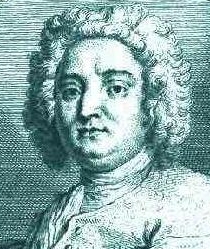
Antonio Bernacchi

Encyclopedia
Italy
Italy , officially the Italian Republic languages]] under the European Charter for Regional or Minority Languages. In each of these, Italy's official name is as follows:;;;;;;;;), is a unitary parliamentary republic in South-Central Europe. To the north it borders France, Switzerland, Austria and...
castrato
Castrato
A castrato is a man with a singing voice equivalent to that of a soprano, mezzo-soprano, or contralto voice produced either by castration of the singer before puberty or one who, because of an endocrinological condition, never reaches sexual maturity.Castration before puberty prevents a boy's...
, composer
Composer
A composer is a person who creates music, either by musical notation or oral tradition, for interpretation and performance, or through direct manipulation of sonic material through electronic media...
, and teacher of singing. He studied with Francesco Antonio Pistocchi
Francesco Antonio Pistocchi
Francesco Antonio Mamiliano Pistocchi nicknamed Pistocchino was an Italian singer, composer and librettist.Pistocchino was born in Palermo. He was a boy soprano prodigy, and later made his career as a castrato. From 1696 to 1700 he was maestro di cappella for the Duke of Ansbach. After 1700 he...
. His pupils included Farinelli
Farinelli
Farinelli , was the stage name of Carlo Maria Broschi, celebrated Italian castrato singer of the 18th century and one of the greatest singers in the history of opera.- Early years :...
, for a brief period during 1727, and the tenor Anton Raaff
Anton Raaff
Anton Raaff was a German tenor from Gelsdorf near Bonn.-Career:He studied at the Jesuit school in Bonn where the Elector of Bavaria, Clement Augustus, heard him singing and paid for him to train professionally. Raaff was brought to the capital, Munich, where he was engaged on an annual salary of...
. Nowadays Bernacchi is best remembered for his association with the composer George Frideric Handel
George Frideric Handel
George Frideric Handel was a German-British Baroque composer, famous for his operas, oratorios, anthems and organ concertos. Handel was born in 1685, in a family indifferent to music...
, in six of whose opera
Opera
Opera is an art form in which singers and musicians perform a dramatic work combining text and musical score, usually in a theatrical setting. Opera incorporates many of the elements of spoken theatre, such as acting, scenery, and costumes and sometimes includes dance...
s he sang.
Career
Bernacchi was born in BolognaBologna
Bologna is the capital city of Emilia-Romagna, in the Po Valley of Northern Italy. The city lies between the Po River and the Apennine Mountains, more specifically, between the Reno River and the Savena River. Bologna is a lively and cosmopolitan Italian college city, with spectacular history,...
and, having been engaged at the court of Johann Wilhelm, the Elector Palatine
Johann Wilhelm, Elector Palatine
Johann Wilhelm II, Elector Palatine was Elector Palatine , Duke Palatine of Neuburg/Danube , Duke of Jülich and Berg , and Duke of Upper Palatinate and Cham...
in 1701, began his operatic career in Genoa
Genoa
Genoa |Ligurian]] Zena ; Latin and, archaically, English Genua) is a city and an important seaport in northern Italy, the capital of the Province of Genoa and of the region of Liguria....
in 1703. His appointment in 1714 as virtuoso to Prince Antonio Farnese led to widespread recognition throughout Europe, and he performed in operas by various famous composers of the day, including Johann Adolph Hasse
Johann Adolph Hasse
Johann Adolph Hasse was an 18th-century German composer, singer and teacher of music. Immensely popular in his time, Hasse was best known for his prolific operatic output, though he also composed a considerable quantity of sacred music...
, Leonardo Vinci
Leonardo Vinci
Leonardo Vinci was an Italian composer, best known for his operas.He was born at Strongoli and educated at Naples under Gaetano Greco in the Conservatorio dei Poveri di Gesù Cristo. He first became known for his opere buffe in Neapolitan dialect in 1719; he also composed many opere serie...
, and Alessandro Scarlatti
Alessandro Scarlatti
Alessandro Scarlatti was an Italian Baroque composer especially famous for his operas and chamber cantatas. He is considered the founder of the Neapolitan school of opera. He was the father of two other composers, Domenico Scarlatti and Pietro Filippo Scarlatti.-Life:Scarlatti was born in...
(Rome 1721). He was an especially frequent visitor to the theatres of Venice, appearing in more than twenty operas in that city between 1712 and 1724. In 1720 the Elector of Bavaria engaged him to sing at Munich
Munich
Munich The city's motto is "" . Before 2006, it was "Weltstadt mit Herz" . Its native name, , is derived from the Old High German Munichen, meaning "by the monks' place". The city's name derives from the monks of the Benedictine order who founded the city; hence the monk depicted on the city's coat...
, where he often performed until 1727. In the following season, he appeared in Naples in the same company as Carestini
Giovanni Carestini
Giovanni Carestini was an Italian castrato of the 18th century, who sang in the operas and oratorios of George Frideric Handel...
. This occasioned much rivalry and musico-political intrigue, with the older singer attempting unsuccessfully to have his younger colleague removed. Bernacchi stood on his dignity and left for Milan in a huff.
In 1729 Handel took Bernacchi as his primo uomo for the second Royal Academy, in place of the departed Senesino
Senesino
Senesino was a celebrated Italian contralto castrato, particularly remembered today for his long collaboration with the composer George Frideric Handel.-Early life and career:...
. For Handel, Bernacchi created roles in Lotario
Lotario
Lotario is an opera seria in three acts written for the Royal Academy of Music by George Frideric Handel. The Italian-language libretto was adapted from Antonio Salvi's Adelaide.-Performance history:...
(1729) and Partenope
Partenope
Partenope is an opera by George Frideric Handel, first performed at the King's Theatre in London on 24 February 1730.-Background:...
(1730). He also sang in revivals of Giulio Cesare
Giulio Cesare
Giulio Cesare in Egitto , commonly known simply as Giulio Cesare, is an Italian opera in three acts written for the Royal Academy of Music by George Frideric Handel in 1724...
and Tolomeo
Tolomeo
Tolomeo, re d'Egitto is an opera in three acts by George Frideric Handel to an Italian text by Nicola Francesco Haym, adapted from Carlo Sigismondo Capece's Tolomeo et Alessandro.-Performance history:...
, and in the pasticcio
Pasticcio
In music, a pasticcio or pastiche is an opera or other musical work composed of works by different composers who may or may not have been working together, or an adaptation or localization of an existing work that is loose, unauthorized, or inauthentic.-Etymology:The term is first attested in the...
Ormisda. Despite his fine European reputation, Bernacchi's success in England was mixed: though Charles Burney
Charles Burney
Charles Burney FRS was an English music historian and father of authors Frances Burney and Sarah Burney.-Life and career:...
praised his intelligence as a singer, English audiences preferred Senesino.
In 1736 Bernacchi retired from the stage. He continued to give private concerts and to sing at ecclesiastical events. Of his compositions, some church music survives, as do various concert arias and duets. In his retirement, he founded a singing school at Bologna.
Bernacchi died in the city of his birth in 1756. He was much lamented by his fellow citizens, while Farinelli
Farinelli
Farinelli , was the stage name of Carlo Maria Broschi, celebrated Italian castrato singer of the 18th century and one of the greatest singers in the history of opera.- Early years :...
, a friend as well as a rival and sometime pupil, arranged an elaborate memorial service in his honour.
Bernacchi as a performer