

Antirrhinum majus

Encyclopedia
Antirrhinum majus is a species of plants belonging to the genus Antirrhinum
. It is native to the Mediterranean region, from Morocco
and Portugal
north to southern France
, and east to Turkey
and Syria
.
The common name "snapdragon", originates from the flowers' reaction to having their throats squeezed, which causes the "mouth" of the flower to snap open.
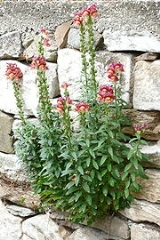
growing to 0.5-1 m tall, rarely up to 2 m. The leaves
are spirally arranged, broadly lanceolate, 1-7 cm long and 2-2.5 cm broad. The flower
s are produced on a tall spike, each flower is 3.5-4.5 cm long, zygomorphic, with two 'lips' closing the corolla tube; wild plants have pink to purple flowers, often with yellow lips. The fruit
is an ovoid capsule
10-14 mm diameter, containing numerous small seed
s.
The plants are pollinated by bumblebees, and the flowers close over the insects when they enter and deposit pollen on their bodies.
 There are five subspecies
:
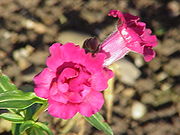 The species is often planted in garden
s for its flowers. Although perennial, it is often treated as an annual plant
, particularly in colder areas where they may not survive the winter. Numerous cultivar
s are available, including plants with lavender, orange, pink, yellow, or white flowers, and also plants with peloric flowers, where the normal flowering spike is topped with a single large, symmetrical flower.
The trailing (creeping) variety is often referred to as A. majus pendula (syn. A. pendula, A. repens).
It often escapes from cultivation, and naturalised
populations occur widely in Europe north of the native range, and elsewhere in temperate regions of the world.
In the laboratory it is a model organism
, for example containing the gene DEFICIENS which provides the letter "D" in the acronym MADS-box
for a family of genes which are important in plant development
.
Antirrhinum
Antirrhinum is a genus of plants commonly known as snapdragons from the flowers' fancied resemblance to the face of a dragon that opens and closes its mouth when laterally squeezed...
. It is native to the Mediterranean region, from Morocco
Morocco
Morocco , officially the Kingdom of Morocco , is a country located in North Africa. It has a population of more than 32 million and an area of 710,850 km², and also primarily administers the disputed region of the Western Sahara...
and Portugal
Portugal
Portugal , officially the Portuguese Republic is a country situated in southwestern Europe on the Iberian Peninsula. Portugal is the westernmost country of Europe, and is bordered by the Atlantic Ocean to the West and South and by Spain to the North and East. The Atlantic archipelagos of the...
north to southern France
France
The French Republic , The French Republic , The French Republic , (commonly known as France , is a unitary semi-presidential republic in Western Europe with several overseas territories and islands located on other continents and in the Indian, Pacific, and Atlantic oceans. Metropolitan France...
, and east to Turkey
Turkey
Turkey , known officially as the Republic of Turkey , is a Eurasian country located in Western Asia and in East Thrace in Southeastern Europe...
and Syria
Syria
Syria , officially the Syrian Arab Republic , is a country in Western Asia, bordering Lebanon and the Mediterranean Sea to the West, Turkey to the north, Iraq to the east, Jordan to the south, and Israel to the southwest....
.
The common name "snapdragon", originates from the flowers' reaction to having their throats squeezed, which causes the "mouth" of the flower to snap open.
Description
It is a herbaceous perennial plantPerennial plant
A perennial plant or simply perennial is a plant that lives for more than two years. The term is often used to differentiate a plant from shorter lived annuals and biennials. The term is sometimes misused by commercial gardeners or horticulturalists to describe only herbaceous perennials...
growing to 0.5-1 m tall, rarely up to 2 m. The leaves
Leaf
A leaf is an organ of a vascular plant, as defined in botanical terms, and in particular in plant morphology. Foliage is a mass noun that refers to leaves as a feature of plants....
are spirally arranged, broadly lanceolate, 1-7 cm long and 2-2.5 cm broad. The flower
Flower
A flower, sometimes known as a bloom or blossom, is the reproductive structure found in flowering plants . The biological function of a flower is to effect reproduction, usually by providing a mechanism for the union of sperm with eggs...
s are produced on a tall spike, each flower is 3.5-4.5 cm long, zygomorphic, with two 'lips' closing the corolla tube; wild plants have pink to purple flowers, often with yellow lips. The fruit
Fruit
In broad terms, a fruit is a structure of a plant that contains its seeds.The term has different meanings dependent on context. In non-technical usage, such as food preparation, fruit normally means the fleshy seed-associated structures of certain plants that are sweet and edible in the raw state,...
is an ovoid capsule
Capsule (fruit)
In botany a capsule is a type of simple, dry fruit produced by many species of flowering plants. A capsule is a structure composed of two or more carpels that in most cases is dehiscent, i.e. at maturity, it splits apart to release the seeds within. A few capsules are indehiscent, for example...
10-14 mm diameter, containing numerous small seed
Seed
A seed is a small embryonic plant enclosed in a covering called the seed coat, usually with some stored food. It is the product of the ripened ovule of gymnosperm and angiosperm plants which occurs after fertilization and some growth within the mother plant...
s.
The plants are pollinated by bumblebees, and the flowers close over the insects when they enter and deposit pollen on their bodies.
Taxonomy
Subspecies
Subspecies in biological classification, is either a taxonomic rank subordinate to species, ora taxonomic unit in that rank . A subspecies cannot be recognized in isolation: a species will either be recognized as having no subspecies at all or two or more, never just one...
:
- Antirrhinum majus subsp. majus. Southern France, northeast Spain.
- Antirrhinum majus subsp. cirrhigerum (Ficalho) Franco. Southern Portugal, southwest Spain.
- Antirrhinum majus subsp. linkianum (Boiss. & Reut.) Rothm. Western Portugal (endemic).
- Antirrhinum majus subsp. litigiosum (Pau) Rothm. Southeastern Spain.
- Antirrhinum majus subsp. tortuosum (Bosc) Rouy. Throughout the species' range.
Cultivation and uses
Garden
A garden is a planned space, usually outdoors, set aside for the display, cultivation, and enjoyment of plants and other forms of nature. The garden can incorporate both natural and man-made materials. The most common form today is known as a residential garden, but the term garden has...
s for its flowers. Although perennial, it is often treated as an annual plant
Annual plant
An annual plant is a plant that usually germinates, flowers, and dies in a year or season. True annuals will only live longer than a year if they are prevented from setting seed...
, particularly in colder areas where they may not survive the winter. Numerous cultivar
Cultivar
A cultivar'Cultivar has two meanings as explained under Formal definition. When used in reference to a taxon, the word does not apply to an individual plant but to all those plants sharing the unique characteristics that define the cultivar. is a plant or group of plants selected for desirable...
s are available, including plants with lavender, orange, pink, yellow, or white flowers, and also plants with peloric flowers, where the normal flowering spike is topped with a single large, symmetrical flower.
The trailing (creeping) variety is often referred to as A. majus pendula (syn. A. pendula, A. repens).
It often escapes from cultivation, and naturalised
Naturalisation (biology)
In biology, naturalisation is any process by which a non-native organism spreads into the wild and its reproduction is sufficient to maintain its population. Such populations are said to be naturalised....
populations occur widely in Europe north of the native range, and elsewhere in temperate regions of the world.
In the laboratory it is a model organism
Model organism
A model organism is a non-human species that is extensively studied to understand particular biological phenomena, with the expectation that discoveries made in the organism model will provide insight into the workings of other organisms. Model organisms are in vivo models and are widely used to...
, for example containing the gene DEFICIENS which provides the letter "D" in the acronym MADS-box
MADS-box
The MADS box is a conserved sequence motif found in genes which comprise the MADS-box gene family. The MADS box encodes the DNA-binding MADS domain. The MADS domain binds to DNA sequences of high similarity to the motif CC[A/T]6GG termed the CArG-box. MADS-domain proteins are generally...
for a family of genes which are important in plant development
Plant evolutionary developmental biology
Evolutionary developmental biology refers to the study of developmental programs and patterns from an evolutionary perspective. It seeks to understand the various influences shaping the form and nature of life on the planet. Evo-devo arose as a separate branch of science rather recently. An early...
.