
The
Angora rabbit is a variety of domestic
rabbitRabbits are small mammals in the family Leporidae of the order Lagomorpha, found in several parts of the world...
bred for its long, soft wool. The Angora is one of the oldest types of domestic rabbit, originating in
AnkaraAnkara is the capital of Turkey and the country's second largest city after Istanbul. The city has a mean elevation of , and as of 2010 the metropolitan area in the entire Ankara Province had a population of 4.4 million....
(historically known as
AngoraAngora is the historic name of Ankara, Turkey Angora may also refer to:* Angora, Philadelphia, Pennsylvania** Angora , a commuter rail station* Angora Township, Minnesota* Angora, Nebraska* Angora , a musical group...
),
TurkeyTurkey , known officially as the Republic of Turkey , is a Eurasian country located in Western Asia and in East Thrace in Southeastern Europe...
, along with the Angora cat and
Angora goatThe Angora goat is a breed of domestic goat that originated in Ankara , Turkey and its surrounding region in central Anatolia...
. The rabbits were popular pets with
FrenchThe French Republic , The French Republic , The French Republic , (commonly known as France , is a unitary semi-presidential republic in Western Europe with several overseas territories and islands located on other continents and in the Indian, Pacific, and Atlantic oceans. Metropolitan France...
royalty in the mid 18th century, and spread to other parts of
EuropeEurope is, by convention, one of the world's seven continents. Comprising the westernmost peninsula of Eurasia, Europe is generally 'divided' from Asia to its east by the watershed divides of the Ural and Caucasus Mountains, the Ural River, the Caspian and Black Seas, and the waterways connecting...
by the end of the century. They first appeared in the
United StatesThe United States of America is a federal constitutional republic comprising fifty states and a federal district...
in the early 20th century. They are bred largely for their long
Angora woolAngora wool or Angora fibre refers to the downy coat produced by the Angora rabbit. While their names are similar, Angora fibre is distinct from mohair, which comes from the Angora goat. Angora is known for its softness, thin fibres, and what knitters refer to as a halo...
, which may be removed by
shearSheep shearing, shearing or clipping is the process by which the woollen fleece of a sheep is cut off. The person who removes the sheep's wool is called a shearer. Typically each adult sheep is shorn once each year...
ing, combing, or
pluckPlucking or tweezing can mean the process of removing human hair, animal hair or a bird's feathers by mechanically pulling the item from the owner's body.In humans, this is done for personal grooming purposes, usually with tweezers...
ing. There are many individual breeds of Angora rabbits, four of which are recognized by
ARBAThe American Rabbit Breeders Association is a national club for domestic rabbit and cavy breeders. The ARBA is headquartered in Bloomington, Illinois in the United States...
; English, French, Giant, and Satin. Other breeds include German, Chinese, Swiss, and Finnish.
Coat and appearance
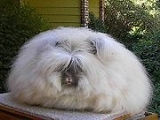
Angoras are bred mainly for their wool because it is silky and soft. They have a humorous appearance, as they oddly resemble a fur ball with a face. Most are calm and docile, but should be handled carefully. Grooming is necessary to prevent the fibre from matting and felting on the rabbit. A condition, wool block, is common in Angora rabbits, and should be treated quickly. These rabbits are shorn every three to four months throughout the year.
Wool Block & Diet
As with all rabbits, abundant and unlimited hay should be provided for the rabbit. The fiber the rabbit gains from the hay helps prevent wool block (also referred to as intestinal impaction). It is also recommended particularly for Angora and other long-haired rabbit species that any pellet diets have at least 13% fiber. Fiber content can be found in the nutritional analysis on the food bag. Additionally cecal impaction can be caused by dehydration, which can be prevented by providing unlimited water as well as a salt lick to encourage drinking water.
Medical considerations
Rabbits are unique because they do not possess the same allergy-causing qualities as many other animals. The average rabbit can live for about 7-12 years when kept indoors and well-cared for. However, many outdoors rabbits have a shorter lifespan. Maintenance is a must. The Satin Angora has a much lower guard hair count and their wool becomes easily tangled. Regardless of breed, all Angoras must be monitored to prevent wool block, a potentially lethal condition where their digestive tracts become clogged with hair. Proper diet is also crucial in lowering their susceptibility to the block.
Breeds
There are four different
ARBAThe American Rabbit Breeders Association is a national club for domestic rabbit and cavy breeders. The ARBA is headquartered in Bloomington, Illinois in the United States...
-recognized Angora rabbit breeds: English, French, Giant and Satin. The German Angora is also common, but is not ARBA recognized. It has its own association, the IAGARB.
English
- Weight: 2–3.5 kg (4.4–7.7 lb).
- ARBA-accepted varieties: ruby-eye white, pointed white, self, shaded, agouti,broken
Prior to the 1939, there was one breed of "Angora Wooler". In 1939, ARBA reclassified "Angora Wooler" into "English Type" and "French Type". In 1944, ARBA officially separated Angora rabbits into two breeds: English Angora and French Angora.
Rabbits of the Angora breed are adorned with "fur," growths of wool on the ears and the entire face except above the nose, and front feet, along with their thick body, and wool. They are gentle in nature, but they are not recommended for those who do not groom their animals. Their wool is very dense and needs to be groomed twice a week.
This is the smallest Angora rabbit of the four breeds recognized by
ARBAThe American Rabbit Breeders Association is a national club for domestic rabbit and cavy breeders. The ARBA is headquartered in Bloomington, Illinois in the United States...
. This breed is more common as a pet because of the facial features that give it a puppy dog or teddy bear look. If the texture of the wool is correct, the maintenance is relatively easy; if the texture of the rabbit is
cottonCotton is a soft, fluffy staple fiber that grows in a boll, or protective capsule, around the seeds of cotton plants of the genus Gossypium. The fiber is almost pure cellulose. The botanical purpose of cotton fiber is to aid in seed dispersal....
y, it requires a great deal of maintenance.
The English Angora can be bred to have broken colors, (e.g.: the rabbit is white with black spots.) This is not accepted by ARBA standards, and would lead to a disqualification when showing the rabbit. When showing an English Angora rabbit, the toenails should also be only one color, the ears could be folded over at the tips, and the furnishings on the face may cover their eyes. The English Angora rabbit is the only rabbit that has hair covering its eyes.
French
- Weight: 3.5–4.5 kg (7.7–9.9 lb).
- ARBA-accepted varieties: agouti
The Agouti gene is responsible for determining whether a mammal's coat is banded or of a solid color . The chief product of the Agouti gene is Agouti signalling peptide , but there are a number of alternative splice products....
, pointed white, self, shaded, ticked, wide band, also it can be brown tones, and broken
This breed has a preponderance of guard hair on the surface, with wool as an undercoat. If the texture is correct, it requires less maintenance than other Angora breeds. Small ear tufts are allowed, but not usually preferred by breeders. ARBA recognizes the same colors as with English Angora, plus broken. They are shown at ARBA shows using the types "white" and "colored" (broken being a colored). As with other ARBA shown rabbits, toenails should also be only one color.
The French Angora is one of the large Angora breeds at 7.5 to 10 lbs, with a commercial body type. It differs from the English, Giant and German Angora in that it possesses a clean face and front feet, with only minor tufting on the rear legs. The color of a French Angora is determined by the color of its head, feet and tail (all the same color) the angora fibre has smooth silky texture making it difficult to spin. Desirable characteristics of the fibre include its texture, warmth, lightweight and pure white color. It is used for sweaters, mittens, baby clothes and millinery.
German
- Weight: 2–5.5 kg (4.4–12.1 lb).
- IAGARB-accepted varieties: all (not subject to ARBA standards)
This breed, while not ARBA recognized, is common in the United States and Canada. It looks much like the Giant Angora. The majority of German Angora are ruby-eyed white or albino. In 2006, several black German Angoras were imported to the USA and Canada.
Many hand spinners have bred the German Angoras with another type of colored Angora (or other breeds in some cases) in an effort to acquire color in the more dense nonmatting German-type wool. These resulting rabbits are called German crosses, not to be confused with the rabbits called German Angora hybrids. Briefly explained, a German hybrid is a rabbit that has a 3 generation pedigree with only 100% German Angoras listed as ancestors.
A separate association for German Angoras exists called the International Association of German Angora Rabbit Breeders, or IAGARB. Instead of conformation showing, the emphasis is on both the wool-bearing properties and the body type characteristics of the rabbit for commercial purposes. The rabbit must meet objective standards and perform well on 90 day shearing tests to be officially recognized as a registered German Angora rabbit.
IAGARB will now also recognize colored [hybrid] German angora rabbits, and they may achieve a German registration if they conform to the IAGARB breed standards and prove their wool-bearing ability by passing the judges testing via 90 day wool shearing tests. Since IAGARB registration is independent of parentage or ancestry, any ruby-eyed-white or colored angora rabbit that meets the registration standards of the club can be registered as a German Angora. The notion they come only in white is a common misconception, as the rules have recently been changed to include colored Angoras, as well as ruby-eyed whites.
Giant
- Weight: 4.5 kg (9.9 lb) or larger
- ARBA-accepted varieties: ruby-eyed white
The Giant Angora is the largest of the ARBA accepted Angora breeds, having been created by Louise Walsh, of Taunton, Massachusetts to be an efficient wool-producing rabbit sustained with 16-18% alfalfa based rabbit feed and hay, and living in the standard size all wire cages used for commercial breeds. Its coat contains three types of wool: soft under wool, awn fluff, and awn hair; the awn type wool exists only on the Giant and German Angora. This breed should have furnishings on the face and ears. Many people confuse German with Giant Angora, but they are not the same.
This is the largest of the four ARBA recognized Angora breeds. The only color ARBA officially recognizes for Giant Angora is ruby-eyed white (REW), or as more commonly referred to as an "albino", indicating the absence of color pigment in the genetic makeup. The Giant Angora produces more wool than the French, Satin or English Angora. It is easiest to set the rabbit on a standard grooming table, with a "turn table" to do the clipping. You then stay in control of where the rabbit is. Like the German Angora, they require their wool to be harvested every 90 days. When Giants are on a good feeding program, their wool will grow abut 3 cm or 1 inch per month. The coat needs to be monitored after 6 months of growth as it may tend to "die" and easily mat. 12+ ounces of wool is not uncommon per clipping of a good sized Giant Angora.
Since rabbits ingest their wool when they groom themselves, clipping their wool at least once every 180 days is considered a must to prevent wool block from occurring. A dietary supplement of papaya (from the vitamin section of the grocery store) in their diet helps wool to breakdown in their digestive tract. The wool swallowed by a rabbit cannot be coughed or vomited up, and will cause it to slowly starve to death as its digestive tract fills up with ingested wool; if left untreated, wool block can lead to death. It is widely held among serious Angora breeders that ample cage space to exercise and feeding fresh horse quality hay on a daily basis will help keep the wool moving through the system and prevent wool block. It is also widely held that feeding both bromelin from fresh pineapple and
papainPapain, also known as papaya proteinase I, is a cysteine protease enzyme present in papaya and mountain papaya .-Papain family:...
from fresh papaya occasionally will aid in breaking down the ingested wool (they are proteolytic enzymes), and aid in its passage through the rabbits' system. Other helpful tips for loose wool control include, giving the rabbit a pine cone to play with. They nibble them, throw them around, and they turn into a good wool catcher in their cage. When the pine cone is all nibbled or full of wool, replace it.
Like many other "giant" breeds of rabbits, the Giant Angora grows slowly. A senior doe usually takes more than a year to reach full maturity (size and weight). A senior buck can take up to 1.5 years to fully mature (size and weight).
Satin
- Weight: 3–4.5 kg (6.6–9.9 lb).
- ARBA-accepted varieties: agouti, pointed white, self, shaded, sicked, wide band
The Satin Angora is derived from cross breeding between a Satin and a French Angora. This breed is named for the high sheen of the wool, commonly referred to as "satinized," the hair shaft has a semi-transparent outer shell and reflects light, resulting in deep color, high luster, and extreme soft texture of its wool. It resembles the French Angora, having no furnishings on the face, ears, or feet, and it is also easy to groom compared to the English variety, although the soft texture makes matting an issue, and daily combing is recommended. Satin Angora's wool is said to be stronger for
spinningSpinning is a major industry. It is part of the textile manufacturing process where three types of fibre are converted into yarn, then fabric, then textiles. The textiles are then fabricated into clothes or other artifacts. There are three industrial processes available to spin yarn, and a...
than other varieties of Angora, although it is considered more difficult to spin. The rewards are many, since the lowest micron count can be found in this breed, it is suitable for next-to-the-skin and baby garments, even for people who consider Angora too prickly to wear.
They are shown at ARBA shows using the types "white" and "colored" (broken not yet approved). As with other ARBA shown rabbits, toenails should also be only one color. The color of a Satin Angora is determined by the color of its head, feet and tail (all the same color).
This breed does not produce as much wool as other breeds of Angora rabbits. This trait is being improved upon by
selective breedingSelective breeding is the process of breeding plants and animals for particular genetic traits. Typically, strains that are selectively bred are domesticated, and the breeding is sometimes done by a professional breeder. Bred animals are known as breeds, while bred plants are known as varieties,...
. The wool should have a silky texture, high luster, with good guard hair for ease of maintenance.
Personality
Angora rabbits are active, playful and social, with lots of personality. They enjoy the attention of their owners, as well as the companionship of other rabbits, and often house Angoras will nap with a docile mannered cat. They enjoy having toys, for example a plastic ball, a pine cone, a piece of soft wood, a stuffed sock, or an old glove.
External links
- Angora Breeder Exhibitor in the UK
- National Angora Rabbit Breeders Club official site
- German Angora information, pictures, links to sites in Germany
- Home of Grand Champions Information on breeding, caring for, and showing Angora rabbits, as well as an extensive photo gallery
- Spang Angoras Information on the French Angora rabbits
- International Association of German Angora Rabbit Breeders official site
- German, Giant and French Angora rabbit information, photos, educational and health articles Angora wool for use in fiber arts, step by step how to spin Angora into yarn, links