

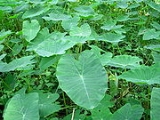
Alocasia odora

Encyclopedia
Alocasia odora; in Lao the plant known as thon toon (ຕົ້ນທູນ), the stalk known as khan toon ( ກ້ານທູນ) is a flowering plant
native to Asia.
Its stems are used as a green vegetable in the cuisines of Southeast Asia
, and often used to flavor soups (such as canh chua
) or stir fried
dishes. Bac ha stems should not be consumed raw. It is usually peeled and boiled, sold either frozen, bagged in its own liquids, or canned. The plant is actually inedible when raw because of needle-shaped raphides (calcium oxalate crystals) in the plant cells.
Typical of leaf vegetables, bac ha or "taro stem" leaves are rich in vitamins and minerals. They are a good source of thiamin, riboflavin, iron, phosphorus, and zinc, and a very good source of vitamin B6, vitamin C, niacin, potassium, copper, and manganese. Taro corms are very high in starch, and are a good source of dietary fiber. Oxalic acid
may be present in the corm and especially in the leaf
The plant is a member of the genus Alocasia
, and is thus related to taro
.
Flowering plant
The flowering plants , also known as Angiospermae or Magnoliophyta, are the most diverse group of land plants. Angiosperms are seed-producing plants like the gymnosperms and can be distinguished from the gymnosperms by a series of synapomorphies...
native to Asia.
Its stems are used as a green vegetable in the cuisines of Southeast Asia
Southeast Asia
Southeast Asia, South-East Asia, South East Asia or Southeastern Asia is a subregion of Asia, consisting of the countries that are geographically south of China, east of India, west of New Guinea and north of Australia. The region lies on the intersection of geological plates, with heavy seismic...
, and often used to flavor soups (such as canh chua
Canh chua
Canh chua is a sour soup indigenous to the Mekong Delta region of southern Vietnam. It is typically made with fish from the Mekong River Delta, pineapple, tomatoes , and bean sprouts, in a tamarind-flavored broth...
) or stir fried
Stir frying
Stir frying is an umbrella term used to describe two Chinese cooking techniques for preparing food in a wok: chǎo and bào . The term stir-fry was introduced into the English language by Buwei Yang Chao, in her book How to Cook and Eat in Chinese, to describe the chǎo technique...
dishes. Bac ha stems should not be consumed raw. It is usually peeled and boiled, sold either frozen, bagged in its own liquids, or canned. The plant is actually inedible when raw because of needle-shaped raphides (calcium oxalate crystals) in the plant cells.
Typical of leaf vegetables, bac ha or "taro stem" leaves are rich in vitamins and minerals. They are a good source of thiamin, riboflavin, iron, phosphorus, and zinc, and a very good source of vitamin B6, vitamin C, niacin, potassium, copper, and manganese. Taro corms are very high in starch, and are a good source of dietary fiber. Oxalic acid
Oxalic acid
Oxalic acid is an organic compound with the formula H2C2O4. This colourless solid is a dicarboxylic acid. In terms of acid strength, it is about 3,000 times stronger than acetic acid. Oxalic acid is a reducing agent and its conjugate base, known as oxalate , is a chelating agent for metal cations...
may be present in the corm and especially in the leaf
The plant is a member of the genus Alocasia
Alocasia
Alocasia is a genus of broad-leaved rhizomatous or tuberous perennials from the Family Araceae. There are 78 species of Alocasia occurring in Tropical & Subtropical Asia to Eastern Australia and widely cultivated in Oceania and South America. The large cordate or sagittate leaves grow to a length...
, and is thus related to taro
Taro
Taro is a common name for the corms and tubers of several plants in the family Araceae . Of these, Colocasia esculenta is the most widely cultivated, and is the subject of this article. More specifically, this article describes the 'dasheen' form of taro; another variety is called eddoe.Taro is...
.