


All-American Publications

Encyclopedia
All-American Publications is one of three American comic book
companies that combined to form the modern-day DC Comics
, one of the world's two largest comics publishers. Superhero
es created for All-American include the original Atom, Flash
, Green Lantern
, Hawkman, and Wonder Woman
, all in the 1940s' Golden Age of comic books
.
, future founder of EC Comics
, formed All-American Publications in 1938 after successfully seeking funding from Harry Donenfeld
, CEO of both National Allied Publications (publisher of Action Comics
and other titles) and sister company Detective Comics (publisher of that namesake comic book
). As Gerard Jones writes of Donenfeld's investment:
While All-American, at 225 Lafayette Street in Manhattan, was physically separated from DC's office space uptown at 480 Lexington Avenue, it used the informal "DC" logo on most of its covers for distribution and marketing reasons. (The DC logo at the time was also used for National's unofficial branding, capitalizing on the success of Batman
in Detective Comics.) In 1946, Gaines let Liebowitz buy him out, keeping only Picture Stories from the Bible as the foundation of his own new company, EC. "Liebowitz promptly orchestrated the merger of All-American and Detective Comics into National Comics.... Next he took charge of organizing National Comics, Independent News, and their affiliated firms into a single corporate entity, National Periodical Publications".
Before that merger, Gaines had first rebranded All-American with its own logo, beginning with books cover-dated February 1945: All-Flash #17, Sensation Comics
#38, Flash Comics #62, Green Lantern #14, Funny Stuff #3, and Mutt & Jeff #16, and the following month's All-American Comics
#64 and the hyphenless All Star Comics
#24. When Liebowitz later merged his and Donenfeld's companies, the All-American titles first bore the DC logo once again (starting with December 1945's Sensation #48 and Flash Comics #68, continuing with All-American #70, All-Flash #21, Comic Cavalcade #13, Green Lantern #18, Funny Stuff #7, and Mutt & Jeff #20) before finally being fully absorbed by what was now National Periodical.
 During All-American's existence, much cross-promotion took place between the two editorially independent companies, so much so that the first iteration of the Justice Society of America
, in All Star Comics
#3 (Winter 1940/41), included in its roster the National characters Doctor Fate
, Hour-Man (as it was then spelled), the Spectre
, and the Sandman — creating comics' first intercompany crossover
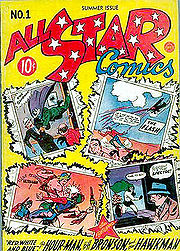
, with characters interacting, although National's Sandman, Spectre and Hour-Man had previously appeared in solo adventures in All Star Comics #1 (Summer 1940).
With Gaines as editor, assisted by Sheldon Mayer
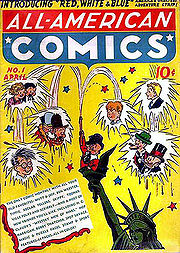
, All-American Publications launched its flagship series All-American Comics
with an April 1938 premiere. Like many comics of the time, All-American debuted with a mix of newspaper
comic strips, reprinted in color, and a smattering of original, comic-strip-like features. Among the strips were three huge hits of the era: Mutt and Jeff, by Al Smith
ghosting for strip creator Bud Fisher
; Skippy
, by Percy Crosby
; and Toonerville Folks
by Fontaine Fox
. New content included Scribbly, a semiautobiographical Mayer feature about a boy cartoonist. All-American Comics lasted 102 issues through October 1948.
Also debuting that month was Movie Comics ("A full movie show for 10 cents"), featuring simple adaptations of movies using painted movie stills, as well as cartoonist
Ed Wheelan
's popular Minute Movies comics. The first of its six issues through Aug. 1939 adapted no fewer than five films: Son of Frankenstein
, Gunga Din
, The Great Man Votes, Fisherman's Wharf, and Scouts to the Rescue.
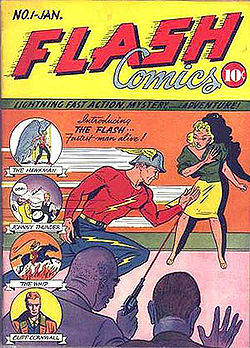
The next two comics were Mutt & Jeff, which ran 103 issues from Summer 1939 - June 1958; and the company's superhero debut, Flash Comics #1 (Jan. 1940), which introduced the super-speedster title character, created by writer Gardner Fox
and artist Harry Lampert
, as well as the Golden Age Hawkman and future Hawkgirl, by Fox and artist Dennis Neville, and Johnny Thunder
, by scripter John Wentworth and artist Stan Aschmeier, among other features.
The Golden Age Green Lantern, from Batman writer Bill Finger
and artist Martin Nodell
, debuted in All-American Comics #16 (July 1940), followed by the original Atom, created by Bill O'Connor and penciler Ben Flinton, in All-American #19 (Nov. 1940). Wonder Woman was introduced in a nine-page story in All Star Comics #8 (Jan. 1942), the product of psychologist William Moulton Marston
and Max Charles Gaines (under the pseudonym
Charles Moulton), and drawn by artist Harry G. Peter.
American comic book
An American comic book is a small magazine originating in the United States and containing a narrative in the form of comics. Since 1975 the dimensions have standardized at 6 5/8" x 10 ¼" , down from 6 ¾" x 10 ¼" in the Silver Age, although larger formats appeared in the past...
companies that combined to form the modern-day DC Comics
DC Comics
DC Comics, Inc. is one of the largest and most successful companies operating in the market for American comic books and related media. It is the publishing unit of DC Entertainment a company of Warner Bros. Entertainment, which itself is owned by Time Warner...
, one of the world's two largest comics publishers. Superhero
Superhero
A superhero is a type of stock character, possessing "extraordinary or superhuman powers", dedicated to protecting the public. Since the debut of the prototypical superhero Superman in 1938, stories of superheroes — ranging from brief episodic adventures to continuing years-long sagas —...
es created for All-American include the original Atom, Flash
Jay Garrick
Jay Garrick is a fictional character, a comic book superhero in the DC Comics universe and the first to use the name Flash.-The Flash:...
, Green Lantern
Alan Scott
Alan Scott is a fictional character, a superhero in the and the first superhero to bear the name Green Lantern.-Publication history:The original Green Lantern was created by young struggling artist Martin Nodell, who was inspired by the sight of a New York Subway employee waving a red lantern to...
, Hawkman, and Wonder Woman
Wonder Woman
Wonder Woman is a DC Comics superheroine created by William Moulton Marston. She first appeared in All Star Comics #8 . The Wonder Woman title has been published by DC Comics almost continuously except for a brief hiatus in 1986....
, all in the 1940s' Golden Age of comic books
Golden Age of Comic Books
The Golden Age of Comic Books was a period in the history of American comic books, generally thought of as lasting from the late 1930s until the late 1940s or early 1950s...
.
Publishing history
Max GainesMax Gaines
Maxwell Charles Gaines was a pioneering figure in the creation of the modern comic book. Born Maxwell Ginsburg or Maxwell Ginzberg, he was also known as Max Gaines, M.C...
, future founder of EC Comics
EC Comics
Entertaining Comics, more commonly known as EC Comics, was an American publisher of comic books specializing in horror fiction, crime fiction, satire, military fiction and science fiction from the 1940s through the mid-1950s, notably the Tales from the Crypt series...
, formed All-American Publications in 1938 after successfully seeking funding from Harry Donenfeld
Harry Donenfeld
Harry Donenfeld was an American publisher who is known primarily for being the owner of National Allied Publications, which distributed Detective Comics and Action Comics, the originator publications for the superhero characters Batman and Superman...
, CEO of both National Allied Publications (publisher of Action Comics
Action Comics
Action Comics is an American comic book series that introduced Superman, the first major superhero character as the term is popularly defined...
and other titles) and sister company Detective Comics (publisher of that namesake comic book
Detective Comics
Detective Comics is an American comic book series published monthly by DC Comics since 1937, best known for introducing the iconic superhero Batman in Detective Comics #27 . It is, along with Action Comics, the book that launched with the debut of Superman, one of the medium's signature series, and...
). As Gerard Jones writes of Donenfeld's investment:
While All-American, at 225 Lafayette Street in Manhattan, was physically separated from DC's office space uptown at 480 Lexington Avenue, it used the informal "DC" logo on most of its covers for distribution and marketing reasons. (The DC logo at the time was also used for National's unofficial branding, capitalizing on the success of Batman
Batman
Batman is a fictional character created by the artist Bob Kane and writer Bill Finger. A comic book superhero, Batman first appeared in Detective Comics #27 , and since then has appeared primarily in publications by DC Comics...
in Detective Comics.) In 1946, Gaines let Liebowitz buy him out, keeping only Picture Stories from the Bible as the foundation of his own new company, EC. "Liebowitz promptly orchestrated the merger of All-American and Detective Comics into National Comics.... Next he took charge of organizing National Comics, Independent News, and their affiliated firms into a single corporate entity, National Periodical Publications".
Before that merger, Gaines had first rebranded All-American with its own logo, beginning with books cover-dated February 1945: All-Flash #17, Sensation Comics
Sensation Comics
Sensation Comics is the title of a comic book series published by DC Comics that ran for 109 issues between 1942 and 1952. For most of its run, the lead feature was Wonder Woman. Other series that appeared were the Black Pirate, the Gay Ghost, Mr...
#38, Flash Comics #62, Green Lantern #14, Funny Stuff #3, and Mutt & Jeff #16, and the following month's All-American Comics
All-American Comics
All-American Comics was the flagship title of comic book publisher All-American Publications, one of the forerunners of DC Comics. It ran for 102 issues from April 1939 to October 1948, at which time it was renamed All-American Western. In 1952, the title was changed again to All-American Men of...
#64 and the hyphenless All Star Comics
All Star Comics
All Star Comics is a 1940s comic book series from All-American Publications, one of the early companies that merged with National Periodical Publications to form the modern-day DC Comics. With the exception of the first two issues, All Star Comics primarily told stories about the adventures of the...
#24. When Liebowitz later merged his and Donenfeld's companies, the All-American titles first bore the DC logo once again (starting with December 1945's Sensation #48 and Flash Comics #68, continuing with All-American #70, All-Flash #21, Comic Cavalcade #13, Green Lantern #18, Funny Stuff #7, and Mutt & Jeff #20) before finally being fully absorbed by what was now National Periodical.
Creative legacy
Justice Society of America
The Justice Society of America, or JSA, is a DC Comics superhero group, the first team of superheroes in comic book history. Conceived by editor Sheldon Mayer and writer Gardner Fox, the JSA first appeared in All Star Comics #3 ....
, in All Star Comics
All Star Comics
All Star Comics is a 1940s comic book series from All-American Publications, one of the early companies that merged with National Periodical Publications to form the modern-day DC Comics. With the exception of the first two issues, All Star Comics primarily told stories about the adventures of the...
#3 (Winter 1940/41), included in its roster the National characters Doctor Fate
Doctor Fate
Doctor Fate is the name of a succession of fictional sorcerers who appear in books published by DC Comics. The original version was created by writer Gardner Fox and artist Howard Sherman, and first appeared in More Fun Comics #55...
, Hour-Man (as it was then spelled), the Spectre
Spectre (comics)
The Spectre is a fictional character and superhero who has appeared in numerous comic books published by DC Comics. The character first appeared in a next issue ad in More Fun Comics #51 and received his first story the following month, #52...
, and the Sandman — creating comics' first intercompany crossover
Intercompany crossover
In comic books, an intercompany crossover is a comic or series of comics where characters published by one company meet those published by another...
, with characters interacting, although National's Sandman, Spectre and Hour-Man had previously appeared in solo adventures in All Star Comics #1 (Summer 1940).
With Gaines as editor, assisted by Sheldon Mayer
Sheldon Mayer
Sheldon Mayer was an American comic book writer, artist and editor. One of the earliest employees of Major Malcolm Wheeler-Nicholson's National Allied Publications, Mayer produced almost all of his comics work for the company that would become known as DC Comics.He is credited with rescuing the...
, All-American Publications launched its flagship series All-American Comics
All-American Comics
All-American Comics was the flagship title of comic book publisher All-American Publications, one of the forerunners of DC Comics. It ran for 102 issues from April 1939 to October 1948, at which time it was renamed All-American Western. In 1952, the title was changed again to All-American Men of...
with an April 1938 premiere. Like many comics of the time, All-American debuted with a mix of newspaper
Newspaper
A newspaper is a scheduled publication containing news of current events, informative articles, diverse features and advertising. It usually is printed on relatively inexpensive, low-grade paper such as newsprint. By 2007, there were 6580 daily newspapers in the world selling 395 million copies a...
comic strips, reprinted in color, and a smattering of original, comic-strip-like features. Among the strips were three huge hits of the era: Mutt and Jeff, by Al Smith
Al Smith (cartoonist)
Al Smith was an American cartoonist whose work included a long run on the comic strip Mutt and Jeff.Born in Brooklyn, New York, Smith was the art editor for the syndication department of the New York World from 1920 to 1930. He began working on Bud Fisher's Mutt and Jeff in 1932. Smith drew Mutt...
ghosting for strip creator Bud Fisher
Bud Fisher
Harry Conway "Bud" Fisher was an American cartoonist who created Mutt and Jeff, the first successful daily comic strip in the United States....
; Skippy
Skippy (comic strip)
Skippy was an American comic strip written and drawn by Percy Crosby that was published from 1923 to 1945. A highly popular, acclaimed and influential feature about rambunctious fifth-grader Skippy Skinner, his friends and his enemies, it was adapted into movies, a novel and a radio show. It was...
, by Percy Crosby
Percy Crosby
Percy Leo Crosby was an American author, illustrator and cartoonist best known for his popular comic strip Skippy. Adapted into movies, a novel and a radio show, Crosby's creation was commemorated on a 1997 U.S. Postal Service stamp...
; and Toonerville Folks
Toonerville Folks
Toonerville Folks was a popular newspaper cartoon feature by Fontaine Fox, which ran from 1908 to 1955. It began in 1908 in the Chicago Post, and by 1913, it was syndicated nationally by the Wheeler Syndicate...
by Fontaine Fox
Fontaine Fox
Fontaine Talbot Fox Jr. was an American cartoonist and illustrator born near Louisville, Kentucky.Fox is best known for writing and illustrating his Toonerville Folks comic panel. It ran from 1913 to 1955 in 250 to 300 newspapers across North America.The cartoons are set in the small town of...
. New content included Scribbly, a semiautobiographical Mayer feature about a boy cartoonist. All-American Comics lasted 102 issues through October 1948.
Also debuting that month was Movie Comics ("A full movie show for 10 cents"), featuring simple adaptations of movies using painted movie stills, as well as cartoonist
Cartoonist
A cartoonist is a person who specializes in drawing cartoons. This work is usually humorous, mainly created for entertainment, political commentary or advertising...
Ed Wheelan
Ed Wheelan
Edgar S. Wheelan was an American cartoonist best known for his comic strip Minute Movies, satirizing silent films, and his comic book Fat and Slat, published by EC Comics...
's popular Minute Movies comics. The first of its six issues through Aug. 1939 adapted no fewer than five films: Son of Frankenstein
Son of Frankenstein
Son of Frankenstein is the third film in Universal Studios' Frankenstein series and the last to feature Boris Karloff as the Monster as well as the first to feature Béla Lugosi as Ygor. It is a sequel to Bride of Frankenstein....
, Gunga Din
Gunga Din
-Background:The poem is a rhyming narrative from the point of view of a British soldier, about a native water-bearer who saves the soldier's life but dies himself. The last line suggests a deep-down unease of conscience about the prevailing views of natural hierarchies, both in the depicted...
, The Great Man Votes, Fisherman's Wharf, and Scouts to the Rescue.
The next two comics were Mutt & Jeff, which ran 103 issues from Summer 1939 - June 1958; and the company's superhero debut, Flash Comics #1 (Jan. 1940), which introduced the super-speedster title character, created by writer Gardner Fox
Gardner Fox
Gardner Francis Cooper Fox was an American writer best known for creating numerous comic book characters for DC Comics. Comic-book historians estimate that he wrote over 4,000 comics stories....
and artist Harry Lampert
Harry Lampert
Harry Lampert was a cartoonist, adman and author, bridge book author, and bridge teacher.Born in New York, Lampert began cartooning when he was sixteen years old, and worked for the legendary Max Fleischer, inking and helping produce Betty Boop, Popeye, and Koko the Clown cartoons...
, as well as the Golden Age Hawkman and future Hawkgirl, by Fox and artist Dennis Neville, and Johnny Thunder
Johnny Thunder
Johnny Thunder is the name of three fictional characters in comics published by DC Comics. A fourth character has the variant name Jonni Thunder.It is also the name of an unrelated Lego character.-Fictional character biography:...
, by scripter John Wentworth and artist Stan Aschmeier, among other features.
The Golden Age Green Lantern, from Batman writer Bill Finger
Bill Finger
William "Bill" Finger was an American comic strip and comic book writer best known as the uncredited co-creator, with Bob Kane, of the DC Comics character Batman, as well as the co-architect of the series' development...
and artist Martin Nodell
Martin Nodell
Martin Nodell was an American cartoonist and commercial artist, best known as the creator of the Golden Age superhero Green Lantern. Some of his work appeared under the pen name "Mart Dellon."-Early life and career:...
, debuted in All-American Comics #16 (July 1940), followed by the original Atom, created by Bill O'Connor and penciler Ben Flinton, in All-American #19 (Nov. 1940). Wonder Woman was introduced in a nine-page story in All Star Comics #8 (Jan. 1942), the product of psychologist William Moulton Marston
William Moulton Marston
Dr. William Moulton Marston , also known by the pen name Charles Moulton, was an American psychologist, feminist theorist, inventor and comic book writer who created the character Wonder Woman...
and Max Charles Gaines (under the pseudonym
Pseudonym
A pseudonym is a name that a person assumes for a particular purpose and that differs from his or her original orthonym...
Charles Moulton), and drawn by artist Harry G. Peter.
All-American characters
Superhero/masked crimefighter
- The Atom
- Doctor Mid-NiteDoctor Mid-NiteDoctor Mid-Nite is a fictional superhero physician in DC Comics. The figure has been represented in the comics by three different individuals, Charles McNider, Beth Chapel and Pieter Anton Cross. Dr. Mid-Nite was originally created by writer Charles Reizenstein and artist Stanley Josephs Aschmeier...
- The FlashJay GarrickJay Garrick is a fictional character, a comic book superhero in the DC Comics universe and the first to use the name Flash.-The Flash:...
- The Gay GhostGay GhostThe Gay Ghost is a fictional superhero in the DC Comics universe, whose first appearance was in Sensation Comics #1 , published by one DC's predecessor companies, All-American Publications...
- Green LanternAlan ScottAlan Scott is a fictional character, a superhero in the and the first superhero to bear the name Green Lantern.-Publication history:The original Green Lantern was created by young struggling artist Martin Nodell, who was inspired by the sight of a New York Subway employee waving a red lantern to...
- Hawkman and HawkgirlHawkgirlHawkgirl is the name of several female fictional superhero characters, all owned by DC Comics and existing in that company's universe. The character is one of the first costumed female superheroes...
- Hop HarriganHop HarriganHop Harrigan first appeared in All American Comics #1 created by Jon Blummer as one of the first successful aviation heroes in comic history...
- Little Boy Blue and the Blue Boys
- Mr. TerrificMister Terrific (comics)Mister Terrific is the name of two different superheroes in the DC Comics universe.-Terry Sloane:The Golden Age's Mister Terrific was Terry Sloane, a self-made millionaire whose photographic memory, Olympic-level athletic skills, and mastery of the martial arts made him a virtual Renaissance man...
- Sargon the SorcererSargon the SorcererSargon the Sorcerer is a fictional character, a second string mystic, superhero and sorcerer appearing in DC Comics during the Golden Age. The original Sargon first appeared in All-American Comics # 26, , and was created by John B. Wentworth and Howard Purcell...
- Johnny ThunderJohnny ThunderJohnny Thunder is the name of three fictional characters in comics published by DC Comics. A fourth character has the variant name Jonni Thunder.It is also the name of an unrelated Lego character.-Fictional character biography:...
- Gary Concord, the Ultra-ManUltra-ManGary Concord, the Ultra-Man was the name of two fictional, comic-book superheroes, father and son, who first appeared during the 1940s period fans and historians call the Golden Age of comic books...
- The Whip (El Castigo)
- WildcatWildcat (comics)Wildcat is the name of several fictional characters, all DC Comics superheroes. The first and most famous of these is Ted Grant, a long-time member of the Justice Society of America...
- Wonder WomanWonder WomanWonder Woman is a DC Comics superheroine created by William Moulton Marston. She first appeared in All Star Comics #8 . The Wonder Woman title has been published by DC Comics almost continuously except for a brief hiatus in 1986....
Adventurer/war
- The Black Pirate
- Gunner Godbee
- Red, White and Blue (Red Dugan, Whitey Smith, Blooey Blue)
Funny-animal/other humor
- Bulldog Drumhead
- The Red TornadoRed Tornado (Golden Age)The Red Tornado is a fictional character, a superhero in the DC Comics universe, debuting during the Golden Age of Comic Books. Created by Sheldon Mayer, she first appeared in her civilian identity as Abigail Mathilda "Ma" Hunkel in All-American Publications' All-American Comics #3 , and became the...
- ScribblyScribblyScribbly is a comic that ran daily in the Dutch edition of the Metro free newspaper for over five years. It was written and drawn by Jan-Paul Arends. Seven albums have been published containing the daily strips...