
All Topics  
Golden Age of Comic Books

 
Golden Age of Comic Books

   Email Print
   Bookmark   Link


Golden Age of Comic Books


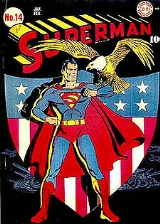
The Golden Age of Comic Books was a period in the history of American comic book
American comic book

An American comic book is a small magazine originating in the United States and containing a narrative in the form of comics. The standard dimensions are 17 x 26 cm , although they were larger in the past....
s, generally thought as lasting from the late 1930s until the late 1940s. During this time, modern comic books were first published and enjoyed a surge of popularity; the archetype of the superhero
Superhero

A superhero is a Character "of unprecedented physical prowess dedicated to act of derring-do in the public interest". Since the debut of the prototype superhero Superman in 1938, stories of superheroes?ranging from brief episodic adventures to continuing years-long sagas?have dominated American comic books and crossed over into other mass...
 was created and defined; and many of the most famous superheroes debuted, among them Batman
Batman

Batman is a Character , a comic book superhero co-created by artist Bob Kane and writer Bill Finger , appearing in publications by DC Comics. The character first appeared in Detective Comics #27 in May 1939....
, Captain America
Captain America

Captain America is a Character that appears in comic books published by Marvel Comics. The character First appearance in Captain America Comics #1 , from Marvel Comics' 1940s predecessor, Timely Comics, and was created by Joe Simon and Jack Kirby....
, Superman
Superman

Superman is a Character , a comic book superhero widely considered to be an American cultural icon. Created by American writer Jerry Siegel and Canadian-born artist Joe Shuster in 1932 while both were living in Cleveland, Ohio, Ohio, and sold to DC Comics in 1938, the character first appeared in Action Comics Action Comics 1 and subseque...
, and Wonder Woman
Wonder Woman

Wonder Woman is a Character , a DC Comics Superhero#Superheroines created by William Moulton Marston. First appearing in All Star Comics #8 , she is one of three characters to have been continuously published by DC Comics since the company's 1944 inception ....
.

The period saw the arrival of the comic book as a mainstream art form, and the defining of the medium's artistic vocabulary and creative conventions by its first generation of writers, artists, and editors.

c book fans and historians widely agree that the Golden Age began no later than 1938
1938 in comics

Events and publications...
 with the debut of Superman
Superman

Superman is a Character , a comic book superhero widely considered to be an American cultural icon. Created by American writer Jerry Siegel and Canadian-born artist Joe Shuster in 1932 while both were living in Cleveland, Ohio, Ohio, and sold to DC Comics in 1938, the character first appeared in Action Comics Action Comics 1 and subseque...
 in Action Comics
Action Comics

Action Comics is an USA comic book series which first appearance Superman, the first major superhero character as the term is popularly defined....
 #1, published by DC Comics
DC Comics

DC Comics is one of the largest and most popular American comic book and related media companies, along with Marvel Comics. A subsidiary of Warner Bros....
.


Discussion
Ask a question about 'Golden Age of Comic Books'
Start a new discussion about 'Golden Age of Comic Books'
Answer questions from other users
Full Discussion Forum


Encyclopedia


The Golden Age of Comic Books was a period in the history of American comic book
American comic book

An American comic book is a small magazine originating in the United States and containing a narrative in the form of comics. The standard dimensions are 17 x 26 cm , although they were larger in the past....
s, generally thought as lasting from the late 1930s until the late 1940s. During this time, modern comic books were first published and enjoyed a surge of popularity; the archetype of the superhero
Superhero

A superhero is a Character "of unprecedented physical prowess dedicated to act of derring-do in the public interest". Since the debut of the prototype superhero Superman in 1938, stories of superheroes?ranging from brief episodic adventures to continuing years-long sagas?have dominated American comic books and crossed over into other mass...
 was created and defined; and many of the most famous superheroes debuted, among them Batman
Batman

Batman is a Character , a comic book superhero co-created by artist Bob Kane and writer Bill Finger , appearing in publications by DC Comics. The character first appeared in Detective Comics #27 in May 1939....
, Captain America
Captain America

Captain America is a Character that appears in comic books published by Marvel Comics. The character First appearance in Captain America Comics #1 , from Marvel Comics' 1940s predecessor, Timely Comics, and was created by Joe Simon and Jack Kirby....
, Superman
Superman

Superman is a Character , a comic book superhero widely considered to be an American cultural icon. Created by American writer Jerry Siegel and Canadian-born artist Joe Shuster in 1932 while both were living in Cleveland, Ohio, Ohio, and sold to DC Comics in 1938, the character first appeared in Action Comics Action Comics 1 and subseque...
, and Wonder Woman
Wonder Woman

Wonder Woman is a Character , a DC Comics Superhero#Superheroines created by William Moulton Marston. First appearing in All Star Comics #8 , she is one of three characters to have been continuously published by DC Comics since the company's 1944 inception ....
.

The period saw the arrival of the comic book as a mainstream art form, and the defining of the medium's artistic vocabulary and creative conventions by its first generation of writers, artists, and editors.

History

Comic book fans and historians widely agree that the Golden Age began no later than 1938
1938 in comics

Events and publications...
 with the debut of Superman
Superman

Superman is a Character , a comic book superhero widely considered to be an American cultural icon. Created by American writer Jerry Siegel and Canadian-born artist Joe Shuster in 1932 while both were living in Cleveland, Ohio, Ohio, and sold to DC Comics in 1938, the character first appeared in Action Comics Action Comics 1 and subseque...
 in Action Comics
Action Comics

Action Comics is an USA comic book series which first appearance Superman, the first major superhero character as the term is popularly defined....
 #1, published by DC Comics
DC Comics

DC Comics is one of the largest and most popular American comic book and related media companies, along with Marvel Comics. A subsidiary of Warner Bros....
. Some date the start to earlier events in the 1930s: The Overstreet Comic Book Price Guide
Overstreet Comic Book Price Guide

The Overstreet Comic Book Price Guide is widely considered the primary authority on the subject of United States comic book grading and collection values in the industry....
's regular publication The Golden Age Quarterly lists comic books from 1933 onwards (1933 saw the publication of the first comic book in the size that would subsequently define the format); some historians, including Roger Sabin
Roger Sabin

Roger Sabin is a comics writer and lecturer at Central St. Martins in London, England. He is best known for his book titled Comics, Comix & Graphic Novels: A History of Comic Art....
 (in Comics, Comix and Graphic Novels: a History of Comic Art), date it to the publication of the first comic books featuring entirely original stories rather than re-prints of comic strip
Comic strip

A comic strip is a sequence of drawings that tells a story.Currently in the Western world, most comic strips are written and drawn by a comics artist or cartoonist, and many such strips are published on a recurring basis in newspapers and on the Internet....
s from newspapers (1935), by the company that would become DC Comics. However, Superman, the first comic book superhero, was so popular that superheroes soon dominated the pages of comic books, which characterized the Golden Age. Between early 1939 and late 1941, DC and sister company All-American Comics
All-American Comics

All-American Comics was the flagship title of comic book publisher All-American Publications. It ran for 102 issues from April 1939 to October 1948, at which time it was renamed All-American Western....
 introduced such popular superheroes as Batman
Batman

Batman is a Character , a comic book superhero co-created by artist Bob Kane and writer Bill Finger , appearing in publications by DC Comics. The character first appeared in Detective Comics #27 in May 1939....
 and Robin
Robin (comics)

Robin is the name of several fictional characters appearing in comic books published by DC Comics, originally created by Bob Kane, Bill Finger and Jerry Robinson, as a junior counterpart to DC Comics superhero Batman....
, Wonder Woman
Wonder Woman

Wonder Woman is a Character , a DC Comics Superhero#Superheroines created by William Moulton Marston. First appearing in All Star Comics #8 , she is one of three characters to have been continuously published by DC Comics since the company's 1944 inception ....
, The Flash
Flash (comics)

The Flash is a name shared by several fictional comic book superheroes from the DC Comics DC Comics Universe. Created by writer Gardner Fox and artist Harry Lampert, the original Flash first appeared in Flash Comics #1 ....
, Green Lantern
Green Lantern

Green Lantern is the name of several Character s, superheroes appearing in comic books published by DC Comics. The first was created by writer Bill Finger and artist Martin Nodell in All-American Comics #16 ....
, the Atom
Atom (comics)

The Atom is a name shared by several Fictional character comic book superheroes from the DC Comics DC Universe.There have been four characters who have shared the Atom codename....
, Hawkman
Hawkman

Hawkman is a fictional superhero that appears comic books published by DC Comics. Created by writer Gardner Fox and artist Dennis Neville, the original Hawkman first appeared in Flash Comics #1, published by All-American Publications in 1940....
, and Aquaman
Aquaman

Aquaman is a fictional comic book superhero who appears in DC Comics. Created by Paul Norris and Mort Weisinger, the character debuted in More Fun Comics #73 ....
, while Timely Comics
Timely Comics

Timely Comics is the 1940s comic book publishing company that would evolve into first Atlas Comics , and then Marvel Comics. During this era, called the Golden Age of comic books, "Timely" was the umbrella name for the comics division of pulp magazine publisher Martin Goodman , whose business strategy involved having a multitude...
, the 1940s predecessor of Marvel Comics
Marvel Comics

Marvel Comics is an American comic book and related media company owned by Marvel Publishing, Inc., a subsidiary of Marvel Entertainment, Inc. Marvel counts among as its List of Marvel Comics characters such well-known properties as Captain America, the Fantastic Four, the Hulk , Iron Man, Spider-Man, the X-Men, and many others....
, had million-selling titles that featured the Human Torch, the Sub-Mariner, and Captain America
Captain America

Captain America is a Character that appears in comic books published by Marvel Comics. The character First appearance in Captain America Comics #1 , from Marvel Comics' 1940s predecessor, Timely Comics, and was created by Joe Simon and Jack Kirby....
.

Whiz2
Although DC and Timely characters are more famous today, circulation figures suggest that the best-selling superhero title of the era may have been Fawcett Comics
Fawcett Comics

Fawcett Comics, a subsidiary of Fawcett Publications, was one of several successful comics publishers during the Golden Age of Comic Books in the 1940s....
' Captain Marvel
Captain Marvel (DC Comics)

Captain Marvel is a Fictional character comic book superhero, originally published by Fawcett Comics and later by DC Comics. Created in 1939 by artist C....
, whose approximately 1.4 million copies per issue made it "the most widely circulated comic book in America
United States

The United States of America is a Federal government constitutional republic comprising U.S. state and a federal district. The country is situated mostly in central North America, where its Contiguous United States and Washington, D.C., the Capital districts and territories, lie between the Pacific Ocean and Atlantic Oceans, Borders of the U...
. Captain Marvel's sales soundly trounced Superman
Superman

Superman is a Character , a comic book superhero widely considered to be an American cultural icon. Created by American writer Jerry Siegel and Canadian-born artist Joe Shuster in 1932 while both were living in Cleveland, Ohio, Ohio, and sold to DC Comics in 1938, the character first appeared in Action Comics Action Comics 1 and subseque...
's self-titled series and Action Comics
Action Comics

Action Comics is an USA comic book series which first appearance Superman, the first major superhero character as the term is popularly defined....
 alike".

Other popular and long-running characters included Quality Comics
Quality Comics

Quality Comics was an American comic book publishing company that operated from 1939 to 1956 and was an influential creative force in what historians and fans call the Golden Age of comic books....
' Plastic Man
Plastic Man

Plastic Man is a fictional character comic-book superhero originally published by Quality Comics and later acquired by DC Comics. Created by writer-artist Jack Cole , he first appeared in Police Comics #1 ....
, and cartoonist Will Eisner
Will Eisner

William Erwin Eisner was an acclaimed Jewish-American comics writer, artist and entrepreneur. He is considered one of the most important contributors to the development of the medium and is known for the cartooning studio he founded; for his highly influential series The Spirit; for his use of comics as an instructional medium; for his l...
's non-superpowered masked detective the Spirit, originally published in a Sunday-newspaper insert.

World War II
World War II

World War II, or the Second World War , was a global military conflict which involved a Participants in World War II, including all of the great powers, organised into two opposing military alliances: the Allies of World War II and the Axis powers....
 had a significant impact. Comic books, particularly superhero comics, gained immense popularity during the war as cheap, portable, easily read tales of good triumphing over evil. American comic book companies showcased their heroes battling the Axis Powers
Axis Powers

The Axis powers were those countries that were opposed to the Allies of World War II during World War II. The three major Axis powers - Nazi Germany, Kingdom of Italy , and Empire of Japan - were part of a military alliance on the signing of the Tripartite Pact in September 1940, which officially founded the Axis powers....
: covers featuring superheroes punching Nazi leader Adolf Hitler
Adolf Hitler

Adolf Hitler was an Austrian-born Germany politician and the leader of the National Socialist German Workers Party , popularly known as the Nazi Party....
 or fighting caricatures of buck-toothed Japan
Japan

Japan is an island country in East Asia. Located in the Pacific Ocean, it lies to the east of the Sea of Japan, People's Republic of China, North Korea, South Korea and Russia, stretching from the Sea of Okhotsk in the north to the East China Sea and Taiwan in the south....
ese soldiers have become relics of the age.

Although the creation of the superhero was the Golden Age's most significant contribution to pop culture, many other genres of comic book appeared on the newsstands side-by-side with Superman and Captain America. The Golden Age included many funny animal
Funny animal

Funny animal is a cartooning term for the genre of comics and animated cartoons in which the main characters are humanoid or talking animal animals, with anthropomorphism personality traits....
, western
Western fiction

File:Wild West 1908.jpgWestern fiction is a genre of literature set in the American Old West frontier and typically between the years of 1860 and 1900 ....
, romance
Romance comics

Romance comics in the United States was a genre of American comic books that featured realistic scripts and art about love, domestic strife, and heartache....
, and jungle
Jungle

Jungle usually refers to a dense forest in a hot climate, such as a tropical rainforest. The word Jungle originates from the Sanskrit word Jangala which means a desert or uncultivated land....
 comics. The Steranko History of Comics 2 notes that it was the non-superhero characters of Dell Comics
Dell Comics

Dell Comics was the comic book publishing arm of Dell Publishing, which got its start in pulp magazines. It published comics from 1929 to 1973....
 — most notably the licensed Walt Disney
Walt Disney

Walter Elias Disney was a multiple Academy Award-winning American film producer, film director, screenwriter, voice actor, animator, entrepreneur and philanthropist....
 animated character
Animation

Animation is the rapid display of a sequence of images of 2-D or 3-D artwork or model positions in order to create an illusion of movement. It is an optical illusion of Motion due to the phenomenon of persistence of vision, and can be created and demonstrated in a number of ways....
 comics — that outsold all the supermen of the day. Dell comics, featuring such licensed movie and literary properties Mickey Mouse
Mickey Mouse

Mickey Mouse is a funny animal cartoon character who has become an icon for The Walt Disney Company. Mickey Mouse was created in 1928 by Walt Disney and Ub Iwerks and voiced by Walt Disney....
, Donald Duck
Donald Duck

Donald Duck is a cartoon fictional character from The Walt Disney Company. Donald is a white anthropomorphism duck with a yellow-orange bill, legs, and feet....
, Roy Rogers
Roy Rogers

Roy Rogers , was a singer and cowboy actor, as well as the founder of the famous Roy Rogers Restaurants chain. He and his third wife Dale Evans, his golden palomino Trigger , and his German Shepherd Dog, Bullet, were featured in over one hundred movies and The Roy Rogers Show....
, and Tarzan
Tarzán

Tarz?n was a half-hour syndicated series that aired 1991 in television?1994 in television. In this version of the show, Tarzan was portrayed as a blond environmentalist, with Jane turned into a French ecologist....
, boasted circulations of over a million copies a month, and Donald Duck writer/artist Carl Barks
Carl Barks

Carl Barks was a famous The Walt Disney Company illustrator and comic book creator, who invented Duckburg and many of its inhabitants, such as Scrooge McDuck , Gladstone Gander , the Beagle Boys , Gyro Gearloose , Flintheart Glomgold , John D....
 is considered one of the era's major talents. Another notable and enduring non-superhero property created during the Golden Age was the Archie Comics
Archie Comics

Archie Comics is an United States of America comic book publisher, known for its many series featuring the fictional teenager Archie Andrews , Betty Cooper, Veronica Lodge, Reggie Mantle and Jughead Jones characters by publisher/editor John L....
 cast of teen-humor characters.

Post War and the Atomic Era


As with WWII, the ushering in of the Atomic Era in 1945 colored the content and subject matter of comic books in the mid to late 1940s. The best example being 1949s education book Dagwood Splits the Atom. A statement forwarded the book from former Manhattan Project military leader Leslie Groves that introduced the dangers of atomic power. He warned that “we must choose the path of the benevolent future, we must have light in order to see the way, we must have the light of knowledge.” He goes on to say that “this book will reassure the fearful that the future can be made bright.” The book then likens the discovery of atomic energy to that of fire, listing its practical uses as a tool more so than a weapon. A tool whose untold destructive power can also move ships, cure cancer and produce electricity. This would however only be possible if the younger generation can benevolently harnesses this power. The book ends with a reminder that “Atomic energy cannot be put back into the realm of the unknown. It is here and we must vigilantly watch its development and help influence its use for the rest of mankind.”

The prevailing message of comic books in the early nuclear age was that of inspiration for the younger generation. However, this concept of educational comics failed to catch on, as more parents bought Dagwood Splits the Atom than the youths who remained interested in the adventures of their favourite super-heroes. Benevolent atomic super heroes did exist in this period, and normally received their power from exposure to radiation, or an atomic blast. Heroes such at the Atomic Thunderbolt in his first and only issue vowed to use his power for the good of mankind, while Atoman taught readers that “atomic power ... belongs to the whole world.” The more popular Superman fought against a villain named Atom-Man in the televised series, while his weakness to kryptonite reminded audiences and readers of the dangers of radiation. Even the above mentioned Captain Marvel journeyed through some atomic themed story lines. Contrasting these serious characters were more light-hearted series’ about atomic animals like Atomic Mouse and, later, Atomic Rabbit. These cute creations helped readers ease fears over the prospect of nuclear war and neutralise anxieties over the big questions posed by atomic power.

Dagwood and his panelled companions introduced Americans to the notion of the ‘peaceful atom,’ which had been popularised in the late 1940s. This notion had been growing in popularity since the decline in public interest in an atomic threat. This was however no accident, but in fact a product of conscious media manipulation geared towards soothing public opinion about an arms industry that was here to stay. It is thus no surprise that the Atomic Energy Council had consulted the creators of Dagwood Splits the Atom. Their participation ensured that it would be as therapeutic as it was educational. This therapy was necessary to improve the atoms public image, as, on the other side of the atomic coin, was the growth of the arms industry and the strategic reliance on atomic supremacy at the dawn of the cold war.

End of the era

Strangetales114 Detail
Fans differ in marking the end of the Golden Age. Some events considered demarcation points include:
  • The rise of gritty crime and horror comics, such as those of EC Comics
    EC Comics

    Entertaining Comics, more commonly known as EC Comics, was an United States publisher of comic books specializing in crime fiction, horror fiction, satire, war novel and science fiction from the 1940s through the 1950s, until censorship pressures prompted it to concentrate on the seminal humor magazine Mad , which became a major p...
    , in the late 1940s and early 1950s.
  • 1950. For Timely Comics, the Golden Age ended with the cancellation of Captain America Comics at issue #75 (Feb. 1950) — by which time the series had already been Captain America's Weird Tales for two issues, with no superhero stories. The company's flagship title, Marvel Mystery Comics
    Marvel Mystery Comics

    Marvel Mystery Comics is an USA comic book series published during the 1930s-1940s period known to fans and historians as the Golden Age of Comic Books....
    , starring the Human Torch, had already ended its run (with #92, June 1949), as had Sub-Mariner Comics (with #32, the same month).
  • 1951. Stories featuring the all-star superhero team the Justice Society of America
    Justice Society of America

    The Justice Society of America, or JSA, is a DC Comics superhero group, the first team of superheroes in comic book history. Conceived by editor Sheldon Mayer and writer Gardner Fox, the JSA first appeared in All Star Comics #3 ....
     in All Star Comics
    All Star Comics

    All Star Comics is a 1940s comic book series from All-American Publications, one of the early companies that merged with National Periodical Publications to form the modern-day DC Comics....
     ended. (The series changed its name with #58 to All-Star Western
    All-Star Western

    All-Star Western was the name of two United States comic book series published by DC Comics, each a Western fiction omnibus featuring both continuing characters and anthological stories....
    .) This event climaxed a long decline in the popularity of superheroes. At Timely Comics, Goodman began using the Atlas Comics logo on comics cover-dated Nov. 1951.
  • The subsequent Silver Age of Comic Books
    Silver Age of Comic Books

    The Silver Age of Comic Books was a period of artistic advancement and commercial success in mainstream American comic books, predominantly those which featured the superhero archetype....
     is generally recognized as beginning with the debut of a the first successful new superhero since the Golden Age, DC Comics
    DC Comics

    DC Comics is one of the largest and most popular American comic book and related media companies, along with Marvel Comics. A subsidiary of Warner Bros....
    ' new Flash, in Showcase
    Showcase (comics)

    Showcase has been the title of several anthology series published by DC Comics. The general theme of these series has been to feature new and minor characters as a way to gauge reader interest in them, without the difficulty and risk of featuring "untested" characters in their own ongoing titles....
     #4 (Oct. 1956). The interim period, from the mid-1940s to the mid-1950s, is sometimes described as the Atomic Age
    Atomic Age

    The Atomic Age, also known as the Atomic Era, is a phrase typically used to delineate the period of history following the detonation of the first nuclear bomb....
     of Comics Books.


See also

  • Bronze Age of Comic Books
    Bronze Age of Comic Books

    The Bronze Age of Comic Books is an informal name for a period in the history of mainstream American comic books usually said to run from the early 1970s to the mid-1980s....
  • Modern Age of Comic Books
    Modern Age of Comic Books

    The Modern Age of Comic Books is an informal name for the period in the history of mainstream American comic books generally considered to last from the mid-1980s until present day....


External links