

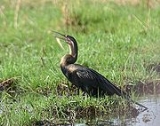
African Darter

Encyclopedia
The African Darter sometimes called the Snakebird, is a water bird of sub-Sahara
n Africa
.
(Anhinga anhinga), Oriental
(Anhinga melanogaster), and Australian
(Anhinga novaehollandiae) Darters.
It is an 80 cm long cormorant-like fish-eating species with a very long neck, like other anhingas.
There is an isolated tiny population of the African Darter at the Lower Mesopotamian wetlands in Iraq. The bird used to breed there in breeding colonies with Pygmy Cormorant and Sacred Ibis and other waterfowl.
s, egret
s and cormorant
s.
It often swims with only the neck above water, hence the common name snakebird. This too is a habit shared with the other anhingas.
Unlike many other waterbirds the feathers of the African Darter do not contain any oil and are therefore not waterproof. Because of this, the bird is less positively buoyant and its diving capabilities are enhanced. After diving for fish, the feathers can become waterlogged. In order to be able to fly and maintain heat insulation it needs to dry its feathers. Thus the African Darter is often seen sitting along the waterside spreading its wings and drying its feathers in the wind and the sun along with cormorants which may share its habitat.
Sahara
The Sahara is the world's second largest desert, after Antarctica. At over , it covers most of Northern Africa, making it almost as large as Europe or the United States. The Sahara stretches from the Red Sea, including parts of the Mediterranean coasts, to the outskirts of the Atlantic Ocean...
n Africa
Africa
Africa is the world's second largest and second most populous continent, after Asia. At about 30.2 million km² including adjacent islands, it covers 6% of the Earth's total surface area and 20.4% of the total land area...
.
Taxonomy
The African Darter is a member of the darter family, Anhingidae, and is closely related to AmericanAnhinga
The Anhinga , sometimes called Snakebird, Darter, American Darter, or Water Turkey, is a water bird of the warmer parts of the Americas. The word "anhinga" comes from the Brazilian Tupi language and means devil bird or snake bird.It is a cormorant-like bird with an average body length of , a...
(Anhinga anhinga), Oriental
Oriental Darter
The Oriental Darter or Indian Darter , sometimes called Snakebird, is a water bird of tropical South Asia and Southeast Asia.-Taxonomy:...
(Anhinga melanogaster), and Australian
Australian Darter
The Australasian Darter or Australian Darter is a species of bird in the darter family, Anhingidae. It is found in Australia, Indonesia, New Zealand, and Papua New Guinea...
(Anhinga novaehollandiae) Darters.
Description
The male is mainly glossy black with white streaking, but females and immature birds are browner. The African Darter differs in appearance from the American Darter most recognisably by its thin white lateral neck stripe against a rufous background colour. The pointed bill should prevent confusion with cormorants.It is an 80 cm long cormorant-like fish-eating species with a very long neck, like other anhingas.
Distribution
The African Darter is found throughout sub-Saharan Africa wherever large bodies of water occur.There is an isolated tiny population of the African Darter at the Lower Mesopotamian wetlands in Iraq. The bird used to breed there in breeding colonies with Pygmy Cormorant and Sacred Ibis and other waterfowl.
Behaviour
This species builds a stick nest in a tree and lays 3-6 eggs. It often nests with heronHeron
The herons are long-legged freshwater and coastal birds in the family Ardeidae. There are 64 recognised species in this family. Some are called "egrets" or "bitterns" instead of "heron"....
s, egret
Egret
An egret is any of several herons, most of which are white or buff, and several of which develop fine plumes during the breeding season. Many egrets are members of the genera Egretta or Ardea which contain other species named as herons rather than egrets...
s and cormorant
Cormorant
The bird family Phalacrocoracidae is represented by some 40 species of cormorants and shags. Several different classifications of the family have been proposed recently, and the number of genera is disputed.- Names :...
s.
It often swims with only the neck above water, hence the common name snakebird. This too is a habit shared with the other anhingas.
Unlike many other waterbirds the feathers of the African Darter do not contain any oil and are therefore not waterproof. Because of this, the bird is less positively buoyant and its diving capabilities are enhanced. After diving for fish, the feathers can become waterlogged. In order to be able to fly and maintain heat insulation it needs to dry its feathers. Thus the African Darter is often seen sitting along the waterside spreading its wings and drying its feathers in the wind and the sun along with cormorants which may share its habitat.