

Anhinga

Encyclopedia
The Anhinga sometimes called Snakebird, Darter, American Darter, or Water Turkey, is a water bird of the warmer parts of the Americas
. The word "anhinga" comes from the Brazil
ian Tupi language and means devil
bird
or snake
bird.
It is a cormorant
-like bird with an average body length of 85 cm (33.5 in), a wingspan of 117 cm (46.1 in), and a mass of 1.35 kg (47.6 oz). It is a dark-plumaged piscivore
with a very long neck, and often swims with only the neck above water. When swimming in this style the name Snakebird is apparent, since only the colored neck appears above water the bird looks like a snake ready to strike.
The Anhinga is placed in the darter family, Anhingidae, and is closely related to Indian
(Anhinga melanogaster), African
(A. rufa), and Australian
(A. novaehollandiae) Darter
s.
Unlike duck
s, the Anhinga is not able to waterproof its feather
s using oil produced by the uropygial gland
. Consequently, feathers can become waterlogged, making the bird barely buoyant
. However, this allows it to dive easily and search for underwater prey, such as fish
and amphibian
s. It can stay down for significant periods.
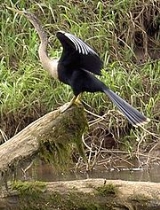
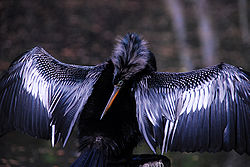
When necessary, the Anhinga will dry out its wings and feathers, with the resemblance of the semicircular full-spread shape of its group of tail feathers while drying them out, to that of true meleagrine
males lending the name "water turkey" to it. It will perch for long periods with its wings spread to allow the drying process, as do cormorants. If it attempts to fly while its wings are wet, it has great difficulty getting off the water and takes off by flapping vigorously while 'running' on the water. Anhinga will often search for food in small groups.
 Anhinga
species are found all over the world in warm shallow waters. The American Anhinga has been subdivided into two subspecies, A. a. anhinga and A. a. leucogaster, based on their location. A. a. anhinga can be found mainly east of the Andes
in South America
and also the islands of Trinidad and Tobago
. A. a. leucogaster can be found in the southern United States
, Mexico
, Cuba
, and Grenada
.
Only birds that live in the extreme north and south of their range migrate and do so based on temperature
and available sunlight
. Anhingas will migrate towards the equator
during winter but this range is "determined by the amount of sunshine to warm the chilled birds". Although not in their usual range, anhingas have been found as far north as the states of Pennsylvania
and Wisconsin
in the United States
.
Kettles of anhingas often migrate with other birds and have been described as resembling black paper gliders.
Most of the male Anhinga's body is a glossy black green with the wings, base of wings, and tail being a glossy black blue. The tip of the tail has white feathers. The back of the head and the neck have elongated feathers that have been described as gray or light purple white. The upper back of the body and wings is spotted or streaked with white.
The female Anhinga is similar to the male Anhinga except that it has a pale gray-buff or light brown head, neck, and upper chest. The lower chest or breast is a chestnut color and as compared to the male, the female has a more brown back.
The hatchling starts out bald but gains tan down within a few days of hatching. Within two weeks the tan down has been replaced by white down. Three weeks after hatching, the first juvenile feathers appear. Juveniles are mostly brown until first breeding after the second or third winter.
This bird is often mistaken for the Double-crested Cormorant
due to its similar size and behavior. However, the two species can be differentiated by their tails and bills. The tail of the anhinga is wider and much longer than that of the cormorant. The bill of the anhinga is pointed, while the bill of the cormorant has a hook-tip.
. The number of individual anhingas has not been estimated but they are considered to be of least concern
because of the frequency of their occurrence in their 15000000 km² (5,791,532.4 sq mi) global range.
Americas
The Americas, or America , are lands in the Western hemisphere, also known as the New World. In English, the plural form the Americas is often used to refer to the landmasses of North America and South America with their associated islands and regions, while the singular form America is primarily...
. The word "anhinga" comes from the Brazil
Brazil
Brazil , officially the Federative Republic of Brazil , is the largest country in South America. It is the world's fifth largest country, both by geographical area and by population with over 192 million people...
ian Tupi language and means devil
Devil
The Devil is believed in many religions and cultures to be a powerful, supernatural entity that is the personification of evil and the enemy of God and humankind. The nature of the role varies greatly...
bird
Bird
Birds are feathered, winged, bipedal, endothermic , egg-laying, vertebrate animals. Around 10,000 living species and 188 families makes them the most speciose class of tetrapod vertebrates. They inhabit ecosystems across the globe, from the Arctic to the Antarctic. Extant birds range in size from...
or snake
Snake
Snakes are elongate, legless, carnivorous reptiles of the suborder Serpentes that can be distinguished from legless lizards by their lack of eyelids and external ears. Like all squamates, snakes are ectothermic, amniote vertebrates covered in overlapping scales...
bird.
It is a cormorant
Cormorant
The bird family Phalacrocoracidae is represented by some 40 species of cormorants and shags. Several different classifications of the family have been proposed recently, and the number of genera is disputed.- Names :...
-like bird with an average body length of 85 cm (33.5 in), a wingspan of 117 cm (46.1 in), and a mass of 1.35 kg (47.6 oz). It is a dark-plumaged piscivore
Piscivore
A piscivore is a carnivorous animal which eats primarily fish. Piscivory was the diet of early tetrapods , insectivory came next, then in time reptiles added herbivory....
with a very long neck, and often swims with only the neck above water. When swimming in this style the name Snakebird is apparent, since only the colored neck appears above water the bird looks like a snake ready to strike.
The Anhinga is placed in the darter family, Anhingidae, and is closely related to Indian
Oriental Darter
The Oriental Darter or Indian Darter , sometimes called Snakebird, is a water bird of tropical South Asia and Southeast Asia.-Taxonomy:...
(Anhinga melanogaster), African
African Darter
The African Darter , sometimes called the Snakebird, is a water bird of sub-Saharan Africa.-Taxonomy:The African Darter is a member of the darter family, Anhingidae, and is closely related to American , Oriental , and Australian Darters.-Description:The male is mainly glossy...
(A. rufa), and Australian
Australian Darter
The Australasian Darter or Australian Darter is a species of bird in the darter family, Anhingidae. It is found in Australia, Indonesia, New Zealand, and Papua New Guinea...
(A. novaehollandiae) Darter
Darter
The darters or snakebirds are mainly tropical waterbirds in the family Anhingidae. There are four living species, three of which are very common and widespread while the fourth is rarer and classified as near-threatened by the IUCN. The term "snakebird" is usually used without any additions to...
s.
Unlike duck
Duck
Duck is the common name for a large number of species in the Anatidae family of birds, which also includes swans and geese. The ducks are divided among several subfamilies in the Anatidae family; they do not represent a monophyletic group but a form taxon, since swans and geese are not considered...
s, the Anhinga is not able to waterproof its feather
Feather
Feathers are one of the epidermal growths that form the distinctive outer covering, or plumage, on birds and some non-avian theropod dinosaurs. They are considered the most complex integumentary structures found in vertebrates, and indeed a premier example of a complex evolutionary novelty. They...
s using oil produced by the uropygial gland
Uropygial gland
The uropygial gland, informally known as the preen gland, is a gland found in the large majority of birds that secretes an oil that birds use for preening. The chief compounds of preen oil are diester waxes called uropygiols....
. Consequently, feathers can become waterlogged, making the bird barely buoyant
Buoyancy
In physics, buoyancy is a force exerted by a fluid that opposes an object's weight. In a column of fluid, pressure increases with depth as a result of the weight of the overlying fluid. Thus a column of fluid, or an object submerged in the fluid, experiences greater pressure at the bottom of the...
. However, this allows it to dive easily and search for underwater prey, such as fish
Fish
Fish are a paraphyletic group of organisms that consist of all gill-bearing aquatic vertebrate animals that lack limbs with digits. Included in this definition are the living hagfish, lampreys, and cartilaginous and bony fish, as well as various extinct related groups...
and amphibian
Amphibian
Amphibians , are a class of vertebrate animals including animals such as toads, frogs, caecilians, and salamanders. They are characterized as non-amniote ectothermic tetrapods...
s. It can stay down for significant periods.
When necessary, the Anhinga will dry out its wings and feathers, with the resemblance of the semicircular full-spread shape of its group of tail feathers while drying them out, to that of true meleagrine
Turkey (bird)
A turkey is a large bird in the genus Meleagris. One species, Meleagris gallopavo, commonly known as the Wild Turkey, is native to the forests of North America. The domestic turkey is a descendant of this species...
males lending the name "water turkey" to it. It will perch for long periods with its wings spread to allow the drying process, as do cormorants. If it attempts to fly while its wings are wet, it has great difficulty getting off the water and takes off by flapping vigorously while 'running' on the water. Anhinga will often search for food in small groups.
Distribution and migration
Darter
The darters or snakebirds are mainly tropical waterbirds in the family Anhingidae. There are four living species, three of which are very common and widespread while the fourth is rarer and classified as near-threatened by the IUCN. The term "snakebird" is usually used without any additions to...
species are found all over the world in warm shallow waters. The American Anhinga has been subdivided into two subspecies, A. a. anhinga and A. a. leucogaster, based on their location. A. a. anhinga can be found mainly east of the Andes
Andes
The Andes is the world's longest continental mountain range. It is a continual range of highlands along the western coast of South America. This range is about long, about to wide , and of an average height of about .Along its length, the Andes is split into several ranges, which are separated...
in South America
South America
South America is a continent situated in the Western Hemisphere, mostly in the Southern Hemisphere, with a relatively small portion in the Northern Hemisphere. The continent is also considered a subcontinent of the Americas. It is bordered on the west by the Pacific Ocean and on the north and east...
and also the islands of Trinidad and Tobago
Trinidad and Tobago
Trinidad and Tobago officially the Republic of Trinidad and Tobago is an archipelagic state in the southern Caribbean, lying just off the coast of northeastern Venezuela and south of Grenada in the Lesser Antilles...
. A. a. leucogaster can be found in the southern United States
United States
The United States of America is a federal constitutional republic comprising fifty states and a federal district...
, Mexico
Mexico
The United Mexican States , commonly known as Mexico , is a federal constitutional republic in North America. It is bordered on the north by the United States; on the south and west by the Pacific Ocean; on the southeast by Guatemala, Belize, and the Caribbean Sea; and on the east by the Gulf of...
, Cuba
Cuba
The Republic of Cuba is an island nation in the Caribbean. The nation of Cuba consists of the main island of Cuba, the Isla de la Juventud, and several archipelagos. Havana is the largest city in Cuba and the country's capital. Santiago de Cuba is the second largest city...
, and Grenada
Grenada
Grenada is an island country and Commonwealth Realm consisting of the island of Grenada and six smaller islands at the southern end of the Grenadines in the southeastern Caribbean Sea...
.
Only birds that live in the extreme north and south of their range migrate and do so based on temperature
Temperature
Temperature is a physical property of matter that quantitatively expresses the common notions of hot and cold. Objects of low temperature are cold, while various degrees of higher temperatures are referred to as warm or hot...
and available sunlight
Sunlight
Sunlight, in the broad sense, is the total frequency spectrum of electromagnetic radiation given off by the Sun. On Earth, sunlight is filtered through the Earth's atmosphere, and solar radiation is obvious as daylight when the Sun is above the horizon.When the direct solar radiation is not blocked...
. Anhingas will migrate towards the equator
Equator
An equator is the intersection of a sphere's surface with the plane perpendicular to the sphere's axis of rotation and containing the sphere's center of mass....
during winter but this range is "determined by the amount of sunshine to warm the chilled birds". Although not in their usual range, anhingas have been found as far north as the states of Pennsylvania
Pennsylvania
The Commonwealth of Pennsylvania is a U.S. state that is located in the Northeastern and Mid-Atlantic regions of the United States. The state borders Delaware and Maryland to the south, West Virginia to the southwest, Ohio to the west, New York and Ontario, Canada, to the north, and New Jersey to...
and Wisconsin
Wisconsin
Wisconsin is a U.S. state located in the north-central United States and is part of the Midwest. It is bordered by Minnesota to the west, Iowa to the southwest, Illinois to the south, Lake Michigan to the east, Michigan to the northeast, and Lake Superior to the north. Wisconsin's capital is...
in the United States
United States
The United States of America is a federal constitutional republic comprising fifty states and a federal district...
.
Kettles of anhingas often migrate with other birds and have been described as resembling black paper gliders.
Physical description and taxonomy
The A. anhinga species is a large bird and measures approximately 89 cm (35 in) in length with a 1.14 m (3.7 ft) wingspan. The A. a. anhinga is larger than A. a. leucogaster and has "broader buffy tail lips". They weigh 1.22 kilogram. The bill is long (about twice the length of the head), sharply pointed and yellow as are the webbed feet.Most of the male Anhinga's body is a glossy black green with the wings, base of wings, and tail being a glossy black blue. The tip of the tail has white feathers. The back of the head and the neck have elongated feathers that have been described as gray or light purple white. The upper back of the body and wings is spotted or streaked with white.
The female Anhinga is similar to the male Anhinga except that it has a pale gray-buff or light brown head, neck, and upper chest. The lower chest or breast is a chestnut color and as compared to the male, the female has a more brown back.
The hatchling starts out bald but gains tan down within a few days of hatching. Within two weeks the tan down has been replaced by white down. Three weeks after hatching, the first juvenile feathers appear. Juveniles are mostly brown until first breeding after the second or third winter.
This bird is often mistaken for the Double-crested Cormorant
Double-crested Cormorant
The Double-crested Cormorant is a member of the cormorant family of seabirds. It occurs along inland waterways as well as in coastal areas, and is widely distributed across North America, from the Aleutian Islands in Alaska down to Florida and Mexico...
due to its similar size and behavior. However, the two species can be differentiated by their tails and bills. The tail of the anhinga is wider and much longer than that of the cormorant. The bill of the anhinga is pointed, while the bill of the cormorant has a hook-tip.
Conservation status
The Anhinga is protected in the US under the Migratory Bird Treaty Act of 1918Migratory Bird Treaty Act of 1918
The Migratory Bird Treaty Act of 1918 , codified at , is a United States federal law, at first enacted in 1916 in order to implement the convention for the protection of migratory birds between the United States and Great Britain...
. The number of individual anhingas has not been estimated but they are considered to be of least concern
Least Concern
Least Concern is an IUCN category assigned to extant taxon or lower taxa which have been evaluated but do not qualify for any other category. As such they do not qualify as threatened, Near Threatened, or Conservation Dependent...
because of the frequency of their occurrence in their 15000000 km² (5,791,532.4 sq mi) global range.
External links
- Anhinga anhinga at BirdLife.org
- Anhinga anhinga at the Internet Bird Collection