


Afar Depression

Encyclopedia
Afar Triple Junction
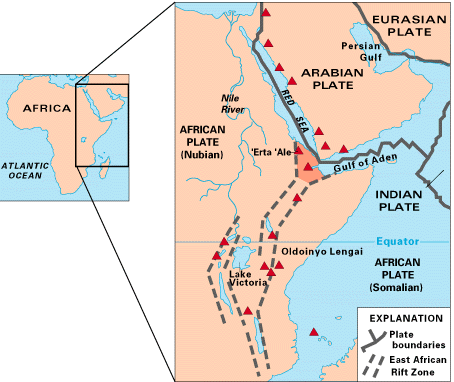
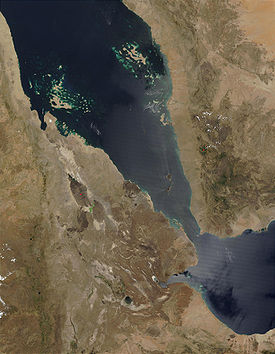
The Afar Triple Junction is a junction of three tectonic rifts centered in the Afar Depression, informally known as the Afar Triangle, of northeastern Africa. Here, the Red Sea Rift meets the Aden Ridge and the East African Rift...
which is part of the Great Rift Valley
Great Rift Valley
The Great Rift Valley is a name given in the late 19th century by British explorer John Walter Gregory to the continuous geographic trench, approximately in length, that runs from northern Syria in Southwest Asia to central Mozambique in South East Africa...
. It overlaps Eritrea
Eritrea
Eritrea , officially the State of Eritrea, is a country in the Horn of Africa. Eritrea derives it's name from the Greek word Erethria, meaning 'red land'. The capital is Asmara. It is bordered by Sudan in the west, Ethiopia in the south, and Djibouti in the southeast...
, Djibouti
Djibouti
Djibouti , officially the Republic of Djibouti , is a country in the Horn of Africa. It is bordered by Eritrea in the north, Ethiopia in the west and south, and Somalia in the southeast. The remainder of the border is formed by the Red Sea and the Gulf of Aden at the east...
and the entire Afar Region of Ethiopia
Ethiopia
Ethiopia , officially known as the Federal Democratic Republic of Ethiopia, is a country located in the Horn of Africa. It is the second-most populous nation in Africa, with over 82 million inhabitants, and the tenth-largest by area, occupying 1,100,000 km2...
. The Afar Triangle includes the Danakil Depression
Danakil Depression
The Danakil Depression is a desert basin which lies in the Danakil Desert in north-eastern Ethiopia and southern Eritrea. It belongs to the homeland of the Afar people. It lies up to 100 m below sea level as a result of tectonic activity caused by plate movements...
and the lowest point in Africa
Africa
Africa is the world's second largest and second most populous continent, after Asia. At about 30.2 million km² including adjacent islands, it covers 6% of the Earth's total surface area and 20.4% of the total land area...
, Lake Asal
Lake Asal (Djibouti)
Lake Assal is a crater lake in central-eastern Djibouti. It is located at the western end of Gulf of Tadjoura in the Tadjoura Region, touching Dikhil Region, at the top of the Great Rift Valley, some west of Djibouti city...
(155 metres (509 ft) below sea level). Only the Awash River
Awash River
The Awash is a major river of Ethiopia. Its course is entirely contained within the boundaries of Ethiopia, and empties into a chain of interconnected lakes that begin with Lake Gargori and end with Lake Abbe on the border with Djibouti, some 100 kilometers from the head of the Gulf of Tadjoura...
flows into the area, where it ends in a chain of lakes that increase in salinity
Salinity
Salinity is the saltiness or dissolved salt content of a body of water. It is a general term used to describe the levels of different salts such as sodium chloride, magnesium and calcium sulfates, and bicarbonates...
. Dallol
Dallol, Ethiopia
Dallol was a settlement in northern Ethiopia. Located in Administrative Zone 2 of the Afar Region in the Afar Depression, it has a latitude and longitude of with an elevation of about 130 meters below sea level...
is also part of the depression, one of the hottest places year-round anywhere on Earth
Earth
Earth is the third planet from the Sun, and the densest and fifth-largest of the eight planets in the Solar System. It is also the largest of the Solar System's four terrestrial planets...
. The climate varies from around 25 °C (77 °F) during the rainy season (September–March) to 48 °C (118 °F) during the dry season
Dry season
The dry season is a term commonly used when describing the weather in the tropics. The weather in the tropics is dominated by the tropical rain belt, which oscillates from the northern to the southern tropics over the course of the year...
(March–September).
Afar is well known as one of the cradles of hominids, containing the Middle Awash
Middle Awash
The Middle Awash is an archaeological site along the Awash River in Ethiopia's Afar Depression. A number of Pleistocene and late Miocene hominid remains have been found at the site, along with some of the oldest known Olduwan stone artifacts and patches of fire-baked clay, disputed evidence of the...
, site of many fossil hominid discoveries such as Ardi, (Ardipithecus ramidus); the Gona (Gawis cranium)
Gawis cranium
The Gawis cranium is a hominid skull discovered on February 16, 2006 near the drainage of Gawis, a tributary of the Awash River in the Afar Depression, Ethiopia...
, site of the world's oldest stone tools; and Hadar
Hadar, Ethiopia
Hadar is a village in Ethiopia, on the southern edge of the Afar Triangle with a latitude and longitude of approximately . The village is known for the nearby archaeological site....
, site of Lucy
Lucy (Australopithecus)
Lucy is the common name of AL 288-1, several hundred pieces of bone representing about 40% of the skeleton of an individual Australopithecus afarensis. The specimen was discovered in 1974 at Hadar in the Awash Valley of Ethiopia's Afar Depression. Lucy is estimated to have lived 3.2 million years...
, the fossilized specimen of Australopithecus afarensis
Australopithecus afarensis
Australopithecus afarensis is an extinct hominid that lived between 3.9 and 2.9 million years ago. A. afarensis was slenderly built, like the younger Australopithecus africanus. It is thought that A...
.
Environment
Drought
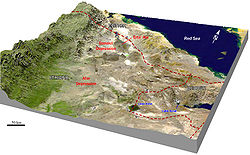
A drought is an extended period of months or years when a region notes a deficiency in its water supply. Generally, this occurs when a region receives consistently below average precipitation. It can have a substantial impact on the ecosystem and agriculture of the affected region...
. There is no rain for most of the year, and yearly rainfall averages range from 100 to 200 millimetres (4 to 7 in), with less rain falling closer to the coast. The Awash River
Awash River
The Awash is a major river of Ethiopia. Its course is entirely contained within the boundaries of Ethiopia, and empties into a chain of interconnected lakes that begin with Lake Gargori and end with Lake Abbe on the border with Djibouti, some 100 kilometers from the head of the Gulf of Tadjoura...
, flowing north-eastward through southern Afar, provides a narrow green belt and enables life for the flora and fauna in the area and for the Afars
Afar people
The Afar , also known as the Danakil, are an ethnic group in the Horn of Africa. They primarily live in the Afar Region of Ethiopia and in northern Djibouti, although some also inhabit the southern point of Eritrea.-Early history:...
, the nomadic people living in the Danakil desert. About 128 kilometres (79.5 mi) from the Red Sea
Red Sea
The Red Sea is a seawater inlet of the Indian Ocean, lying between Africa and Asia. The connection to the ocean is in the south through the Bab el Mandeb strait and the Gulf of Aden. In the north, there is the Sinai Peninsula, the Gulf of Aqaba, and the Gulf of Suez...
, the Awash ends in a chain of salt lakes, where its water evaporates as quickly as it is supplied. About 1200 km² (463.3 sq mi) of the Afar Depression is covered by salt
Salt
In chemistry, salts are ionic compounds that result from the neutralization reaction of an acid and a base. They are composed of cations and anions so that the product is electrically neutral...
, and salt mining is still a major source of income for many Afar tribes.
The Afar Depression biome
Biome
Biomes are climatically and geographically defined as similar climatic conditions on the Earth, such as communities of plants, animals, and soil organisms, and are often referred to as ecosystems. Some parts of the earth have more or less the same kind of abiotic and biotic factors spread over a...
is characterized as desert scrubland
Deserts and xeric shrublands
Deserts and xeric shrublands is a biome characterized by, relating to, or requiring only a small amount of moisture.-Definition and occurrence:...
. Vegetation is mostly confined to drought-resistant plants such as small trees (e.g. species of the dragon tree), shrubs, and grasses. Wildlife includes many herbivore
Herbivore
Herbivores are organisms that are anatomically and physiologically adapted to eat plant-based foods. Herbivory is a form of consumption in which an organism principally eats autotrophs such as plants, algae and photosynthesizing bacteria. More generally, organisms that feed on autotrophs in...
s such as Grevy's Zebra
Grevy's Zebra
The Grévy's zebra , also known as the Imperial zebra, is the largest extant wild equid and one of three species of zebra, the other two being the plains zebra and the mountain zebra. Named after Jules Grévy, it is the sole extant member of the subgenus Dolichohippus. The Grévy's zebra is found in...
, Soemmering’s Gazelle
Gazelle
A gazelle is any of many antelope species in the genus Gazella, or formerly considered to belong to it. Six species are included in two genera, Eudorcas and Nanger, which were formerly considered subgenera...
, Oryx Beisa
East African Oryx
The East African Oryx , also known as the Beisa occurs in two subspecies, Common Beisa Oryx found in steppe and semi-desert throughout the Horn of Africa and north of the Tana River, and Fringe-eared Oryx south of the Tana River in southern Kenya and parts of Tanzania...
and, notably, the last viable population of African wild ass
African Wild Ass
The African Wild Ass is a wild member of the horse family, Equidae. This species is believed to be the ancestor of the domestic donkey which is usually placed within the same species. They live in the deserts and other arid areas of northeastern Africa, in Eritrea, Ethiopia and Somalia; it...
(Equus africanus somalicus). Birds include the ostrich
Ostrich
The Ostrich is one or two species of large flightless birds native to Africa, the only living member of the genus Struthio. Some analyses indicate that the Somali Ostrich may be better considered a full species apart from the Common Ostrich, but most taxonomists consider it to be a...
, the endemic
Endemic (ecology)
Endemism is the ecological state of being unique to a defined geographic location, such as an island, nation or other defined zone, or habitat type; organisms that are indigenous to a place are not endemic to it if they are also found elsewhere. For example, all species of lemur are endemic to the...
Archer's lark
Lark
Larks are passerine birds of the family Alaudidae. All species occur in the Old World, and in northern and eastern Australia; only one, the Shore Lark, has spread to North America, where it is called the Horned Lark...
(Heteromirafra archeri), the Secretary Bird
Secretary Bird
The Secretarybird or Secretary Bird is a large, mostly terrestrial bird of prey. Endemic to Africa, it is usually found in the open grasslands and savannah of the sub-Sahara...
, Arabian and Kori bustard
Bustard
Bustards, including floricans and korhaans, are large terrestrial birds mainly associated with dry open country and steppes in the Old World...
s, Abyssinian Roller
Abyssinian Roller
The Abyssinian Roller, Coracias abyssinicus, is a member of the roller family of birds which breeds across tropical Africa in a belt south of the Sahara, known as the Sahel...
and Crested Francolin
Francolin
Francolins are birds that traditionally have been placed in the genus Francolinus, but now commonly are divided into multiple genera , although some of the major taxonomic listing sources have yet to divide them. They are members of the pheasant family, Phasianidae...
. In the southern part of the plain, in Ethiopia, lies the Mille-Sardo Wildlife Reserve (established 1973). Many fossils have been found in the Awash region, not only hominids but also elephantoids
Proboscidea
Proboscidea is a taxonomic order containing one living family, Elephantidae, and several extinct families. This order was first described by J. Illiger in 1881 and encompasses the trunked mammals...
, crocodile
Crocodile
A crocodile is any species belonging to the family Crocodylidae . The term can also be used more loosely to include all extant members of the order Crocodilia: i.e...
s and hippopotamus
Hippopotamus
The hippopotamus , or hippo, from the ancient Greek for "river horse" , is a large, mostly herbivorous mammal in sub-Saharan Africa, and one of only two extant species in the family Hippopotamidae After the elephant and rhinoceros, the hippopotamus is the third largest land mammal and the heaviest...
.
Geology
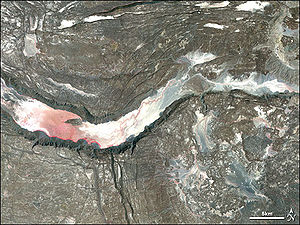
Triple junction
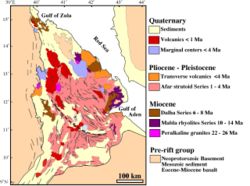
A triple junction is the point where the boundaries of three tectonic plates meet. At the triple junction a boundary will be one of 3 types - a ridge, trench or transform fault - and triple junctions can be described according to the types of plate margin that meet at them...
(the Afar Triple Junction
Afar Triple Junction
The Afar Triple Junction is a junction of three tectonic rifts centered in the Afar Depression, informally known as the Afar Triangle, of northeastern Africa. Here, the Red Sea Rift meets the Aden Ridge and the East African Rift...
), where the spreading ridges that form the Red Sea
Red Sea
The Red Sea is a seawater inlet of the Indian Ocean, lying between Africa and Asia. The connection to the ocean is in the south through the Bab el Mandeb strait and the Gulf of Aden. In the north, there is the Sinai Peninsula, the Gulf of Aqaba, and the Gulf of Suez...
and the Gulf of Aden
Gulf of Aden
The Gulf of Aden is located in the Arabian Sea between Yemen, on the south coast of the Arabian Peninsula, and Somalia in the Horn of Africa. In the northwest, it connects with the Red Sea through the Bab-el-Mandeb strait, which is about 20 miles wide....
emerge on land and meet the East African Rift
Great Rift Valley
The Great Rift Valley is a name given in the late 19th century by British explorer John Walter Gregory to the continuous geographic trench, approximately in length, that runs from northern Syria in Southwest Asia to central Mozambique in South East Africa...
. The central meeting place for these three pieces of Earth's crust is around Lake Abbe
Lake Abbe
Lake Abbe or Lake Abhe Bad is a salt lake, lying on the Ethiopia-Djibouti border. It is one of a chain of six connected lakes, which also includes lakes Gargori, Laitali, Gummare, Bario and Afambo.-Overview:...
. The Afar Depression is one of two places on Earth where a mid-ocean ridge
Mid-ocean ridge
A mid-ocean ridge is a general term for an underwater mountain system that consists of various mountain ranges , typically having a valley known as a rift running along its spine, formed by plate tectonics. This type of oceanic ridge is characteristic of what is known as an oceanic spreading...
can be studied on land, the other being Iceland
Iceland
Iceland , described as the Republic of Iceland, is a Nordic and European island country in the North Atlantic Ocean, on the Mid-Atlantic Ridge. Iceland also refers to the main island of the country, which contains almost all the population and almost all the land area. The country has a population...
.
In the Depression, the Earth's crust is slowly rifting apart at a rate of 1–2 centimetres (0.4–0.8 in) per year along each of the three rifts which form the "legs" of the triple junction. The immediate consequence of this is that there are a continuous sequence of earthquakes, fissures hundreds of metres long and deep appearing in the ground, and the valley floor sinking as much as 100 metres. Between September and October 2005, 163 earthquakes of magnitudes greater than 3.9 and a volcanic eruption occurred within the Afar rift. 2.5 cubic kilometers of molten rock was injected into the plate along a dyke
Dike (geology)
A dike or dyke in geology is a type of sheet intrusion referring to any geologic body that cuts discordantly across* planar wall rock structures, such as bedding or foliation...
between depths of 2 and 9 km, forcing open an 8 meter wide gap on the surface. Related eruptions have taken place in Teru
Teru
Teru is one of the 29 woredas in the Afar Region of Ethiopia. Part of the Administrative Zone 4, Teru is bordered on the south by Aura, on the southwest by Gulina, on the west by Yalo, and on the north and east by the Administrative Zone 2...
and Aura
Aura (woreda)
Aura is one of the 29 woredas in the Afar Region of Ethiopia. Part of the Administrative Zone 4, Aura is bordered on the southwest by Ewa, on the west by Gulina, on the north by Teru, and on the east by Administrative Zone 1; the Logiya River defines part of its southeastern boundary...
woredas. The rift has recently been recorded by means of three-dimensional laser mapping.
Over millions of years, geologists expect the Red Sea
Red Sea
The Red Sea is a seawater inlet of the Indian Ocean, lying between Africa and Asia. The connection to the ocean is in the south through the Bab el Mandeb strait and the Gulf of Aden. In the north, there is the Sinai Peninsula, the Gulf of Aqaba, and the Gulf of Suez...
to erode through the highlands surrounding the Afar Depression and flood the valley. In about 10 million years, geologists predict that the whole 6,000 km length of the East African Rift will be submerged, forming a new sea as large as the Red Sea is now. At that point, Africa will have lost its Horn.
The floor of the Afar Depression is composed of lava
Lava
Lava refers both to molten rock expelled by a volcano during an eruption and the resulting rock after solidification and cooling. This molten rock is formed in the interior of some planets, including Earth, and some of their satellites. When first erupted from a volcanic vent, lava is a liquid at...
, mostly basalt
Basalt
Basalt is a common extrusive volcanic rock. It is usually grey to black and fine-grained due to rapid cooling of lava at the surface of a planet. It may be porphyritic containing larger crystals in a fine matrix, or vesicular, or frothy scoria. Unweathered basalt is black or grey...
. One of Earth's five lava lakes, Erta Ale
Erta Ale
Erta Ale is a continuously active basaltic shield volcano in the Afar Region of northeastern Ethiopia, the most active volcano in Ethiopia. It is in the Afar Depression, a badlands desert area spanning the border with Eritrea, and the volcano itself is surrounded completely by an area below sea...
is found here, as well as Dabbahu Volcano
Dabbahu Volcano
Dabbahu Volcano is a volcano located in the remote Afar Region of Ethiopia. This stratovolcano is part of the Afar Triangle , a highly active volcanic region which includes Erta Ale...
. The Afar Depression is, in the views of some geologists, underlain by a mantle plume
Mantle plume
A mantle plume is a hypothetical thermal diapir of abnormally hot rock that nucleates at the core-mantle boundary and rises through the Earth's mantle. Such plumes were invoked in 1971 to explain volcanic regions that were not thought to be explicable by the then-new theory of plate tectonics. Some...
, a great upwelling of mantle
Mantle (geology)
The mantle is a part of a terrestrial planet or other rocky body large enough to have differentiation by density. The interior of the Earth, similar to the other terrestrial planets, is chemically divided into layers. The mantle is a highly viscous layer between the crust and the outer core....
that melts to yield basalt as it approaches the surface.
See also
- Horst
- Lake Assal in Djibouti
- List of fossil sites (with link directory)
- List of hominina (hominid) fossils (with images)
- The Afar peopleAfar peopleThe Afar , also known as the Danakil, are an ethnic group in the Horn of Africa. They primarily live in the Afar Region of Ethiopia and in northern Djibouti, although some also inhabit the southern point of Eritrea.-Early history:...
who inhabit the region
External links
- The Ethiopian state of Afar: Topography and Climate Photos of Erta Ale, Hotsprings at Dallol and Danakil Huge collection of (3000) photos from different expeditions in the Dallol, Erta Ale and Danakil regions Photos of Afar Depression: between Ethiopia and Djibouti Web site of Main Ethiopian Rift
- Science news: Death of a Continent, Birth of an Ocean