

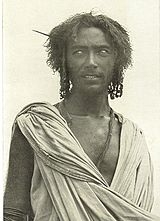
Afar people

Encyclopedia
The Afar also known as the Danakil, are an ethnic group in the Horn of Africa
. They primarily live in the Afar Region
of Ethiopia
and in northern Djibouti
, although some also inhabit the southern point of Eritrea
.
.
The earliest surviving written mention of the Afar is from the 13th century Arab writer ibn Sa'id, who reported that they lived in the area around the port of Suakin
, as far south as Mandeb, near Zeila
. They are mentioned intermittently in Ethiopian records, first as helping Emperor
Amda Seyon in a campaign beyond the Awash River
, then over a century later when they assisted Emperor Baeda Maryam
when he campaigned against their neighbors the Dobe'a
.
Along with the closely related Somali
and other adjacent Muslim
peoples, the Afar are also associated with the medieval Adal Sultanate
that controlled large parts of the northern Horn of Africa.
 The Aussa Sultanate or Afar Sultanate succeeded the earlier Imamate of Aussa. The latter polity had come into existence in 1577, when Muhammed Jasa moved his capital from Harar
to Aussa with the split of the Adal Sultanate into Aussa and the Harari city-state. At some point after 1672, Aussa declined and temporarily came to an end in conjunction with Imam Umar Din bin Adam's recorded ascension to the throne. The Sultanate was subsequently re-established by Kedafu around the year 1734, and was thereafter ruled by his Mudaito Dynasty
. The primary symbol of the Sultan was a silver baton
, which was considered to have magical properties.
was founded in 1975 to promote the interests of the Afar people. Sultan Hanfadhe was shortly afterwards exiled to Saudi Arabia
. Ethiopia's then-ruling communist Derg
regime later established the Autonomous Region of Assab (now called Aseb and located in Eritrea
), although low level insurrection continued until the early 1990s. In Djibouti, a similar movement simmered throughout the 1980s, eventually culminating in the Afar Insurgency in 1991. After the fall of the Derg that same year, Sultan Hanfadhe returned from exile.
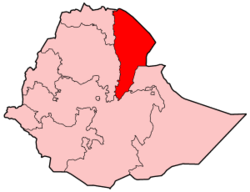 The Afar principally reside in the Danakil Desert
in the Afar Region of Ethiopia
, as well as in Eritrea
and Djibouti
. They number 1,276,867 people in Ethiopia (or 1.73% of the total population), of whom 108,488 are urban inhabitants, according to the most recent census (2007). The Afar make up over a third of the population of Djibouti, and are one of the nine recognized ethnic divisions
(kililoch) of Ethiopia.
as a mother tongue. It is part of the Cushitic
branch of the Afro-Asiatic
language family, and is spoken by ethnic Afars in the Afar Region of Ethiopia, as well as in southern Eritrea and northern Djibouti. However, since the Afar are traditionally nomad
ic herder
s, Afar speakers may be found further afield.
. They have a long history of association with Islam
through the various local Muslim polities.
s, sheep, and cattle
in the desert.
Socially, they are organized into clan
families and two main classes: the asaimara ('reds') who are the dominant class politically, and the adoimara ('whites') who are a working class and are found in the Mabla Mountains
.
In addition, the Afar are reputed for their martial prowess. Men traditionally sport the jile, a famous curved knife. They also have an extensive repertoire of battle songs.
Horn of Africa
The Horn of Africa is a peninsula in East Africa that juts hundreds of kilometers into the Arabian Sea and lies along the southern side of the Gulf of Aden. It is the easternmost projection of the African continent...
. They primarily live in the Afar Region
Afar Region
Afar is one of the nine ethnic divisions of Ethiopia, and is the homeland of the Afar people. Formerly known as Region 2, its current capital is Asayita; a new capital named Semera on the paved Awash - Asseb highway is under construction....
of Ethiopia
Ethiopia
Ethiopia , officially known as the Federal Democratic Republic of Ethiopia, is a country located in the Horn of Africa. It is the second-most populous nation in Africa, with over 82 million inhabitants, and the tenth-largest by area, occupying 1,100,000 km2...
and in northern Djibouti
Djibouti
Djibouti , officially the Republic of Djibouti , is a country in the Horn of Africa. It is bordered by Eritrea in the north, Ethiopia in the west and south, and Somalia in the southeast. The remainder of the border is formed by the Red Sea and the Gulf of Aden at the east...
, although some also inhabit the southern point of Eritrea
Eritrea
Eritrea , officially the State of Eritrea, is a country in the Horn of Africa. Eritrea derives it's name from the Greek word Erethria, meaning 'red land'. The capital is Asmara. It is bordered by Sudan in the west, Ethiopia in the south, and Djibouti in the southeast...
.
Early history
Afar society has traditionally been divided into independent kingdoms, each ruled by its own SultanSultan
Sultan is a title with several historical meanings. Originally, it was an Arabic language abstract noun meaning "strength", "authority", "rulership", and "dictatorship", derived from the masdar سلطة , meaning "authority" or "power". Later, it came to be used as the title of certain rulers who...
.
The earliest surviving written mention of the Afar is from the 13th century Arab writer ibn Sa'id, who reported that they lived in the area around the port of Suakin
Suakin
Suakin or Sawakin is a port in north-eastern Sudan, on the west coast of the Red Sea. In 1983 it had a population of 18,030 and the 2009 estimate is 43, 337.It was formerly the region's chief port, but is now secondary to Port Sudan, about 30 miles north. The old city built of coral is in ruins...
, as far south as Mandeb, near Zeila
Zeila
Zeila, also known as Zaila , is a port city on the Gulf of Aden coast, situated in the northwestern Awdal region of Somalia.Located near the Djibouti border, the town sits on a sandy spit surrounded by the sea. It is known for its offshore islands, coral reef and mangroves. Landward, the terrain is...
. They are mentioned intermittently in Ethiopian records, first as helping Emperor
Emperor of Ethiopia
The Emperor of Ethiopia was the hereditary ruler of Ethiopia until the abolition of the monarchy in 1974. The Emperor was the head of state and head of government, with ultimate executive, judicial and legislative power in that country...
Amda Seyon in a campaign beyond the Awash River
Awash River
The Awash is a major river of Ethiopia. Its course is entirely contained within the boundaries of Ethiopia, and empties into a chain of interconnected lakes that begin with Lake Gargori and end with Lake Abbe on the border with Djibouti, some 100 kilometers from the head of the Gulf of Tadjoura...
, then over a century later when they assisted Emperor Baeda Maryam
Baeda Maryam of Ethiopia
Baeda Maryam was of Ethiopia, and a member of the Solomonic dynasty...
when he campaigned against their neighbors the Dobe'a
Dobe'a
The Dobe'a were a people of medieval Ethiopia, living in northeastern Ethiopia between what are now Amhara, Tigray and Afar Regions.-Homeland:They were first described, during the reign of Emperor Ba'eda Maryam The Dobe'a were a people of medieval Ethiopia, living in northeastern Ethiopia between...
.
Along with the closely related Somali
Somali people
Somalis are an ethnic group located in the Horn of Africa, also known as the Somali Peninsula. The overwhelming majority of Somalis speak the Somali language, which is part of the Cushitic branch of the Afro-Asiatic language family...
and other adjacent Muslim
Muslim
A Muslim, also spelled Moslem, is an adherent of Islam, a monotheistic, Abrahamic religion based on the Quran, which Muslims consider the verbatim word of God as revealed to prophet Muhammad. "Muslim" is the Arabic term for "submitter" .Muslims believe that God is one and incomparable...
peoples, the Afar are also associated with the medieval Adal Sultanate
Adal Sultanate
The Adal Sultanate or the Kingdom of Adal was a medieval multi-ethnic Muslim state located in the Horn of Africa.-Overview:...
that controlled large parts of the northern Horn of Africa.
Aussa Sultanate
Harar
Harar is an eastern city in Ethiopia, and the capital of the modern Harari ethno-political division of Ethiopia...
to Aussa with the split of the Adal Sultanate into Aussa and the Harari city-state. At some point after 1672, Aussa declined and temporarily came to an end in conjunction with Imam Umar Din bin Adam's recorded ascension to the throne. The Sultanate was subsequently re-established by Kedafu around the year 1734, and was thereafter ruled by his Mudaito Dynasty
Mudaito dynasty
-History:The Aussa Sultanate or Afar Sultanate succeeded the earlier Imamate of Aussa. The latter polity had come into existence in 1577, when Muhammed Jasa moved his capital from Harar to Aussa with the split of the Adal Sultanate into Aussa and the Harari city-state...
. The primary symbol of the Sultan was a silver baton
Baton (symbol)
The ceremonial baton is a short, thick stick, carried by select high-ranking military officers as a uniform article. The baton is distinguished from the swagger stick in being thicker and less functional . Unlike a staff of office, a baton is not rested on the ground...
, which was considered to have magical properties.
Afar Liberation Front
Following an unsuccessful rebellion led by the Afar Sultan, Alimirah Hanfadhe, the Afar Liberation FrontAfar Liberation Front
The Afar Liberation Front is a political party in Ethiopia, commonly considered to be the most important organization dedicated to promoting the interests of the Afar people...
was founded in 1975 to promote the interests of the Afar people. Sultan Hanfadhe was shortly afterwards exiled to Saudi Arabia
Saudi Arabia
The Kingdom of Saudi Arabia , commonly known in British English as Saudi Arabia and in Arabic as as-Sa‘ūdiyyah , is the largest state in Western Asia by land area, constituting the bulk of the Arabian Peninsula, and the second-largest in the Arab World...
. Ethiopia's then-ruling communist Derg
Derg
The Derg or Dergue was a Communist military junta that came to power in Ethiopia following the ousting of Haile Selassie I. Derg, which means "committee" or "council" in Ge'ez, is the short name of the Coordinating Committee of the Armed Forces, Police, and Territorial Army, a committee of...
regime later established the Autonomous Region of Assab (now called Aseb and located in Eritrea
Eritrea
Eritrea , officially the State of Eritrea, is a country in the Horn of Africa. Eritrea derives it's name from the Greek word Erethria, meaning 'red land'. The capital is Asmara. It is bordered by Sudan in the west, Ethiopia in the south, and Djibouti in the southeast...
), although low level insurrection continued until the early 1990s. In Djibouti, a similar movement simmered throughout the 1980s, eventually culminating in the Afar Insurgency in 1991. After the fall of the Derg that same year, Sultan Hanfadhe returned from exile.
Geographical distribution
Danakil Desert
The Danakil Desert lies in the Afar Triangle. It extends into the north-east of Ethiopia, the south of Eritrea and into much of Djibouti. It is the homeland of the Afar people who are known for their ability to withstand the extremes and survive as they have done for hundreds of years. It is known...
in the Afar Region of Ethiopia
Ethiopia
Ethiopia , officially known as the Federal Democratic Republic of Ethiopia, is a country located in the Horn of Africa. It is the second-most populous nation in Africa, with over 82 million inhabitants, and the tenth-largest by area, occupying 1,100,000 km2...
, as well as in Eritrea
Eritrea
Eritrea , officially the State of Eritrea, is a country in the Horn of Africa. Eritrea derives it's name from the Greek word Erethria, meaning 'red land'. The capital is Asmara. It is bordered by Sudan in the west, Ethiopia in the south, and Djibouti in the southeast...
and Djibouti
Djibouti
Djibouti , officially the Republic of Djibouti , is a country in the Horn of Africa. It is bordered by Eritrea in the north, Ethiopia in the west and south, and Somalia in the southeast. The remainder of the border is formed by the Red Sea and the Gulf of Aden at the east...
. They number 1,276,867 people in Ethiopia (or 1.73% of the total population), of whom 108,488 are urban inhabitants, according to the most recent census (2007). The Afar make up over a third of the population of Djibouti, and are one of the nine recognized ethnic divisions
Regions of Ethiopia
||Ethiopia is divided into 9 ethnically-based administrative regions and two chartered cities...
(kililoch) of Ethiopia.
Language
Afars speak the Afar languageAfar language
Afar is a Lowland East Cushitic language spoken in Ethiopia, Eritrea and Djibouti. It is believed to have 1.5 million speakers, the Afar. The basic word order in Afar, like in other East Cushitic languages, is subject–object–verb. Its speakers have a literacy rate of between one and three per cent...
as a mother tongue. It is part of the Cushitic
Cushitic languages
The Cushitic languages are a branch of the Afroasiatic language family spoken in the Horn of Africa, Tanzania, Kenya, Sudan and Egypt. They are named after the Biblical character Cush, who was identified as an ancestor of the speakers of these specific languages as early as AD 947...
branch of the Afro-Asiatic
Afro-Asiatic languages
The Afroasiatic languages , also known as Hamito-Semitic, constitute one of the world's largest language families, with about 375 living languages...
language family, and is spoken by ethnic Afars in the Afar Region of Ethiopia, as well as in southern Eritrea and northern Djibouti. However, since the Afar are traditionally nomad
Nomad
Nomadic people , commonly known as itinerants in modern-day contexts, are communities of people who move from one place to another, rather than settling permanently in one location. There are an estimated 30-40 million nomads in the world. Many cultures have traditionally been nomadic, but...
ic herder
Herder
A herder is a worker who lives a possibly semi-nomadic life, caring for various domestic animals, in places where these animals wander pasture lands....
s, Afar speakers may be found further afield.
Religion
Afar people are predominantly MuslimMuslim
A Muslim, also spelled Moslem, is an adherent of Islam, a monotheistic, Abrahamic religion based on the Quran, which Muslims consider the verbatim word of God as revealed to prophet Muhammad. "Muslim" is the Arabic term for "submitter" .Muslims believe that God is one and incomparable...
. They have a long history of association with Islam
Islam
Islam . The most common are and . : Arabic pronunciation varies regionally. The first vowel ranges from ~~. The second vowel ranges from ~~~...
through the various local Muslim polities.
Culture
The Afar are traditionally pastoralists, raising goatGoat
The domestic goat is a subspecies of goat domesticated from the wild goat of southwest Asia and Eastern Europe. The goat is a member of the Bovidae family and is closely related to the sheep as both are in the goat-antelope subfamily Caprinae. There are over three hundred distinct breeds of...
s, sheep, and cattle
Cattle
Cattle are the most common type of large domesticated ungulates. They are a prominent modern member of the subfamily Bovinae, are the most widespread species of the genus Bos, and are most commonly classified collectively as Bos primigenius...
in the desert.
Socially, they are organized into clan
Clan
A clan is a group of people united by actual or perceived kinship and descent. Even if lineage details are unknown, clan members may be organized around a founding member or apical ancestor. The kinship-based bonds may be symbolical, whereby the clan shares a "stipulated" common ancestor that is a...
families and two main classes: the asaimara ('reds') who are the dominant class politically, and the adoimara ('whites') who are a working class and are found in the Mabla Mountains
Mabla Mountains
The Mabla Mountains are located in Obock Region, Djibouti, Africa. The endemic Djibouti Francolin makes its home here and in the Forêt du Day.-Geography:...
.
In addition, the Afar are reputed for their martial prowess. Men traditionally sport the jile, a famous curved knife. They also have an extensive repertoire of battle songs.
Further reading
- Glyn Flood, 1975, "Nomadism and its Future: the Afar" RAI News 6, Jan/Feb 1975, pages 5-9