

Acanthamoeba

Encyclopedia
Acanthamoeba is a genus of amoebae
, one of the most common protozoa
in soil, and also frequently found in fresh water
and other habitats
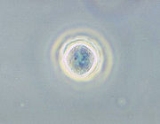
. The cells are small, usually 15 to 35 μm in length and oval to triangular in shape when moving. The pseudopods form a clear hemispherical lobe at the anterior, and there are various short filose extensions from the margins of the body. These give it a spiny appearance, which is what the name Acanthamoeba refers to. Cysts are common. Most species are free-living bacterivore
s, but some are opportunists that can cause infections in humans and other animals.
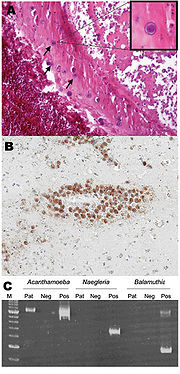 Diseases caused by Acanthamoeba include amoebic keratitis
and encephalitis
. The latter is caused by Acanthamoeba entering cuts and spreading to the central nervous system
.
, diabetes, malignancies, malnutrition, systemic lupus erythematosus
, or alcoholism. The parasite's portal of entry is via lesions in the skin or the upper respiratory tract or via inhalation of airborne cysts. The parasite then spreads hematogenously into the central nervous system. Acanthamoeba crosses the blood brain barrier by means that are not yet understood. Subsequent invasion of the connective tissue and induction of pro-inflammatory responses leads to neuronal damage which can be fatal within days. A post-mortem biopsy
reveals severe oedema and hemorrhagic necrosis
. A patient that has contracted this illness usually displays subacute symptoms including altered mental status, headaches, fever, neck stiffness, seizures, focal neurological signs such as cranial nerve palsies and coma all leading to death within one week to several months. Due to the rarity of this parasite and a lack of knowledge there are currently no good diagnoses or treatments for Acanthamoeba.
Infection usually mimics that of bacterial leptomeningitis, tuberculous meningitis
, or viral encephalitis. The misdiagnosis often leads to erroneous treatment that is ineffective. In the case that Acanthamoeba is diagnosed correctly, the current treatments such as amphotericin-B, rifampicin, trimethroprim-sulfamethoxazole, ketokonazole, fluconazole, sulfadiazine, albendazole are only tentatively successful. Correct and timely diagnosis as well as improved treatment methods as well as understanding of the parasite are important factors in improving the outcome of infection by Acanthamoeba.
(MRSA) is an important pathogen in the hospital setting due to its resistance
to many antibiotic
s. Recent findings from the University of Bath
demonstrate that MRSA can infect and replicate inside of Acanthamoeba polyphaga; this Acanthamoeba species is widespread throughout the environment. Since A. polyphaga can form cysts, cysts infected with MRSA can act as a mode of airborne dispersal for MRSA. Additionally, it is noted that "evidence with other pathogens suggests that pathogens that emerge from amoeba are more resistant to antibiotics and more virulent." It has been observed that Acanthamoeba can increase MRSA numbers by 1000-fold.
This species is able to lyse bacteria and produce a wide range of enzymes such as cellulases or chitinases and probably contributes to the breakdown of organic matter in soil, contributing to the microbial loop
.
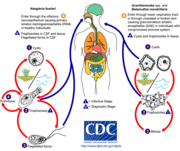
s which are similar to human pathogens. Because of this they are considered to be potential emerging human pathogens. The exact nature of these symbionts and the benefit they represent for the amoebal host still have to be clarified.
These include Legionella
and Legionella-like pathogens.
Owing to its ease and economy of cultivation, the Neff strain of A. castellanii discovered in a pond in Golden Gate Park
in the 1960s, has been effectively utilized as a classic model organism in the field of cell biology. From just 30 liters of simple medium inoculated with A. castellanii, approximately one kilogram of cells can be obtained after several days of aerated culture at room temperature. Pioneered in the laboratory of Dr. Edward D. Korn at the National Institutes of Health
(NIH), many important biological molecules have been discovered and their pathways elucidated using the Acanthamoeba model. Dr. Thomas Dean Pollard applied this model at the NIH, Harvard Medical School
, Johns Hopkins University School of Medicine, and the Salk Institute for Biological Studies
to discover and characterize many proteins that are essential for cell motility not only in amoebas but in many other eukaryotic cells, especially those of the human nervous and immune systems, the developing embryo, and cancer cells.
The manufacturer recalled the product after the Centers for Disease Control in the United States found that 21 individuals had possibly received an acanthamoeba infection after using Complete Moisture Plus in the month prior to diagnosis.
Amoeboid
Amoeboids are single-celled life-forms characterized by an irregular shape."Amoeboid" and "amœba" are often used interchangeably even by biologists, and especially refer to a creature moving by using pseudopodia. Most references to "amoebas" or "amoebae" are to amoeboids in general rather than to...
, one of the most common protozoa
Protozoa
Protozoa are a diverse group of single-cells eukaryotic organisms, many of which are motile. Throughout history, protozoa have been defined as single-cell protists with animal-like behavior, e.g., movement...
in soil, and also frequently found in fresh water
Fresh Water
Fresh Water is the debut album by Australian rock and blues singer Alison McCallum, released in 1972. Rare for an Australian artist at the time, it came in a gatefold sleeve...
and other habitats
Habitat (ecology)
A habitat is an ecological or environmental area that is inhabited by a particular species of animal, plant or other type of organism...
. The cells are small, usually 15 to 35 μm in length and oval to triangular in shape when moving. The pseudopods form a clear hemispherical lobe at the anterior, and there are various short filose extensions from the margins of the body. These give it a spiny appearance, which is what the name Acanthamoeba refers to. Cysts are common. Most species are free-living bacterivore
Bacterivore
Bacterivores are free-living, generally heterotrophic organisms, exclusively microscopic, which obtain energy and nutrients primarily or entirely from the consumption of bacteria. Many species of amoeba are bacterivores, as well as other types of protozoans. In common all species of bacteria will...
s, but some are opportunists that can cause infections in humans and other animals.
Human pathogen
Keratitis
Keratitis is a condition in which the eye's cornea, the front part of the eye, becomes inflamed. The condition is often marked by moderate to intense pain and usually involves impaired eyesight.-Types:...
and encephalitis
Encephalitis
Encephalitis is an acute inflammation of the brain. Encephalitis with meningitis is known as meningoencephalitis. Symptoms include headache, fever, confusion, drowsiness, and fatigue...
. The latter is caused by Acanthamoeba entering cuts and spreading to the central nervous system
Central nervous system
The central nervous system is the part of the nervous system that integrates the information that it receives from, and coordinates the activity of, all parts of the bodies of bilaterian animals—that is, all multicellular animals except sponges and radially symmetric animals such as jellyfish...
.
Acanthamoeba granulomatous encephalitis
This is an opportunistic protozoan pathogen that rarely causes disease in humans. Approximately 400 cases have been reported worldwide with a survival rate of only two to three percent. Infection usually occurs in patients with an immunodeficiencyImmunodeficiency
Immunodeficiency is a state in which the immune system's ability to fight infectious disease is compromised or entirely absent. Immunodeficiency may also decrease cancer immunosurveillance. Most cases of immunodeficiency are acquired but some people are born with defects in their immune system,...
, diabetes, malignancies, malnutrition, systemic lupus erythematosus
Systemic lupus erythematosus
Systemic lupus erythematosus , often abbreviated to SLE or lupus, is a systemic autoimmune disease that can affect any part of the body. As occurs in other autoimmune diseases, the immune system attacks the body's cells and tissue, resulting in inflammation and tissue damage...
, or alcoholism. The parasite's portal of entry is via lesions in the skin or the upper respiratory tract or via inhalation of airborne cysts. The parasite then spreads hematogenously into the central nervous system. Acanthamoeba crosses the blood brain barrier by means that are not yet understood. Subsequent invasion of the connective tissue and induction of pro-inflammatory responses leads to neuronal damage which can be fatal within days. A post-mortem biopsy
Biopsy
A biopsy is a medical test involving sampling of cells or tissues for examination. It is the medical removal of tissue from a living subject to determine the presence or extent of a disease. The tissue is generally examined under a microscope by a pathologist, and can also be analyzed chemically...
reveals severe oedema and hemorrhagic necrosis
Necrosis
Necrosis is the premature death of cells in living tissue. Necrosis is caused by factors external to the cell or tissue, such as infection, toxins, or trauma. This is in contrast to apoptosis, which is a naturally occurring cause of cellular death...
. A patient that has contracted this illness usually displays subacute symptoms including altered mental status, headaches, fever, neck stiffness, seizures, focal neurological signs such as cranial nerve palsies and coma all leading to death within one week to several months. Due to the rarity of this parasite and a lack of knowledge there are currently no good diagnoses or treatments for Acanthamoeba.
Infection usually mimics that of bacterial leptomeningitis, tuberculous meningitis
Meningitis
Meningitis is inflammation of the protective membranes covering the brain and spinal cord, known collectively as the meninges. The inflammation may be caused by infection with viruses, bacteria, or other microorganisms, and less commonly by certain drugs...
, or viral encephalitis. The misdiagnosis often leads to erroneous treatment that is ineffective. In the case that Acanthamoeba is diagnosed correctly, the current treatments such as amphotericin-B, rifampicin, trimethroprim-sulfamethoxazole, ketokonazole, fluconazole, sulfadiazine, albendazole are only tentatively successful. Correct and timely diagnosis as well as improved treatment methods as well as understanding of the parasite are important factors in improving the outcome of infection by Acanthamoeba.
MRSA
Methicillin-resistant Staphylococcus aureusMethicillin-resistant Staphylococcus aureus
Methicillin-resistant Staphylococcus aureus is a bacterium responsible for several difficult-to-treat infections in humans. It is also called multidrug-resistant Staphylococcus aureus and oxacillin-resistant Staphylococcus aureus...
(MRSA) is an important pathogen in the hospital setting due to its resistance
Antibiotic resistance
Antibiotic resistance is a type of drug resistance where a microorganism is able to survive exposure to an antibiotic. While a spontaneous or induced genetic mutation in bacteria may confer resistance to antimicrobial drugs, genes that confer resistance can be transferred between bacteria in a...
to many antibiotic
Antibiotic
An antibacterial is a compound or substance that kills or slows down the growth of bacteria.The term is often used synonymously with the term antibiotic; today, however, with increased knowledge of the causative agents of various infectious diseases, antibiotic has come to denote a broader range of...
s. Recent findings from the University of Bath
University of Bath
The University of Bath is a campus university located in Bath, United Kingdom. It received its Royal Charter in 1966....
demonstrate that MRSA can infect and replicate inside of Acanthamoeba polyphaga; this Acanthamoeba species is widespread throughout the environment. Since A. polyphaga can form cysts, cysts infected with MRSA can act as a mode of airborne dispersal for MRSA. Additionally, it is noted that "evidence with other pathogens suggests that pathogens that emerge from amoeba are more resistant to antibiotics and more virulent." It has been observed that Acanthamoeba can increase MRSA numbers by 1000-fold.
Importance in soil ecology
A. castellanii can be found at high densities in various soil ecosystems. It preys on bacteria, but also fungi and other protozoa.This species is able to lyse bacteria and produce a wide range of enzymes such as cellulases or chitinases and probably contributes to the breakdown of organic matter in soil, contributing to the microbial loop
Microbial loop
The microbial loop describes a trophic pathway in the marine microbial food web where dissolved organic carbon is returned to higher trophic levels via the incorporation into bacterial biomass, and coupled with the classic food chain formed by phytoplankton-zooplankton-nekton. The term microbial...
.
Species
Species of Acanthamoeba are distinguished mainly on the form of cysts, and include the following; those marked with an asterisk are known to cause infections.- A. astronyxis*
- A. castellanii*
- A. comandoni
- A. culbertsoni*
- A. divionensis
- A. griffini
- A. hatchetti*
- A. healyi
- A. jacobsi
- A. keratitis*
- A. lenticulata
- A. lugdunensis*
- A. mauritaniensis
- A. palestinensis*
- A. pearcei
- A. polyphaga*
- A. pustulosa
- A. quina*
- A. rhysodes*
- A. royreba
- A. terricola (renamed A. castellanii Poussard)
- A. triangularis
- A. tubiashi
Endosymbiontes of Acanthamoeba
Acanthamoeba sp. contain diverse bacterial endosymbiontEndosymbiont
An endosymbiont is any organism that lives within the body or cells of another organism, i.e. forming an endosymbiosis...
s which are similar to human pathogens. Because of this they are considered to be potential emerging human pathogens. The exact nature of these symbionts and the benefit they represent for the amoebal host still have to be clarified.
These include Legionella
Legionella
Legionella is a pathogenic Gram negative bacterium, including species that cause legionellosis or Legionnaires' disease, most notably L. pneumophila. It may be readily visualized with a silver stain....
and Legionella-like pathogens.
Role as a model organism
Because Acanthamoeba does not differ greatly at the ultrastructural-level from a mammalian cell, it is an attractive model for cell biology studies. Acanthamoeba is important in cellular microbiology, environmental biology, physiology, cellular interactions, molecular biology, biochemistry, and evolutionary studies. This is due to the organism's versatile roles in the ecosystem and its ability to capture prey by phagocytosis, act as vector, reservoir for microbial pathogens, and to produce serious human infections. In addition, Acanthamoeba has been used extensively to understand the molecular biology of cell motility.Owing to its ease and economy of cultivation, the Neff strain of A. castellanii discovered in a pond in Golden Gate Park
Golden Gate Park
Golden Gate Park, located in San Francisco, California, is a large urban park consisting of of public grounds. Configured as a rectangle, it is similar in shape but 20% larger than Central Park in New York, to which it is often compared. It is over three miles long east to west, and about half a...
in the 1960s, has been effectively utilized as a classic model organism in the field of cell biology. From just 30 liters of simple medium inoculated with A. castellanii, approximately one kilogram of cells can be obtained after several days of aerated culture at room temperature. Pioneered in the laboratory of Dr. Edward D. Korn at the National Institutes of Health
National Institutes of Health
The National Institutes of Health are an agency of the United States Department of Health and Human Services and are the primary agency of the United States government responsible for biomedical and health-related research. Its science and engineering counterpart is the National Science Foundation...
(NIH), many important biological molecules have been discovered and their pathways elucidated using the Acanthamoeba model. Dr. Thomas Dean Pollard applied this model at the NIH, Harvard Medical School
Harvard Medical School
Harvard Medical School is the graduate medical school of Harvard University. It is located in the Longwood Medical Area of the Mission Hill neighborhood of Boston, Massachusetts....
, Johns Hopkins University School of Medicine, and the Salk Institute for Biological Studies
Salk Institute for Biological Studies
The Salk Institute for Biological Studies is a premier independent, non-profit, scientific research institute located in La Jolla, California. It was founded in 1960 by Jonas Salk, the developer of the polio vaccine; among the founding consultants were Jacob Bronowski and Francis Crick. Building...
to discover and characterize many proteins that are essential for cell motility not only in amoebas but in many other eukaryotic cells, especially those of the human nervous and immune systems, the developing embryo, and cancer cells.
Recall from Advanced Medical Optics
In May 2007, Advanced Medical Optics, manufacturer of Complete Moisture Plus Contact Lens Solution products, issued a voluntary recall of their Complete Moisture Plus solutions. The fear was that contact lens wearers who used Complete Moisture Plus were at higher risk than those who used other contact lens solutions to develop acanthamoeba keratitis.The manufacturer recalled the product after the Centers for Disease Control in the United States found that 21 individuals had possibly received an acanthamoeba infection after using Complete Moisture Plus in the month prior to diagnosis.
External links
- Acanthamoeba - Centers for Disease Control and PreventionCenters for Disease Control and PreventionThe Centers for Disease Control and Prevention are a United States federal agency under the Department of Health and Human Services headquartered in Druid Hills, unincorporated DeKalb County, Georgia, in Greater Atlanta...
- Video of Acanthamoeba from contact lens keratitis
- Acanthamoeba spp. as Agents of Disease in Humans - Clinical Microbiology Reviews, accessed on 4 February 2006
- http://www.bms.ed.ac.uk/research/others/smaciver/acanthamoeba.htmComprehensive resource on AmoebaAmoebaAmoeba is a genus of Protozoa.History=The amoeba was first discovered by August Johann Rösel von Rosenhof in 1757. Early naturalists referred to Amoeba as the Proteus animalcule after the Greek god Proteus, who could change his shape...
] - - Eye health and Acanthamoeba
- Acanthamoeba pictures and illustrations
- Advanced Medical Optics recall of Moisture Plus products