


3 inch Gun M5

Encyclopedia
3 inch Gun M5 was an anti-tank gun developed in the United States
during World War II
. The gun combined a 3 inches (76.2 mm) barrel of the anti-aircraft gun T9
and elements of the 105 mm howitzer M2
. The M5 was issued exclusively to the US Army
tank destroyer battalions starting in 1943. It saw combat in the Italian Campaign
and in the Northwest Europe
.
While the M5 outperformed earlier anti-tank guns in the US service, its effective employment was hindered by its heavy weight and ammunition-related issues. Losses suffered by towed TD battalions in the Battle of the Bulge
and the existence of more mobile, better protected alternative in form of self-propelled tank destroyers led to gradual removal of the M5 from frontline service in 1945.
just started to receive its first antitank gun, the 37 mm Gun M3. While it fitted the request of the Infantry
for light, easy to manhandle anti-tank weapon, Artillery and Ordnance foresaw a need for a more powerful gun. This led to a number of expedient designs, such as adaptations of the 75 mm M1897
or towed variants of the 75 mm M3
.
Late in 1940 the Ordnance Corps started another project - an anti-tank gun based on the 3 inch anti-aircraft gun T9
. The barrel
of the T9 was combined with breech
, recoil system
and carriage, all adapted from the 105 mm howitzer M2
. The pilot of the weapon, named 3 inch Gun T10, was ready by September 1941. Although the subsequent testing revealed minor problems, it was clear that the gun, eventually standardized as M5 on carriage M1, presented major performance improvement over existing designs.
Production began in December 1942. In November 1943 a slightly modified carriage was standardized as M6. In this carriage a flat shield borrowed from the 105 mm howitzer was replaced by a new sloped one. In January 1944 AGF requested to upgrade the guns built with the early carriage M1 to carriage M6; consequently most of the guns that reached the frontline had the M6 carriage.
was adapted from the 3 inch Gun T9
; it had rifling with uniform right hand twist, with 28 grooves and one turn in 25 calibers. It was combined with breech
, recoil system
and carriage from the 105 mm Howitzer M2
. The breech was of horizontal sliding type, manual; the recoil system hydropneumatic. The carriage was of split trail type, equipped with a single equilibrator spring beneath the breech and wheels with pneumatic tires.
 Despite the performance advantages, it turned out that no branch of the US Army wanted the new gun. The Infantry considered it too large and heavy. The other possible user, the Tank Destroyer Center, preferred more mobile self-propelled weapons. Finally, a pressure from the head of Army Ground Forces, Gen. Lesley McNair
, resulted in the gun being adopted by the TD Center. McNair's opinion was apparently influenced by the experience of the North African Campaign
, where self-propelled guns were found to be hard to conceal.
On 31 March 1943 AGF ordered to convert fifteen self-propelled tank destroyer battalions
to a towed form; eventually AGF decided that half of TD battalions should be towed. A towed TD battalion possessed 36 pieces, in three companies of 12. M3 Halftracks were issued as prime movers. The organization from 1 September 1944 authorized M39 Armored Utility Vehicle
instead, but these only reached frontline in spring 1945.
Those towed tank destroyer battalions were attached to US Army division
to improve their anti-tank capabilities. Most often, a complete battalion was attached to an infantry
division. In some cases towed TD battalions were attached to armored
or airborne
divisions; sometimes companies of the same battalion were given to different divisions; and sometimes a single division had several TD battalions - including a mix between towed and self-propelled - at once.
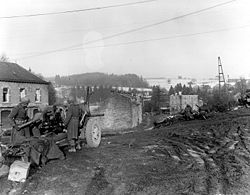 In October 1943 the first towed battalion - the 805th TD
- arrived in Italy
. Subsequently the M5 saw combat in the Italian Campaign
and in the Northwest Europe
. One of the most notable engagements came during the German counterattack on Mortain
in August 1944. The 823rd TD, attached to the 30th Infantry Division, played a key role in the successful defence of Saint Barthelemy
, destroying fourteen tanks and a number of other vehicles, though at the price of losing eleven of its guns.
In addition to the anti-tank role, the gun was often used to supplement divisional field artillery or to provide direct fire against enemy fortifications (e.g. a combat report from the 614th TD
mentioned a two-gun section firing 143 shells at enemy post, achieving 139 hits
Although the M5 easily outperformed older anti-tank guns in the US service, it was large and heavy - making it hard to manhandle into position - and its anti-armor characteristics were found to be somewhat disappointing. In part that reputation reflected initial problems with fuses of APCBC/HE shells. The 3 inch APHE round which was based on the naval 3 inch round, had a small charge in the rear of the round which was supposed to explode after penetration of the targeted tank's armor plating. Unfortunately it was discovered that it exploded on impact or shortly after causing the round not to penetrate. It is still a puzzling mystery as to why this problem was never addressed with a better base fuze or even removing the small HE charge in the rear of the round. This was also the problem with the M10 tank destroyer.
It also must be noted that APDS round was never developed for the M5; an APCR round existed (see ammunition table below), but it is not clear if it was ever issued to towed TD battalions.
As a result of the aforementioned shortcomings, commanders and troops generally preferred an alternative in form of self-propelled tank destroyers, which offered better mobility and also better protection for their crews.
The greatest test of the TD battalions and their M5 guns came during the Battle of the Bulge
. In this battle, towed tank destroyers fought much less successfully and suffered much higher losses than the self-propelled ones. A report from the aforementioned 823rd battalion said that "tank destroyer guns were one by one flanked by enemy tanks and personnel driven from guns by small arms and machine guns fire". Taking the recent combat experience into account, on 11 January 1945 the War Department
confirmed a request to convert the towed TD battalions to the self-propelled form. This decision meant gradual removal of the M5 from frontline service, a process that continued until the end of the war in Europe.
Today, the M5 is utilized by the US Army for ceremonial purposes
. The Presidential Salute Guns Platoon of The Old Guard currently maintains a battery of ten M5's at Fort Myer
for service mainly in the National Capital Region
.
). The below table lists ammunition available for the three guns. It is possible that some types (e.g. the APCR round) were never issued to towed TD battalions.
United States
The United States of America is a federal constitutional republic comprising fifty states and a federal district...
during World War II
World War II
World War II, or the Second World War , was a global conflict lasting from 1939 to 1945, involving most of the world's nations—including all of the great powers—eventually forming two opposing military alliances: the Allies and the Axis...
. The gun combined a 3 inches (76.2 mm) barrel of the anti-aircraft gun T9
3-inch M1918 gun
The 3-inch M1918 gun was a United States 3-inch anti-aircraft gun that entered service in 1918 and served until it was finally superseded by the 90 mm M3 gun just prior to the opening of World War II...
and elements of the 105 mm howitzer M2
M101 howitzer
The 105 mm M2A1 howitzer was the standard light field howitzer for the United States in World War II, seeing action in both European and Pacific theaters. Entering production in 1941, it quickly entered the war against the Imperial Japanese Army in the Pacific, where it gained a reputation...
. The M5 was issued exclusively to the US Army
United States Army
The United States Army is the main branch of the United States Armed Forces responsible for land-based military operations. It is the largest and oldest established branch of the U.S. military, and is one of seven U.S. uniformed services...
tank destroyer battalions starting in 1943. It saw combat in the Italian Campaign
Italian Campaign (World War II)
The Italian Campaign of World War II was the name of Allied operations in and around Italy, from 1943 to the end of the war in Europe. Joint Allied Forces Headquarters AFHQ was operationally responsible for all Allied land forces in the Mediterranean theatre, and it planned and commanded the...
and in the Northwest Europe
Western Front (World War II)
The Western Front of the European Theatre of World War II encompassed, Denmark, Norway, Luxembourg, Belgium, the Netherlands, France, and West Germany. The Western Front was marked by two phases of large-scale ground combat operations...
.
While the M5 outperformed earlier anti-tank guns in the US service, its effective employment was hindered by its heavy weight and ammunition-related issues. Losses suffered by towed TD battalions in the Battle of the Bulge
Battle of the Bulge
The Battle of the Bulge was a major German offensive , launched toward the end of World War II through the densely forested Ardennes mountain region of Wallonia in Belgium, hence its French name , and France and...
and the existence of more mobile, better protected alternative in form of self-propelled tank destroyers led to gradual removal of the M5 from frontline service in 1945.
Development and production history
In 1940, the US ArmyUnited States Army
The United States Army is the main branch of the United States Armed Forces responsible for land-based military operations. It is the largest and oldest established branch of the U.S. military, and is one of seven U.S. uniformed services...
just started to receive its first antitank gun, the 37 mm Gun M3. While it fitted the request of the Infantry
Infantry
Infantrymen are soldiers who are specifically trained for the role of fighting on foot to engage the enemy face to face and have historically borne the brunt of the casualties of combat in wars. As the oldest branch of combat arms, they are the backbone of armies...
for light, easy to manhandle anti-tank weapon, Artillery and Ordnance foresaw a need for a more powerful gun. This led to a number of expedient designs, such as adaptations of the 75 mm M1897
Canon de 75 modèle 1897
The French 75mm field gun was a quick-firing field artillery piece adopted in March 1898. Its official French designation was: Matériel de 75mm Mle 1897. It was commonly known as the French 75, simply the 75 and Soixante-Quinze .The French 75 is widely regarded as the first modern artillery piece...
or towed variants of the 75 mm M3
75 mm Gun (US)
The US 75 mm gun tank gun M2 and the later M3 were the standard American tank guns of the Second World War.Besides use on the two main American medium tanks of the war the M3 Lee and the M4 Sherman . The lightweight M6 and M5 variants were developed to equip the Light Tank M24 and the B-25...
.
Late in 1940 the Ordnance Corps started another project - an anti-tank gun based on the 3 inch anti-aircraft gun T9
3-inch M1918 gun
The 3-inch M1918 gun was a United States 3-inch anti-aircraft gun that entered service in 1918 and served until it was finally superseded by the 90 mm M3 gun just prior to the opening of World War II...
. The barrel
Gun barrel
A gun barrel is the tube, usually metal, through which a controlled explosion or rapid expansion of gases are released in order to propel a projectile out of the end at a high velocity....
of the T9 was combined with breech
Breechblock
A breechblock is the part of the firearm action that closes the breech of a weapon at the moment of firing....
, recoil system
Recoil
Recoil is the backward momentum of a gun when it is discharged. In technical terms, the recoil caused by the gun exactly balances the forward momentum of the projectile and exhaust gasses, according to Newton's third law...
and carriage, all adapted from the 105 mm howitzer M2
M101 howitzer
The 105 mm M2A1 howitzer was the standard light field howitzer for the United States in World War II, seeing action in both European and Pacific theaters. Entering production in 1941, it quickly entered the war against the Imperial Japanese Army in the Pacific, where it gained a reputation...
. The pilot of the weapon, named 3 inch Gun T10, was ready by September 1941. Although the subsequent testing revealed minor problems, it was clear that the gun, eventually standardized as M5 on carriage M1, presented major performance improvement over existing designs.
Production began in December 1942. In November 1943 a slightly modified carriage was standardized as M6. In this carriage a flat shield borrowed from the 105 mm howitzer was replaced by a new sloped one. In January 1944 AGF requested to upgrade the guns built with the early carriage M1 to carriage M6; consequently most of the guns that reached the frontline had the M6 carriage.
| Production of М5, pcs. | |||||||||||
| Year | 1942 | 1943 | 1944 | Total | |||||||
| Produced, pcs. | 250 | 1,250 | 1,000 | 2,500 | |||||||
Description
The barrelGun barrel
A gun barrel is the tube, usually metal, through which a controlled explosion or rapid expansion of gases are released in order to propel a projectile out of the end at a high velocity....
was adapted from the 3 inch Gun T9
3-inch M1918 gun
The 3-inch M1918 gun was a United States 3-inch anti-aircraft gun that entered service in 1918 and served until it was finally superseded by the 90 mm M3 gun just prior to the opening of World War II...
; it had rifling with uniform right hand twist, with 28 grooves and one turn in 25 calibers. It was combined with breech
Breechblock
A breechblock is the part of the firearm action that closes the breech of a weapon at the moment of firing....
, recoil system
Recoil
Recoil is the backward momentum of a gun when it is discharged. In technical terms, the recoil caused by the gun exactly balances the forward momentum of the projectile and exhaust gasses, according to Newton's third law...
and carriage from the 105 mm Howitzer M2
M101 howitzer
The 105 mm M2A1 howitzer was the standard light field howitzer for the United States in World War II, seeing action in both European and Pacific theaters. Entering production in 1941, it quickly entered the war against the Imperial Japanese Army in the Pacific, where it gained a reputation...
. The breech was of horizontal sliding type, manual; the recoil system hydropneumatic. The carriage was of split trail type, equipped with a single equilibrator spring beneath the breech and wheels with pneumatic tires.
Organization
Lesley J. McNair
General Lesley James McNair was an American Army officer who served during World War I and World War II. He was killed by friendly fire when a USAAF Eighth Air Force bomb landed in his foxhole near Saint-Lô during Operation Cobra as part of the Battle of Normandy.McNair, Frank Maxwell Andrews and...
, resulted in the gun being adopted by the TD Center. McNair's opinion was apparently influenced by the experience of the North African Campaign
North African campaign
During the Second World War, the North African Campaign took place in North Africa from 10 June 1940 to 13 May 1943. It included campaigns fought in the Libyan and Egyptian deserts and in Morocco and Algeria and Tunisia .The campaign was fought between the Allies and Axis powers, many of whom had...
, where self-propelled guns were found to be hard to conceal.
On 31 March 1943 AGF ordered to convert fifteen self-propelled tank destroyer battalions
Tank destroyer battalion (United States)
The tank destroyer battalion was a type of unit used by the United States Army during World War II. The unit was organized in one of two different forms—a towed battalion equipped with anti-tank guns, or a self-propelled battalion equipped with armored tank destroyers. U.S. Army doctrine held that...
to a towed form; eventually AGF decided that half of TD battalions should be towed. A towed TD battalion possessed 36 pieces, in three companies of 12. M3 Halftracks were issued as prime movers. The organization from 1 September 1944 authorized M39 Armored Utility Vehicle
M18 Hellcat
The 76 mm Gun Motor Carriage M18 was an American tank destroyer of World War II. The manufacturer, Buick, gave it the nickname "Hellcat" and it was the fastest tracked armored fighting vehicle during the war with a top speed up to 60 mph. Hellcat crews took advantage of the vehicle's...
instead, but these only reached frontline in spring 1945.
Those towed tank destroyer battalions were attached to US Army division
Division (military)
A division is a large military unit or formation usually consisting of between 10,000 and 20,000 soldiers. In most armies, a division is composed of several regiments or brigades, and in turn several divisions typically make up a corps...
to improve their anti-tank capabilities. Most often, a complete battalion was attached to an infantry
Infantry
Infantrymen are soldiers who are specifically trained for the role of fighting on foot to engage the enemy face to face and have historically borne the brunt of the casualties of combat in wars. As the oldest branch of combat arms, they are the backbone of armies...
division. In some cases towed TD battalions were attached to armored
Armoured warfare
Armoured warfare or tank warfare is the use of armoured fighting vehicles in modern warfare. It is a major component of modern methods of war....
or airborne
Airborne forces
Airborne forces are military units, usually light infantry, set up to be moved by aircraft and 'dropped' into battle. Thus they can be placed behind enemy lines, and have an ability to deploy almost anywhere with little warning...
divisions; sometimes companies of the same battalion were given to different divisions; and sometimes a single division had several TD battalions - including a mix between towed and self-propelled - at once.
Combat service
805th Tank Destroyer Battalion
The 805th Tank Destroyer Battalion was a tank destroyer battalion of the United States Army active during the Second World War.The battalion was formed from the 105th Antitank Battalion on 15 December 1941, in line with the reorganization of the anti-tank force...
- arrived in Italy
Italy
Italy , officially the Italian Republic languages]] under the European Charter for Regional or Minority Languages. In each of these, Italy's official name is as follows:;;;;;;;;), is a unitary parliamentary republic in South-Central Europe. To the north it borders France, Switzerland, Austria and...
. Subsequently the M5 saw combat in the Italian Campaign
Italian Campaign (World War II)
The Italian Campaign of World War II was the name of Allied operations in and around Italy, from 1943 to the end of the war in Europe. Joint Allied Forces Headquarters AFHQ was operationally responsible for all Allied land forces in the Mediterranean theatre, and it planned and commanded the...
and in the Northwest Europe
Western Front (World War II)
The Western Front of the European Theatre of World War II encompassed, Denmark, Norway, Luxembourg, Belgium, the Netherlands, France, and West Germany. The Western Front was marked by two phases of large-scale ground combat operations...
. One of the most notable engagements came during the German counterattack on Mortain
Operation Lüttich
Operation Lüttich was a codename given to a German counterattack during the Battle of Normandy, which took place around the American positions near Mortain from 7 August to 13 August 1944...
in August 1944. The 823rd TD, attached to the 30th Infantry Division, played a key role in the successful defence of Saint Barthelemy
Saint-Barthélemy, Manche
Saint-Barthélemy is a commune in the Manche department in Normandy in north-western France.-References:*...
, destroying fourteen tanks and a number of other vehicles, though at the price of losing eleven of its guns.
In addition to the anti-tank role, the gun was often used to supplement divisional field artillery or to provide direct fire against enemy fortifications (e.g. a combat report from the 614th TD
614th Tank Destroyer Battalion
The 614th Tank Destroyer Battalion was a tank destroyer battalion of the United States Army active during the Second World War. The 3rd Platoon, Company C, of the 614th was the first black unit to receive a Distinguished Unit Citation.-Early service:...
mentioned a two-gun section firing 143 shells at enemy post, achieving 139 hits
Although the M5 easily outperformed older anti-tank guns in the US service, it was large and heavy - making it hard to manhandle into position - and its anti-armor characteristics were found to be somewhat disappointing. In part that reputation reflected initial problems with fuses of APCBC/HE shells. The 3 inch APHE round which was based on the naval 3 inch round, had a small charge in the rear of the round which was supposed to explode after penetration of the targeted tank's armor plating. Unfortunately it was discovered that it exploded on impact or shortly after causing the round not to penetrate. It is still a puzzling mystery as to why this problem was never addressed with a better base fuze or even removing the small HE charge in the rear of the round. This was also the problem with the M10 tank destroyer.
It also must be noted that APDS round was never developed for the M5; an APCR round existed (see ammunition table below), but it is not clear if it was ever issued to towed TD battalions.
As a result of the aforementioned shortcomings, commanders and troops generally preferred an alternative in form of self-propelled tank destroyers, which offered better mobility and also better protection for their crews.
The greatest test of the TD battalions and their M5 guns came during the Battle of the Bulge
Battle of the Bulge
The Battle of the Bulge was a major German offensive , launched toward the end of World War II through the densely forested Ardennes mountain region of Wallonia in Belgium, hence its French name , and France and...
. In this battle, towed tank destroyers fought much less successfully and suffered much higher losses than the self-propelled ones. A report from the aforementioned 823rd battalion said that "tank destroyer guns were one by one flanked by enemy tanks and personnel driven from guns by small arms and machine guns fire". Taking the recent combat experience into account, on 11 January 1945 the War Department
United States Department of War
The United States Department of War, also called the War Department , was the United States Cabinet department originally responsible for the operation and maintenance of the United States Army...
confirmed a request to convert the towed TD battalions to the self-propelled form. This decision meant gradual removal of the M5 from frontline service, a process that continued until the end of the war in Europe.
Today, the M5 is utilized by the US Army for ceremonial purposes
Ceremony
A ceremony is an event of ritual significance, performed on a special occasion. The word may be of Etruscan origin.-Ceremonial occasions:A ceremony may mark a rite of passage in a human life, marking the significance of, for example:* birth...
. The Presidential Salute Guns Platoon of The Old Guard currently maintains a battery of ten M5's at Fort Myer
Fort Myer
Fort Myer is a U.S. Army post adjacent to Arlington National Cemetery in Arlington County, Virginia, across the Potomac River from Washington, D.C. It is a small post by U.S...
for service mainly in the National Capital Region
Washington Metropolitan Area
The Washington Metropolitan Area is the metropolitan area centered on Washington, D.C., the capital of the United States. The area includes all of the federal district and parts of the U.S...
.
Ammunition
The M5 utilized fixed ammunition, with the same 76.2x585R cartridge case - designated 3 inch Cartridge Case Mk IIM2 - as other descendants of the 3 inch M1918 anti-aircraft gun, and had basically the same barrel. That meant the same anti-tank characteristics as those of vehicle mounted anti-tank guns derived from the T9, namely the M6 (used in the 3 inch Gun Motor Carriage M5, which never reached production) and the M7 (which was the main armament of the 3 inch Gun Motor Carriage M10 and the M6 Heavy TankM6 Heavy Tank
The Heavy Tank M6 was an American heavy tank designed during World War II. The tank was produced in small numbers and never saw combat.-History and description:...
). The below table lists ammunition available for the three guns. It is possible that some types (e.g. the APCR round) were never issued to towed TD battalions.
| Available ammunition | |||||
| Type | Model | Weight (round/projectile) | Filler | Muzzle velocity | |
| AP-T | AP M79 Shot | 12.05 / 6.8 kg (26.56 / 15 lbs) |
- | 792 m/s (2,600 ft/s) |
|
| APCBC APCBC The armour-piercing capped ballistic cap is a type of armor-piercing shell introduced in the 1930s.-Development:The APCBC munition type was an evolutionary development of the early war armour-piercing capped shell, itself an evolution of the more basic AP and APHE shell types... /HE-T |
APC M62 Projectile | 12.36 / 7 kg (27.24 / 15.43 lbs) |
792 m/s (2,600 ft/s) |
||
| APCR-T | HVAP M93 Shot | 9.42 / 4.26 kg (20.76 / 9.39 lbs) |
- | 1,036 m/s (3,400 ft/s) |
|
| HE | HE M42A1 Shell | 11. 3 / 5.84 kg (25 / 12.87 lbs) |
TNT, 390 g | 853 m/s (2,800 ft/s) |
|
| Smoke | Smoke M88 Shell | 6.99 / 3.35 kg (15.41 / 7.38 lbs) |
Zinc chloride (HC) | 274 m/s (900 ft/s) |
|
| Target practice | TP M85 Shot | ||||
| Practice | Practice M42B2 Shell | ||||
| Armor penetration table | ||||
| Ammunition \ Distance | 457 m (500 yds) |
914 m (1,000 yds) |
1,371 m (1,500 yds) |
1,828 m (2,000 yds) |
| AP M79 Shot (meet angle 30°, homogeneous armor) | 109 mm | 92 mm | 76 mm | 64 mm |
| APC M62 Projectile (meet angle 30°, homogeneous armor) | 93 mm | 88 mm | 82 mm | 75 mm |
| HVAP M93 Shot (meet angle 30°, homogeneous armor) | 157 mm | 135 mm | 116 mm | 98 mm |
| Different methods of armor penetration measurement were used in different countries / periods. Therefore, direct comparison is often impossible. | ||||