

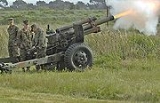
M101 howitzer

Overview
Howitzer
A howitzer is a type of artillery piece characterized by a relatively short barrel and the use of comparatively small propellant charges to propel projectiles at relatively high trajectories, with a steep angle of descent...
for the United States
United States
The United States of America is a federal constitutional republic comprising fifty states and a federal district...
in World War II
World War II
World War II, or the Second World War , was a global conflict lasting from 1939 to 1945, involving most of the world's nations—including all of the great powers—eventually forming two opposing military alliances: the Allies and the Axis...
, seeing action in both European
European Theatre of World War II
The European Theatre of World War II was a huge area of heavy fighting across Europe from Germany's invasion of Poland on September 1, 1939 until the end of the war with the German unconditional surrender on May 8, 1945...
and Pacific theaters
Pacific Ocean theater of World War II
The Pacific Ocean theatre was one of four major naval theatres of war of World War II, which pitted the forces of Japan against those of the United States, the British Commonwealth, the Netherlands and France....
. Entering production in 1941, it quickly entered the war against the Imperial Japanese Army
Imperial Japanese Army
-Foundation:During the Meiji Restoration, the military forces loyal to the Emperor were samurai drawn primarily from the loyalist feudal domains of Satsuma and Chōshū...
in the Pacific, where it gained a reputation for its accuracy and powerful punch. The M101 fired 105 mm high explosive (HE) semi-fixed ammunition and had a range of 11200 metres (12,248.5 yd), making it suitable for supporting infantry
Infantry
Infantrymen are soldiers who are specifically trained for the role of fighting on foot to engage the enemy face to face and have historically borne the brunt of the casualties of combat in wars. As the oldest branch of combat arms, they are the backbone of armies...
.
All of these qualities of the weapon, along with its widespread production, led to its adoption by many countries after the war.
Unanswered Questions
