

Kinorhyncha

Encyclopedia
Kinorhyncha is a phylum of small (1 mm or less) marine pseudocoelomate
invertebrate
s that are widespread in mud or sand at all depths as part of the meiobenthos
. They are also called mud dragons.
, withdrawing the head and pushing forward, then gripping the substrate with the spines while drawing up the body.
The body wall consists of a thin syncitial layer, which secretes a tough cuticle
; this is molted several times while growing to adulthood. The spines are essentially moveable extensions of the body wall, and are hollow and covered by cuticle. The head is completely retractable, and is covered by a set of neck plates called placids when retracted.
Kinorhynchs eat either diatoms or organic material found in the mud, depending on species. The mouth is located in a conical structure at the apex of the head, and opens into a pharynx
and then an oesophagus, both of which are lined by cuticle. Two pairs of salivary gland
s and one or more pairs of pancreatic glands connect to the oesophagus and presumably secrete digestive enzyme
s. Beyond the oesophagus lies a midgut that combines the functions of a stomach and intestine, and lacks a cuticle, enabling it to absorb nutrients. The short hind-gut is lined by cuticle, and empties into an anus
at the posterior end of the trunk.
There is no circulatory system, although the body cavity (or pseudocoel) is well developed, and includes amoebocytes. The excretory system consists of two proronephridia emptying through pores in the final segment.
The nervous system consists of a ventral nerve cord, with one ganglion
in each segment, and an anterior nerve ring surrounding the pharynx. Smaller ganglia are also located in the lateral and dorsal portions of each segment, but do not form distinct cords. Some species have simple ocelli
on the head, and all species have tiny bristles on the body to provide a sense of touch.
s are located in the mid-region of the trunk, and open to pores in the final segment. In most species, the sperm duct includes two or three spiny structures that presumably aid in copulation, although the details are unknown. The larva
e are free-living, but little else is known of their reproductive process.
and Priapulida
. Together they constitute the Scalidophora
.
Phylum Kinorhyncha
Body cavity
By the broadest definition, a body cavity is any fluid-filled space in a multicellular organism. However, the term usually refers to the space located between an animal’s outer covering and the outer lining of the gut cavity, where internal organs develop...
invertebrate
Invertebrate
An invertebrate is an animal without a backbone. The group includes 97% of all animal species – all animals except those in the chordate subphylum Vertebrata .Invertebrates form a paraphyletic group...
s that are widespread in mud or sand at all depths as part of the meiobenthos
Meiobenthos
Meiofauna are small benthic invertebrates that live in both marine and fresh water environments . The term Meiofauna loosely defines a group of organisms by their size, larger than Microfauna but smaller than Macrofauna, rather than a taxonomic grouping...
. They are also called mud dragons.
Anatomy
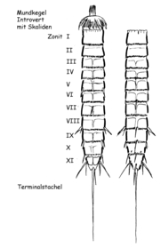
Kinorhynchans are segmented, limbless animals, with a body consisting of a head, neck, and a trunk of eleven segments. Unlike some similar invertebrates, they do not have external cilia, but instead have a number of spines along the body, plus up to seven circles of spines around the head. These spines are used for locomotionAnimal locomotion
Animal locomotion, which is the act of self-propulsion by an animal, has many manifestations, including running, swimming, jumping and flying. Animals move for a variety of reasons, such as to find food, a mate, or a suitable microhabitat, and to escape predators...
, withdrawing the head and pushing forward, then gripping the substrate with the spines while drawing up the body.
The body wall consists of a thin syncitial layer, which secretes a tough cuticle
Cuticle
A cuticle , or cuticula, is a term used for any of a variety of tough but flexible, non-mineral outer coverings of an organism, or parts of an organism, that provide protection. Various types of "cuticles" are non-homologous; differing in their origin, structure, function, and chemical composition...
; this is molted several times while growing to adulthood. The spines are essentially moveable extensions of the body wall, and are hollow and covered by cuticle. The head is completely retractable, and is covered by a set of neck plates called placids when retracted.
Kinorhynchs eat either diatoms or organic material found in the mud, depending on species. The mouth is located in a conical structure at the apex of the head, and opens into a pharynx
Pharynx
The human pharynx is the part of the throat situated immediately posterior to the mouth and nasal cavity, and anterior to the esophagus and larynx. The human pharynx is conventionally divided into three sections: the nasopharynx , the oropharynx , and the laryngopharynx...
and then an oesophagus, both of which are lined by cuticle. Two pairs of salivary gland
Salivary gland
The salivary glands in mammals are exocrine glands, glands with ducts, that produce saliva. They also secrete amylase, an enzyme that breaks down starch into maltose...
s and one or more pairs of pancreatic glands connect to the oesophagus and presumably secrete digestive enzyme
Digestive enzyme
'Digestive enzymes' are enzymes that break down polymeric macromolecules into their smaller building blocks, in order to facilitate their absorption by the body. Digestive enzymes are found in the digestive tract of animals where they aid in the digestion of food as well as inside the cells,...
s. Beyond the oesophagus lies a midgut that combines the functions of a stomach and intestine, and lacks a cuticle, enabling it to absorb nutrients. The short hind-gut is lined by cuticle, and empties into an anus
Anus
The anus is an opening at the opposite end of an animal's digestive tract from the mouth. Its function is to control the expulsion of feces, unwanted semi-solid matter produced during digestion, which, depending on the type of animal, may be one or more of: matter which the animal cannot digest,...
at the posterior end of the trunk.
There is no circulatory system, although the body cavity (or pseudocoel) is well developed, and includes amoebocytes. The excretory system consists of two proronephridia emptying through pores in the final segment.
The nervous system consists of a ventral nerve cord, with one ganglion
Ganglion
In anatomy, a ganglion is a biological tissue mass, most commonly a mass of nerve cell bodies. Cells found in a ganglion are called ganglion cells, though this term is also sometimes used to refer specifically to retinal ganglion cells....
in each segment, and an anterior nerve ring surrounding the pharynx. Smaller ganglia are also located in the lateral and dorsal portions of each segment, but do not form distinct cords. Some species have simple ocelli
Ocellus
A simple eye refers to a type of eye design or optical arrangement that contains a single lens which detect light. A "simple eye" is so-called in distinction from a multi-lensed "compound eye", and is not necessarily at all simple in the usual sense of the word...
on the head, and all species have tiny bristles on the body to provide a sense of touch.
Reproduction
There are two sexes that look alike. A pair of gonadGonad
The gonad is the organ that makes gametes. The gonads in males are the testes and the gonads in females are the ovaries. The product, gametes, are haploid germ cells. For example, spermatozoon and egg cells are gametes...
s are located in the mid-region of the trunk, and open to pores in the final segment. In most species, the sperm duct includes two or three spiny structures that presumably aid in copulation, although the details are unknown. The larva
Larva
A larva is a distinct juvenile form many animals undergo before metamorphosis into adults. Animals with indirect development such as insects, amphibians, or cnidarians typically have a larval phase of their life cycle...
e are free-living, but little else is known of their reproductive process.
Classification
Their closest relatives are thought to be the phyla LoriciferaLoricifera
Loricifera is a phylum of very small to microscopic marine sediment-dwelling animals with twenty-two described species, in eight genera. Aside from these described species, there are approximately 100 more that have been collected and not yet described. Their size ranges from 100 µm to ca....
and Priapulida
Priapulida
Priapulida is a phylum of marine worms. They are named for their extensible spiny proboscis, which, in some species, may have a shape like that of a human penis...
. Together they constitute the Scalidophora
Scalidophora
Scalidophora is a group of marine pseudocoelomate invertebrates, consisting of the three phyla Kinorhyncha, Priapulida, and Loricifera. The members of the group share a number of characteristics, including introvert larvae and moulting of the cuticle...
.
Taxonomy
The two groups of Kinorhynchs are still generally characterized as orders rather than classes. About 150 species are known.Phylum Kinorhyncha
- Order Cyclorhagida
- Suborder Cyclorhagae
- Family Echinoderidae
- Family Zelinkaderidae
- Family Centroderidae
- Family Dracoderidae
- Suborder Conchorhagae
- Family Semnoderidae
- Suborder Cryptorhagae
- Family Cateriidae
- Suborder Cyclorhagae
- Order Homalorhagida
- Suborder Homalorhagae
- Family Pycnophyidae
- Family Neocentrophyidae
- Suborder Homalorhagae