

Zygomycota

Encyclopedia
Zygomycota, or zygote fungi, is a phylum
of fungi
. The name comes from zygosporangia, where resistant spherical spores
are formed during sexual reproduction
. Approximately 1060 species are known. They are mostly terrestrial in habitat, living in soil or on decaying plant or animal material. Some are parasites of plants, insects, and small animals, while others form symbiotic relationships with plants. Zygomycete hypha
e may be coenocytic
, forming septa only where gamete
s are formed or to wall off dead hyphae.
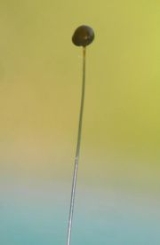
(Rhizopus stolonifer), a member of the Mucorales
. It spreads over the surface of bread and other food sources, sending hyphae inward to absorb nutrients.
In its asexual
phase it develops bulbous black sporangia
at the tips of upright hyphae, each containing hundreds of haploid spore
s.
As in most zygomycetes, asexual reproduction is the most common form of reproduction. Sexual reproduction in Rhizopus stolonifera, as in other zygomycetes, occurs when haploid hyphae of different mating types are in close proximity to each other. Growth of the gametangia commences after gametangia come in contact, and plasmogamy
, or the fusion of the cytoplasm, occurs. Karyogamy
, which is the fusion of the nuclei, follows closely after. The zygosporangia are then diploid. Zygosporangia are typically thick-walled, highly resilient to environmental hardships, and metabolically inert. When conditions improve, however, they germinate to produce a sporangium or vegetative hypha
e. Meiosis occurs during germination of the zygosporagium so the resulting spores or hyphae are haploid. Grows in warm and damp conditions.
Some zygomycetes disperse their spores in a more precise manner than simply allowing them to drift aimlessly on air currents. Pilobolus
, a fungus which grows on animal dung, bends its sporangiophores towards light with the help of a light sensitive pigment and then "fires" them with an explosive squirt of high-pressure cytoplasm
. Sporangia can be launched as far as 2 m, placing them far away from the dung and hopefully on vegetation which will be eaten by an herbivore, eventually to be deposited with dung elsewhere. Different mechanisms for forcible spore discharge have evolved among members of the zygomycete order Entomophthorales
.
, having diverged from other fungi after chytrids
.
Molecular phylogenetics reveals that they form a polyphyletic group and could see a split into several new phyla.
The order Glomales was removed in 2001 and elevated to Division (or phylum) Glomeromycota
due to their lack of zygospore formation, mycorrhiza
l habit, and lack of DNA
sequence homology.
Phylum
In biology, a phylum The term was coined by Georges Cuvier from Greek φῦλον phylon, "race, stock," related to φυλή phyle, "tribe, clan." is a taxonomic rank below kingdom and above class. "Phylum" is equivalent to the botanical term division....
of fungi
Fungus
A fungus is a member of a large group of eukaryotic organisms that includes microorganisms such as yeasts and molds , as well as the more familiar mushrooms. These organisms are classified as a kingdom, Fungi, which is separate from plants, animals, and bacteria...
. The name comes from zygosporangia, where resistant spherical spores
Zygospore
A zygospore is a diploid reproductive stage in the life cycle of many fungi and protists. Zygospores are created by the nuclear fusion of haploid cells. In fungi, zygospores are termed chlamydospores and are formed after the fusion of hyphae of different mating types...
are formed during sexual reproduction
Sexual reproduction
Sexual reproduction is the creation of a new organism by combining the genetic material of two organisms. There are two main processes during sexual reproduction; they are: meiosis, involving the halving of the number of chromosomes; and fertilization, involving the fusion of two gametes and the...
. Approximately 1060 species are known. They are mostly terrestrial in habitat, living in soil or on decaying plant or animal material. Some are parasites of plants, insects, and small animals, while others form symbiotic relationships with plants. Zygomycete hypha
Hypha
A hypha is a long, branching filamentous structure of a fungus, and also of unrelated Actinobacteria. In most fungi, hyphae are the main mode of vegetative growth, and are collectively called a mycelium; yeasts are unicellular fungi that do not grow as hyphae.-Structure:A hypha consists of one or...
e may be coenocytic
Coenocyte
A coenocyte is a multinucleate cell. It can result from multiple nuclear divisions without accompanying cell divisions, or from cellular aggregation followed by dissolution of the cell membranes inside the mass. Coenocytes are found in fungi and some protists, such as algae and slime mold. Some...
, forming septa only where gamete
Gamete
A gamete is a cell that fuses with another cell during fertilization in organisms that reproduce sexually...
s are formed or to wall off dead hyphae.
Reproduction
The common example of a zygomycete is black bread moldBlack bread mold
Rhizopus stolonifer is a widely distributed thread-like Mucoralean mold. Commonly found on bread surfaces, it takes food and nutrients from the bread and causes damage to the surface where it lives....
(Rhizopus stolonifer), a member of the Mucorales
Mucorales
The Mucorales is the largest and best studied order of Zygomycete fungi. Members of this order are sometimes called pin molds.-Systematics:...
. It spreads over the surface of bread and other food sources, sending hyphae inward to absorb nutrients.
In its asexual
Asexual reproduction
Asexual reproduction is a mode of reproduction by which offspring arise from a single parent, and inherit the genes of that parent only, it is reproduction which does not involve meiosis, ploidy reduction, or fertilization. A more stringent definition is agamogenesis which is reproduction without...
phase it develops bulbous black sporangia
Sporangium
A sporangium is an enclosure in which spores are formed. It can be composed of a single cell or can be multicellular. All plants, fungi, and many other lineages form sporangia at some point in their life cycle...
at the tips of upright hyphae, each containing hundreds of haploid spore
Spore
In biology, a spore is a reproductive structure that is adapted for dispersal and surviving for extended periods of time in unfavorable conditions. Spores form part of the life cycles of many bacteria, plants, algae, fungi and some protozoa. According to scientist Dr...
s.
As in most zygomycetes, asexual reproduction is the most common form of reproduction. Sexual reproduction in Rhizopus stolonifera, as in other zygomycetes, occurs when haploid hyphae of different mating types are in close proximity to each other. Growth of the gametangia commences after gametangia come in contact, and plasmogamy
Plasmogamy
Plasmogamy is a stage in the sexual reproduction of fungi. In this stage, the cytoplasm of two parent mycelia fuse together without the fusion of nuclei, as occurs in higher terrestrial fungi. After plasmogamy occurs, the secondary mycelium forms. The secondary mycelium consists of dikaryotic...
, or the fusion of the cytoplasm, occurs. Karyogamy
Karyogamy
Karyogamy is the fusion of pronuclei of two cells, as part of syngamy, fertilization, or true bacterial conjugation.It is one of the two major modes of reproduction in fungi...
, which is the fusion of the nuclei, follows closely after. The zygosporangia are then diploid. Zygosporangia are typically thick-walled, highly resilient to environmental hardships, and metabolically inert. When conditions improve, however, they germinate to produce a sporangium or vegetative hypha
Hypha
A hypha is a long, branching filamentous structure of a fungus, and also of unrelated Actinobacteria. In most fungi, hyphae are the main mode of vegetative growth, and are collectively called a mycelium; yeasts are unicellular fungi that do not grow as hyphae.-Structure:A hypha consists of one or...
e. Meiosis occurs during germination of the zygosporagium so the resulting spores or hyphae are haploid. Grows in warm and damp conditions.
Some zygomycetes disperse their spores in a more precise manner than simply allowing them to drift aimlessly on air currents. Pilobolus
Pilobolus
Pilobolus is a genus of fungi that commonly grows on herbivore dung.-Life cycle:The life cycle of Pilobolus begins with a black sporangium that has been discharged onto a plant substrate such as grass. A herbivorous animal such as a horse then eats the substrate, unknowingly consuming the...
, a fungus which grows on animal dung, bends its sporangiophores towards light with the help of a light sensitive pigment and then "fires" them with an explosive squirt of high-pressure cytoplasm
Cytoplasm
The cytoplasm is a small gel-like substance residing between the cell membrane holding all the cell's internal sub-structures , except for the nucleus. All the contents of the cells of prokaryote organisms are contained within the cytoplasm...
. Sporangia can be launched as far as 2 m, placing them far away from the dung and hopefully on vegetation which will be eaten by an herbivore, eventually to be deposited with dung elsewhere. Different mechanisms for forcible spore discharge have evolved among members of the zygomycete order Entomophthorales
Entomophthorales
The Entomophthorales are an order of fungi that were previously classified in the class Zygomycetes. A new subphylum, Entomophthoromycotina, has recently been described for them.Most species of the Entomophthorales are pathogens of insects...
.
Phylogeny
The Zygomycota are generally placed near the base of the fungal phylogenetic treePhylogenetic tree
A phylogenetic tree or evolutionary tree is a branching diagram or "tree" showing the inferred evolutionary relationships among various biological species or other entities based upon similarities and differences in their physical and/or genetic characteristics...
, having diverged from other fungi after chytrids
Chytridiomycota
Chytridiomycota is a division of the Fungi kingdom. The name is derived from the Greek chytridion, meaning "little pot", describing the structure containing unreleased spores. In older classifications, chytrids were placed in the Class Phycomycetes under the subdivision Myxomycophyta of the...
.
Molecular phylogenetics reveals that they form a polyphyletic group and could see a split into several new phyla.
The order Glomales was removed in 2001 and elevated to Division (or phylum) Glomeromycota
Glomeromycota
Glomeromycota is one of seven currently recognized phyla within the kingdom Fungi, with approximately 230 described species. Members of the Glomeromycota form arbuscular mycorrhizas with the roots or thalli of land plants. Geosiphon pyriformis forms an endocytobiotic association with Nostoc...
due to their lack of zygospore formation, mycorrhiza
Mycorrhiza
A mycorrhiza is a symbiotic association between a fungus and the roots of a vascular plant....
l habit, and lack of DNA
DNA
Deoxyribonucleic acid is a nucleic acid that contains the genetic instructions used in the development and functioning of all known living organisms . The DNA segments that carry this genetic information are called genes, but other DNA sequences have structural purposes, or are involved in...
sequence homology.
Evolution of conidia
The evolution of sporangiospores typical of zygomycetes to conidia similar to those found in ascomycetes can be modeled by a series of forms seen in zygomycetes. The evolution of the conidia from the sporangiospore is the main defining difference between Zygomycetes and Ascomycetes. Many zygomycetes produce multiple sporangiospores inside a single sporangium. Some have evolved multiple small sporangiola that contain few sporangiospores. In some cases, there may be a few as three spores in each sporangiolum, and a few species have sporangiola which contain just a single spore. "Choanephora", a zygomycete, has a sporangiolum that contains one spore with a sporangium wall that is visible at the base of the sporangium. This structure is similar to a conidium, which has two, fused cell walls, an inner spore wall and an outer sporangium wall.External links
- Zygomycota at the Tree of Life Web Project
- Zygomycetes.org
- List of all Zygomycetes species from Zygomycetes database by PM Kirk in Catalogue of Life 2008