

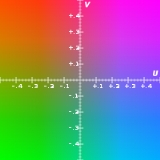
YUV

Encyclopedia


Color space
A color model is an abstract mathematical model describing the way colors can be represented as tuples of numbers, typically as three or four values or color components...
typically used as part of a color image pipeline
Color image pipeline
An image pipeline or video pipeline is a term used to describe the components that are typically or commonly used between an image source , and an image renderer , or for performing any intermediate digital image processing...
. It encodes a color image or video taking human perception into account, allowing reduced bandwidth for chrominance
Chrominance
Chrominance is the signal used in video systems to convey the color information of the picture, separately from the accompanying luma signal . Chrominance is usually represented as two color-difference components: U = B' − Y' and V = R' − Y'...
components, thereby typically enabling transmission errors or compression artifacts to be more efficiently masked by the human perception than using a "direct" RGB-representation. Other color spaces have similar properties, and the main reason to implement or investigate properties of Y'UV would be for interfacing with analog or digital television or photographic equipment that conforms to certain Y'UV standards.
The scope of the terms Y'UV, YUV, YCbCr
YCbCr
YCbCr or Y′CbCr, sometimes written or , is a family of color spaces used as a part of the color image pipeline in video and digital photography systems. Y′ is the luma component and CB and CR are the blue-difference and red-difference chroma components...
, YPbPr
YPbPr
' is a color space used in video electronics, in particular in reference to component video cables. is the analog version of the YCBCR color space; the two are numerically equivalent, but YPBPR is designed for use in analog systems whereas YCBCR is intended for digital video. cables are also...
, etc., is sometimes ambiguous and overlapping. Historically, the terms YUV and Y'UV were used for a specific analog encoding of color information in television systems, while YCbCr was used for digital encoding of color information suited for video and still-image compression and transmission such as MPEG and JPEG
JPEG
In computing, JPEG . The degree of compression can be adjusted, allowing a selectable tradeoff between storage size and image quality. JPEG typically achieves 10:1 compression with little perceptible loss in image quality....
. Today, the term YUV is commonly used in the computer industry to describe file-formats that are encoded using YCbCr.
The Y'UV model defines a color space
Color space
A color model is an abstract mathematical model describing the way colors can be represented as tuples of numbers, typically as three or four values or color components...
in terms of one luma
Luma (video)
In video, luma, sometimes called luminance, represents the brightness in an image . Luma is typically paired with chrominance. Luma represents the achromatic image without any color, while the chroma components represent the color information...
(Y') and two chrominance
Chrominance
Chrominance is the signal used in video systems to convey the color information of the picture, separately from the accompanying luma signal . Chrominance is usually represented as two color-difference components: U = B' − Y' and V = R' − Y'...
(UV) components. The Y'UV color model is used in the PAL
PAL
PAL, short for Phase Alternating Line, is an analogue television colour encoding system used in broadcast television systems in many countries. Other common analogue television systems are NTSC and SECAM. This page primarily discusses the PAL colour encoding system...
and SECAM
SECAM
SECAM, also written SÉCAM , is an analog color television system first used in France....
composite color video
Composite video
Composite video is the format of an analog television signal before it is combined with a sound signal and modulated onto an RF carrier. In contrast to component video it contains all required video information, including colors in a single line-level signal...
standards. Previous black-and-white systems used only luma (Y') information. Color information (U and V) was added separately via a sub-carrier so that a black-and-white receiver would still be able to receive and display a color picture transmission in the receiver's native black-and-white
Black-and-white
Black-and-white, often abbreviated B/W or B&W, is a term referring to a number of monochrome forms in visual arts.Black-and-white as a description is also something of a misnomer, for in addition to black and white, most of these media included varying shades of gray...
format.
Y' stands for the luma
Luma (video)
In video, luma, sometimes called luminance, represents the brightness in an image . Luma is typically paired with chrominance. Luma represents the achromatic image without any color, while the chroma components represent the color information...
component (the brightness) and U and V are the chrominance
Chrominance
Chrominance is the signal used in video systems to convey the color information of the picture, separately from the accompanying luma signal . Chrominance is usually represented as two color-difference components: U = B' − Y' and V = R' − Y'...
(color) components; luminance is denoted by Y and luma by Y' – the prime symbols (') denote gamma compression, with "luminance" meaning perceptual (color science) brightness, while "luma" is electronic (voltage of display) brightness.
The YPbPr
YPbPr
' is a color space used in video electronics, in particular in reference to component video cables. is the analog version of the YCBCR color space; the two are numerically equivalent, but YPBPR is designed for use in analog systems whereas YCBCR is intended for digital video. cables are also...
color model used in analog component video
Component video
Component video is a video signal that has been split into two or more component channels. In popular use, it refers to a type of component analog video information that is transmitted or stored as three separate signals...
and its digital version YCbCr
YCbCr
YCbCr or Y′CbCr, sometimes written or , is a family of color spaces used as a part of the color image pipeline in video and digital photography systems. Y′ is the luma component and CB and CR are the blue-difference and red-difference chroma components...
used in digital video are more or less derived from it, and are sometimes called Y'UV. (CB/PB and CR/PR are deviations from grey on blue–yellow and red–cyan axes, whereas U and V are blue–luminance and red–luminance differences.) The Y'IQ
YIQ
YIQ is the color space used by the NTSC color TV system, employed mainly in North and Central America, and Japan. It is currently in use only for low-power television stations, as full-power analog transmission was ended by the U.S. Federal Communications Commission on 12 June 2009...
color space used in the analog NTSC
NTSC
NTSC, named for the National Television System Committee, is the analog television system that is used in most of North America, most of South America , Burma, South Korea, Taiwan, Japan, the Philippines, and some Pacific island nations and territories .Most countries using the NTSC standard, as...
television broadcasting system is related to it, although in a more complex way.
History
Y'UV was invented when engineers wanted color televisionColor television
Color television is part of the history of television, the technology of television and practices associated with television's transmission of moving images in color video....
in a black-and-white
Black-and-white
Black-and-white, often abbreviated B/W or B&W, is a term referring to a number of monochrome forms in visual arts.Black-and-white as a description is also something of a misnomer, for in addition to black and white, most of these media included varying shades of gray...
infrastructure. They needed a signal transmission method that was compatible with black-and-white (B&W) TV while being able to add color. The luma component already existed as the black and white signal; they added the UV signal to this as a solution.
The UV representation of chrominance was chosen over straight R and B signals because U and V are color difference signals. This meant that in a black and white scene the U and V signals would be zero and only the Y' signal would need to be transmitted. If R and B were to have been used, these would have non-zero values even in a B&W scene, requiring all three data-carrying signals. This was important in the early days of color television, because holding the U and V signals to zero while connecting the black and white signal to Y' allowed color TV sets to display B&W TV without the additional expense and complexity of special B&W circuitry. In addition, black and white receivers could take the Y' signal and ignore the color signals, making Y'UV backward-compatible with all existing black-and-white equipment, input and output. It was necessary to assign a narrower bandwidth to the chrominance channel because there was no additional bandwidth available. If some of the luminance information arrived via the chrominance channel (as it would have if RB signals were used instead of differential UV signals), B&W resolution would have been compromised.
Conversion to/from RGB
Y'UV signals are typically created from RGB (redRed
Red is any of a number of similar colors evoked by light consisting predominantly of the longest wavelengths of light discernible by the human eye, in the wavelength range of roughly 630–740 nm. Longer wavelengths than this are called infrared , and cannot be seen by the naked eye...
, green
Green
Green is a color, the perception of which is evoked by light having a spectrum dominated by energy with a wavelength of roughly 520–570 nanometres. In the subtractive color system, it is not a primary color, but is created out of a mixture of yellow and blue, or yellow and cyan; it is considered...
and blue
Blue
Blue is a colour, the perception of which is evoked by light having a spectrum dominated by energy with a wavelength of roughly 440–490 nm. It is considered one of the additive primary colours. On the HSV Colour Wheel, the complement of blue is yellow; that is, a colour corresponding to an equal...
) source. Weighted values of R, G, and B are summed to produce Y', a measure of overall brightness or luminance. U and V are computed as scaled differences between Y' and the B and R values.
Defining the following constants:
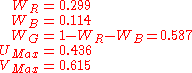
Y'UV is computed from RGB as follows:
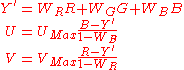
The resulting ranges of Y', U, and V respectively are [0, 1], [-UMax, UMax], and [-VMax, VMax].
Inverting the above transformation converts Y'UV to RGB:
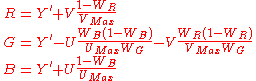
Equivalently, substituting values for the constants and expressing them as matrices gives:


BT.709 and BT.601
When standardising high-definition videoHigh-definition video
High-definition video or HD video refers to any video system of higher resolution than standard-definition video, and most commonly involves display resolutions of 1,280×720 pixels or 1,920×1,080 pixels...
, the ATSC
ATSC
ATSC standards are a set of standards developed by the Advanced Television Systems Committee for digital television transmission over terrestrial, cable, and satellite networks....
chose a different formula for the YCbCr than that used for standard-definition video. This means that when converting between SDTV and HDTV, the color information has to be altered, in addition to image scaling
Image scaling
In computer graphics, image scaling is the process of resizing a digital image. Scaling is a non-trivial process that involves a trade-off between efficiency, smoothness and sharpness. As the size of an image is increased, so the pixels which comprise the image become increasingly visible, making...
the video.
The formulae above reference Rec. 601. For HDTV, a slightly different matrix is used, where WR and WB in the above formula is replaced by Rec. 709
Rec. 709
ITU-R Recommendation BT.709, more commonly known by the abbreviations Rec. 709 or BT.709, standardizes the format of high-definition television, having 16:9 aspect ratio. The first edition of the standard was approved in 1990....
:

This gives the matrices :


Numerical approximations
Prior to the development of fast SIMDSIMD
Single instruction, multiple data , is a class of parallel computers in Flynn's taxonomy. It describes computers with multiple processing elements that perform the same operation on multiple data simultaneously...
floating-point processors, most digital implementations of RGB->Y'UV used integer math, in particular fixed-point
Fixed-point arithmetic
In computing, a fixed-point number representation is a real data type for a number that has a fixed number of digits after the radix point...
approximations. In the following examples, the operator "
 " denotes a right-shift of a by b bits.
Traditional 8 bit representation of Y'UV with unsigned integers uses the following
1. Basic transform
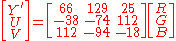
2. Scale down to 8 bits with rounding
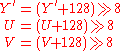
3. Shift values

Y' values are conventionally shifted and scaled to the range [16, 235] (referred to as studio swing) rather than using the full range of [0, 255] (referred to as full swing). This confusing practice derives from the MPEG standards and explains why 16 is added to Y' and why the Y' coefficients in the basic transform sum to 220 instead of 255. U and V values, which may be positive or negative, are summed with 128 to make them always positive.
Luminance/chrominance systems in general
The primary advantages of luma/chroma systems such as Y'UV, and its relatives Y'IQYIQ
YIQ is the color space used by the NTSC color TV system, employed mainly in North and Central America, and Japan. It is currently in use only for low-power television stations, as full-power analog transmission was ended by the U.S. Federal Communications Commission on 12 June 2009...
and YDbDr
YDbDr
YDbDr, sometimes written YDBDR, is the colour space used in the SÉCAM analog terrestrial colour television broadcasting standard, which is used in France and some countries of the former Eastern Bloc. It is very close to YUV and its related colour spaces such as YIQ , YPbPr and YCbCr.YDbDr is...
, are that they remain compatible with black and white analog television
Analog television
Analog television is the analog transmission that involves the broadcasting of encoded analog audio and analog video signal: one in which the message conveyed by the broadcast signal is a function of deliberate variations in the amplitude and/or frequency of the signal...
(largely due to the work of Georges Valensi
Georges Valensi
Georges Valensi was a French telecommunications engineer who, in 1938, invented and patented a method of transmitting color images so that they could be received on both color and black & white television sets....
). The Y' channel saves nearly all the data recorded by black and white cameras, so it produces a signal suitable for reception on old monochrome displays. In this case, the U and V are simply discarded. If displaying color, all three channels are used, and the original RGB information can be decoded.
Another advantage of Y'UV is that some of the information can be discarded in order to reduce bandwidth. The human eye has fairly little spatial sensitivity to color: the accuracy of the brightness information of the luminance channel has far more impact on the image detail discerned than that of the other two. Understanding this human shortcoming, standards such as NTSC
NTSC
NTSC, named for the National Television System Committee, is the analog television system that is used in most of North America, most of South America , Burma, South Korea, Taiwan, Japan, the Philippines, and some Pacific island nations and territories .Most countries using the NTSC standard, as...
reduce the bandwidth of the chrominance channels considerably. (Bandwidth is in the temporal domain, but this translates into the spatial domain as the image is scanned out.)
Therefore, the resulting U and V signals can be substantially "compressed". In the NTSC
NTSC
NTSC, named for the National Television System Committee, is the analog television system that is used in most of North America, most of South America , Burma, South Korea, Taiwan, Japan, the Philippines, and some Pacific island nations and territories .Most countries using the NTSC standard, as...
(Y'IQ) and PAL
PAL
PAL, short for Phase Alternating Line, is an analogue television colour encoding system used in broadcast television systems in many countries. Other common analogue television systems are NTSC and SECAM. This page primarily discusses the PAL colour encoding system...
systems, the chrominance signals had significantly narrower bandwidth than that for the luminance. Early versions of NTSC rapidly alternated between particular colors in identical image areas to make them appear adding up to each other to the human eye, while all modern analogue and even most digital video standards use chroma subsampling
Chroma subsampling
Chroma subsampling is the practice of encoding images by implementing less resolution for chroma information than for luma information, taking advantage of the human visual system's lower acuity for color differences than for luminance....
by recording a picture's color information at only half the resolution compared to the brightness information. This ratio is the most common form, known as 4:2:2, which is the sample ratio of Y:U:V, or Y:I:Q. The 4:x:x standard was adopted due to the very earliest color NTSC standard which used a chroma subsampling of 4:1:1 so that the picture carried only a quarter as much resolution in color than it did in brightness. Today, only high-end equipment processing uncompressed signals uses a chroma subsampling of 4:4:4 with identical resolution for both brightness and color information.
The I and Q axes were chosen according to bandwidth needed by human vision, one axis being that requiring the most bandwidth, and the other (fortuitously at 90 degrees) the minimum. However, true I and Q demodulation was relatively more complex, requiring two analog delay lines, and NTSC receivers rarely used it.
However, this color space conversion is lossy, particularly obvious in crosstalk from the luma to the chroma-carrying wire, and vice versa, in analogue equipment (including RCA connector
RCA connector
An RCA connector, sometimes called a phono connector or cinch connector, is a type of electrical connector commonly used to carry audio and video signals...
s to transfer a digital signal, as all they carry is analogue composite video
Composite video
Composite video is the format of an analog television signal before it is combined with a sound signal and modulated onto an RF carrier. In contrast to component video it contains all required video information, including colors in a single line-level signal...
, which is either YUV, YIQ, or even CVBS). Furthermore, NTSC and PAL encoded color signals in a manner that causes high bandwidth chroma and luma signals to mix with each other in a bid to maintain backward compatibility with black and white television equipment, which results in dot crawl
Dot crawl
Dot crawl is the popular name for a visual defect of color analog video standards when signals are transmitted as composite video, as in terrestrial broadcast television. It consists of animated checkerboard patterns which appear along vertical color transitions...
and cross color artifacts. When the NTSC standard was created in the 1950s, this was not a real concern since the quality of the image was limited by the monitor equipment, not the limited-bandwidth signal being received. However today's modern television is capable of displaying more information than is contained in these lossy signals. To keep pace with the abilities of new display technologies, attempts were made since the late 1970s to preserve more of the Y'UV signal while transferring images, such as SCART
SCART
SCART is a French-originated standard and associated 21-pin connector for connecting audio-visual equipment together...
(1977) and S-Video
S-Video
Separate Video, more commonly known as S-Video and Y/C, is often referred to by JVC as both an S-VHS connector and as Super Video. It is an analog video transmission scheme, in which video information is encoded on two channels: luma and chroma...
(1987) connectors.
Instead of Y'UV, Y'CbCr was used as the standard format for (digital) common video compression algorithms such as MPEG-2
MPEG-2
MPEG-2 is a standard for "the generic coding of moving pictures and associated audio information". It describes a combination of lossy video compression and lossy audio data compression methods which permit storage and transmission of movies using currently available storage media and transmission...
. Digital television and DVDs preserve their compressed video streams in the MPEG-2
MPEG-2
MPEG-2 is a standard for "the generic coding of moving pictures and associated audio information". It describes a combination of lossy video compression and lossy audio data compression methods which permit storage and transmission of movies using currently available storage media and transmission...
format, which uses a full Y'CbCr color space, although retaining the established process of chroma subsampling. The professional CCIR 601
CCIR 601
ITU-R Recommendation BT.601, more commonly known by the abbreviations Rec. 601 or BT.601 is a standard published in 1982 by International Telecommunication Union - Radiocommunications sector for encoding interlaced analog video signals in digital video form...
digital video format also uses Y'CbCr at the common chroma subsampling rate of 4:2:2, primarily for compatibility with previous analog video standards. This stream can be easily mixed into any output format needed.
Y'UV is not an absolute color space
Absolute color space
In color science, there are two meanings of the term absolute color space:* A color space in which the perceptual difference between colors is directly related to distances between colors as represented by points in the color space....
. It is a way of encoding RGB information, and the actual color displayed depends on the actual RGB colorants used to display the signal. Therefore a value expressed as Y'UV is only predictable if standard RGB colorants are used (i.e. a fixed set of primary chromaticities, or particular set of red, green, and blue).
Confusion with Y'CbCr
Y'UV is often used as the term for YCbCrYCbCr
YCbCr or Y′CbCr, sometimes written or , is a family of color spaces used as a part of the color image pipeline in video and digital photography systems. Y′ is the luma component and CB and CR are the blue-difference and red-difference chroma components...
. However, they are different formats. Y'UV is an analog system with scale factors different from the digital Y'CbCr system.
In digital video/image systems, Y'CbCr is the most common way to express color in a way suitable for compression/transmission. The confusion stems from computer implementations and text-books erroneously using the term YUV where Y'CbCr would be correct.
Types of sampling
To get a digital signal, Y'UV images can be sampled in several different ways; see chroma subsamplingChroma subsampling
Chroma subsampling is the practice of encoding images by implementing less resolution for chroma information than for luma information, taking advantage of the human visual system's lower acuity for color differences than for luminance....
.
Converting between Y'UV and RGB
The function [R, G, B] = Y'UV444toRGB888(Y', U, V) converts Y'UV format to simple RGB format and could be implemented using floating point arithmetic as:Y'UV444
The RGB conversion formulae used for Y'UV444 format are also applicable to the standard NTSC TV transmission format of YUV420 (or YUV422 for that matter). For YUV420, since each U or V sample is used to represent 4 Y samples that form a square, a proper sampling method can allow the utilization of the exact conversion formulae shown below. For more details, please see the 420 format demonstration in the bottom section of this article.These formulae are based on the NTSC standard;



On older, non-SIMD
SIMD
Single instruction, multiple data , is a class of parallel computers in Flynn's taxonomy. It describes computers with multiple processing elements that perform the same operation on multiple data simultaneously...
architectures, floating point arithmetic is much slower than using fixed-point arithmetic, so an alternative formulation is:


Using the previous coefficients and noting that clamp denotes clamping a value to the range of 0 to 255, the following formulae provide the conversion from Y'UV to RGB (NTSC version):



Note: The above formulae are actually implied for YCbCr.
Though the term YUV is used here, it should be noted that YUV and YCbCr are not exactly the same in a strict manner.
The ITU-R version of the formulae is different:






Integer operation of ITU-R standard for YCbCr(8 bits per channel) to RGB888:





Y'UV422
- Input: Read 4 bytes of Y'UV (u, y1, v, y2 )
- Output: Writes 6 bytes of RGB (R, G, B, R, G, B)
y1 = yuv[0];
u = yuv[1];
y2 = yuv[2];
v = yuv[3];
Using this information it could be parsed as regular Y'UV444 format to get 2 RGB pixels info:
rgb1 = Y'UV444toRGB888(y1, u, v);
rgb2 = Y'UV444toRGB888(y2, u, v);
Y'UV422 can also be expressed in YUY2 FourCC
FourCC
A FourCC is a sequence of four bytes used to uniquely identify data formats.The concept originated in the OSType scheme used in the Macintosh system software and was adopted for the Amiga/Electronic Arts Interchange File Format and derivatives...
format code. That means 2 pixels will be defined in each macropixel (four bytes) treated in the image.
 .
.Y'UV411
// Extract YUV componentsu = yuv[0];
y1 = yuv[1];
y2 = yuv[2];
v = yuv[3];
y3 = yuv[4];
y4 = yuv[5];
rgb1 = Y'UV444toRGB888(y1, u, v);
rgb2 = Y'UV444toRGB888(y2, u, v);
rgb3 = Y'UV444toRGB888(y3, u, v);
rgb4 = Y'UV444toRGB888(y4, u, v);
So the result is we are getting 4 RGB pixels values (4*3 bytes) from 6 bytes. This means reducing the size of transferred data to half, with a loss of quality.
Y'UV420p (and Y'V12 or YV12)
Y'UV420p is a planar format, meaning that the Y', U, and V values are grouped together instead of interspersed. The reason for this is that by grouping the U and V values together, the image becomes much more compressible. When given an array of an image in the Y'UV420p format, all the Y' values come first, followed by all the U values, followed finally by all the V values.The Y'V12 format is essentially the same as Y'UV420p, but it has the U and V data reversed: the Y' values are followed by the V values, with the U values last. As long as care is taken to extract U and V values from the proper locations, both Y'UV420p and Y'V12 can be processed using the same algorithm.
As with most Y'UV formats, there are as many Y' values as there are pixels. Where X equals the height multiplied by the width, the first X indices in the array are Y' values that correspond to each individual pixel. However, there are only one fourth as many U and V values. The U and V values correspond to each 2 by 2 block of the image, meaning each U and V entry applies to four pixels. After the Y' values, the next X/4 indices are the U values for each 2 by 2 block, and the next X/4 indices after that are the V values that also apply to each 2 by 2 block.
Translating Y'UV420p to RGB is a more involved process compared to the previous formats. Lookup of the Y', U and V values can be done using the following method:
size.total = size.width * size.height;
y = yuv[position.y * size.width + position.x];
u = yuv[(position.y / 2) * (size.width / 2) + (position.x / 2) + size.total];
v = yuv[(position.y / 2) * (size.width / 2) + (position.x / 2) + size.total + (size.total / 4)];
rgb = Y'UV444toRGB888(y, u, v);
Here "/" is Div not division.
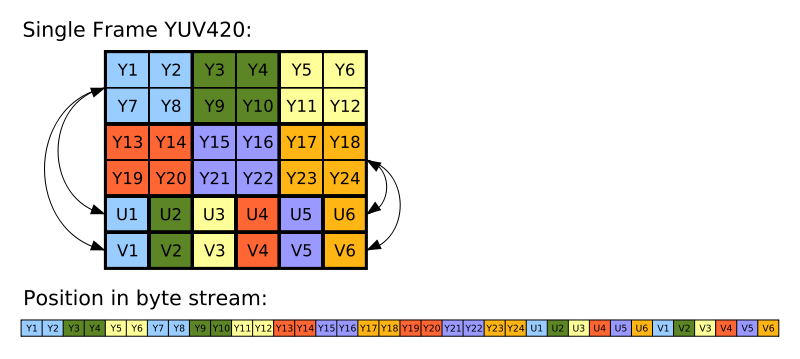
As shown in the above image, the Y', U and V components in Y'UV420 are encoded separately in sequential blocks. A Y' value is stored for every pixel, followed by a U value for each 2×2 square block of pixels, and finally a V value for each 2×2 block. Corresponding Y', U and V values are shown using the same color in the diagram above. Read line-by-line as a byte stream from a device, the Y' block would be found at position 0, the U block at position x×y (6×4 = 24 in this example) and the V block at position x×y + (x×y)/4 (here, 6×4 + (6×4)/4 = 30).
External links
- RGB/Y'UV Pixel Conversion
- Explanation of many different formats in the Y'UV family
- Poynton, Charles. Video engineering
- Kohn, Mike. Y'UV422 to RGB using SSE/Assembly
- YUV, YCbCr, YPbPr colour spaces.
- Color formats for image and video processing - Color conversion between RGB, YUV, YCbCr and YPbPr.
- How to convert RGB to YUV420P
- C library of SSE-optimised color format conversions.