

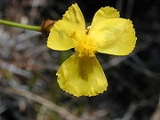
Xyridaceae

Encyclopedia
Xyridaceae is the botanical name
of a family
of flowering plants. Such a family has been recognized by many taxonomists and is known as the Yellow-eyed-grass Family.
The APG II system
, of 2003 (unchanged from the APG system
, of 1998), also recognizes this family, and assigns it to the order Poales
in the clade commelinids
, in the monocots. This treatment in APG II represents a slight change from the APG system
, of 1998, which had recognized the family Abolbodaceae for some of the plants included here: that family was unplaced as to order, but was assigned to this same clade (although APG used the spelling "commelinoids").
The family contains almost three hundred species in five genera, but most of the species are found in the genus Xyris
(see also Abolboda
). The species are mostly tropical and subtropical.
The Cronquist system
, of 1981, also recognized such a family and placed it in the order Commelinales
in the subclass Commelinidae
in class Liliopsida
in division Magnoliophyta.
The Wettstein system
, last update in 1935, placed the family in order Enantioblastae.
Xyris torta or Twisted Yellow-Eyed Grass is on Minnesota
's endangered species
list.
Botanical name
A botanical name is a formal scientific name conforming to the International Code of Botanical Nomenclature and, if it concerns a plant cultigen, the additional cultivar and/or Group epithets must conform to the International Code of Nomenclature for Cultivated Plants...
of a family
Family (biology)
In biological classification, family is* a taxonomic rank. Other well-known ranks are life, domain, kingdom, phylum, class, order, genus, and species, with family fitting between order and genus. As for the other well-known ranks, there is the option of an immediately lower rank, indicated by the...
of flowering plants. Such a family has been recognized by many taxonomists and is known as the Yellow-eyed-grass Family.
The APG II system
APG II system
The APG II system of plant classification is the second, now obsolete, version of a modern, mostly molecular-based, system of plant taxonomy that was published in April 2003 by the Angiosperm Phylogeny Group. It was a revision of the first APG system, published in 1998, and was superseded in 2009...
, of 2003 (unchanged from the APG system
APG system
The APG system of plant classification is the first, now obsolete, version of a modern, mostly molecular-based, system of plant taxonomy that was published in 1998 by the Angiosperm Phylogeny Group. It was superseded in 2003 by a revision, the APG II system, and then in 2009 by a further...
, of 1998), also recognizes this family, and assigns it to the order Poales
Poales
Poales is a large order of flowering plants in the monocotyledons, and includes families of plants such as the grasses, bromeliads, and sedges. Sixteen plant families are currently recognized by botanists to be part of Poales....
in the clade commelinids
Commelinids
In plant taxonomy, commelinids is a name used by the APG III system for a clade within the monocots, which in its turn is a clade within the angiosperms. The commelinids are the only clade that the APG has informally named within the monocots...
, in the monocots. This treatment in APG II represents a slight change from the APG system
APG system
The APG system of plant classification is the first, now obsolete, version of a modern, mostly molecular-based, system of plant taxonomy that was published in 1998 by the Angiosperm Phylogeny Group. It was superseded in 2003 by a revision, the APG II system, and then in 2009 by a further...
, of 1998, which had recognized the family Abolbodaceae for some of the plants included here: that family was unplaced as to order, but was assigned to this same clade (although APG used the spelling "commelinoids").
The family contains almost three hundred species in five genera, but most of the species are found in the genus Xyris
Xyris
Xyris is the botanical name of a genus of flowering plants in the Yellow-eyed-grass family. The genus counts over two hundred fifty species, with the center of distribution in the Guianas....
(see also Abolboda
Abolboda
Abolboda is a genus of flowering plants, traditionally and nowadays assigned to family Xyridaceae. It comprises about 17 species in South America, on marshy savanna.List of species...
). The species are mostly tropical and subtropical.
The Cronquist system
Cronquist system
The Cronquist system is a taxonomic classification system of flowering plants. It was developed by Arthur Cronquist in his texts An Integrated System of Classification of Flowering Plants and The Evolution and Classification of Flowering Plants .Cronquist's system places flowering plants into two...
, of 1981, also recognized such a family and placed it in the order Commelinales
Commelinales
Commelinales is the botanical name of an order of flowering plants. It comprises five families: Commelinaceae, Haemodoraceae, Hanguanaceae, Philydraceae, and Pontederiaceae. All the families combined contain over 800 species in about 70 genera; the majority of species are in the Commelinaceae...
in the subclass Commelinidae
Commelinidae
Commelinidae is a botanical name at the rank of subclass. Circumscription of the subclass will vary with the taxonomic system being used ; the only requirement being that it includes the family Commelinaceae...
in class Liliopsida
Liliopsida
Liliopsida is a botanical name for the class containing the family Liliaceae . It is considered synonymous with the name monocotyledon. Publication of the name is credited to Scopoli : see author citation...
in division Magnoliophyta.
The Wettstein system
Wettstein system
A system of plant taxonomy, the Wettstein system recognised the following main groups, according to* I. phylum Schizophyta*::: 1. classis Schizophyceae*::: 2. classis Schizomycetes* II. phylum Monadophyta* III. phylum Myxophyta...
, last update in 1935, placed the family in order Enantioblastae.
Xyris torta or Twisted Yellow-Eyed Grass is on Minnesota
Minnesota
Minnesota is a U.S. state located in the Midwestern United States. The twelfth largest state of the U.S., it is the twenty-first most populous, with 5.3 million residents. Minnesota was carved out of the eastern half of the Minnesota Territory and admitted to the Union as the thirty-second state...
's endangered species
Endangered species
An endangered species is a population of organisms which is at risk of becoming extinct because it is either few in numbers, or threatened by changing environmental or predation parameters...
list.
External links
- Xyridaceae in L. Watson and M.J. Dallwitz (1992 onwards). The families of flowering plants: descriptions, illustrations, identification, information retrieval. Version: 27 April 2006. http://delta-intkey.com
- Xyridaceae in the Flora of North America
- Xyridaceae in the Flora of China
- Xyris in western Australia
- NCBI Taxonomy Browser
- links at CSDL