
All Topics  
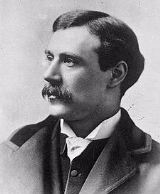
William Friese-Greene

 
William Friese Greene

   Email Print
   Bookmark   Link


William Friese-Greene


William Friese-Greene (September 7, 1855-May 5, 1921) (born William Edward Green) was a portrait photographer
Photographer

A photographer is a person who takes a photograph using a camera. A professional photographer uses photography to make a living whilst an amateur photographer does not earn a living and typically takes photographs for pleasure and to record an event, place or person for future enjoyment....
 and prolific inventor
Inventor

An inventor is a person who creates or discovers a new method, form, device or other useful means. The word inventor comes form the latin verb invenire, invent-, to find....
. He is principally known as a pioneer in the field of motion pictures
Film

Film encompasses individual motion pictures, the field of film as an art form, and the film industry. Films are produced by recording images from the world with cameras, or by creating images using animation techniques or special effects....
 and is credited by some as the inventor of cinematography
Cinematography

Cinematography , is the making of Stage lighting and camera choices when recording photographic s for the film. It is closely related to the art of photography....
.

iam Edward Green was born on September 7, 1855, in Bristol
Bristol

Bristol is a City status in the United Kingdom, unitary authority area and Ceremonial counties of England in South West England, west of London, and east of Cardiff....
. He was educated there at Queen Elizabeth's Hospital
Queen Elizabeth's Hospital

Queen Elizabeth's Hospital is an independent school for boys in Clifton, Bristol, Bristol, England. Stephen Holliday has served as Headmaster since 2000, having succeeded Dr Richard Gliddon....
. In 1869 he became an apprentice to a photographer named Maurice Guttenberg.


Discussion
Ask a question about 'William Friese-Greene'
Start a new discussion about 'William Friese-Greene'
Answer questions from other users
Full Discussion Forum


Recent Posts


Encyclopedia


William Friese-Greene (September 7, 1855-May 5, 1921) (born William Edward Green) was a portrait photographer
Photographer

A photographer is a person who takes a photograph using a camera. A professional photographer uses photography to make a living whilst an amateur photographer does not earn a living and typically takes photographs for pleasure and to record an event, place or person for future enjoyment....
 and prolific inventor
Inventor

An inventor is a person who creates or discovers a new method, form, device or other useful means. The word inventor comes form the latin verb invenire, invent-, to find....
. He is principally known as a pioneer in the field of motion pictures
Film

Film encompasses individual motion pictures, the field of film as an art form, and the film industry. Films are produced by recording images from the world with cameras, or by creating images using animation techniques or special effects....
 and is credited by some as the inventor of cinematography
Cinematography

Cinematography , is the making of Stage lighting and camera choices when recording photographic s for the film. It is closely related to the art of photography....
.

Career

William Edward Green was born on September 7, 1855, in Bristol
Bristol

Bristol is a City status in the United Kingdom, unitary authority area and Ceremonial counties of England in South West England, west of London, and east of Cardiff....
. He was educated there at Queen Elizabeth's Hospital
Queen Elizabeth's Hospital

Queen Elizabeth's Hospital is an independent school for boys in Clifton, Bristol, Bristol, England. Stephen Holliday has served as Headmaster since 2000, having succeeded Dr Richard Gliddon....
. In 1869 he became an apprentice to a photographer named Maurice Guttenberg. By 1875 he had set up his own studios in Bath and Bristol, and later expanded his business with two more studios in London
London

London is the capital of both England and the United Kingdom, and the most populous municipality in the European Union. An important settlement for two millennia, History of London goes back to its founding by the Roman Empire....
 and Brighton
Brighton

Brighton is a city on the south coast of England and, with its neighbours Hove and Portslade, forms the Brighton and Hove.The ancient settlement of Brighthelmston dates from before the Domesday Book , but it emerged as a health resort during the 18th Century and became a destination for day-trippers after the arrival of the railway in...
. He married Helena Friese on March 24 1874, and decided to modify his name to include her maiden name.

In Bath he came into contact with John Arthur Roebuck Rudge. Rudge was a maker of a number of instruments but had begun to specialise in the creation of magic lanterns. He had recently developed the 'Biophantic Lantern'. The lantern was unique in that could display seven slides in rapid succession, and produce an effective illusion of movement. Friese-Greene was fascinated by the machine and in 1886 he began work with Rudge on enhancing it in order to project photographic plates. They called the device a 'Biophantascope'. Friese-Greene realised that glass plates would never be a practical medium for true moving pictures and in 1885 he began to experiment with oiled paper and by 1887 was experimenting with celluloid
Celluloid

Celluloid is the name of a class of Chemical compound created from nitrocellulose and camphor, plus dyes and other agents. Generally regarded to be the first thermoplastic, it was first created as Parkesine in 1856 and as Xylonite in 1869 before being registered as Celluloid in 1870....
 as a medium for motion picture cameras.

On June 21 1889, Friese-Greene was issued patent
Patent

A patent is a set of exclusive rights granted by a state to an inventor or his assignee for a term of patent in exchange for a disclosure of an invention....
 no. 10131 for his 'chronophotographic' camera. It was apparently capable of taking up to ten photographs per second using perforated celluloid film. A report on the camera was published in the British Photographic News on February 28 1890. On 18 March, Friese-Greene sent a clipping of the story to Thomas Edison
Thomas Edison

Thomas Alva Edison was an American inventor and businessman who developed many devices that greatly influenced life around the world, including the phonograph and the long-lasting, practical electric light bulb....
, whose laboratory had been developing a motion picture system known as the Kinetoscope
Kinetoscope

The Kinetoscope is an early film exhibition device. Though not a movie projector?it was designed for films to be viewed individually through the window of a cabinet housing its components?the Kinetoscope introduced the basic approach that would become the standard for all cinematic projection before the advent of video: it creates the illusi...
. The report was reprinted in Scientific American
Scientific American

Scientific American is a popular science science magazine, published since August 28, 1845, making it one of the oldest continuously published magazines in the United States....
 on April 19. Friese-Greene gave a public demonstration in 1890 but the low frame rate
Frame rate

Frame rate, or frame frequency, is the measurement of the frequency at which an imaging device produces unique consecutive images called Film frames....
 combined with the device's apparent unreliability failed to make an impression. In the early 1890s he experimented with stereoscopic
Stereoscopy

Stereoscopy, stereoscopic imaging or 3-D imaging is any technique capable of recording three-dimensional visual information or creating the stereopsis in an image....
 cameras but met with limited success. Friese-Greene’s experiments in the field of motion pictures were at the expense of his other business interests and in 1891 he was declared bankrupt. To cover his debts he sold the rights to the 'chronophotographic' camera patent for £500. The renewal fee was never paid and the patent eventually lapsed.

Friese-Greene's later exploits were in the field of colour in motion pictures. Working in Brighton, he experimented with a system known as
Biocolour. This process produced the illusion of true colour by exposing each alternate frame of ordinary black and white film stock through a two different coloured filters. Each alternate frame of the monochrome print was then stained red or green. Although the projection of Biocolour prints did provide a tolerable illusion of true colour, it suffered from noticeable flickering and red and green fringing when the subject was in rapid motion.

Friese-Greene found it impossible to exhibit Biocolour motion pictures because a rival system -- developed by George Albert Smith
George Albert Smith (inventor)

George Albert Smith was an inventor, a stage hypnotism, psychic, astronomy and magic lantern lecturer and one of the pioneer's of British cinema....
 and Charles Urban
Charles Urban

Charles Urban was an Anglo-American film producer and distributor, and one of the most significant figures in Cinema of the United Kingdom before the First World War....
 and known as Kinemacolor
Kinemacolor

Kinemacolor was the first successful colour motion picture process, used commercially from 1908 to 1914. It was invented by George Albert Smith of Brighton, England in 1906, and launched by Charles Urban's Urban Trading Co....
 -- claimed that any colour film was an infringement of their prior patent. With the financial assistance of the renowned British racing driver Selwyn Francis Edge
Selwyn Edge

Selwyn Francis Edge was an Australian businessman and race car driver. He was born in Concord, New South Wales township, near Sydney, on 29th March 1868....
, Friese-Greene attempted to invalidate Urban's patent in court. Friese-Greene claimed that the patent did not contain enough detail to encompass the Biocolour process. The judge ruled in Urban's favour, but an appeal in the House of Lords
House of Lords

The House of Lords is the second house of the Parliament of the United Kingdom and is also commonly referred to as "the Lords". The Parliament comprises the British monarchy, the British House of Commons , and the Lords....
 in 1914 reversed the decision. Friese-Greene's system was still in its infancy and he was unable to exploit this success. His son Claude Friese-Greene
Claude Friese-Greene

Claude Friese-Greene , British-born cinema technician and filmmaker, and notably most famous for his 1926 collection of films entitled The Open Road....
 continued to develop the system during 1920s. Claude went on to become a successful cinematographer.
Wfggrave
In 1921 Friese-Greene was attending a film and cinema industry meeting in London. The meeting had been called to discuss the current poor state of the British film industry. Disturbed by the tone of the proceedings Friese-Greene got to his feet to speak but soon became incoherent. He was assisted in returning to his seat, and shortly afterward slumped forward and died. His grave can be found in London's Highgate Cemetery
Highgate Cemetery

Highgate Cemetery is a cemetery located in Highgate, London, England. It is designated Grade II* on the English Heritage National Register of Historic Parks and Gardens....
. A memorial designed by Edwin Lutyens
Edwin Lutyens

Sir Edwin Landseer Lutyens, Order of Merit , Order of the Indian Empire, Royal Academy, Royal Institute of British Architects, LLD was a leading 20th century British architect who is known for imaginatively adapting traditional architectural styles to the requirements of his era....
 describes him as 'The inventor of Kinematography'.

The actor Richard Greene
Richard Greene

Richard Marius Joseph Greene - some sources list his birth date as 1914 - was a noted England movie and television actor. A matinee idol who appeared in more than 40 films, he was perhaps best known for the lead role in the long-running British TV series The Adventures of Robin Hood , which ran 143 episodes from 1955 to 1960....
 was his grandson.

After death

In 1951 a romanticised account of his life, starring Robert Donat
Robert Donat

Friedrich Robert Donat , was an England Academy Award-winning film and stage actor.Donat was born in Withington, Manchester, England, to Ernst Emil Donat and his wife Rose Alice nee Green who married at Withington St Paul in 1895....
 was filmed as part of the Festival of Britain
Festival of Britain

The Festival of Britain was a national Art exhibition which opened in London and around United Kingdom in May 1951. The official opening was on 3 May....
. Unfortunately, The Magic Box
The Magic Box (film)

The Magic Box is a British film released in 1951 in film....
 was not premiered until the Festival was nearly over, and only went on full release after it had finished. Despite the all-star cast and a great deal of publicity, the film was a costly box office flop. A pub in the former Academy Cinema
Academy Cinema

The Academy Cinema is a historic building on Cheltenham Road, Bristol, England.It was built in 1914 in an Edwardian Baroque style. It closed as a cinema in 1955 and became a Christadelphian Hall or chapel....
 in Stokes Croft
Stokes Croft

Stokes Croft in the city of Bristol is a small area between North Street and Cheltenham Road, about a kilometre north of the centre of the city....
, Bristol
Bristol

Bristol is a City status in the United Kingdom, unitary authority area and Ceremonial counties of England in South West England, west of London, and east of Cardiff....
 is named The Magic Box in reference to . (The Magic Box was replaced by Jesters Comedy Club In 2007)

Friese-Greene's former home in Brighton's Middle Street was refurbished in 2006 and is now home to the offices of Worth, a leading media company. The building bears a plaque (in a format designed by Eric Gill
Eric Gill

Arthur Eric Rowton Gill was a England sculpture, typography, stonecutter and printmaking, who was associated with the Arts and Crafts movement....
 in 1924) commemorating Friese-Green's achievements. The plaque was unveiled by Michael Redgrave
Michael Redgrave

Sir Michael Scudamore Redgrave Order of the British Empire was a well-known English people stage and film actor, director, manager and author....
, one of the stars of The Magic Box
The Magic Box (film)

The Magic Box is a British film released in 1951 in film....
, in September 1957. A modern office building a few metres away is named Friese-Greene House. Other notices include the 1930s Kings Road, Chelsea, London
Chelsea, London

Chelsea is an area of south-west London, England, bounded to the south by the River Thames, where its frontage runs from Chelsea Bridge along the Chelsea Embankment, Cheyne Walk, Lots Road power station and Chelsea Harbour....
, Odeon Cinema, with its iconic facade, which carries high upon it a large sculptored head-and-shoulders medalion of "William Friese-Greene" and his year of birth and death. There is a bronze statue of him at Pinewood Studios
Pinewood Studios

Pinewood Studios is a major United Kingdom film studio situated in Iver, Buckinghamshire. Approximately 20 miles west of Central London on what was the estate of Heatherden Hall, the studios were created in 1934 by Charles Boot and built within 12 months by the Henry Boot Company of Sheffield....
.

In 2006 the BBC ran a series of programmes called The Lost World of Friese-Greene, presented by Dan Cruickshank
Dan Cruickshank

Dan Cruickshank is an Architecture History and television presenter, currently working for the BBC, and lives in Spitalfields, London. As a young child he lived for some years in Poland....
 about Claude Friese-Greene's road trip from Land's End to John o' Groats
Land's End to John o' Groats

Land's End to John o' Groats is a journey - the traversal of the whole of the island of Great Britain from southwest to northeast.* Land's End is the extreme southwestward point of Great Britain, situated in western Cornwall at the end of the Penwith Peninsula....
, The Open Road, which he filmed from 1924 to 1926 using the Biocolour process. The original print of Claude's film was subjected to computer enhancement by the British Film Institute
British Film Institute

The British Film Institute is a charitable organisation established by Royal Charter to:...
 to remove the flickering problem.

External links