


Wildland fire suppression

Encyclopedia
Wildfire suppression refers to the firefighting tactics used to suppress wildfire
s. Firefighting efforts in wildland areas requires different techniques, equipment, and training from the more familiar structure fire
fighting found in populated areas. Working in conjunction with specially designed firefighting aircraft
, these wildfire-trained crews suppress flames, construct firelines, and extinguish flames and areas of heat to protect resources and natural wilderness. Wildfire suppression also addresses the issues of the wildland-urban interface, where populated areas border with wildland areas.
in 1871 and the Great Fire of 1910
. In the 1960s, policies governing wildfire suppression changed due to ecological studies that recognized fire as a natural process necessary for new growth. Today, policies advocating complete fire suppression have been exchanged for those who encourage wildland fire use, or the allowing of fire to act as a tool, such as the case with controlled burns.
During a typical year there are over 9,000 forest fires in Canada, burning an average of 2.5 million hectares (ha) or 25,000 square kilometres. The number of fires and area burned can vary dramatically from year to year. Average suppression costs are $300 million to $500 million annually.
In Canada, two-thirds of all forest fires are caused by people, while lightning causes the remaining third. Despite this, lightning fires account for over 85% of the area burned in Canada, largely because many of the lightning-caused fires occur in remote, inaccessible areas. Currently about ninety percent of forest fires are fought. Generally fires near communities, industrial infrastructure, and forests with high commercial and recreation value are given high priority for suppression efforts. In remote areas and wilderness parks, fires may be left to burn as part of the natural ecological cycle.
, the South Australian Country Fire Service
, and the Victorian Department of Sustainability and Environment and the volunteer Country Fire Authority
.
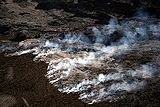 Protection of human life, both firefighters and civilians, is first priority. When arriving on a scene a fire crew will establish a safety zone(s), escape routes, verify communication is in place and designate lookouts (known in the U.S. by the acronym LCES, for lookouts, communications, escape routes, safety zones). This allows the firefighters to engage a fire with options for a retreat should their current situation become unsafe. Although other safety zones should be designated, areas already burned generally provide a safe refuge from fire provided they have cooled sufficiently, are accessible, and have burned enough fuels so as to not reignite. Briefings may be done to inform new fire resources of hazards and other pertinent information.
A great emphasis is placed on safety and preventing entrapment, or a situation where escape from the fire is impossible. Prevention of this situation is reinforced with a list of 10 fire orders and 18 watch out situations for firefighters to be aware of, which warn of potentially dangerous situations. As a last resort, many wildland firefighters carry a fire shelter
. In this unescapable situation, the shelter will provide limited protection from radiant and convective heat, as well as superheated air. Entrapment within a fire shelter is called a burnover. In Australia, firefighters rarely carry fireshelters, (commonly referred to as "Shake 'N' Bake" shelters) rather training is given to locate natural shelters or the use of handtools to create protection. Or in the instance of 'burnover' in a Tanker or other fire appliance, 'fire over-run' training is used.
Hazards beyond the fire are posed as well. A very small sample of these include: unstable hazard trees, animals, electrical cables, unexploded ordnance
, hazardous materials, rolling and falling debris, and lightning.
is charged with overall command of an incident. In the U.S., the Incident Command System
designates this as being the first on scene providing he has sufficient training. The size of the fire, measured in acres or chains, will later dictate the class-level of IC required. Incident management teams
aid on larger fire incidents to meet more complex priorities and objectives of the incident commander. It provides support staff to handle duties such as communication, fire behavior modeling, and map- and photo-interpretation. Again in the U.S., management coordination between fires is primarily done by the National Interagency Fire Center (NIFC)
Specific agencies and different incident management teams may include a number of different individuals with various responsibilities and varying titles. A fire information officer (IFO) generally provides fire-related information to the public for example. Branch chiefs and division chiefs serve as management on branches and divisions, respectively, as the need for these divisions arise. Investigators may be called to ascertain the fire's cause. Prevention officers such as forest rangers may patrol their jurisdictional areas to teach fire prevention and prevent some human-caused fires from happening to begin with.
The USFS Visual Signal Code system provides symbols used to communicate from ground to air, while aircraft may use wing tilting, motor gunning or circling to communicate air-to-ground.
All fire suppression activities are based from an anchor point (such as lake, rock slide, road or other natural or artificial fire break). From an anchor point firefighters can work to contain a wild land fire without the fire outflanking them.
Large fires often become extended campaigns. Incident command posts (ICPs) and other temporary fire camps are constructed to provide food, showers, and rest to fire crews.
Weather conditions
and fuel conditions are large factors in the decisions made on a fire. Within the U.S., the Energy Release Component
(ERC) is a scale relating fuel energy potential to area. The Burning Index (BI) relates flame length to fire spread speed and temperature. The Haines Index (HI) tracks stability and humidity of air over a fire. The Keeth-Byrum Drought Index relates fuels to how quickly they could ignite and to what percentage they should burn. The Lightning Activity Level (LAL) ranks lightning potential into six classes.
Fuel models are specific fuel designations determined by energy burning potential. Placed into 13 classes, they range from "short grass" (model 1) to "logging slash" (model 13). Low-numbered models burn at lower intensities than those at the higher end.
 Direct attack is any treatment applied directly to burning fuel such as wetting, smothering, or chemically quenching the fire or by physically separating the burning from unburned fuel. This includes the work of urban and wildland fire engine
s, fire personnel and aircraft applying water or fire retardant
directly to the burning fuel. For most agencies, the objective is to construct a fireline around all fire meant to be suppressed.
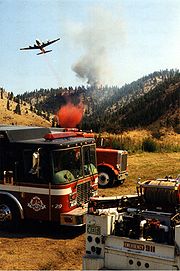 Preparatory suppression tactics used a distance away from the oncoming fire are considered indirect. Firelines may be built in this manner as well. Fuel reduction, indirect firelines, contingency firelines, backburning and wetting unburnt fuels are examples. This method may allow for more effective planning. It may allow for more ideally placed firelines in lighter fuels using natural barriers to fire and for safer firefighter working conditions in less smoke filled and cooler areas. However, it may also allow for more burned acreage, larger hotter fires, and the possibility of wasted time constructing unused firelines.
Attempts to control wildfires may also include by controlling the area that it can spread to by creating control lines: boundaries that contain no combustible material. These may be constructed by physically removing combustible material with tools and equipment, or portions may be naturally occurring. Lines may also be created by backfiring: creating small, low-intensity fires using driptorch
es or flares
. The resultant fires are extinguished by firefighters or, ideally, directed in such a way that they meet the main fire front, at which point both fires run out of flammable material and are thus extinguished. Additionally, the use of long-term fire retardant
s, fire-fighting foams, and superabsorbent polymer
gels
may be used. Such compounds reduce the flammability of materials by either blocking the fire physically or by initiating a chemical reaction
that stops the fire.
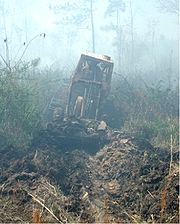 Unfortunately, any method can fail in the face of erratic or high-intensity winds and changing weather. Changing winds may cause fires to change direction and miss control lines. High-intensity winds may cause jumping or spotting as burning embers are carried through the air over a fireline. Burning trees may fall and burning materials may roll across the line, effectively negating the barrier.
formation. The loss of plant life from the fire also contributes to erosion. Construction of waterbar
s, the addition of plants and debris to exposed soils and other measures help to reduce this.
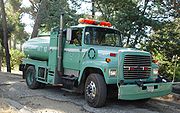 "There are three categories of interface fire: The classic wildland/urban interface exists where well-defined urban and suburban development presses up against open expanses of wildland areas; the mixed wildland/urban interface is characterized by isolated homes, subdivisions and small communities situated predominantly in wildland settings; and the occluded wildland/urban interface exists where islands of wildland vegetation occur inside a largely urbanized area."
Expansive urbanization
and other human activity in areas adjacent to wildlands is a primary reason for the catastrophic structural losses experienced in wildfires. Continued development of wildland-urban interface firefighting measures and the rebuilding of structures destroyed by fires has been met with criticism. Communities such as Sydney
and Melbourne
in Australia
have been built within highly flammable forest fuels. The city of Cape Town
, South Africa
lies on the fringe of the Table Mountain National Park. In the western United States from the 1990s to 2007, over 8.5 million new homes were constructed on the wildland-urban interface.
Fuel buildup can result in costly, devastating fires as more new houses and ranches are built adjacent to wilderness areas. However, the population growth in these fringe areas discourages the use of current fuel management techniques. Smoke from fires is an irritant and a pollutant. Attempts to thin out the fuel load may be met with opposition due to the desirability of forested areas. Wildland goals may be further resisted because of endangered species protections and habitat preservation. The ecological benefit of fire is often overridden by the economic benefits of protecting structures and lives. Additionally, federal policies that cover wildland areas usually differ from local and state policies that govern urban lands.
In North America, the belief that fire suppression has substantially reduced the average annual area burned is widely held by resource managers and is often thought to be self-evident. However, this belief has been the focus of vocal debate in the scientific literature.
s (firefighters who parachute into remote areas) and Helicopter
support.
Other studies have concluded that the 20th century change in the fire cycle is a result of climate change. A 1993 study by Bergeron & Archambault said: "post-'Little Ice Age' climate change has profoundly decreased the frequency of fires in the northwestern Québec boreal forest" Critics have also highlighted that small fires are virtually unreported in areas without aggressive fire suppression policies, where detection often relies on reports from settlements or commercial aircraft, leading to incorrect average fire size data for those regions.
Wildfire
A wildfire is any uncontrolled fire in combustible vegetation that occurs in the countryside or a wilderness area. Other names such as brush fire, bushfire, forest fire, desert fire, grass fire, hill fire, squirrel fire, vegetation fire, veldfire, and wilkjjofire may be used to describe the same...
s. Firefighting efforts in wildland areas requires different techniques, equipment, and training from the more familiar structure fire
Structure fire
A structure fire is a fire involving the structural components of various residential buildings ranging from single-family detached homes and townhouses to apartments and tower blocks, or various commercial buildings ranging from offices to shopping malls...
fighting found in populated areas. Working in conjunction with specially designed firefighting aircraft
Aircraft
An aircraft is a vehicle that is able to fly by gaining support from the air, or, in general, the atmosphere of a planet. An aircraft counters the force of gravity by using either static lift or by using the dynamic lift of an airfoil, or in a few cases the downward thrust from jet engines.Although...
, these wildfire-trained crews suppress flames, construct firelines, and extinguish flames and areas of heat to protect resources and natural wilderness. Wildfire suppression also addresses the issues of the wildland-urban interface, where populated areas border with wildland areas.
United States
Wildfire suppression in the United States has had a long and varied history. For most of the 20th century, any form of wildland fire, whether it was naturally caused or otherwise, was quickly suppressed for fear of uncontrollable and destructive conflagrations such as the Peshtigo FirePeshtigo Fire
The October 8, 1871 Peshtigo Fire in Peshtigo, Wisconsin, is the conflagration that caused the most deaths by fire in United States history, killing as many as 1,500. Occurring on the same day as the more infamous Great Chicago Fire, the Peshtigo Fire is mostly forgotten...
in 1871 and the Great Fire of 1910
Great Fire of 1910
The Great Fire of 1910 was a wildfire which burned about three million acres in northeast Washington, northern Idaho , and western Montana...
. In the 1960s, policies governing wildfire suppression changed due to ecological studies that recognized fire as a natural process necessary for new growth. Today, policies advocating complete fire suppression have been exchanged for those who encourage wildland fire use, or the allowing of fire to act as a tool, such as the case with controlled burns.
Canada
Canada has about 4,020,000 km² of forest land, of which the Boreal forest—characterized by its predominance of coniferous trees—makes up nearly three-quarters. More than ninety percent of forest land is publicly owned, and the provincial and territorial governments are responsible for fire-suppression activities. The Federal Canadian Interagency Forest Fire Centre (CIFFC) provides operational fire-control services and links to all provincial and territorial fire agencies.During a typical year there are over 9,000 forest fires in Canada, burning an average of 2.5 million hectares (ha) or 25,000 square kilometres. The number of fires and area burned can vary dramatically from year to year. Average suppression costs are $300 million to $500 million annually.
In Canada, two-thirds of all forest fires are caused by people, while lightning causes the remaining third. Despite this, lightning fires account for over 85% of the area burned in Canada, largely because many of the lightning-caused fires occur in remote, inaccessible areas. Currently about ninety percent of forest fires are fought. Generally fires near communities, industrial infrastructure, and forests with high commercial and recreation value are given high priority for suppression efforts. In remote areas and wilderness parks, fires may be left to burn as part of the natural ecological cycle.
Australia
Wildland fire, known in Australia as bushfire, has played a major role in Australia due to arid conditions similar to those in the western U.S. Notable fire services tasked with wildfire suppression include the New South Wales Rural Fire ServiceNew South Wales Rural Fire Service
The New South Wales Rural Fire Service is a volunteer-based firefighting agency and statutory body of the NSW Government. The NSW RFS is responsible for the general administration of rural fire management affairs including administration of the Rural Fire Fighting Fund, co-ordination with local...
, the South Australian Country Fire Service
Country Fire Service
The SA Country Fire Service is a volunteer based fire service in the state of South Australia in Australia. Many parts of Australia are sparsely populated whilst at the same time they are under significant risk of bushfire. Due to economics, it is prohibitively expensive for each Australian town...
, and the Victorian Department of Sustainability and Environment and the volunteer Country Fire Authority
Country Fire Authority
Country Fire Authority, or CFA, is the name of the fire service that provides firefighting and other emergency services to all of the country areas and regional townships within the state of Victoria, Australia, as well as large portions of the outer suburban areas and growth corridors of Melbourne...
.
Safety
A great emphasis is placed on safety and preventing entrapment, or a situation where escape from the fire is impossible. Prevention of this situation is reinforced with a list of 10 fire orders and 18 watch out situations for firefighters to be aware of, which warn of potentially dangerous situations. As a last resort, many wildland firefighters carry a fire shelter
Fire shelter
A fire shelter is a safety device of last resort used by wildland firefighters when trapped by wildfires. It is designed to reflect radiant heat, protect against convective heat, and trap breathable air in an attempt to save the firefighter's life...
. In this unescapable situation, the shelter will provide limited protection from radiant and convective heat, as well as superheated air. Entrapment within a fire shelter is called a burnover. In Australia, firefighters rarely carry fireshelters, (commonly referred to as "Shake 'N' Bake" shelters) rather training is given to locate natural shelters or the use of handtools to create protection. Or in the instance of 'burnover' in a Tanker or other fire appliance, 'fire over-run' training is used.
Hazards beyond the fire are posed as well. A very small sample of these include: unstable hazard trees, animals, electrical cables, unexploded ordnance
Unexploded ordnance
Unexploded ordnance are explosive weapons that did not explode when they were employed and still pose a risk of detonation, potentially many decades after they were used or discarded.While "UXO" is widely and informally used, munitions and explosives of...
, hazardous materials, rolling and falling debris, and lightning.
Resource protection
Other resources are ranked according to importance and/or value. These include but are not limited to human health and safety, construction cost, ecological impacts, social and legal consequences and the costs of protection. Defendability is also considered, as more effort will be expended on saving a house with a tile roof than one with a wooden-shake roof, for example.Management
Managing any number of resources over varying-size areas in often very rugged terrain is extremely challenging. An incident commander (IC)Incident Commander
The incident commander is the person responsible for all aspects of an emergency response; including quickly developing incident objectives, managing all incident operations, application of resources as well as responsibility for all persons involved. The incident commander sets priorities and...
is charged with overall command of an incident. In the U.S., the Incident Command System
Incident Command System
The Incident Command System is "a systematic tool used for the command, control, and coordination of emergency response" according to the United States Federal Highway Administration...
designates this as being the first on scene providing he has sufficient training. The size of the fire, measured in acres or chains, will later dictate the class-level of IC required. Incident management teams
Incident Management Team
In the United States, there are predominantly five types of incident management teams . An incident such as a wildland fire is initially managed by local fire departments or fire agencies, but if the fire becomes complex additional resources are called in to address the emergency, and higher...
aid on larger fire incidents to meet more complex priorities and objectives of the incident commander. It provides support staff to handle duties such as communication, fire behavior modeling, and map- and photo-interpretation. Again in the U.S., management coordination between fires is primarily done by the National Interagency Fire Center (NIFC)
National Interagency Fire Center
The National Interagency Fire Center in Boise, Idaho, is the physical facility that is home to the National Interagency Coordination Center , and the National Multi-Agency Coordination group ....
| U.S. Fire Size Class | ||||||
| A | B | C | D | E | F | G |
| 0-1/4 acre | 1/4-10 acres | 10-99 acres | 100-299 acres | 300-999 acres | 1000-4999 acres | 5000+ |
Specific agencies and different incident management teams may include a number of different individuals with various responsibilities and varying titles. A fire information officer (IFO) generally provides fire-related information to the public for example. Branch chiefs and division chiefs serve as management on branches and divisions, respectively, as the need for these divisions arise. Investigators may be called to ascertain the fire's cause. Prevention officers such as forest rangers may patrol their jurisdictional areas to teach fire prevention and prevent some human-caused fires from happening to begin with.
Communication
Information may be communicated on fires in many forms. Radios, vocals, visual signals such as flagging and mirrors, literature such as an IAP or incident action plan, whistles and mobile touch-screen computer terminals are some examples.The USFS Visual Signal Code system provides symbols used to communicate from ground to air, while aircraft may use wing tilting, motor gunning or circling to communicate air-to-ground.
Tactics
Operating in the U.S. within the context of fire use, firefighters may only suppress fire that has become uncontrollable. Conversely, fires or portions of a fire that have previously been engaged by firefighters may, by management's decision, may be treated as fire use situation and be left to burn unfettered.All fire suppression activities are based from an anchor point (such as lake, rock slide, road or other natural or artificial fire break). From an anchor point firefighters can work to contain a wild land fire without the fire outflanking them.
Large fires often become extended campaigns. Incident command posts (ICPs) and other temporary fire camps are constructed to provide food, showers, and rest to fire crews.
Weather conditions
Weather
Weather is the state of the atmosphere, to the degree that it is hot or cold, wet or dry, calm or stormy, clear or cloudy. Most weather phenomena occur in the troposphere, just below the stratosphere. Weather refers, generally, to day-to-day temperature and precipitation activity, whereas climate...
and fuel conditions are large factors in the decisions made on a fire. Within the U.S., the Energy Release Component
Energy Release Component
The Energy Release Component is a number related to the available energy per unit area within the flaming front at the head of a fire. Daily variations in ERC are due to changes in moisture content of the various fuels present, both live and dead...
(ERC) is a scale relating fuel energy potential to area. The Burning Index (BI) relates flame length to fire spread speed and temperature. The Haines Index (HI) tracks stability and humidity of air over a fire. The Keeth-Byrum Drought Index relates fuels to how quickly they could ignite and to what percentage they should burn. The Lightning Activity Level (LAL) ranks lightning potential into six classes.
Fuel models are specific fuel designations determined by energy burning potential. Placed into 13 classes, they range from "short grass" (model 1) to "logging slash" (model 13). Low-numbered models burn at lower intensities than those at the higher end.
Direct attack
Wildland fire engine
Wildland fire engines use special equipment to spray water, foam, and chemicals. The engines are able to carry up to of water. Many wildland fire engines are also equipped with four wheel drive and special equipment for off-road use.*...
s, fire personnel and aircraft applying water or fire retardant
Fire retardant
A fire retardant is a substance other than water that reduces flammability of fuels or delays their combustion. This typically refers to chemical retardants but may also include substances that work by physical action, such as cooling the fuels; examples of these include fire-fighting foams and...
directly to the burning fuel. For most agencies, the objective is to construct a fireline around all fire meant to be suppressed.
Indirect attack
Attempts to control wildfires may also include by controlling the area that it can spread to by creating control lines: boundaries that contain no combustible material. These may be constructed by physically removing combustible material with tools and equipment, or portions may be naturally occurring. Lines may also be created by backfiring: creating small, low-intensity fires using driptorch
Driptorch
A driptorch is a tool used in wildfire suppression, controlled burning, and other forestry applications to intentionally ignite fires.The driptorch consists of a canister for holding fuel with a handle attached to the side, a spout with a loop to prevent fire from entering the fuel canister, a...
es or flares
Flare (pyrotechnic)
A flare, also sometimes called a fusee, is a type of pyrotechnic that produces a brilliant light or intense heat without an explosion. Flares are used for signalling, illumination, or defensive countermeasures in civilian and military applications...
. The resultant fires are extinguished by firefighters or, ideally, directed in such a way that they meet the main fire front, at which point both fires run out of flammable material and are thus extinguished. Additionally, the use of long-term fire retardant
Fire retardant
A fire retardant is a substance other than water that reduces flammability of fuels or delays their combustion. This typically refers to chemical retardants but may also include substances that work by physical action, such as cooling the fuels; examples of these include fire-fighting foams and...
s, fire-fighting foams, and superabsorbent polymer
Superabsorbent polymer
Superabsorbent polymers are polymers that can absorb and retain extremely large amounts of a liquid relative to their own mass....
gels
Fire-retardant gel
Fire-retardant gels are superabsorbent polymer slurries with a "consistency almost like petroleum jelly." Used as fire retardants, they can be used for structure protection and in direct-attack applications against wildfires.- History :...
may be used. Such compounds reduce the flammability of materials by either blocking the fire physically or by initiating a chemical reaction
Chemical reaction
A chemical reaction is a process that leads to the transformation of one set of chemical substances to another. Chemical reactions can be either spontaneous, requiring no input of energy, or non-spontaneous, typically following the input of some type of energy, such as heat, light or electricity...
that stops the fire.
Mop-up
The threat of wildfires does not cease after the flames have passed, as smoldering heavy fuels may continue to burn unnoticed for days after flaming. It is during this phase that either the burn area exterior or the complete burn area of a fire is cooled so as to not reignite another fire.Rehabilitation
Constructed firelines, breaks, safety zones and other items may damage soil systems, encouraging erosion from surface run-off and gullyGully
A gully is a landform created by running water, eroding sharply into soil, typically on a hillside. Gullies resemble large ditches or small valleys, but are metres to tens of metres in depth and width...
formation. The loss of plant life from the fire also contributes to erosion. Construction of waterbar
Waterbar
A water bar or interceptor dyke is a road construction feature that is used to prevent erosion on sloping roads, cleared paths through woodland , or other accessways by reducing flow length...
s, the addition of plants and debris to exposed soils and other measures help to reduce this.
Fires on the wildland-urban interface
Expansive urbanization
Urbanization
Urbanization, urbanisation or urban drift is the physical growth of urban areas as a result of global change. The United Nations projected that half of the world's population would live in urban areas at the end of 2008....
and other human activity in areas adjacent to wildlands is a primary reason for the catastrophic structural losses experienced in wildfires. Continued development of wildland-urban interface firefighting measures and the rebuilding of structures destroyed by fires has been met with criticism. Communities such as Sydney
Sydney
Sydney is the most populous city in Australia and the state capital of New South Wales. Sydney is located on Australia's south-east coast of the Tasman Sea. As of June 2010, the greater metropolitan area had an approximate population of 4.6 million people...
and Melbourne
Melbourne
Melbourne is the capital and most populous city in the state of Victoria, and the second most populous city in Australia. The Melbourne City Centre is the hub of the greater metropolitan area and the Census statistical division—of which "Melbourne" is the common name. As of June 2009, the greater...
in Australia
Australia
Australia , officially the Commonwealth of Australia, is a country in the Southern Hemisphere comprising the mainland of the Australian continent, the island of Tasmania, and numerous smaller islands in the Indian and Pacific Oceans. It is the world's sixth-largest country by total area...
have been built within highly flammable forest fuels. The city of Cape Town
Cape Town
Cape Town is the second-most populous city in South Africa, and the provincial capital and primate city of the Western Cape. As the seat of the National Parliament, it is also the legislative capital of the country. It forms part of the City of Cape Town metropolitan municipality...
, South Africa
South Africa
The Republic of South Africa is a country in southern Africa. Located at the southern tip of Africa, it is divided into nine provinces, with of coastline on the Atlantic and Indian oceans...
lies on the fringe of the Table Mountain National Park. In the western United States from the 1990s to 2007, over 8.5 million new homes were constructed on the wildland-urban interface.
Fuel buildup can result in costly, devastating fires as more new houses and ranches are built adjacent to wilderness areas. However, the population growth in these fringe areas discourages the use of current fuel management techniques. Smoke from fires is an irritant and a pollutant. Attempts to thin out the fuel load may be met with opposition due to the desirability of forested areas. Wildland goals may be further resisted because of endangered species protections and habitat preservation. The ecological benefit of fire is often overridden by the economic benefits of protecting structures and lives. Additionally, federal policies that cover wildland areas usually differ from local and state policies that govern urban lands.
In North America, the belief that fire suppression has substantially reduced the average annual area burned is widely held by resource managers and is often thought to be self-evident. However, this belief has been the focus of vocal debate in the scientific literature.
Equipment and personnel
Wildfire suppression requires specialist personnel and equipment. Notable examples include SmokejumperSmokejumper
A smokejumper is a wildland firefighter who parachutes into a remote area to combat wildfires.Smokejumpers are most often deployed to fires that are extremely remote. The risks associated with this method of personnel deployment are mitigated by an extremely well developed training program that has...
s (firefighters who parachute into remote areas) and Helicopter
Helitack
Helitack refers to "helicopter-delivered fire resources", and is the system of managing and using helicopters and their crews to perform aerial firefighting and other firefighting duties, primarily initial attack on wildfires...
support.
Success of fire supression
The success of wildfire suppression techniques is debated amongst the scientific community. A number of studies (produced during the 1990s) using Ontario government fire records compared either the number of fires or the average fire size between areas with and without aggressive fire suppression policies. They found that the average fire size was generally smaller in areas of aggressive policy. One report, written in 1998 by Stocks and Weber, said; "Use of fire as a management tool recognizes the natural role of fire and is applied judiciously for ecosystem maintenance and restoration in selected areas." A later 2005 study concluded that "Fire suppression is (functionally) effective insofar as it reduces area burned".Other studies have concluded that the 20th century change in the fire cycle is a result of climate change. A 1993 study by Bergeron & Archambault said: "post-'Little Ice Age' climate change has profoundly decreased the frequency of fires in the northwestern Québec boreal forest" Critics have also highlighted that small fires are virtually unreported in areas without aggressive fire suppression policies, where detection often relies on reports from settlements or commercial aircraft, leading to incorrect average fire size data for those regions.
See also
External links
- The International Association of Wildland Fire
- Canadian Wildland Fire Information System
- The Canadian Interagency Forest Fire Centre (CIFFC)
- British Columbia Ministry of Forests Protection Branch -- FAQs
- United States National Interagency Fire Center
- Wildfire History and Ecology
- National Institute for Occupational Safety and Health - Fighting Wildfires
- Ballistic System for Fighting Forest Fire