
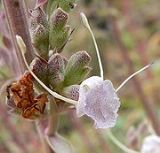
Salvia apiana, also known as
white sage,
bee sage, or
sacred sage, is an
evergreenIn botany, an evergreen plant is a plant having leaves all year round. This contrasts with deciduous plants, which completely lose their foliage for part of the year....
perennialA perennial plant or perennial is a plant that lives for more than two years. When used by gardeners or horticulturalists, this term applies specifically to perennial herbaceous plants...
shrubA shrub or bush is a horticultural rather than strictly botanical category of woody plant, distinguished from a tree by its multiple stems and lower height, usually less than 5-6 m tall. A large number of plants can be either shrubs or trees, depending on the growing conditions they experience...
of the genus
SalviaSalvia is the largest genus of plants in the mint family, Lamiaceae, with approximately 900 species of shrubs, herbaceous perennials, and annuals. It is one of three genera commonly referred to as sage. When used without modifiers, sage generally refers to Salvia officinalis ; however, it can be...
, the sages. It is native to the southwestern
United StatesThe United States of America is a federal constitutional republic comprising fifty states and a federal district...
and northwestern
MexicoThe United Mexican States , commonly known as Mexico , is a federal constitutional republic in North America. It is bordered on the north by the United States; on the south and west by the Pacific Ocean; on the southeast by Guatemala, Belize, and the Caribbean Sea; and on the east by the Gulf of...
, being found mainly in the
coastal sage scrubCoastal sage scrub is a low scrubland plant community found in the California chaparral and woodlands ecoregion of coastal California and northern Baja California. It is characterized by low-growing aromatic, and drought-deciduous shrubs adapted to the semi-arid Mediterranean climate of the...
habitat of
Southern CaliforniaSouthern California, or SoCal, is defined as the southern portion of the U.S. state of California. Its population centers around three major metropolitan areas, each of which have over 3 million people; the Los Angeles Metropolitan Area with over 12 million inhabitants, the San Bernardino-Riverside...
and
Baja CaliforniaBaja California is both the northernmost and westernmost state of Mexico. Before becoming a state in 1953, the area was known as the North Territory of Baja California. It has an area of , or 3.57% of the land mass of Mexico and comprises the northern half of the Baja California peninsula, north...
, on the western edges of the
MojaveThe Mojave Desert , , locally referred to as the High Desert, occupies a significant portion of southeastern California and smaller parts of central California, southern Nevada, southwestern Utah and northwestern Arizona, in the United States...
and
Sonoran desertThe Sonoran Desert is a North American desert which straddles part of the United States-Mexico border and covers large parts of the U.S. states of Arizona and California and the northwest Mexican states of Sonora, Baja California, and Baja California Sur...
s.
White sage is a sub-shrub that can reach over 1 meter tall. The leaves are widely lanceolate and tapered at the base.
Salvia apiana, also known as
white sage,
bee sage, or
sacred sage, is an
evergreenIn botany, an evergreen plant is a plant having leaves all year round. This contrasts with deciduous plants, which completely lose their foliage for part of the year....
perennialA perennial plant or perennial is a plant that lives for more than two years. When used by gardeners or horticulturalists, this term applies specifically to perennial herbaceous plants...
shrubA shrub or bush is a horticultural rather than strictly botanical category of woody plant, distinguished from a tree by its multiple stems and lower height, usually less than 5-6 m tall. A large number of plants can be either shrubs or trees, depending on the growing conditions they experience...
of the genus
SalviaSalvia is the largest genus of plants in the mint family, Lamiaceae, with approximately 900 species of shrubs, herbaceous perennials, and annuals. It is one of three genera commonly referred to as sage. When used without modifiers, sage generally refers to Salvia officinalis ; however, it can be...
, the sages. It is native to the southwestern
United StatesThe United States of America is a federal constitutional republic comprising fifty states and a federal district...
and northwestern
MexicoThe United Mexican States , commonly known as Mexico , is a federal constitutional republic in North America. It is bordered on the north by the United States; on the south and west by the Pacific Ocean; on the southeast by Guatemala, Belize, and the Caribbean Sea; and on the east by the Gulf of...
, being found mainly in the
coastal sage scrubCoastal sage scrub is a low scrubland plant community found in the California chaparral and woodlands ecoregion of coastal California and northern Baja California. It is characterized by low-growing aromatic, and drought-deciduous shrubs adapted to the semi-arid Mediterranean climate of the...
habitat of
Southern CaliforniaSouthern California, or SoCal, is defined as the southern portion of the U.S. state of California. Its population centers around three major metropolitan areas, each of which have over 3 million people; the Los Angeles Metropolitan Area with over 12 million inhabitants, the San Bernardino-Riverside...
and
Baja CaliforniaBaja California is both the northernmost and westernmost state of Mexico. Before becoming a state in 1953, the area was known as the North Territory of Baja California. It has an area of , or 3.57% of the land mass of Mexico and comprises the northern half of the Baja California peninsula, north...
, on the western edges of the
MojaveThe Mojave Desert , , locally referred to as the High Desert, occupies a significant portion of southeastern California and smaller parts of central California, southern Nevada, southwestern Utah and northwestern Arizona, in the United States...
and
Sonoran desertThe Sonoran Desert is a North American desert which straddles part of the United States-Mexico border and covers large parts of the U.S. states of Arizona and California and the northwest Mexican states of Sonora, Baja California, and Baja California Sur...
s.
Morphology
White sage is a sub-shrub that can reach over 1 meter tall. The leaves are widely lanceolate and tapered at the base. The margin is minutely toothed and rounded. The leaves are generally basal, covered with dense hairs, which gives it a white coloring, and are about 4–8 cm long. The
inflorescenceAn inflorescence is a group or cluster of flowers arranged on a stem that is composed of a main branch or a complicated arrangement of branches. Strictly, it is the part of the shoot of seed plants where flowers are formed and which is accordingly modified...
is a spike-like clusters with few flowers. The
flowerA flower, sometimes known as a bloom or blossom, is the reproductive structure found in flowering plants . The biological function of a flower is to mediate the union of male sperm with female ovum in order to produce seeds...
s are bilateral, about 12–22 mm in length, and are white with lavender spots and streaks. Both the
stamenThe stamen is the male organ of a flower. Each stamen generally has a stalk called the filament , and, on top of the filament, an anther , and pollen sacs,...
s and styles are exserted. The
fruitThe term fruit has different meanings dependent on context, and the term is not synonymous in food preparation and biology. Fruits are the means by which flowering plants disseminate seeds, and the presence of seeds indicates that a structure is most likely a fruit, though not all seeds come from...
form into shiny, light brown
nutletNutlet may refer to one of the following.*A small nut.*In botany, a nutlet is a pyrena or pyrene, which is a seed covered by a stony layer, such as the kernel of a drupe....
s that are 2.5–3 mm in size.
Ecology and Reproduction
White sage is a common plant that requires well drained dry soil, full sun, and little water. They occur on dry slopes in
coastal sage scrubCoastal sage scrub is a low scrubland plant community found in the California chaparral and woodlands ecoregion of coastal California and northern Baja California. It is characterized by low-growing aromatic, and drought-deciduous shrubs adapted to the semi-arid Mediterranean climate of the...
,
chaparralChaparral is a shrubland or heathland plant community found primarily in the U.S. state of California and in the northern portion of the Baja California peninsula, Mexico. It is shaped by a Mediterranean climate and wildfire...
, and yellow-pine forests of Southern California to Baja California at less than 1500 m elevation.
BumblebeeA bumblebee is any member of the bee genus Bombus, in the family Apidae. There are over 250 known species, existing primarily in the Northern Hemisphere....
s, hawk moths and
waspThe term wasp is typically defined as any insect of the order Hymenoptera and suborder Apocrita that is neither a bee nor ant. Almost every pest insect species has at least one wasp species that preys upon it or parasitizes it, making wasps critically important in natural control of their numbers,...
s
pollinatePollination is the process by which pollen is transferred in plants, thereby enabling fertilization and sexual reproduction. Pollen grains, which contain the male gametes to where the female gamete are contained within the carpel; in gymnosperms the pollen is directly applied to the ovule itself...
white sage, and
hummingbirdHummingbirds are among the smallest of birds, and include the smallest extant bird species, the Bee Hummingbirds. They can hover in mid-air by rapidly flapping their wings 12-90 times per second . They can also fly backwards, and are the only group of birds able to do so. Their English name derives...
s also appear to like the plant.
White sage typically flowers between May and August.
Ethnobotany
Native Americans had several uses for this plant: seeds were ground into a
flourFlour is a powder made of cereal grains or roots. It is the main ingredient of bread, which is a staple food for many civilizations, making the availability of adequate supplies of flour a major economic and political issue at various times throughout history...
and used for mush; leaves were used for flavoring in cooking; leaves were also eaten, smoked or used in a sweathouse as a remedy for colds; seeds were dropped into the eye and permitted to roll around under the eyelids in order to cleanse the eyes; and leaves were crushed and mixed with water to create a hair shampoo, dye and straightener.
White sage is also
used medicinallyHerbalism is a traditional medicinal or folk medicine practice based on the use of plants and plant extracts. Herbalism is also known as botanical medicine, medical herbalism, herbal medicine, herbology, and phytotherapy...
. It can be made into a tea, which decreases sweating, salivation, and mucous secretions in the sinuses, throat, and lungs. Cold tea can be a good stomach tonic, while a lukewarm tea is good for treating sore throats. The leaves can also be used as a uterine hemostatic tea for heavy menstruation; however, since it can also decrease lactation, nursing mothers are advised not to use it.
White sage is considered sacred by many Native Americans since it is used to make
smudge stickA smudge stick is a bundle of dried herbs, most commonly white sage. Often other herbs or plants are used or added and the leaves are usually bound with string in a small bundle and dried. Some other herbs and spices that are often used include cilantro, cedar, lavender, and mugwort, none of...
s, a type of
incenseIncense is composed of aromatic biotic materials, which release fragrant smoke when burned. The term incense refers to the substance itself, rather than to the odor that it produces....
. White sage is believed to cleanse a space of any evil spirits or 'negative' energies that may be present. This power is said to be released from the plant by the burning of the leaves, which are typically bundled into a wand or stick. Today many Native American tribes still use the stems and leaves for smudging as part of purification ceremonies. The practice has also been adopted by some modern
neopagansNeopaganism or Neo-Paganism is an umbrella term used to identify a wide variety of modern religious movements, particularly those influenced by pre-Christian pagan beliefs of Europe....
, and for general spiritual uses.
Magical Uses
Magical uses: Regular Green (or garden) Sage, is used in protection, prosperity, fertility, longevity, money attraction, healing, and business rituals. It is said that if you eat sage, you will become more wise and immortal.
Smudges: Are a traditional incense of ceremonial offering, cleansing, purification, and protection. White Broadleaf Sage, considered the King of all sages, is also used as an ingredient of smudge sticks, when it is bundled up whole and dried.
How to make smudge bundle: WHITE SAGE BUNDLES are hand-tied with cotton embroidery floss and wrapped for use just as they come from the shrub. Light the leafy end with a flame, then wave the smudge in the air and the SAGE will smolder.
How to use smudge bundle: Offer smoke to the four quarters in the traditional fashion or employ it in your own rituals. The bundle may be extinguished and re-lit many times and need not all be consumed at once.
Element: Air
Planet: Jupiter