

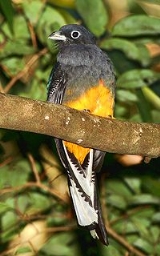
White-tailed Trogon

Encyclopedia
The White-tailed Trogon (Trogon chionurus), also known as the Western White-tailed Trogon, is a near passerine
bird in the trogon
family. It is found in tropical humid forests of the Chocó, ranging from Panama
, through western Colombia
, to western Ecuador
. It was formerly considered a subspecies
of T. viridis
, which is widespread in South America
east of the Andes
, but under the English name White-tailed Trogon (a name now reserved for T. chionurus, leaving T. viridis as the Green-backed Trogon
).
For comparison, the similar but smaller Gartered Trogon
(T. caligatus) has a yellow (male) or incomplete white eye-ring (female), and the male also has barring to the undertail.
There is no overlap in the distribution of the White-tailed and Green-backed Trogon
s, but the two can be separated by the undertail pattern: Unlike the White-tailed Trogon, the male Green-backed Trogon has a broad black base to each feather, and the female has relatively distinct black-and-white barring mainly to the outer webs of each feather. The male White-tailed Trogon also has a bluer rump than the Green-backed Trogon.
The song of the White-tailed Trogon consists of 15-20 very fast cow notes.
, supplemented by arthropod
s – slightly more so in the dry season
when fruit are scarce.
Near passerine
Near passerine or higher land-bird assemblage are terms often given to arboreal birds or those most often believed to be related to the true passerines due to ecological similarities; the group corresponds to some extent with the Anomalogonatae of Garrod All near passerines are land birds...
bird in the trogon
Trogon
The trogons and quetzals are birds in the order Trogoniformes which contains only one family, the Trogonidae. The family contains 39 species in eight genera. The fossil record of the trogons dates back 49 million years to the mid-Eocene. They might constitute a member of the basal radiation of...
family. It is found in tropical humid forests of the Chocó, ranging from Panama
Panama
Panama , officially the Republic of Panama , is the southernmost country of Central America. Situated on the isthmus connecting North and South America, it is bordered by Costa Rica to the northwest, Colombia to the southeast, the Caribbean Sea to the north and the Pacific Ocean to the south. The...
, through western Colombia
Colombia
Colombia, officially the Republic of Colombia , is a unitary constitutional republic comprising thirty-two departments. The country is located in northwestern South America, bordered to the east by Venezuela and Brazil; to the south by Ecuador and Peru; to the north by the Caribbean Sea; to the...
, to western Ecuador
Ecuador
Ecuador , officially the Republic of Ecuador is a representative democratic republic in South America, bordered by Colombia on the north, Peru on the east and south, and by the Pacific Ocean to the west. It is one of only two countries in South America, along with Chile, that do not have a border...
. It was formerly considered a subspecies
Subspecies
Subspecies in biological classification, is either a taxonomic rank subordinate to species, ora taxonomic unit in that rank . A subspecies cannot be recognized in isolation: a species will either be recognized as having no subspecies at all or two or more, never just one...
of T. viridis
Green-backed Trogon
The Green-backed Trogon , also known as the Amazonian White-tailed Trogon, is a near passerine bird in the trogon family. It is found in tropical humid forests in South America, where its range includes the Amazon, the Guiana Shield, Trinidad, and the Atlantic Forest in eastern Brazil. It formerly...
, which is widespread in South America
South America
South America is a continent situated in the Western Hemisphere, mostly in the Southern Hemisphere, with a relatively small portion in the Northern Hemisphere. The continent is also considered a subcontinent of the Americas. It is bordered on the west by the Pacific Ocean and on the north and east...
east of the Andes
Andes
The Andes is the world's longest continental mountain range. It is a continual range of highlands along the western coast of South America. This range is about long, about to wide , and of an average height of about .Along its length, the Andes is split into several ranges, which are separated...
, but under the English name White-tailed Trogon (a name now reserved for T. chionurus, leaving T. viridis as the Green-backed Trogon
Green-backed Trogon
The Green-backed Trogon , also known as the Amazonian White-tailed Trogon, is a near passerine bird in the trogon family. It is found in tropical humid forests in South America, where its range includes the Amazon, the Guiana Shield, Trinidad, and the Atlantic Forest in eastern Brazil. It formerly...
).
Description
This relatively large trogon is 28 to 30 cm (11 to 11.8 in) long. As most trogons, it is strongly sexually dimorphic. In the male the head and upper breast are dark blue (appears blackish in poor light), and the back is green, becoming bluer on the rump. The lower underparts are orange-yellow. The wings are black, vermiculated with white. The undertail is almost entirely white with only a very narrow black base to each feather. The complete eye-ring is pale bluish. The female White-tailed Trogon resembles the male, but has a grey back, head and breast, and rather indistinct black-and-white barring mainly to the inner webs of each tail feather (less on outer webs).For comparison, the similar but smaller Gartered Trogon
Gartered Trogon
The Gartered Trogon , also known as the Northern Violaceous Trogon, is a near passerine bird in the trogon family, Trogonidae. It is found in forests in east-central Mexico, south through Central America, to north-western South America...
(T. caligatus) has a yellow (male) or incomplete white eye-ring (female), and the male also has barring to the undertail.
There is no overlap in the distribution of the White-tailed and Green-backed Trogon
Green-backed Trogon
The Green-backed Trogon , also known as the Amazonian White-tailed Trogon, is a near passerine bird in the trogon family. It is found in tropical humid forests in South America, where its range includes the Amazon, the Guiana Shield, Trinidad, and the Atlantic Forest in eastern Brazil. It formerly...
s, but the two can be separated by the undertail pattern: Unlike the White-tailed Trogon, the male Green-backed Trogon has a broad black base to each feather, and the female has relatively distinct black-and-white barring mainly to the outer webs of each feather. The male White-tailed Trogon also has a bluer rump than the Green-backed Trogon.
The song of the White-tailed Trogon consists of 15-20 very fast cow notes.
Ecology
They typically perch upright and motionless. Although their flight is fast, they are reluctant to fly any distance. Their broad bills and weak legs reflect their diet and arboreal habits. White-tailed Trogons feed mainly on small fruitFruit
In broad terms, a fruit is a structure of a plant that contains its seeds.The term has different meanings dependent on context. In non-technical usage, such as food preparation, fruit normally means the fleshy seed-associated structures of certain plants that are sweet and edible in the raw state,...
, supplemented by arthropod
Arthropod
An arthropod is an invertebrate animal having an exoskeleton , a segmented body, and jointed appendages. Arthropods are members of the phylum Arthropoda , and include the insects, arachnids, crustaceans, and others...
s – slightly more so in the dry season
Dry season
The dry season is a term commonly used when describing the weather in the tropics. The weather in the tropics is dominated by the tropical rain belt, which oscillates from the northern to the southern tropics over the course of the year...
when fruit are scarce.