

West Wing

Encyclopedia
White House Complex
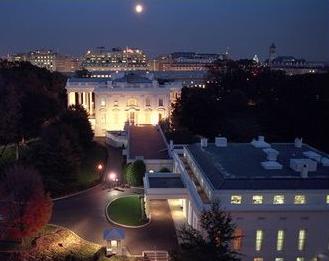
The White House Complex is the designation of the three principal structures and the adjoining outdoor ceremonial areas, which, along with the Eisenhower Executive Office Building, serve as the seat of the executive branch of United States government...
in which the Oval Office
Oval Office
The Oval Office, located in the West Wing of the White House, is the official office of the President of the United States.The room features three large south-facing windows behind the president's desk, and a fireplace at the north end...
, the Cabinet Room, the Situation Room
White House Situation Room
The White House Situation Room is a conference room and intelligence management center in the basement of the West Wing of the White House. It is run by the National Security Council staff for the use of the President of the United States and his advisors to monitor and deal...
, and the Roosevelt Room
Roosevelt Room
The Roosevelt Room is a meeting room in the West Wing of the White House, the official home and principal workplace of the President of the United States. Located almost in the center of the West Wing, and near the Oval Office the room is named for two related U.S. presidents, Theodore Roosevelt...
are located. Besides serving as the day-to-day office of the President of the United States
President of the United States
The President of the United States of America is the head of state and head of government of the United States. The president leads the executive branch of the federal government and is the commander-in-chief of the United States Armed Forces....
, the three floors of the West Wing include offices for senior members of the Executive Office of the President of the United States
Executive Office of the President of the United States
The Executive Office of the President consists of the immediate staff of the President of the United States, as well as multiple levels of support staff reporting to the President. The EOP is headed by the White House Chief of Staff, currently William M. Daley...
and their support staff. The West Wing is located directly west of the Executive Residence
Executive Residence
The Executive Residence is the central building of the White House Complex located between the East Wing and West Wing. This central building, first constructed 1792–1800, is home to the President of the United States and the First Family. The Executive Residence primarily occupies three floors:...
and is largely concealed from view by trees because its height is lower than that of the main structure.
White House mess
The West Wing ground floor is also the site of a cafeteriaCafeteria
A cafeteria is a type of food service location in which there is little or no waiting staff table service, whether a restaurant or within an institution such as a large office building or school; a school dining location is also referred to as a dining hall or canteen...
, staffed by Naval culinary specialists
Culinary Specialist (US Navy)
Culinary Specialist is a United States Navy occupational rating. It was formerly the Mess Management Specialist rating until 15 January 2004, and as Steward prior to 1975.-Duties:...
and called the White House mess. It is located underneath the Oval Office, and was established by President Truman
Harry S. Truman
Harry S. Truman was the 33rd President of the United States . As President Franklin D. Roosevelt's third vice president and the 34th Vice President of the United States , he succeeded to the presidency on April 12, 1945, when President Roosevelt died less than three months after beginning his...
on June 11, 1951. As of 2009, the mess is open daily from 7 am to 8 pm.
Depiction on The West Wing TV series
In 1999, The West Wing television series brought greater public attention to the workings of the Presidential staff, as well as to the location of those working in the West Wing. The show followed the working lives of a fictional Democratic American President, Josiah Bartlet, and his senior staff. When asked whether the show accurately captured the working environment in 2003, Press Secretary Scott McClellanScott McClellan
Scott McClellan is a former White House Press Secretary for President George W. Bush, and author of a controversial No. 1 New York Times bestseller about the Bush Administration titled What Happened. He replaced Ari Fleischer as press secretary in July 2003 and served until May 10, 2006...
commented that the show portrayed more foot traffic and larger rooms than in the real wing.
External links
- White House Museum: West Wing, with floorplan and historical images
- West Wing Interactive, from National Journal Magazine