
All Topics  
Water frame


   Email Print
   Bookmark   Link


Water frame


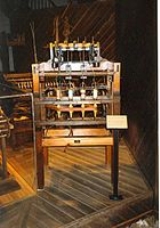
The water frame is the name given to the spinning frame
Spinning frame

The spinning frame was an invention developed during the 18th century Great Britain Industrial Revolution. It was later developed into the water frame , and was used to increase production of textiles in factory....
, when water power was used to drive it. Both are credited to Richard Arkwright
Richard Arkwright

Sir Richard Arkwright , was an England who is credited for inventing the spinning frame ? later renamed the water frame following the transition to Hydropower....
 who patent
Patent

A patent is a set of exclusive rights granted by a state to an inventor or his assignee for a term of patent in exchange for a disclosure of an invention....
ed and exploited the technology
Technology

Technology is a broad concept that deals with an animal species' usage and knowledge of tools and crafts, and how it affects an animal species' ability to control and adapt to its Natural environment....
 in 1762. It was based on an invention
Invention

An invention is the creation of a new configuration, composition of matter, device, or process. Some inventions are based on pre-existing models or ideas....
 by Thomas Highs
Thomas Highs

Thomas Highs was a talented England reed-maker and inventor known for his creation of the spinning jenny, the throstle , and the water frame during the Industrial Revolution....
 and the patent was later overturned. John Kay
John Kay (spinning frame)

John Kay was a clockmaker from Warrington, Lancashire, England. He is known by association with Thomas Highs and later Richard Arkwright for the scandal associated with the inventor of the spinning frame in 1767: an important stage in the development of textile manufacturing in the Industrial Revolution....
, a clock maker and mechanic who helped Highs build the spinning frame, sold the design to Arkwright (for what might be considered a derisory sum). It was Arkwright, however, who made the system work, realising that account had to be taken of the fibre lengths in the batch being spun.

The water frame is derived from the use of a water wheel
Water wheel

A water wheel is a machine for converting the energy of flowing or falling water into more useful forms of power, a process otherwise known as hydropower....
 to drive a number of spinning frames.


Discussion
Ask a question about 'Water frame'
Start a new discussion about 'Water frame'
Answer questions from other users
Full Discussion Forum


Encyclopedia


The water frame is the name given to the spinning frame
Spinning frame

The spinning frame was an invention developed during the 18th century Great Britain Industrial Revolution. It was later developed into the water frame , and was used to increase production of textiles in factory....
, when water power was used to drive it. Both are credited to Richard Arkwright
Richard Arkwright

Sir Richard Arkwright , was an England who is credited for inventing the spinning frame ? later renamed the water frame following the transition to Hydropower....
 who patent
Patent

A patent is a set of exclusive rights granted by a state to an inventor or his assignee for a term of patent in exchange for a disclosure of an invention....
ed and exploited the technology
Technology

Technology is a broad concept that deals with an animal species' usage and knowledge of tools and crafts, and how it affects an animal species' ability to control and adapt to its Natural environment....
 in 1762. It was based on an invention
Invention

An invention is the creation of a new configuration, composition of matter, device, or process. Some inventions are based on pre-existing models or ideas....
 by Thomas Highs
Thomas Highs

Thomas Highs was a talented England reed-maker and inventor known for his creation of the spinning jenny, the throstle , and the water frame during the Industrial Revolution....
 and the patent was later overturned. John Kay
John Kay (spinning frame)

John Kay was a clockmaker from Warrington, Lancashire, England. He is known by association with Thomas Highs and later Richard Arkwright for the scandal associated with the inventor of the spinning frame in 1767: an important stage in the development of textile manufacturing in the Industrial Revolution....
, a clock maker and mechanic who helped Highs build the spinning frame, sold the design to Arkwright (for what might be considered a derisory sum). It was Arkwright, however, who made the system work, realising that account had to be taken of the fibre lengths in the batch being spun.

The water frame is derived from the use of a water wheel
Water wheel

A water wheel is a machine for converting the energy of flowing or falling water into more useful forms of power, a process otherwise known as hydropower....
 to drive a number of spinning frames. The water wheel provided more power to the spinning frame than human operators, reducing the amount of human labor needed and increasing the spindle count dramatically. However, unlike the spinning jenny
Spinning jenny

The spinning jenny is a multi-spool spinning wheel. It was invented circa 1764 by James Hargreaves in Stanhill, near Blackburn, Lancashire in the northwest of England ....
, the water frame could only spin one thread at a time until Samuel Crompton
Samuel Crompton

Samuel Crompton was an English inventor and pioneer of the spinning industry....
 combined the two inventions into his spinning mule
Spinning mule

The spinning mule was a mechanized spinning wheel which created high quality yarns in a short amount of time. It was created in 1779 by Samuel Crompton....
 in 1779. However the water frame could be assembled with hundreds of spinning heads in a single building and was easy to operate.

In 1771 Arkwright installed the water frame in his cotton mill
Cotton mill

A cotton mill is a factory housing spinning and weaving machinery. Cotton was a leading sector in the Industrial Revolution, as cotton spinning was mechanised in mills....
 at Cromford
Cromford

Cromford, in Derbyshire, England, is a large village that is one of the significant sites in the development of the Industrial Revolution. It was here that Richard Arkwright built his cotton mill to make use of the Water Frame — a development of a spinning machine produced by Thomas Highs that pre-dated, and was probably the prototyp...
, Derbyshire
Derbyshire

Derbyshire is a county in the East Midlands of England. A substantial portion of the Peak District National Park lies within Derbyshire. The northern part of Derbyshire overlaps with the Pennines, a famous chain of hills and mountains....
, on the River Derwent
River Derwent, Derbyshire

The Derwent is a river in the county of Derbyshire, England. It is 50 miles long and is a tributary of the River Trent which it joins south of Derby....
, creating one of the first factories
Factory

A factory or manufacturing plant is an industry building where workers manufacturing Good or supervise machines Process Manufacturing one product into another....
 that was specifically built to house machine
Machine

A machine is any device that uses energy to perform some activity. In common usage, the meaning is that of a device having parts that perform or assist in performing any type of work....
ry rather than just bringing workers together.

Called by his contemporaries "The father of the factory system", he is considered an innovator as he combined water power, the water frame and continuous production with modern employment practices.