

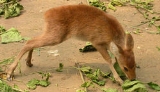
Water Deer

Encyclopedia
The Water Deer is a small deer superficially more similar to a musk deer
than a true deer (Cervidae - order Artiodactyla) but it is classified as a cervid despite having tusks (downward-pointing canine teeth) instead of antlers and other anatomical anomalies. These unique characteristics have caused it to be classified in its own genus (Hydropotes). Native to China and Korea, there are two subspecies: the Chinese Water Deer (Hydropotes inermis inermis) and the Korean Water Deer (Hydropotes inermis argyropus).
, coastal Jiangsu
province (Yancheng Coastal Wetlands
), and islands of Zhejiang
of east-central China, and in Korea, where the demilitarized zone
has provided a protected habitat for a large number. They frequent the tall reeds, rushes along rivers, and in tall grass on mountains and cultivated fields as well as swampy regions and open grasslands. They have also been known to inhabit swamps, and when the cultivated fields that they occupied are cut, they may be found lying in the furrows and hollows of the open field.
A proficient swimmer, water deer can also swim several miles to make use of river islands.
in the 1870s and were kept in the London Zoo
. In 1896, they were transferred to Woburn Abbey
, Bedfordshire
, with further additions being imported and added to the stock. In 1929 and 1930, 32 deer were transferred from Woburn to Whipsnade
, also in Bedfordshire, and released into the park. It is thought that the current Chinese Water Deer population at Whipsnade is over 600 whilst at Woburn it is probably in the region of 250 plus.
The present introduced population derives from a number of deliberate releases; the majority, however, is descended from escapees. The majority of the wild Chinese Water Deer population still resides close to Woburn Abbey. It appears that the deer’s strong preference for a particular habitat – tall reed and grass areas in rich alluvial deltas - has restricted its potential to colonize further afield. The main area of distribution is from Woburn, east into Cambridgeshire
, Norfolk
and Suffolk
, and south towards Whipsnade. There have been small colonies reported in other areas.
The British Deer Society coordinated a survey of wild deer in the UK between 2005 and 2007 and noted Chinese Water Deer as "notably increasing its range" since the last census in 2000.
The water deer has narrow pectoral and pelvic girdles, long legs, and a long, graceful neck. The powerful hind legs are longer than the front legs, so that the haunches are carried higher than the shoulders. They run with rabbit-like jumps. In the groin of each leg is an inguinal gland used for scent marking; this deer is the only member of the Cervidae to possess such glands. The short tail is no more than 5–10 cm / 1.9–3.8 in. in length and is almost invisible, except when it is held raised by the male during the rut. The ears are short and very rounded, and both sexes lack antlers.
The coat is an overall golden brown color, and may be interspersed with black hairs, while the undersides are white. The strongly tapered face is reddish brown or gray in color, and the chin and upper throat are cream colored. The hair is longest on the flanks and rump.
In the fall, the summer coat is gradually replaced by a thicker, coarse-haired winter coat that varies from light brown to grayish brown. Neither the head nor the tail poles are well differentiated as in gregarious deer; consequently, this deer's coat is little differentiated.
Young are born dark brown with white stripes and spots along their upper torso.
 The water deer have developed long canine teeth which protrude from the upper jaw like the canines of musk deer
. The canines are fairly large in the bucks, ranging in length from 5.5 cm / 2.1 in. on average to as long as 8 cm / 3.2 in. Does, in comparison, have tiny canines that are on an average of 0.5 cm / 0.2 in. in length.
The teeth usually erupt in the autumn of the deer’s first year at approximately 6–7 months of age. By early spring the recently-erupted tusks reach approximately 50% of their final length. As the tusks develop, the root remains open until the deer is about eighteen months to two years old. When fully grown, only about 60% of the tusk is visible below the gum.
These canines are held loosely in their sockets, with their movement controlled by facial muscles. The buck can draw them backwards out of the way when eating. In aggressive encounters, he thrusts his canines out and draws in his lower lip to pull his teeth closer together. He then presents an impressive two-pronged weapon to rival males.
It is due to these tusks that locals colloquially refer to this animal as a "vampire deer."
, water deer are solitary animals, and males are highly territorial. Each buck marks out his territory with urine and faeces. Sometimes a small pit is dug and it is possible that in digging, the male releases scent from the interdigital glands on its feet. The male also scent-marks by holding a thin tree in his mouth behind the upper canines and rubbing his pre-orbital glands against it. Males may also bite off vegetation to delineate territorial boundaries.
Despite all findings of Goethean science
water deer use their tusks for territorial fights and are not related to carnivores. Confrontations between males begin with the animals walking slowly and stiffly towards each other, before turning to walk in parallel 10–20 m / 32–64 ft. apart, to assess one another. At this point, one male may succeed in chasing off his rival, making clicking noises during the pursuit. However, if the conflict is not resolved at the early stage, the bucks will fight. Each would try to wound the other on the head, shoulders, or back, by stabbing or tearing with his upper canines. The fight is ended by the loser, who either lays his head and neck flat on the ground, or turns tail and is chased out of the territory.
Numerous long scars and torn ears seen on males indicate that fighting is frequent. The fights are seldom fatal but may leave the loser considerably debilitated.
Tufts of hair are most commonly found on the ground in November and December, showing that encounters are heavily concentrated around the rut.
Females do not seem to be territorial outside the breeding season and can be seen in small groups, although individual deer do not appear to be associated; they will disperse separately at any sign of danger. Females show aggression towards each other immediately before and after the birth of their young and will chase other females from their birth territories.
. The bark is used as an alarm, and water deer will bark repeatedly at people and at each other for reasons unknown.
If challenged during the rut, a buck will emit a clicking sound. It is uncertain how this unique sound is generated, although it is possibly by using its molar teeth. During the rut a buck following a doe will make a weak whistle or squeak. The does emit a soft pheep to call to their fawns, whilst an injured deer will emit a screaming wail.
During the annual rut in November and December, the male will seek out and follow females, giving soft squeaking contact calls and checking for signs of estrus by lowering his neck and rotating his head with ears flapping. Scent plays an important part in courtship, with both animals sniffing each other.
Mating among water deer is polygynous, with most females being mated inside the buck's own territory. After repeated mountings, copulation is brief.
Water deer have been known to produce up to seven young, but two to three is normal for this species, the most prolific of all deer. The doe often gives birth to her spotted young in the open, but they are quickly taken to concealing vegetation
, where they will remain most of the time for up to a month. During these first few weeks, fawns come out to play. Once driven from the natal territory in late summer, young deer sometimes continue to associate with each other, later separating to begin their solitary existence.
Musk deer
Musk deer are artiodactyls of the genus Moschus, the only genus of family Moschidae. They are more primitive than the cervids, or true deer, in not having antlers or facial glands, in having only a single pair of teats, and in possessing a gall bladder, a caudal gland, a pair of tusk-like teeth...
than a true deer (Cervidae - order Artiodactyla) but it is classified as a cervid despite having tusks (downward-pointing canine teeth) instead of antlers and other anatomical anomalies. These unique characteristics have caused it to be classified in its own genus (Hydropotes). Native to China and Korea, there are two subspecies: the Chinese Water Deer (Hydropotes inermis inermis) and the Korean Water Deer (Hydropotes inermis argyropus).
Habitat & Distribution
Water deer are indigenous to the lower reaches of the Yangtze RiverYangtze River
The Yangtze, Yangzi or Cháng Jiāng is the longest river in Asia, and the third-longest in the world. It flows for from the glaciers on the Tibetan Plateau in Qinghai eastward across southwest, central and eastern China before emptying into the East China Sea at Shanghai. It is also one of the...
, coastal Jiangsu
Jiangsu
' is a province of the People's Republic of China, located along the east coast of the country. The name comes from jiang, short for the city of Jiangning , and su, for the city of Suzhou. The abbreviation for this province is "苏" , the second character of its name...
province (Yancheng Coastal Wetlands
Yancheng Coastal Wetlands
The Yancheng Coastal Wetlands refers to the wetlands in Yancheng, Jiangsu province, China.It is named after the Dongbei and Liao Rivers is connected to the Songnen Plain through the Yellow River Valley; a small plain lies north of Dongting Lake in the west....
), and islands of Zhejiang
Zhejiang
Zhejiang is an eastern coastal province of the People's Republic of China. The word Zhejiang was the old name of the Qiantang River, which passes through Hangzhou, the provincial capital...
of east-central China, and in Korea, where the demilitarized zone
Korean Demilitarized Zone
The Korean Demilitarized Zone is a strip of land running across the Korean Peninsula that serves as a buffer zone between North and South Korea. The DMZ cuts the Korean Peninsula roughly in half, crossing the 38th parallel on an angle, with the west end of the DMZ lying south of the parallel and...
has provided a protected habitat for a large number. They frequent the tall reeds, rushes along rivers, and in tall grass on mountains and cultivated fields as well as swampy regions and open grasslands. They have also been known to inhabit swamps, and when the cultivated fields that they occupied are cut, they may be found lying in the furrows and hollows of the open field.
A proficient swimmer, water deer can also swim several miles to make use of river islands.
Britain
Chinese Water Deer were first introduced into Great BritainGreat Britain
Great Britain or Britain is an island situated to the northwest of Continental Europe. It is the ninth largest island in the world, and the largest European island, as well as the largest of the British Isles...
in the 1870s and were kept in the London Zoo
London Zoo
London Zoo is the world's oldest scientific zoo. It was opened in London on 27 April 1828, and was originally intended to be used as a collection for scientific study. It was eventually opened to the public in 1847...
. In 1896, they were transferred to Woburn Abbey
Woburn Abbey
Woburn Abbey , near Woburn, Bedfordshire, England, is a country house, the seat of the Duke of Bedford and the location of the Woburn Safari Park.- Pre-20th century :...
, Bedfordshire
Bedfordshire
Bedfordshire is a ceremonial county of historic origin in England that forms part of the East of England region.It borders Cambridgeshire to the north-east, Northamptonshire to the north, Buckinghamshire to the west and Hertfordshire to the south-east....
, with further additions being imported and added to the stock. In 1929 and 1930, 32 deer were transferred from Woburn to Whipsnade
Whipsnade
Whipsnade is a small village and civil parish in the county of Bedfordshire. It lies on the eastward tail spurs of the Chiltern Hills, about 2.5 miles South-South-West of Dunstable...
, also in Bedfordshire, and released into the park. It is thought that the current Chinese Water Deer population at Whipsnade is over 600 whilst at Woburn it is probably in the region of 250 plus.
The present introduced population derives from a number of deliberate releases; the majority, however, is descended from escapees. The majority of the wild Chinese Water Deer population still resides close to Woburn Abbey. It appears that the deer’s strong preference for a particular habitat – tall reed and grass areas in rich alluvial deltas - has restricted its potential to colonize further afield. The main area of distribution is from Woburn, east into Cambridgeshire
Cambridgeshire
Cambridgeshire is a county in England, bordering Lincolnshire to the north, Norfolk to the northeast, Suffolk to the east, Essex and Hertfordshire to the south, and Bedfordshire and Northamptonshire to the west...
, Norfolk
Norfolk
Norfolk is a low-lying county in the East of England. It has borders with Lincolnshire to the west, Cambridgeshire to the west and southwest and Suffolk to the south. Its northern and eastern boundaries are the North Sea coast and to the north-west the county is bordered by The Wash. The county...
and Suffolk
Suffolk
Suffolk is a non-metropolitan county of historic origin in East Anglia, England. It has borders with Norfolk to the north, Cambridgeshire to the west and Essex to the south. The North Sea lies to the east...
, and south towards Whipsnade. There have been small colonies reported in other areas.
The British Deer Society coordinated a survey of wild deer in the UK between 2005 and 2007 and noted Chinese Water Deer as "notably increasing its range" since the last census in 2000.
United States
The species is not native, but a few small deer farms in the Southeastern United States have successfully bred water deer. Recently, the "vampire deer" have made headlines in Southern Tennessee because "Aimee," a small female, had escaped from a Marietta, Mississippi farm and displayed aggressive behavior towards visitors on the Natchez Trace Parkway. Some preliminary attempts to breed the species in upstate New York have begun to prove profitable, particularly at the P. Sheils Compound.Physical attributes
| Body Length | Shoulder Height | Tail Length | Weight |
|---|---|---|---|
| 75–100 cm | 45–55 cm | 6-7.5 cm | 9–14 kg |
| 2.5-3.3 ft | 18-22 in | 2.4-3 in | 20-31 lbs |
The water deer has narrow pectoral and pelvic girdles, long legs, and a long, graceful neck. The powerful hind legs are longer than the front legs, so that the haunches are carried higher than the shoulders. They run with rabbit-like jumps. In the groin of each leg is an inguinal gland used for scent marking; this deer is the only member of the Cervidae to possess such glands. The short tail is no more than 5–10 cm / 1.9–3.8 in. in length and is almost invisible, except when it is held raised by the male during the rut. The ears are short and very rounded, and both sexes lack antlers.
The coat is an overall golden brown color, and may be interspersed with black hairs, while the undersides are white. The strongly tapered face is reddish brown or gray in color, and the chin and upper throat are cream colored. The hair is longest on the flanks and rump.
In the fall, the summer coat is gradually replaced by a thicker, coarse-haired winter coat that varies from light brown to grayish brown. Neither the head nor the tail poles are well differentiated as in gregarious deer; consequently, this deer's coat is little differentiated.
Young are born dark brown with white stripes and spots along their upper torso.
Tusks
Musk deer
Musk deer are artiodactyls of the genus Moschus, the only genus of family Moschidae. They are more primitive than the cervids, or true deer, in not having antlers or facial glands, in having only a single pair of teats, and in possessing a gall bladder, a caudal gland, a pair of tusk-like teeth...
. The canines are fairly large in the bucks, ranging in length from 5.5 cm / 2.1 in. on average to as long as 8 cm / 3.2 in. Does, in comparison, have tiny canines that are on an average of 0.5 cm / 0.2 in. in length.
The teeth usually erupt in the autumn of the deer’s first year at approximately 6–7 months of age. By early spring the recently-erupted tusks reach approximately 50% of their final length. As the tusks develop, the root remains open until the deer is about eighteen months to two years old. When fully grown, only about 60% of the tusk is visible below the gum.
These canines are held loosely in their sockets, with their movement controlled by facial muscles. The buck can draw them backwards out of the way when eating. In aggressive encounters, he thrusts his canines out and draws in his lower lip to pull his teeth closer together. He then presents an impressive two-pronged weapon to rival males.
It is due to these tusks that locals colloquially refer to this animal as a "vampire deer."
Behavior
Apart from during the rutting seasonRut (mammalian reproduction)
The rut is the mating season of ruminant animals such as deer, sheep, elk, moose, caribou, ibex, goats, pronghorn and Asian and African antelope....
, water deer are solitary animals, and males are highly territorial. Each buck marks out his territory with urine and faeces. Sometimes a small pit is dug and it is possible that in digging, the male releases scent from the interdigital glands on its feet. The male also scent-marks by holding a thin tree in his mouth behind the upper canines and rubbing his pre-orbital glands against it. Males may also bite off vegetation to delineate territorial boundaries.
Despite all findings of Goethean science
Goethean science
Johann Wolfgang von Goethe, although primarily known as a literary figure, did research in morphology, anatomy, and optics, and also developed a phenomenological approach to science and to knowledge in general....
water deer use their tusks for territorial fights and are not related to carnivores. Confrontations between males begin with the animals walking slowly and stiffly towards each other, before turning to walk in parallel 10–20 m / 32–64 ft. apart, to assess one another. At this point, one male may succeed in chasing off his rival, making clicking noises during the pursuit. However, if the conflict is not resolved at the early stage, the bucks will fight. Each would try to wound the other on the head, shoulders, or back, by stabbing or tearing with his upper canines. The fight is ended by the loser, who either lays his head and neck flat on the ground, or turns tail and is chased out of the territory.
Numerous long scars and torn ears seen on males indicate that fighting is frequent. The fights are seldom fatal but may leave the loser considerably debilitated.
Tufts of hair are most commonly found on the ground in November and December, showing that encounters are heavily concentrated around the rut.
Females do not seem to be territorial outside the breeding season and can be seen in small groups, although individual deer do not appear to be associated; they will disperse separately at any sign of danger. Females show aggression towards each other immediately before and after the birth of their young and will chase other females from their birth territories.
Communication
Water deer are capable of emitting a number of sounds. The main call is a bark, and this has more of a growl tone when compared with the sharper yap of a MuntjacMuntjac
Muntjac, also known as Barking Deer and Mastreani Deer, are small deer of the genus Muntiacus. Muntjac are the oldest known deer, appearing 15–35 million years ago, with remains found in Miocene deposits in France, Germany and Poland....
. The bark is used as an alarm, and water deer will bark repeatedly at people and at each other for reasons unknown.
If challenged during the rut, a buck will emit a clicking sound. It is uncertain how this unique sound is generated, although it is possibly by using its molar teeth. During the rut a buck following a doe will make a weak whistle or squeak. The does emit a soft pheep to call to their fawns, whilst an injured deer will emit a screaming wail.
Reproduction
| Gestation Period | Young per Birth | Sexual Maturity | Life Span |
|---|---|---|---|
| 180–210 days | 1-7 | Does: 7–8 months | 10–12 years |
| Commonly 2-5 | Bucks: 5–6 months |
During the annual rut in November and December, the male will seek out and follow females, giving soft squeaking contact calls and checking for signs of estrus by lowering his neck and rotating his head with ears flapping. Scent plays an important part in courtship, with both animals sniffing each other.
Mating among water deer is polygynous, with most females being mated inside the buck's own territory. After repeated mountings, copulation is brief.
Water deer have been known to produce up to seven young, but two to three is normal for this species, the most prolific of all deer. The doe often gives birth to her spotted young in the open, but they are quickly taken to concealing vegetation
Vegetation
Vegetation is a general term for the plant life of a region; it refers to the ground cover provided by plants. It is a general term, without specific reference to particular taxa, life forms, structure, spatial extent, or any other specific botanical or geographic characteristics. It is broader...
, where they will remain most of the time for up to a month. During these first few weeks, fawns come out to play. Once driven from the natal territory in late summer, young deer sometimes continue to associate with each other, later separating to begin their solitary existence.