


Vykhino

Encyclopedia
Vykhino is a station on Moscow Metro
's Tagansko-Krasnopresnenskaya Line
. Opened on 31 December 1966 as the final part of the Zhdanovskiy Radius, the station has remained the southeastern terminus of the line since. The station is unique in many respects. First of all, it was the last station in Moscow (not counting the reconstruction of Vorobyovy Gory in 2002 and the light Metro in 2003) to be built above ground, and the last to have side
(as opposed to island
) platforms. In fact, the metro station is only part of a combined transfer node, the rest of which consists of the mainline suburban railway (Kazan
skoye direction).
Originally designed by A.F. Strelkov and V.F. Cheremin, the whole complex has four platforms, two of which are Island platform
. The railway uses four out of the six tracks, whilst the metro uses the other two. It is the only station where is impossible to get from one platform to another without leaving the metro. Two pedestrian subways
exist for the transfer between platforms (the transfer complex is above ground level and passengers must ascend to get onto the platforms). Direct railway to metro connections are only possible from Moscow-bound mainline trains onto centre-bound metro trains, where the combined platform is divided lengthwise between the metro and the railway. To transfer in the opposite direction, the subways must be used.
When the transfer complex was built, the long-term passenger load was underestimated. As a result, Vykhino became the busiest and most crowded station of the metro system, due to its position at the edge of Moscow
, near many highly populated areas of the hinterland
. In addition to the railway traffic, Vykhino also has a large bus station nearby and many passengers from the surrounding Moscow Oblast
travel to central Moscow via Vykhino. As a result, the station has some of the largest passenger numbers of the metro network — 176,629 passengers per day at the start of 2009. On the morning rush hour, each third train does not board at this and next - Ryazansky prospekt stations in order to pick up passengers at Kuzminky station with strong bus service.
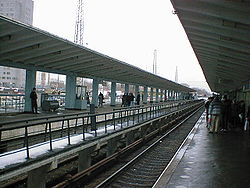 Initially the railway commuter passenger trains stopped just outside the metro pavilion. However, since the early 1990s they have been making longer journeys well beyond the metro trains' arrival zone and most of the passengers were forced to walk a train length. By the early 2000s it was clear that the transfer point needed a major reconstruction. In 2004 the station was closed to mainline trains (passengers were told to use the Kazansky Rail Terminal
instead). During this time the old 1960s concrete hinged roofs on the railway platforms were knocked down. These were replaced with modern light green and white transparent roofs with decorative features. The stairwells from the subways were covered with separate pavilions where turnstiles were inserted, and the concrete floor was repaved with stone. The combined metro and railway platform was re-divided along the width where a pavilion was built. Thus the centre-bound metro platform was nearly trebled in area (accounting for the dismantled ticket offices as well), and safety walls were installed on the railway side. The metro part of the station kept its hinged roofs, but these were completely repainted and the crude lighting elements in the hinges were replaced with never ones. Giving the platform a cleaner look, the subways were also widened and cleaned up with the old tile work replaced by marble. Additional subway was built as well. The complex was re-opened to the public on October 2, 2004.
Since there are no direct connections between metro platforms, the change of train crews takes place at Ryazanskiy Prospekt
station. Behind the station is a surface cross junction used for reversal and the tracks lead on to the Vykhino depot.
Originally the station (as well as the line) was called Zhdanovskaya after the famous revolutionary and politician Andrey Zhdanov. However in 1988 the station was renamed after name of the district in which it is located.
Moscow Metro
The Moscow Metro is a rapid transit system serving Moscow and the neighbouring town of Krasnogorsk. Opened in 1935 with one line and 13 stations, it was the first underground railway system in the Soviet Union. As of 2011, the Moscow Metro has 182 stations and its route length is . The system is...
's Tagansko-Krasnopresnenskaya Line
Tagansko-Krasnopresnenskaya Line
The Tagansko-Krasnopresnenskaya is the busiest line of the Moscow Metro...
. Opened on 31 December 1966 as the final part of the Zhdanovskiy Radius, the station has remained the southeastern terminus of the line since. The station is unique in many respects. First of all, it was the last station in Moscow (not counting the reconstruction of Vorobyovy Gory in 2002 and the light Metro in 2003) to be built above ground, and the last to have side
Side platform
A Side platform is a platform positioned to the side of a pair of tracks at a railway station, a tram stop or a transitway. A pair of side platforms are often provided on a dual track line with a single side platform being sufficient for a single track line...
(as opposed to island
Island platform
An island platform is a station layout arrangement where a single platform is positioned between two tracks within a railway station, tram stop or transitway interchange...
) platforms. In fact, the metro station is only part of a combined transfer node, the rest of which consists of the mainline suburban railway (Kazan
Kazan
Kazan is the capital and largest city of the Republic of Tatarstan, Russia. With a population of 1,143,546 , it is the eighth most populous city in Russia. Kazan lies at the confluence of the Volga and Kazanka Rivers in European Russia. In April 2009, the Russian Patent Office granted Kazan the...
skoye direction).
Originally designed by A.F. Strelkov and V.F. Cheremin, the whole complex has four platforms, two of which are Island platform
Island
An island or isle is any piece of sub-continental land that is surrounded by water. Very small islands such as emergent land features on atolls can be called islets, cays or keys. An island in a river or lake may be called an eyot , or holm...
. The railway uses four out of the six tracks, whilst the metro uses the other two. It is the only station where is impossible to get from one platform to another without leaving the metro. Two pedestrian subways
Subway (underpass)
In England and Wales, the Republic of Ireland, Hong Kong and some Commonwealth countries , the term subway normally refers to a specially constructed underpass for pedestrians and/or cyclists beneath a road or railway, allowing them to reach the other side in safety.The term is also used in the...
exist for the transfer between platforms (the transfer complex is above ground level and passengers must ascend to get onto the platforms). Direct railway to metro connections are only possible from Moscow-bound mainline trains onto centre-bound metro trains, where the combined platform is divided lengthwise between the metro and the railway. To transfer in the opposite direction, the subways must be used.
When the transfer complex was built, the long-term passenger load was underestimated. As a result, Vykhino became the busiest and most crowded station of the metro system, due to its position at the edge of Moscow
Moscow
Moscow is the capital, the most populous city, and the most populous federal subject of Russia. The city is a major political, economic, cultural, scientific, religious, financial, educational, and transportation centre of Russia and the continent...
, near many highly populated areas of the hinterland
Hinterland
The hinterland is the land or district behind a coast or the shoreline of a river. Specifically, by the doctrine of the hinterland, the word is applied to the inland region lying behind a port, claimed by the state that owns the coast. The area from which products are delivered to a port for...
. In addition to the railway traffic, Vykhino also has a large bus station nearby and many passengers from the surrounding Moscow Oblast
Moscow Oblast
Moscow Oblast , or Podmoskovye , is a federal subject of Russia . Its area, at , is relatively small compared to other federal subjects, but it is one of the most densely populated regions in the country and, with the 2010 population of 7,092,941, is the second most populous federal subject...
travel to central Moscow via Vykhino. As a result, the station has some of the largest passenger numbers of the metro network — 176,629 passengers per day at the start of 2009. On the morning rush hour, each third train does not board at this and next - Ryazansky prospekt stations in order to pick up passengers at Kuzminky station with strong bus service.
Kazansky Rail Terminal
Kazansky Rail Terminal is one of nine rail terminals in Moscow, situated on the Komsomolskaya Square, across the square from the Leningradsky and Yaroslavsky terminals....
instead). During this time the old 1960s concrete hinged roofs on the railway platforms were knocked down. These were replaced with modern light green and white transparent roofs with decorative features. The stairwells from the subways were covered with separate pavilions where turnstiles were inserted, and the concrete floor was repaved with stone. The combined metro and railway platform was re-divided along the width where a pavilion was built. Thus the centre-bound metro platform was nearly trebled in area (accounting for the dismantled ticket offices as well), and safety walls were installed on the railway side. The metro part of the station kept its hinged roofs, but these were completely repainted and the crude lighting elements in the hinges were replaced with never ones. Giving the platform a cleaner look, the subways were also widened and cleaned up with the old tile work replaced by marble. Additional subway was built as well. The complex was re-opened to the public on October 2, 2004.
Since there are no direct connections between metro platforms, the change of train crews takes place at Ryazanskiy Prospekt
Ryazanskiy Prospekt
Ryazanskiy Prospekt is a station on Moscow Metro's Tagansko-Krasnopresnenskaya Line. Opened on 31 December 1966 as part of the Zhdanovskiy radius, the station is situated where the line snakes norhtward and instead of following the Volgogradskiy avenue begins to follow the Ryazanskiy avenue which...
station. Behind the station is a surface cross junction used for reversal and the tracks lead on to the Vykhino depot.
Originally the station (as well as the line) was called Zhdanovskaya after the famous revolutionary and politician Andrey Zhdanov. However in 1988 the station was renamed after name of the district in which it is located.
External links
- metro.ru
- mymetro.ru
- KartaMetro.info — Station location and exits on Moscow map (English/Russian)