

Viscum

Encyclopedia
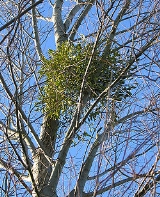
Viscum is a genus of about 70-100 species of mistletoe
s, native to temperate and tropical regions of Europe
, Africa
, Asia
and Australasia
. Traditionally, the genus has been placed in its own family Viscaceae
, but recent genetic research by the Angiosperm Phylogeny Group
shows this family to be correctly placed within a larger circumscription of the sandalwood
family, Santalaceae
.
They are woody, obligate
hemi-parasitic
shrub
s with branches 15–80 cm (5.9–31.5 in) long. Their hosts are woody shrubs and tree
s. The foliage is dichotomously or verticillately branching, with opposite pairs or whorls of green leaves
which perform some photosynthesis
(minimal in some species, notably V. nudum), but with the plant drawing its mineral and water needs from the host tree. Different species of Viscum tend to use different host species; most species are able to utilise several different host species.
The flower
s are inconspicuous, greenish-yellow, 1–3 mm (0.0393700787401575–0.118110236220472 in) diameter. The fruit
is a berry
, white, yellow, orange, or red when mature, containing several seed
s embedded in very sticky juice; the seeds are dispersed when bird
s (notably the Mistle Thrush
) eat the fruit, and remove the sticky seeds from the bill by wiping them on tree branches where they can germinate.
Selected species
Mistletoe
Mistletoe is the common name for obligate hemi-parasitic plants in several families in the order Santalales. The plants in question grow attached to and within the branches of a tree or shrub.-Mistletoe in the genus Viscum:...
s, native to temperate and tropical regions of Europe
Europe
Europe is, by convention, one of the world's seven continents. Comprising the westernmost peninsula of Eurasia, Europe is generally 'divided' from Asia to its east by the watershed divides of the Ural and Caucasus Mountains, the Ural River, the Caspian and Black Seas, and the waterways connecting...
, Africa
Africa
Africa is the world's second largest and second most populous continent, after Asia. At about 30.2 million km² including adjacent islands, it covers 6% of the Earth's total surface area and 20.4% of the total land area...
, Asia
Asia
Asia is the world's largest and most populous continent, located primarily in the eastern and northern hemispheres. It covers 8.7% of the Earth's total surface area and with approximately 3.879 billion people, it hosts 60% of the world's current human population...
and Australasia
Australasia
Australasia is a region of Oceania comprising Australia, New Zealand, the island of New Guinea, and neighbouring islands in the Pacific Ocean. The term was coined by Charles de Brosses in Histoire des navigations aux terres australes...
. Traditionally, the genus has been placed in its own family Viscaceae
Viscaceae
Viscaceae is a family of flowering plants. In past decades, several systems of plant taxonomy recognized this family, notably the 1981 Cronquist system...
, but recent genetic research by the Angiosperm Phylogeny Group
Angiosperm Phylogeny Group
The Angiosperm Phylogeny Group, or APG, refers to an informal international group of systematic botanists who came together to try to establish a consensus on the taxonomy of flowering plants that would reflect new knowledge about plant relationships discovered through phylogenetic studies., three...
shows this family to be correctly placed within a larger circumscription of the sandalwood
Santalum
Santalum is a genus of woody flowering plants, the best known and commercially valuable of which is the Indian Sandalwood tree, S. album. Members of the genus are trees or shrubs. Most are root parasites which photosynthesize their own food but tap the roots of other species for water and...
family, Santalaceae
Santalaceae
Santalaceae is a widely distributed family of flowering plants which, like other members of Santalales, are partially parasitic on other plants...
.
They are woody, obligate
Parasitic plant
A parasitic plant is one that derives some or all of its sustenance from another plant. About 4,100 species in approximately 19 families of flowering plants are known. Parasitic plants have a modified root, the haustorium, that penetrates the host plant and connects to the xylem, phloem, or...
hemi-parasitic
Parasitic plant
A parasitic plant is one that derives some or all of its sustenance from another plant. About 4,100 species in approximately 19 families of flowering plants are known. Parasitic plants have a modified root, the haustorium, that penetrates the host plant and connects to the xylem, phloem, or...
shrub
Shrub
A shrub or bush is distinguished from a tree by its multiple stems and shorter height, usually under 5–6 m tall. A large number of plants may become either shrubs or trees, depending on the growing conditions they experience...
s with branches 15–80 cm (5.9–31.5 in) long. Their hosts are woody shrubs and tree
Tree
A tree is a perennial woody plant. It is most often defined as a woody plant that has many secondary branches supported clear of the ground on a single main stem or trunk with clear apical dominance. A minimum height specification at maturity is cited by some authors, varying from 3 m to...
s. The foliage is dichotomously or verticillately branching, with opposite pairs or whorls of green leaves
Leaf
A leaf is an organ of a vascular plant, as defined in botanical terms, and in particular in plant morphology. Foliage is a mass noun that refers to leaves as a feature of plants....
which perform some photosynthesis
Photosynthesis
Photosynthesis is a chemical process that converts carbon dioxide into organic compounds, especially sugars, using the energy from sunlight. Photosynthesis occurs in plants, algae, and many species of bacteria, but not in archaea. Photosynthetic organisms are called photoautotrophs, since they can...
(minimal in some species, notably V. nudum), but with the plant drawing its mineral and water needs from the host tree. Different species of Viscum tend to use different host species; most species are able to utilise several different host species.
The flower
Flower
A flower, sometimes known as a bloom or blossom, is the reproductive structure found in flowering plants . The biological function of a flower is to effect reproduction, usually by providing a mechanism for the union of sperm with eggs...
s are inconspicuous, greenish-yellow, 1–3 mm (0.0393700787401575–0.118110236220472 in) diameter. The fruit
Fruit
In broad terms, a fruit is a structure of a plant that contains its seeds.The term has different meanings dependent on context. In non-technical usage, such as food preparation, fruit normally means the fleshy seed-associated structures of certain plants that are sweet and edible in the raw state,...
is a berry
Berry
The botanical definition of a berry is a fleshy fruit produced from a single ovary. Grapes are an example. The berry is the most common type of fleshy fruit in which the entire ovary wall ripens into an edible pericarp. They may have one or more carpels with a thin covering and fleshy interiors....
, white, yellow, orange, or red when mature, containing several seed
Seed
A seed is a small embryonic plant enclosed in a covering called the seed coat, usually with some stored food. It is the product of the ripened ovule of gymnosperm and angiosperm plants which occurs after fertilization and some growth within the mother plant...
s embedded in very sticky juice; the seeds are dispersed when bird
Bird
Birds are feathered, winged, bipedal, endothermic , egg-laying, vertebrate animals. Around 10,000 living species and 188 families makes them the most speciose class of tetrapod vertebrates. They inhabit ecosystems across the globe, from the Arctic to the Antarctic. Extant birds range in size from...
s (notably the Mistle Thrush
Mistle Thrush
The Mistle Thrush is a member of the thrush family Turdidae.It is found in open woods and cultivated land over all of Europe and much of Asia...
) eat the fruit, and remove the sticky seeds from the bill by wiping them on tree branches where they can germinate.
Selected species
- Viscum albumViscum albumViscum album is a species of mistletoe, the species originally so-named, and also known as European Mistletoe or Common Mistletoe to distinguish it from other related species...
– European Mistletoe - Viscum articulatum
- Viscum bancroftii
- Viscum capenseViscum capenseViscum capense is a species of Mistletoe that is indigenous to South Africa, especially the area from Cape Town, northwards along the coast up to Namibia, and eastwards as far as the Eastern Cape province....
- Cape Mistletoe (South Africa) - Viscum coloratum
- Viscum cruciatumViscum cruciatumViscum cruciatum, commonly called the red-berry mistletoe, is a species of mistletoe in the family Santalaceae. The plant has small leaves. The flowers have four petals. The berries are red containing 1 seed. It ranges through South West Spain, Southern Portugal, North Africa, Australia and Asia....
– Red-berried Mistletoe - Viscum diospyrosicola
- Viscum fargesii
- Viscum liquidambaricola
- Viscum loranthi
- Viscum minimum
- Viscum monoicum
- Viscum multinerve
- Viscum nudum
- Viscum orientale
- Viscum ovalifolium
- Viscum triflorum
- Viscum whitei
- Viscum yunnanense