

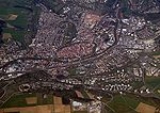
Villingen-Schwenningen

Encyclopedia
Villingen-Schwenningen is a city in the Schwarzwald-Baar district in southern Baden-Württemberg
, Germany
. It has 80,941 inhabitants (as of 2009).
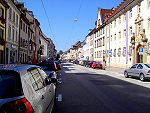 In the Middle Ages
Villingen was a town under Austrian lordship. During the Protestant Reformation
it remained Catholic
. Villingen came to international attention when it was besieged by marshal Tallard in 1704. Colonel Von Wilstorff put up a stout defence of the outdated fortifications, and after six days the siege failed.
Schwenningen remained a village until the 19th century. In 1858 the first watch factory was established, and watchmaking and precision mechanics have been important industries ever since.
As part of the Baden-Württemberg territorial reform of 1972, Villingen and Schwenningen were merged with a number of surrounding villages to form the city of Villingen-Schwenningen. Nevertheless, the two halves of the city are separated by a plateau and remain distinct.
Villingen is a major center of German Carneval celebrations. The traditional Narros represent the old citizens of Villingen: Alt Villingere, Morbili, Hansele, Suribbel.
The town is the birthplace of German footballer Sebastian Rudy
, NHL player Dennis Seidenberg
, Croatian footballer Robert Prosinečki
and Croatian former athlete Ivana Brkljačić
whose parents were working in Germany at the time.
about 700 meters above sea level. The source of the River Neckar
is in Schwenningen (Schwenninger Moos).
Baden-Württemberg
Baden-Württemberg is one of the 16 states of Germany. Baden-Württemberg is in the southwestern part of the country to the east of the Upper Rhine, and is the third largest in both area and population of Germany's sixteen states, with an area of and 10.7 million inhabitants...
, Germany
Germany
Germany , officially the Federal Republic of Germany , is a federal parliamentary republic in Europe. The country consists of 16 states while the capital and largest city is Berlin. Germany covers an area of 357,021 km2 and has a largely temperate seasonal climate...
. It has 80,941 inhabitants (as of 2009).
History
Middle Ages
The Middle Ages is a periodization of European history from the 5th century to the 15th century. The Middle Ages follows the fall of the Western Roman Empire in 476 and precedes the Early Modern Era. It is the middle period of a three-period division of Western history: Classic, Medieval and Modern...
Villingen was a town under Austrian lordship. During the Protestant Reformation
Protestant Reformation
The Protestant Reformation was a 16th-century split within Western Christianity initiated by Martin Luther, John Calvin and other early Protestants. The efforts of the self-described "reformers", who objected to the doctrines, rituals and ecclesiastical structure of the Roman Catholic Church, led...
it remained Catholic
Catholicism
Catholicism is a broad term for the body of the Catholic faith, its theologies and doctrines, its liturgical, ethical, spiritual, and behavioral characteristics, as well as a religious people as a whole....
. Villingen came to international attention when it was besieged by marshal Tallard in 1704. Colonel Von Wilstorff put up a stout defence of the outdated fortifications, and after six days the siege failed.
Schwenningen remained a village until the 19th century. In 1858 the first watch factory was established, and watchmaking and precision mechanics have been important industries ever since.
As part of the Baden-Württemberg territorial reform of 1972, Villingen and Schwenningen were merged with a number of surrounding villages to form the city of Villingen-Schwenningen. Nevertheless, the two halves of the city are separated by a plateau and remain distinct.
Villingen is a major center of German Carneval celebrations. The traditional Narros represent the old citizens of Villingen: Alt Villingere, Morbili, Hansele, Suribbel.
The town is the birthplace of German footballer Sebastian Rudy
Sebastian Rudy
Sebastian Rudy is a German footballer who plays as a midfielder for TSG 1899 Hoffenheim..-Club career:...
, NHL player Dennis Seidenberg
Dennis Seidenberg
Dennis Seidenberg is a German professional ice hockey defenceman currently playing for the Boston Bruins of the National Hockey League...
, Croatian footballer Robert Prosinečki
Robert Prosinecki
Robert Prosinečki is a Croatian football manager and former football midfielder. Prosinečki is regarded by many as the player with best technique that ever played in and for Croatia. Former national squad teammate Zvonimir Boban, humbly, also agreed with this. His dribbling is considered...
and Croatian former athlete Ivana Brkljačić
Ivana Brkljacic
Ivana Brkljačić is a former female hammer thrower from Croatia.She achieved good results as a teenager, winning the World Junior Championships twice and finishing 11th in the 2000 Olympic finals at the age of 17...
whose parents were working in Germany at the time.
Geography
Villingen-Schwenningen lies on the eastern edge of the Black ForestBlack Forest
The Black Forest is a wooded mountain range in Baden-Württemberg, southwestern Germany. It is bordered by the Rhine valley to the west and south. The highest peak is the Feldberg with an elevation of 1,493 metres ....
about 700 meters above sea level. The source of the River Neckar
Neckar
The Neckar is a long river, mainly flowing through the southwestern state of Baden-Württemberg, but also a short section through Hesse, in Germany. The Neckar is a major right tributary of the River Rhine...
is in Schwenningen (Schwenninger Moos).
Boroughs
- Villingen
- Schwenningen
- Obereschach
- WeilersbachWeilersbach (Villingen-Schwenningen)Weilersbach is a borough of the town of Villingen-Schwenningen. Until 1803 Weilersbach was a part of the Rottweiler Bruderschaft. Since 1803, Weilersbach has been a part of Baden. Since 1972 it has been a part of the town of Villingen-Schwenningen....
- Weigheim
- Mühlhausen
- Marbach
- Rietheim
- Pfaffenweiler
- Herzogenweiler
- Tannheim
Main sights
- Town Wall
- Municipal Art Gallery
- Franziskaner Museum
- Schwenningen Clock Museum
- Minster of Our Lady
- Theater am Ring
- Wanne Observation TowerWanne Observation TowerWanne observation tower is one of the oldest lattice towers of the world. It was built in 1888 by the observation tower cooperative on 778 meters high Wanne mountain tub east of Villingen, whereby its erection was done by bell foundry Grueninger of Villingen....
, one of the oldest towers built of iron