

Ventricular tachycardia

Encyclopedia
Ventricular tachycardia (V-tach or VT) is a tachycardia
, or fast heart rhythm, that originates in one of the ventricles
of the heart
. This is a potentially life-threatening arrhythmia because it may lead to ventricular fibrillation
, asystole
, and sudden death
.
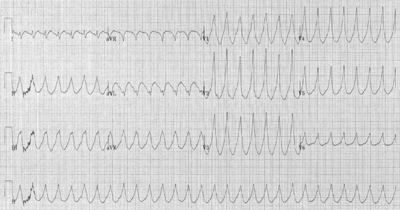 Ventricular tachycardia can be classified based on its morphology:
Another way to classify ventricular tachycardias is the duration of the episodes: Three or more beats in a row on an ECG that originate from the ventricle at a rate of more than 100 beats per minute constitute a ventricular tachycardia.
A third way to classify ventricular tachycardia is on the basis of its symptoms: Pulseless VT is associated with no effective cardiac output, hence, no effective pulse, and is a cause of cardiac arrest. In this circumstance, it is best treated the same way as ventricular fibrillation (VF), and is recognized as one of the shockable rhythms on the cardiac arrest protocol. Some VT is associated with reasonable cardiac output and may even be asymptomatic. The heart usually tolerates this rhythm poorly in the medium to long term, and patients may certainly deteriorate to pulseless VT or to VF.
Less common is ventricular tachycardia which occurs in individuals with structurally normal hearts. This is known as idiopathic ventricular tachycardia and in the Monomorphic form appears with little or no incidence of increased risk of sudden cardiac death. In general, idiopathic ventricular tachycardia occurs in younger individuals diagnosed with VT. While the causes of idiopathic VT are not known, it is generally presumed to be congenital, and can be brought on by any number of diverse factors.
In monomorphic ventricular tachycardia, all the beats look the same because the impulse is either being generated from increased automaticity of a single point in either the left or right ventricle, or due to a reentry circuit within the ventricle. The most common cause of monomorphic ventricular tachycardia is myocardial scarring
from a previous myocardial infarction
(heart attack). This scar cannot conduct electrical activity, so there is a potential circuit around the scar that results in the tachycardia. This is similar to the re-entrant circuits that are the cause of atrial flutter
and the re-entrant forms of supraventricular tachycardia
. Other rarer congenital causes of monomorphic VT include right ventricular dysplasia, and right and left ventricular outflow tract VT.
Polymorphic ventricular tachycardia, on the other hand, is most commonly caused by abnormalities of ventricular muscle repolarization. The predisposition to this problem usually manifests on the ECG as a prolongation of the QT interval. QT prolongation may be congenital or acquired. Congenital problems include Long QT syndrome
and Catecholaminergic polymorphic ventricular tachycardia
. Acquired problems are usually related to drug toxicity or electrolyte abnormalities, but can occur as a result of myocardial ischemia. Class III anti-arrhythmic drugs such as sotalol
and amiodarone
prolong the QT interval and may in some circumstances be pro-arrhythmic. Other relatively common drugs including some antibiotics and antihistamines may also be a danger, particularly in combination with one another. Problems with blood levels of potassium, magnesium and calcium may also contribute. High dose magnesium is often used as an antidote in cardiac arrest protocols.
of ventricular tachycardia is made based on the rhythm seen on either a 12 lead EKG or a telemetry rhythm strip. It may be very difficult to differentiate between ventricular tachycardia and a wide-complex supraventricular tachycardia
in some cases. In particular, supraventricular tachycardias with aberrant conduction from pre-existing bundle branch block
are commonly misdiagnosed as ventricular tachycardia. Other rarer phenomena include ashman beats
and antedromic atrioventricular re-entry tachcyardias.
Various diagnostic criteria have been developed to determine whether a wide complex tachycardia is ventricular tachycardia or a more benign rhythm. In addition to these diagnostic criteria, if the individual has a past history of a myocardial infarction
, congestive heart failure
, or recent angina, the wide complex tachycardia is much more likely to be ventricular tachycardia.
The proper diagnosis is important, as the misdiagnosis of supraventricular tachycardia when ventricular tachycardia is present is associated with worse prognosis. This is particularly true if calcium channel blocker
s, such as verapamil
, are used to attempt to terminate a presumed supraventricular tachycardia. It is therefore wisest to assume that all wide complex tachycardia is VT until proven otherwise.
will be unconscious and treated as an emergency on an ACLS
protocol, given high energy (360J with a monophasic defibrillator, or 200J with a biphasic defibrillator) unsynchronised cardioversion (defibrillation).
The shock may be delivered to the outside of the chest using an external defibrillator, or internally to the heart by an implantable cardioverter-defibrillator
(ICD) if one has previously been inserted.
An ICD may also be set to attempt to overdrive pace the ventricle. Pacing the ventricle at a rate faster than the underlying tachycardia can sometimes be effective in terminating the rhythm. If this fails after a short trial, the ICD will usually stop pacing, charge up and deliver a defibrillation grade shock.
There was consensus among the task force members that catheter ablation for VT should generally be considered early in the treatment of patients with recurrent VT. In the past, ablation was often not considered until pharmacological options had been exhausted, often after the patient had suffered substantial morbidity from recurrent episodes of VT and ICD shocks. Antiarrhythmic medications can reduce the frequency of ICD therapies, but have disappointing efficacy and side effects. Advances in technology and understanding of VT substrates now allow ablation of multiple and unstable VTs with acceptable safety and efficacy, even in patients with advanced heart disease.
Remote magnetic navigation
is recognized as an important method for delivery of ablation therapy for these patients due to the ability of the flexible magnetic catheter to carefully map the diseased tissue without inadvertently inducing abnormal ventricular rhythms. In a series of 110 patients that included all morphologies of VT, 85% of patients treated with magnetic ablation were free from VT at one year after the intervention and were exposed to statistically reduced levels of radiation when compared to non-magnetic VT ablations at the same center. In patients with myocardial scarring from a previous heart attack who were receiving excessive shocks from an ICD, magnetic ablation was shown to be successful in reducing these shocks and demonstrated a 67% reduction in imaging radiation needed to complete the procedure compared to a historical non-magnetic group. For monomorphic idiopathic VT which may originate in thin-walled tissues, magnetic ablation offers catheter flexibility, steering accuracy and reproducibility to navigate to a desired location with a low probability of perforating the myocardium.
or procainamide
may be used in addition to defibrillation
to terminate VT while the underlying cause of the VT can be determined. As hypomagnesia is a common cause of VT, stat dose magnesium sulphate can be given for torsades or if hypomagnesemia is found/suspected.
Long term anti-arrhythmic therapy may be indicated to prevent recurrence of VT. Beta-blockers and a number of class III anti-arrhythmics are commonly used. Lidocaine is now being replaced by amiodarone as the first line anti-arrhythmic treatment of VT.
The implantation of an ICD is more effective than drug therapy for prevention of sudden cardiac death due to VT and VF, but may be constrained by cost issues,(RDM) and well as patient co-morbidities and patient preference.
In the 2006 film Casino Royale
, the protagonist, James Bond
, suffers ventricular tachycardia from intoxication of digitalis
and goes into cardiac arrest.
"V-Tach" is what "The Satin Slayer
" from the American soap opera All My Children
used to kill his victims.
Tachycardia
Tachycardia comes from the Greek words tachys and kardia . Tachycardia typically refers to a heart rate that exceeds the normal range for a resting heart rate...
, or fast heart rhythm, that originates in one of the ventricles
Left ventricle
The left ventricle is one of four chambers in the human heart. It receives oxygenated blood from the left atrium via the mitral valve, and pumps it into the aorta via the aortic valve.-Shape:...
of the heart
Heart
The heart is a myogenic muscular organ found in all animals with a circulatory system , that is responsible for pumping blood throughout the blood vessels by repeated, rhythmic contractions...
. This is a potentially life-threatening arrhythmia because it may lead to ventricular fibrillation
Ventricular fibrillation
Ventricular fibrillation is a condition in which there is uncoordinated contraction of the cardiac muscle of the ventricles in the heart, making them quiver rather than contract properly. Ventricular fibrillation is a medical emergency and most commonly identified arrythmia in cardiac arrest...
, asystole
Asystole
In medicine, asystole is a state of no cardiac electrical activity, hence no contractions of the myocardium and no cardiac output or blood flow...
, and sudden death
Sudden Cardiac Death
Sudden cardiac death is natural death from cardiac causes, heralded by abrupt loss of consciousness within one hour of the onset of acute symptoms. Other forms of sudden death may be noncardiac in origin...
.
Classification
- Monomorphic ventricular tachycardia means that the appearance of all the beats match each other in each lead of a surface electrocardiogramElectrocardiogramElectrocardiography is a transthoracic interpretation of the electrical activity of the heart over a period of time, as detected by electrodes attached to the outer surface of the skin and recorded by a device external to the body...
(ECG).- RVOT tachycardia is a type of monomorphic ventricular tachycardia originating in the right ventricular outflow tract. RVOT morphology refers to the characteristic pattern of this type of tachycardia on an ECG.
- Polymorphic ventricular tachycardia, on the other hand, has beat-to-beat variations in morphology. This most commonly appears as a cyclical progressive change in cardiac axis, previously referred to by its French name torsades de pointesTorsades de pointesTorsades de pointes, or simply torsades, is a French term that literally means "twisting of the points". It was first described by Dessertenne in 1966 and refers to a specific, rare variety of ventricular tachycardia that exhibits distinct characteristics on the electrocardiogram .- Presentation...
("twisting of the points"). However, currently the term torsades is reserved for polymorphic VT occurring in the context of a prolonged resting QT intervalQT intervalIn cardiology, the QT interval is a measure of the time between the start of the Q wave and the end of the T wave in the heart's electrical cycle. In general, the QT interval represents electrical depolarization and repolarization of the left and right ventricles...
.
Another way to classify ventricular tachycardias is the duration of the episodes: Three or more beats in a row on an ECG that originate from the ventricle at a rate of more than 100 beats per minute constitute a ventricular tachycardia.
- If the fast rhythm self-terminates within 30 seconds, it is considered a non-sustained ventricular tachycardia.
- If the rhythm lasts more than 30 seconds, it is known as a sustained ventricular tachycardia (even if it terminates on its own after 30 seconds).
A third way to classify ventricular tachycardia is on the basis of its symptoms: Pulseless VT is associated with no effective cardiac output, hence, no effective pulse, and is a cause of cardiac arrest. In this circumstance, it is best treated the same way as ventricular fibrillation (VF), and is recognized as one of the shockable rhythms on the cardiac arrest protocol. Some VT is associated with reasonable cardiac output and may even be asymptomatic. The heart usually tolerates this rhythm poorly in the medium to long term, and patients may certainly deteriorate to pulseless VT or to VF.
Less common is ventricular tachycardia which occurs in individuals with structurally normal hearts. This is known as idiopathic ventricular tachycardia and in the Monomorphic form appears with little or no incidence of increased risk of sudden cardiac death. In general, idiopathic ventricular tachycardia occurs in younger individuals diagnosed with VT. While the causes of idiopathic VT are not known, it is generally presumed to be congenital, and can be brought on by any number of diverse factors.
Pathophysiology
The morphology of the tachycardia depends on its cause.In monomorphic ventricular tachycardia, all the beats look the same because the impulse is either being generated from increased automaticity of a single point in either the left or right ventricle, or due to a reentry circuit within the ventricle. The most common cause of monomorphic ventricular tachycardia is myocardial scarring
Myocardial scarring
Myocardial scarring is fibrous tissue that replaces normal tissue destroyed by injury or disease pertaining to the muscular tissue of the heart....
from a previous myocardial infarction
Myocardial infarction
Myocardial infarction or acute myocardial infarction , commonly known as a heart attack, results from the interruption of blood supply to a part of the heart, causing heart cells to die...
(heart attack). This scar cannot conduct electrical activity, so there is a potential circuit around the scar that results in the tachycardia. This is similar to the re-entrant circuits that are the cause of atrial flutter
Atrial flutter
Atrial flutter is an abnormal heart rhythm that occurs in the atria of the heart. When it first occurs, it is usually associated with a fast heart rate or tachycardia , and falls into the category of supra-ventricular tachycardias. While this rhythm occurs most often in individuals with...
and the re-entrant forms of supraventricular tachycardia
Supraventricular tachycardia
Supraventricular tachycardia is a general term that refers to any rapid heart rhythm originating above the ventricular tissue. Supraventricular tachycardias can be contrasted to the potentially more dangerous ventricular tachycardias - rapid rhythms that originate within the ventricular...
. Other rarer congenital causes of monomorphic VT include right ventricular dysplasia, and right and left ventricular outflow tract VT.
Polymorphic ventricular tachycardia, on the other hand, is most commonly caused by abnormalities of ventricular muscle repolarization. The predisposition to this problem usually manifests on the ECG as a prolongation of the QT interval. QT prolongation may be congenital or acquired. Congenital problems include Long QT syndrome
Long QT syndrome
The long QT syndrome is a rare inborn heart condition in which delayed repolarization of the heart following a heartbeat increases the risk of episodes of torsade de pointes . These episodes may lead to palpitations, fainting and sudden death due to ventricular fibrillation...
and Catecholaminergic polymorphic ventricular tachycardia
Catecholaminergic polymorphic ventricular tachycardia
Catecholaminergic Polymorphic Ventricular Tachycardia is an electrophysiological disorder of the heart that occurs in genetically predisposed individuals...
. Acquired problems are usually related to drug toxicity or electrolyte abnormalities, but can occur as a result of myocardial ischemia. Class III anti-arrhythmic drugs such as sotalol
Sotalol
Sotalol is a drug used in individuals with rhythm disturbances of the heart, and to treat hypertension in some individuals. It is a non-selective competitive β-adrenergic receptor blocker that also exhibits Class III antiarrhythmic properties by its inhibition of potassium channels...
and amiodarone
Amiodarone
Amiodarone is an antiarrhythmic agent used for various types of tachyarrhythmias , both ventricular and supraventricular arrhythmias. Discovered in 1961, it was not approved for use in the United States until 1985...
prolong the QT interval and may in some circumstances be pro-arrhythmic. Other relatively common drugs including some antibiotics and antihistamines may also be a danger, particularly in combination with one another. Problems with blood levels of potassium, magnesium and calcium may also contribute. High dose magnesium is often used as an antidote in cardiac arrest protocols.
Diagnosis
The diagnosisMedical diagnosis
Medical diagnosis refers both to the process of attempting to determine or identify a possible disease or disorder , and to the opinion reached by this process...
of ventricular tachycardia is made based on the rhythm seen on either a 12 lead EKG or a telemetry rhythm strip. It may be very difficult to differentiate between ventricular tachycardia and a wide-complex supraventricular tachycardia
Supraventricular tachycardia
Supraventricular tachycardia is a general term that refers to any rapid heart rhythm originating above the ventricular tissue. Supraventricular tachycardias can be contrasted to the potentially more dangerous ventricular tachycardias - rapid rhythms that originate within the ventricular...
in some cases. In particular, supraventricular tachycardias with aberrant conduction from pre-existing bundle branch block
Bundle branch block
A bundle branch block refers to a defect of the heart's electrical conduction system.-Anatomy and physiology:The heart's electrical activity begins in the sinoatrial node , which is situated on the upper right atrium. The impulse travels next through the left and right atria and summates at the...
are commonly misdiagnosed as ventricular tachycardia. Other rarer phenomena include ashman beats
Ashman phenomenon
First described by Gouaux and Ashman in 1947, Ashman phenomenon, also known as Ashman beats, describes a particular type of wide complex tachycardia that is often seen in atrial fibrillation...
and antedromic atrioventricular re-entry tachcyardias.
Various diagnostic criteria have been developed to determine whether a wide complex tachycardia is ventricular tachycardia or a more benign rhythm. In addition to these diagnostic criteria, if the individual has a past history of a myocardial infarction
Myocardial infarction
Myocardial infarction or acute myocardial infarction , commonly known as a heart attack, results from the interruption of blood supply to a part of the heart, causing heart cells to die...
, congestive heart failure
Congestive heart failure
Heart failure often called congestive heart failure is generally defined as the inability of the heart to supply sufficient blood flow to meet the needs of the body. Heart failure can cause a number of symptoms including shortness of breath, leg swelling, and exercise intolerance. The condition...
, or recent angina, the wide complex tachycardia is much more likely to be ventricular tachycardia.
The proper diagnosis is important, as the misdiagnosis of supraventricular tachycardia when ventricular tachycardia is present is associated with worse prognosis. This is particularly true if calcium channel blocker
Calcium channel blocker
A calcium channel blocker is a chemical that disrupts the movement of calcium through calcium channels.CCB drugs devised to target neurons are used as antiepileptics. However, the most widespread clinical usage of calcium channel blockers is to decrease blood pressure in patients with...
s, such as verapamil
Verapamil
Verapamil is an L-type calcium channel blocker of the phenylalkylamine class. It has been used in the treatment of hypertension, angina pectoris, cardiac arrhythmia, and most recently, cluster headaches. It is also an effective preventive medication for migraine...
, are used to attempt to terminate a presumed supraventricular tachycardia. It is therefore wisest to assume that all wide complex tachycardia is VT until proven otherwise.
Treatment
Therapy may be directed at either terminating an episode of the arrhythmia or for suppressing a future episode from occurring. The treatment for stable VT is tailored to the specific patient, with regard to how well the individual tolerates episodes of ventricular tachycardia, how frequently episodes occur, their comorbidities, and their wishes. Patients suffering from pulseless VT or unstable VT are hemodynamically compromised and require immediate cardioversion.Synchronized electrical cardioversion
If the patient still has a pulse, it is usually possible to terminate a VT episode with a direct current shock across the heart. This is ideally synchronized to the patient's heartbeat. As this is quite uncomfortable, shocks should be delivered only to an unconscious or sedated patient. As a reminder, this is different from defibrillating the patient. If the patient still had a pulse, defibrillating the patient could potentially send him into asystole.Defibrillation
A patient with pulseless VT or a ventricular fibrillationVentricular fibrillation
Ventricular fibrillation is a condition in which there is uncoordinated contraction of the cardiac muscle of the ventricles in the heart, making them quiver rather than contract properly. Ventricular fibrillation is a medical emergency and most commonly identified arrythmia in cardiac arrest...
will be unconscious and treated as an emergency on an ACLS
Advanced cardiac life support
Advanced cardiac life support or Advanced Cardiovascular Life Support refers to a set of clinical interventions for the urgent treatment of cardiac arrest and other life threatening medical emergencies, as well as the knowledge and skills to deploy those interventions.Extensive medical knowledge...
protocol, given high energy (360J with a monophasic defibrillator, or 200J with a biphasic defibrillator) unsynchronised cardioversion (defibrillation).
The shock may be delivered to the outside of the chest using an external defibrillator, or internally to the heart by an implantable cardioverter-defibrillator
Implantable cardioverter-defibrillator
An implantable cardioverter-defibrillator is a small battery-powered electrical impulse generator which is implanted in patients who are at risk of sudden cardiac death due to ventricular fibrillation and ventricular tachycardia. The device is programmed to detect cardiac arrhythmia and correct it...
(ICD) if one has previously been inserted.
An ICD may also be set to attempt to overdrive pace the ventricle. Pacing the ventricle at a rate faster than the underlying tachycardia can sometimes be effective in terminating the rhythm. If this fails after a short trial, the ICD will usually stop pacing, charge up and deliver a defibrillation grade shock.
Cardiac ablation
Catheter ablation is a key therapeutic modality for patients with recurrent VT. A task force consisting of the European Heart Rhythm Association (EHRA) in conjunction with the Heart Rhythm Society (HRS) developed an expert consensus paper that carefully defines the indications, techniques, and outcomes of this procedure.There was consensus among the task force members that catheter ablation for VT should generally be considered early in the treatment of patients with recurrent VT. In the past, ablation was often not considered until pharmacological options had been exhausted, often after the patient had suffered substantial morbidity from recurrent episodes of VT and ICD shocks. Antiarrhythmic medications can reduce the frequency of ICD therapies, but have disappointing efficacy and side effects. Advances in technology and understanding of VT substrates now allow ablation of multiple and unstable VTs with acceptable safety and efficacy, even in patients with advanced heart disease.
Remote magnetic navigation
Remote magnetic navigation
-Remote Magnetic Navigation:Remote Magnetic Navigation, employed by companies such as Stereotaxis , is an emerging technology in interventional cardiology. Catheters with magnetic tips can be steered within the patient, without the need for an electrophysiologist to maneuver the catheter or...
is recognized as an important method for delivery of ablation therapy for these patients due to the ability of the flexible magnetic catheter to carefully map the diseased tissue without inadvertently inducing abnormal ventricular rhythms. In a series of 110 patients that included all morphologies of VT, 85% of patients treated with magnetic ablation were free from VT at one year after the intervention and were exposed to statistically reduced levels of radiation when compared to non-magnetic VT ablations at the same center. In patients with myocardial scarring from a previous heart attack who were receiving excessive shocks from an ICD, magnetic ablation was shown to be successful in reducing these shocks and demonstrated a 67% reduction in imaging radiation needed to complete the procedure compared to a historical non-magnetic group. For monomorphic idiopathic VT which may originate in thin-walled tissues, magnetic ablation offers catheter flexibility, steering accuracy and reproducibility to navigate to a desired location with a low probability of perforating the myocardium.
Antiarrhythmic drug therapy
Drugs such as amiodaroneAmiodarone
Amiodarone is an antiarrhythmic agent used for various types of tachyarrhythmias , both ventricular and supraventricular arrhythmias. Discovered in 1961, it was not approved for use in the United States until 1985...
or procainamide
Procainamide
Procainamide INN is a pharmaceutical antiarrhythmic agent used for the medical treatment of cardiac arrhythmias, classified by the Vaughan Williams classification system as class Ia.-History:...
may be used in addition to defibrillation
Defibrillation
Defibrillation is a common treatment for life-threatening cardiac arrhythmias, ventricular fibrillation and pulseless ventricular tachycardia. Defibrillation consists of delivering a therapeutic dose of electrical energy to the affected heart with a device called a defibrillator...
to terminate VT while the underlying cause of the VT can be determined. As hypomagnesia is a common cause of VT, stat dose magnesium sulphate can be given for torsades or if hypomagnesemia is found/suspected.
Long term anti-arrhythmic therapy may be indicated to prevent recurrence of VT. Beta-blockers and a number of class III anti-arrhythmics are commonly used. Lidocaine is now being replaced by amiodarone as the first line anti-arrhythmic treatment of VT.
The implantation of an ICD is more effective than drug therapy for prevention of sudden cardiac death due to VT and VF, but may be constrained by cost issues,(RDM) and well as patient co-morbidities and patient preference.
Popular culture
VT is frequently referenced in the 1970s television series Emergency!Emergency!
Emergency! is an American television series that combines the medical drama and action-adventure genres. It was produced by Mark VII Limited and distributed by Universal Studios...
In the 2006 film Casino Royale
Casino Royale (2006 film)
Casino Royale is the twenty-first film in the James Bond film series and the first to star Daniel Craig as fictional MI6 agent James Bond...
, the protagonist, James Bond
James Bond
James Bond, code name 007, is a fictional character created in 1953 by writer Ian Fleming, who featured him in twelve novels and two short story collections. There have been a six other authors who wrote authorised Bond novels or novelizations after Fleming's death in 1964: Kingsley Amis,...
, suffers ventricular tachycardia from intoxication of digitalis
Digitalis
Digitalis is a genus of about 20 species of herbaceous perennials, shrubs, and biennials that are commonly called foxgloves. This genus was traditionally placed in the figwort family Scrophulariaceae, but recent reviews of phylogenetic research have placed it in the much enlarged family...
and goes into cardiac arrest.
"V-Tach" is what "The Satin Slayer
Alexander Cambias, Sr.
Alexander Cambias, Sr. is a fictional character from the ABC daytime drama All My Children, as portrayed by Ronald Guttman, from July 23, 2003 until August 2003. Guttman returned to the role on February 23, 2007 and left April 27, 2007...
" from the American soap opera All My Children
All My Children
All My Children is an American television soap opera that aired on ABC from January 5, 1970 to September 23, 2011. Created by Agnes Nixon, All My Children is set in Pine Valley, Pennsylvania, a fictitious suburb of Philadelphia. The show features Susan Lucci as Erica Kane, one of daytime's most...
used to kill his victims.