
All Topics  
Electrocardiogram


   Email Print
   Bookmark   Link


Electrocardiogram


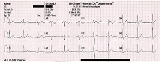
An electrocardiogram (ECG or EKG) is a recording of the electrical
Electricity

Electricity is a general term that encompasses a variety of phenomena resulting from the presence and flow of electric charge. These include many easily recognizable phenomena such as lightning and static electricity, but in addition, less familiar concepts such as the electromagnetic field and electromagnetic induction....
 activity of the heart
Heart

The heart is a muscle organ in all vertebrates responsible for pumping blood through the blood vessels by repeated, rhythmic contractions, or a similar structure in annelids, mollusks, and arthropods....
 over time
Time

Time is a component of the measurement used to sequence events, to compare the durations of events and the intervals between them, and to quantify the motions of objects....
 produced by an electrocardiograph, usually in a noninvasive
Non-invasive (medical)

The term non-invasive in medicine has two meanings:* A medical procedure is strictly defined as non-invasive when no break in the skin is created and there is no contact with the mucosa, or skin break, or internal body cavity beyond a natural or artificial body orifice....
 recording via skin electrodes. Its name is made of different parts: electro, because it is related to electrical activity, cardio, Greek
Greek language

Greek is an Indo-European languages native to the southern Balkan peninsula, the language of the Greek people. It forms an independent branch within Indo-European....
 for heart, gram, a Greek root meaning "to write".

Electrical impulses in the heart originate in the sinoatrial node
Sinoatrial node

The sinoatrial node is the impulse generating tissue located in the right atrium of the heart, and thus the generator of sinus rhythm. It is a group of cells positioned on the wall of the right atrium, near the entrance of the superior vena cava....
 and travel through the heart muscle where they impart electrical initiation of systole
Systole

Systole can mean the following:*Systole is a term describing the contraction of the heart.*Systolic geometry is a term used in mathematics....
 or contraction of the heart.


Discussion
Ask a question about 'Electrocardiogram'
Start a new discussion about 'Electrocardiogram'
Answer questions from other users
Full Discussion Forum


Recent Posts


Encyclopedia


An electrocardiogram (ECG or EKG) is a recording of the electrical
Electricity

Electricity is a general term that encompasses a variety of phenomena resulting from the presence and flow of electric charge. These include many easily recognizable phenomena such as lightning and static electricity, but in addition, less familiar concepts such as the electromagnetic field and electromagnetic induction....
 activity of the heart
Heart

The heart is a muscle organ in all vertebrates responsible for pumping blood through the blood vessels by repeated, rhythmic contractions, or a similar structure in annelids, mollusks, and arthropods....
 over time
Time

Time is a component of the measurement used to sequence events, to compare the durations of events and the intervals between them, and to quantify the motions of objects....
 produced by an electrocardiograph, usually in a noninvasive
Non-invasive (medical)

The term non-invasive in medicine has two meanings:* A medical procedure is strictly defined as non-invasive when no break in the skin is created and there is no contact with the mucosa, or skin break, or internal body cavity beyond a natural or artificial body orifice....
 recording via skin electrodes. Its name is made of different parts: electro, because it is related to electrical activity, cardio, Greek
Greek language

Greek is an Indo-European languages native to the southern Balkan peninsula, the language of the Greek people. It forms an independent branch within Indo-European....
 for heart, gram, a Greek root meaning "to write".

Electrical impulses in the heart originate in the sinoatrial node
Sinoatrial node

The sinoatrial node is the impulse generating tissue located in the right atrium of the heart, and thus the generator of sinus rhythm. It is a group of cells positioned on the wall of the right atrium, near the entrance of the superior vena cava....
 and travel through the heart muscle where they impart electrical initiation of systole
Systole

Systole can mean the following:*Systole is a term describing the contraction of the heart.*Systolic geometry is a term used in mathematics....
 or contraction of the heart. The electrical waves can be measured at selectively placed electrode
Electrode

An electrode is an electrical conductor used to make contact with a nonmetallic part of a Electronic circuit . The word was coined by the scientist Michael Faraday from the Greek language words elektron and hodos, a way....
s (electrical contacts) on the skin. Electrodes on different sides of the heart measure the activity of different parts of the heart muscle. An ECG displays the voltage between pairs of these electrodes, and the muscle activity that they measure, from different directions, also understood as vectors. This display indicates the overall rhythm of the heart and weaknesses in different parts of the heart muscle. It is the best way to measure and diagnose abnormal rhythms of the heart, particularly abnormal rhythms caused by damage to the conductive tissue that carries electrical signals, or abnormal rhythms caused by levels of dissolved salts (electrolytes), such as potassium, that are too high or low. In myocardial infarction
Myocardial infarction

Myocardial infarction , commonly known as a heart attack, occurs when the Blood flow to part of the heart is interrupted. This is most commonly due to occlusion of a coronary artery following the rupture of a Vulnerable plaque, which is an unstable collection of lipids and white blood cells in the wall of an artery....
 (MI), the ECG can identify damaged heart muscle. But it can only identify damage to muscle in certain areas, so it can't rule out damage in other areas. The ECG cannot reliably measure the pumping ability of the heart; for which ultrasound-based (echocardiography
Echocardiography

An echocardiogram, often referred to in the medical community as a cardiac ECHO or simply an ECHO, is a sonography of the heart. Also known as a cardiac ultrasound, it uses standard ultrasound techniques to image two-dimensional slices of the heart....
) or nuclear medicine
Nuclear medicine

Nuclear medicine is a branch of medicine and medical imaging that uses radioactive isotopes in the diagnosis of disease. Nuclear medicine thus relies on the process of radioactive decay....
 tests are used.

History

Alexander Birmick Muirhead is reported to have attached wires to a feverish patient's wrist to obtain a record of the patient's heartbeat while studying for his Doctor of Science
Doctor of Science

Doctor of Science , usually abbreviated D.Sc., Sc.D., S.D. or Dr.Sc., is an academic research degree awarded in a number of countries throughout the world....
 (in electricity) in 1872 at St Bartholomew's Hospital
St Bartholomew's Hospital

St Bartholomew's Hospital, also known as Barts, is a hospital in Smithfield, London in the City of London, England....
. This activity was directly recorded and visualized using a Lippmann capillary electrometer
Lippmann electrometer

A Lippmann electrometer is a device for detecting small rushes of electric current. It was invented by Gabriel Lippmann. The device consists of a U-tube which is thick on one end and very thin on the other....
 by the British physiologist John Burdon Sanderson. The first to systematically approach the heart from an electrical point-of-view was Augustus Waller, working in St Mary's Hospital
St Mary's Hospital (London)

St Mary's Hospital is a hospital located in Paddington, London, England. It was founded in 1845. It is operated by the Imperial College Healthcare NHS Trust, an academic health science centre, which also operates Hammersmith Hospital and the Western Eye Hospital; and runs some services at St Charles Hospital in Ladbroke Grove....
 in Paddington
Paddington

Paddington is an area of the City of Westminster, in Central London, England. It was formerly a London_borough#Inner_London_boroughs of itself, but was integrated with Westminster and Greater London in 1965....
, London
London

London is the capital of both England and the United Kingdom, and the most populous municipality in the European Union. An important settlement for two millennia, History of London goes back to its founding by the Roman Empire....
. His electrocardiograph machine consisted of a Lippmann capillary electrometer fixed to a projector. The trace from the heartbeat was projected onto a photographic plate which was itself fixed to a toy train. This allowed a heartbeat to be recorded in real time. In 1911 he still saw little clinical application for his work.

An initial breakthrough came when Willem Einthoven
Willem Einthoven

Willem Einthoven was a Dutch Physician and physiology. He invented the first practical electrocardiogram in 1903 and received the Nobel Prize in Medicine in 1924 for it....
, working in Leiden
Leiden

Media:Nl-Leiden.ogg is a city and municipality in the province of South Holland in the Netherlands and has 118,000 inhabitants. It forms a single urban area with Oegstgeest, Leiderdorp, Voorschoten, Valkenburg, Rijnsburg and Katwijk, with 254,000 inhabitants....
, The Netherlands, used the string galvanometer
String galvanometer

The String galvanometer was one of the earliest instruments capable of detecting and recording the very small Electricity currents produced by the human heart and provided the first practical Electrocardiogram ....
 that he invented in 1901 . This device was much more sensitive than both the capillary electrometer that Waller used and the string galvanometer that had been invented separately in 1897 by the French engineer Clément Ader.

Einthoven assigned the letters P, Q, R, S and T to the various deflections, and described the electrocardiographic features of a number of cardiovascular disorders. In 1924, he was awarded the Nobel Prize in Medicine for his discovery.

Though the basic principles of that era are still in use today, there have been many advances in electrocardiography over the years. The instrumentation, for example, has evolved from a cumbersome laboratory apparatus to compact electronic systems that often include computerized interpretation of the electrocardiogram.

ECG graph paper


Timed interpretation of an ECG was once incumbent to a stylus and paper speed. Computational analysis now allows considerable study of heart rate variability. A typical electrocardiograph runs at a paper speed of 25 mm/s, although faster paper speeds are occasionally used. Each small block of ECG paper is 1 mm². At a paper speed of 25 mm/s, one small block of ECG paper translates into 0.04 s (or 40 ms). Five small blocks make up 1 large block, which translates into 0.20 s (or 200 ms). Hence, there are 5 large blocks per second. A diagnostic quality 12 lead ECG is calibrated at 10 mm/mV, so 1 mm translates into 0.1 mV. A calibration
Calibration

Calibration is the validation of specific measurement techniques and equipment. At the simplest level, calibration is a comparison between measurements-one of known magnitude or correctness made or set with one device and another measurement made in as similar a way as possible with a second device....
 signal should be included with every record. A standard signal of 1 mV must move the stylus vertically 1 cm, that is two large squares on ECG paper.

Filter selection


Modern ECG monitors offer multiple filters for signal processing. The most common settings are monitor mode and diagnostic mode. In monitor mode, the low frequency filter (also called the high-pass filter because signals above the threshold are allowed to pass) is set at either 0.5 Hz or 1 Hz and the high frequency filter (also called the low-pass filter because signals below the threshold are allowed to pass) is set at 40 Hz. This limits artifact for routine cardiac rhythm monitoring. The high-pass filter helps reduce wandering baseline and the low-pass filter helps reduce 50 or 60 Hz power line noise (the power line network frequency differs between 50 and 60 Hz in different countries). In diagnostic mode, the high-pass filter is set at 0.05 Hz, which allows accurate ST segments to be recorded. The low-pass filter is set to 40, 100, or 150 Hz. Consequently, the monitor mode ECG display is more filtered than diagnostic mode, because its passband is narrower.

Leads


The word lead has two meanings in electrocardiography: it refers to either the wire that connects an electrode to the electrocardiograph, or (more commonly) to a combination of electrodes that form an imaginary line in the body along which the electrical signals are measured. Thus, the term loose lead
Lead (electronics)

In electronics, a lead has two meanings:*An electrical connection consisting of a length of wire or soldering pad that comes from a device. Leads are used for physical support, to transfer power, to probe circuit , and to transmit information....
 artifact
uses the former meaning, while the term 12 lead ECG uses the latter. In fact, a 12 lead electrocardiograph usually only uses 10 wires/electrodes. The latter definition of lead is the one used here.

An electrocardiogram is obtained by measuring electrical potential between various points of the body using a biomedical instrumentation amplifier
Instrumentation amplifier

An instrumentation amplifier is a type of differential amplifier that has been outfitted with input buffers, which eliminate the need for input impedance matching and thus make the amplifier particularly suitable for use in measurement and test equipment....
. A lead records the electrical signals of the heart from a particular combination of recording electrodes which are placed at specific points on the patient's body.

  • When a depolarization wavefront (or mean electrical vector) moves toward a positive electrode, it creates a positive deflection on the ECG in the corresponding lead.


  • When a depolarization wavefront (or mean electrical vector) moves away from a positive electrode, it creates a negative deflection on the ECG in the corresponding lead.


  • When a depolarization wavefront (or mean electrical vector) moves perpendicular to a positive electrode, it creates an equiphasic (or isodiphasic) complex on the ECG. It will be positive as the depolarization wavefront (or mean electrical vector) approaches (A), and then become negative as it passes by (B).


There are two types of leads—unipolar and bipolar. The former have an indifferent electrode at the center of the Einthoven’s triangle (which can be likened to the ‘neutral’ of a wall socket) at zero potential. The direction of these leads is from the “center” of the heart radially outward. These include the precordial (chest) leads and augmented limb leads—VR, VL, & VF. The bipolar type, in contrast, has both electrodes at some potential, with the direction of the corresponding lead being from the electrode at lower potential to the one at higher potential, e.g., in limb lead I, the direction is from left to right. These include the limb leads—I, II, and III.

Note that the colouring scheme for leads varies by country.

Limb

Leads I, II and III are the so-called limb leads because at one time, the subjects of electrocardiography had to literally place their arms and legs in buckets of salt water in order to obtain signals for Einthoven's string galvanometer
String galvanometer

The String galvanometer was one of the earliest instruments capable of detecting and recording the very small Electricity currents produced by the human heart and provided the first practical Electrocardiogram ....
. They form the basis of what is known as Einthoven's triangle. Eventually, electrodes were invented that could be placed directly on the patient's skin. Even though the buckets of salt water are no longer necessary, the electrodes are still placed on the patient's arms and legs to approximate the signals obtained with the buckets of salt water. They remain the first three leads of the modern 12 lead ECG.
  • Lead I is a dipole
    Dipole

    In physics, there are two kinds of dipoles :*An electric dipole is a separation of positive and negative charge. The simplest example of this is a pair of electric charges of equal magnitude but opposite sign, separated by some, usually small, distance....
     with the negative (white) electrode on the right arm and the positive (black) electrode on the left arm.
  • Lead II is a dipole with the negative (white) electrode on the right arm and the positive (red) electrode on the left leg.
  • Lead III is a dipole with the negative (black) electrode on the left arm and the positive (red) electrode on the left leg.


Augmented limb


]

Leads aVR, aVL, and aVF are 'augmented limb leads'. They are derived from the same three electrodes as leads I, II, and III. However, they view the heart from different angles (or vectors) because the negative electrode for these leads is a modification of 'Wilson's central terminal', which is derived by adding leads I, II, and III together and plugging them into the negative terminal of the ECG machine. This zeroes out the negative electrode and allows the positive electrode to become the "exploring electrode" or a unipolar lead. This is possible because Einthoven's Law states that I + (-II) + III = 0. The equation can also be written I + III = II. It is written this way (instead of I - II + III = 0) because Einthoven reversed the polarity of lead II in Einthoven's triangle, possibly because he liked to view upright QRS complexes. Wilson's central terminal paved the way for the development of the augmented limb leads aVR, aVL, aVF and the precordial leads V1, V2, V3, V4, V5, and V6.

  • Lead aVR or "augmented vector right" has the positive electrode (white) on the right arm. The negative electrode is a combination of the left arm (black) electrode and the left leg (red) electrode, which "augments" the signal strength of the positive electrode on the right arm.
  • Lead aVL or "augmented vector left" has the positive (black) electrode on the left arm. The negative electrode is a combination of the right arm (white) electrode and the left leg (red) electrode, which "augments" the signal strength of the positive electrode on the left arm.
  • Lead aVF or "augmented vector foot" has the positive (red) electrode on the left leg. The negative electrode is a combination of the right arm (white) electrode and the left arm (black) electrode, which "augments" the signal of the positive electrode on the left leg.


The augmented limb leads aVR, aVL, and aVF are amplified in this way because the signal is too small to be useful when the negative electrode is Wilson's central terminal. Together with leads I, II, and III, augmented limb leads aVR, aVL, and aVF form the basis of the hexaxial reference system
Hexaxial reference system

The hexaxial reference system is diagram based on the first six leads of the 12 lead electrocardiogram. It is used to help determine the heart's electrical axis in the frontal plane....
, which is used to calculate the heart's electrical axis in the frontal plane.

Precordial


The precordial leads V1, V2, V3, V4, V5, and V6 are placed directly on the chest. Because of their close proximity to the heart, they do not require augmentation. Wilson's central terminal is used for the negative electrode, and these leads are considered to be unipolar. The precordial leads view the heart's electrical activity in the so-called horizontal plane. The heart's electrical axis in the horizontal plane is referred to as the Z axis.

Leads V1, V2, and V3 are referred to as the right precordial leads and V4, V5, and V6 are referred to as the left precordial leads.

The QRS complex should be negative in lead V1 and positive in lead V6. The QRS complex should show a gradual transition from negative to positive between leads V2 and V4. The equiphasic lead is referred to as the transition lead. When the transition occurs earlier than lead V3, it is referred to as an early transition. When it occurs later than lead V3, it is referred to as a late transition. There should also be a gradual increase in the amplitude of the R wave between leads V1 and V4. This is known as R wave progression. Poor R wave progression is a nonspecific finding. It can be caused by conduction abnormalities, myocardial infarction, cardiomyopathy, and other pathological conditions.

  • Lead V1 is placed in the fourth intercostal space to the right of the sternum.
  • Lead V2 is placed in the fourth intercostal space to the left of the sternum.
  • Lead V3 is placed directly between leads V2 and V4.
  • Lead V4 is placed in the fifth intercostal space in the midclavicular line (even if the apex beat
    Apex beat

    The apex beat, also called the point of maximum impulse , is the furthermost point outwards and downwards from the sternum at which the cardiac impulse can be felt....
     is displaced).
  • Lead V5 is placed horizontally with V4 in the anterior axillary line
  • Lead V6 is placed horizontally with V4 and V5 in the midaxillary line.


Ground

An additional electrode (usually green) is present in modern four-lead and twelve-lead ECGs. This is the ground lead and is placed on the right leg by convention, although in theory it can be placed anywhere on the body. With a three-lead ECG, when one dipole is viewed, the remaining lead becomes the ground lead by default.

Waves and intervals

A typical ECG tracing of a normal heartbeat (or cardiac cycle) consists of a P wave, a QRS complex and a T wave. A small U wave is normally visible in 50 to 75% of ECGs. The baseline voltage of the electrocardiogram is known as the isoelectric line. Typically the isoelectric line is measured as the portion of the tracing following the T wave and preceding the next P wave.

P wave

During normal atrial depolarization, the main electrical vector is directed from the SA node towards the AV node, and spreads from the right atrium
Atrium (anatomy)

In anatomy, the atrium , sometimes called auricle, refers to a chamber or space. It may be the atrium of the lateral ventricle in the brain or the blood collection chamber of a heart....
 to the left atrium
Atrium (anatomy)

In anatomy, the atrium , sometimes called auricle, refers to a chamber or space. It may be the atrium of the lateral ventricle in the brain or the blood collection chamber of a heart....
. This turns into the P wave on the ECG, which is upright in II, III, and aVF (since the general electrical activity is going toward the positive electrode in those leads), and inverted in aVR (since it is going away from the positive electrode for that lead). A P wave must be upright in leads II and aVF and inverted in lead aVR to designate a cardiac rhythm as Sinus Rhythm.

  • The relationship between P waves and QRS complexes helps distinguish various cardiac arrhythmia
    Cardiac arrhythmia

    Cardiac arrhythmia is a term for any of a large and heterogeneous group of conditions in which there is abnormal Electrical conduction system of the heart in the heart....
    s.
  • The shape and duration of the P waves may indicate atrial enlargement.


QRS complex


See also: Electrical conduction system of the heart
Electrical conduction system of the heart

The normal electrical conduction in the heart allows the impulse that is generated by the sinoatrial node of the heart to be propagated to the myocardium ....
The QRS complex is a structure on the ECG that corresponds to the depolarization of the ventricles. Because the ventricles contain more muscle mass than the atria, the QRS complex is larger than the P wave. In addition, because the His/Purkinje system coordinates the depolarization of the ventricles, the QRS complex tends to look "spiked" rather than rounded due to the increase in conduction velocity. A normal QRS complex is 0.08 to 0.12 sec (80 to 120 ms) in duration represented by three small squares or less, but any abnormality of conduction takes longer, and causes widened QRS complexes.

Not every QRS complex contains a Q wave, an R wave, and an S wave. By convention, any combination of these waves can be referred to as a QRS complex. However, correct interpretation of difficult ECGs requires exact labeling of the various waves. Some authors use lowercase and capital letters, depending on the relative size of each wave. For example, an Rs complex would be positively deflected, while a rS complex would be negatively deflected. If both complexes were labeled RS, it would be impossible to appreciate this distinction without viewing the actual ECG.

  • The duration, amplitude, and morphology of the QRS complex is useful in diagnosing cardiac arrhythmias, conduction abnormalities, ventricular hypertrophy
    Ventricular hypertrophy

    Ventricular hypertrophy is the enlargement of Ventricle in the heart. Although left ventricular hypertrophy is more common, enlargement can also occur in the right ventricle, or both ventricles....
    , myocardial infarction
    Myocardial infarction

    Myocardial infarction , commonly known as a heart attack, occurs when the Blood flow to part of the heart is interrupted. This is most commonly due to occlusion of a coronary artery following the rupture of a Vulnerable plaque, which is an unstable collection of lipids and white blood cells in the wall of an artery....
    , electrolyte derangements, and other disease states.


  • Q waves can be normal (physiological) or pathological. Pathological Q waves refer to Q waves that have a height of 25% or more than that of the partner R wave and/or have a width of greater than 0.04 seconds. Normal Q waves, when present, represent depolarization of the interventricular septum. For this reason, they are referred to as septal Q waves, and can be appreciated in the lateral leads I, aVL, V5 and V6.


  • Q waves greater than 1/3 the height of the R wave, greater than 0.04 sec (40 ms) in duration, or in the right precordial leads are considered to be abnormal, and may represent myocardial infarction
    Myocardial infarction

    Myocardial infarction , commonly known as a heart attack, occurs when the Blood flow to part of the heart is interrupted. This is most commonly due to occlusion of a coronary artery following the rupture of a Vulnerable plaque, which is an unstable collection of lipids and white blood cells in the wall of an artery....
    .


  • "Buried" inside the QRS wave is the atrial repolarization wave, which resembles an inverse P wave. It is far smaller in magnitude than the QRS and is therefore obscured by it.

PR/PQ interval

The PR interval is measured from the beginning of the P wave to the beginning of the QRS complex. It is usually 120 to 200 ms long. On an ECG tracing, this corresponds to 3 to 5 small boxes. In case a Q wave was measured with a ECG the PR interval is also commonly named PQ interval instead.
  • A PR interval of over 200 ms may indicate a first degree heart block
    First degree heart block

    First degree AV block or PR prolongation is a disease of the electrical conduction system of the heart of the heart in which the PR interval is lengthened beyond 0.20 seconds....
    .
  • A short PR interval may indicate a pre-excitation syndrome via an accessory pathway that leads to early activation of the ventricles, such as seen in Wolff-Parkinson-White syndrome
    Wolff-Parkinson-White syndrome

    Wolff-Parkinson-White syndrome is a syndrome of pre-excitation of the Ventricle of the heart due to an accessory pathway known as the bundle of Kent....
    .
  • A variable PR interval may indicate other types of heart block
    Heart block

    A heart block is a disease in the electrical conduction system of the heart of the heart. This is opposed to coronary artery disease, which is disease of the blood vessels of the heart....
    .
  • PR segment depression may indicate atrial injury or pericarditis
    Pericarditis

    Pericarditis is an inflammation of the pericardium . Pericarditis is further classified according to the composition of the inflammatory exudate: serous, purulent, fibrinous, caseous, and hemorrhagic types are distinguished....
    .
  • Variable morphologies of P waves in a single ECG lead is suggestive of an ectopic pacemaker rhythm such as wandering pacemaker
    Wandering pacemaker

    In cardiology, a wandering pacemaker is an atrial arrhythmia that occurs when the natural cardiac pacemaker site shifts between the SA node, the atria, and/or the AV node....
     or multifocal atrial tachycardia
    Multifocal atrial tachycardia

    Multifocal atrial tachycardia is a cardiac arrhythmia, specifically a type of supraventricular tachycardia."Multifocal atrial rhythm" is the condition in the absence of tachycardia....


ST segment

The ST segment connects the QRS complex and the T wave and has a duration of 0.08 to 0.12 sec (80 to 120 ms). It starts at the J point (junction between the QRS complex and ST segment) and ends at the beginning of the T wave. However, since it is usually difficult to determine exactly where the ST segment ends and the T wave begins, the relationship between the RT segment and T wave should be examined together. The typical ST segment duration is usually around 0.08 sec (80 ms). It should be essentially level with the PR and TP segment.

  • The normal ST segment has a slight upward concavity.
  • Flat, downsloping, or depressed ST segments may indicate coronary ischemia.
  • ST segment elevation
    ST elevation

    ST elevations refers to a finding on an electrocardiogram.It can be associated with:* Myocardial infarction* Acute pericarditis...
     may indicate myocardial infarction
    Myocardial infarction

    Myocardial infarction , commonly known as a heart attack, occurs when the Blood flow to part of the heart is interrupted. This is most commonly due to occlusion of a coronary artery following the rupture of a Vulnerable plaque, which is an unstable collection of lipids and white blood cells in the wall of an artery....
    . An elevation of >1mm and longer than 80 milliseconds following the J-point. This measure has a false positive rate of 15-20% (which is slightly higher in women than men) and a false negative rate of 20-30%.


T wave

The T wave represents the repolarization (or recovery) of the ventricles. The interval from the beginning of the QRS complex to the apex of the T wave is referred to as the absolute refractory period. The last half of the T wave is referred to as the relative refractory period (or vulnerable period).

In most leads, the T wave is positive. However, a negative T wave is normal in lead aVR. Lead V1 may have a positive, negative, or biphasic T wave. In addition, it is not uncommon to have an isolated negative T wave in lead III, aVL, or aVF.
  • Inverted (or negative) T waves can be a sign of coronary ischemia, Wellens' syndrome
    Wellens' syndrome

    Wellens' syndrome is an electrocardiographic manifestation of critical proximal left anterior descending coronary artery stenosis in patients with unstable angina....
    , left ventricular hypertrophy
    Left ventricular hypertrophy

    Left ventricular hypertrophy is the thickening of the myocardium of the left ventricle of the heart....
    , or CNS
    Central nervous system

    The central nervous system is the part of the nervous system that functions to coordinate the activity of all parts of the bodies of multicellular organisms....
     disorder.
  • Tall or "tented" symmetrical T waves may indicate hyperkalemia
    Hyperkalemia

    Hyperkalemia Hyperkalaemia is an elevated blood level of the electrolyte potassium. The prefix hyper- means high . The middle kal refers to kalium, which is neo-Latin for potassium....
    . Flat T waves may indicate coronary ischemia or hypokalemia
    Hypokalemia

    Hypokalemia refers to the condition in which the concentration of potassium in the blood is low. The prefix hypo- means low . Kal refers to kalium, the Neo-Latin for potassium, and -emia means "in the blood."...
    .
  • The earliest electrocardiographic finding of acute myocardial infarction is sometimes the hyperacute T wave, which can be distinguished from hyperkalemia
    Hyperkalemia

    Hyperkalemia Hyperkalaemia is an elevated blood level of the electrolyte potassium. The prefix hyper- means high . The middle kal refers to kalium, which is neo-Latin for potassium....
     by the broad base and slight asymmetry.
  • When a conduction abnormality (e.g., bundle branch block, paced rhythm) is present, the T wave should be deflected opposite the terminal deflection of the QRS complex. This is known as appropriate T wave discordance.


QT interval

The QT interval
QT interval

In medicine, specifically cardiology, the QT interval is a measure of the time between the start of the Q wave and the end of the T wave in the heart's Electrical conduction system of the heart....
 is measured from the beginning of the QRS complex to the end of the T wave. Normal values for the QT interval are between 0.30 and 0.44 (0.45 for women) seconds. The QT interval as well as the corrected QT interval are important in the diagnosis of long QT syndrome
Long QT syndrome

The long QT syndrome is a rare congenital heart condition with delayed repolarization following depolarization of the heart, associated with fainting due to left ventricle cardiac arrhythmia, possibly of type torsade de pointes, which can deteriorate into ventricular fibrillation and ultimately Sudden cardiac death....
 and short QT syndrome
Short QT syndrome

Short QT syndrome is a genetics disease of the electrical system of the heart. It consists of a constellation of signs and symptoms, consisting of a short QT interval interval on EKG that doesn't significantly change with heart rate, tall and peaked T waves, and a structurally normal heart....
. The QT interval varies based on the heart rate, and various correction factors have been developed to correct the QT interval for the heart rate. The QT interval represents on an ECG the total time needed for the ventricles to depolarize and repolarize.

The most commonly used method for correcting the QT interval for rate is the one formulated by Bazett and published in 1920.
Bazett's formula is , where QTc is the QT interval corrected for rate, and RR is the interval from the onset of one QRS complex to the onset of the next QRS complex, measured in seconds. However, this formula tends to be inaccurate, and over-corrects at high heart rates and under-corrects at low heart rates.

QTc may also be found via the following formula: QTc = QT + 1.75(Ventricular Rate - 60).

U wave

The U wave is not always seen. It is typically small, and, by definition, follows the T wave. U waves are thought to represent repolarization of the papillary muscles or Purkinje fibers
Purkinje fibers

For the nervous cells, see Purkinje cellPurkinje fibers are located in the inner Ventricle walls of the heart, just beneath the endocardium....
. Prominent U waves are most often seen in hypokalemia
Hypokalemia

Hypokalemia refers to the condition in which the concentration of potassium in the blood is low. The prefix hypo- means low . Kal refers to kalium, the Neo-Latin for potassium, and -emia means "in the blood."...
, but may be present in hypercalcemia, thyrotoxicosis, or exposure to digitalis
Digitalis

Digitalis is a genus of about 20 species of herbaceous Perennial plant, shrubs, and Biennial plant that are commonly called foxgloves....
, epinephrine
Epinephrine

Epinephrine is a hormone and neurotransmitter.Epinephrine increases the "fight or flight" response of the Sympathetic nervous system of the autonomic nervous system....
, and Class 1A and 3 antiarrhythmics, as well as in congenital long QT syndrome
Long QT syndrome

The long QT syndrome is a rare congenital heart condition with delayed repolarization following depolarization of the heart, associated with fainting due to left ventricle cardiac arrhythmia, possibly of type torsade de pointes, which can deteriorate into ventricular fibrillation and ultimately Sudden cardiac death....
 and in the setting of intracranial hemorrhage. An inverted U wave may represent myocardial ischemia or left ventricular volume overload.

Clinical lead groups


There are twelve leads in total, each recording the electrical activity of the heart from a different perspective, which also correlate to different anatomical areas of the heart for the purpose of identifying acute coronary ischemia or injury. Two leads that look at the same anatomical area of the heart are said to be contiguous (see color coded chart).
  • The inferior leads (leads II, III and aVF) look at electrical activity from the vantage point of the inferior (or diaphragmatic) surface.
  • The lateral leads (I, aVL, V5 and V6) look at the electrical activity from the vantage point of the lateral
    Human anatomical terms

    Human anatomical terms make up a distinct Scientific classification to describe areas of the body, to provide orientation when describing parts of human anatomy, and to distinguish different movements of the body....
     wall of left ventricle
    Ventricle (heart)

    In the heart, a ventricle is a heart chamber which collects blood from an atrium and pumps it out of the heart.In a four-chambered heart, such as that in humans, there are two ventricles: the right ventricle pumps blood into the pulmonary circulation for the lungs, and the left ventricle pumps blood into the systemic cir...
    . The positive electrode for leads I and aVL should be located distally on the left arm and because of which, leads I and aVL are sometimes referred to as the high lateral leads. Because the positive electrodes for leads V5 and V6 are on the patient's chest, they are sometimes referred to as the low lateral leads.
  • The septal leads, V1 and V2 look at electrical activity from the vantage point of the septal wall of the ventricles.
  • The anterior leads, V3 and V4 look at electrical activity from the vantage point of the anterior surface of the heart.
  • In addition, any two precordial leads that are next to one another are considered to be contiguous. For example, even though V4 is an anterior lead and V5 is a lateral lead, they are contiguous because they are next to one another.
  • Lead aVR offers no specific view of the left ventricle. Rather, it views the inside of the endocardial wall to the surface of the right atrium, from its perspective on the right shoulder.


Axis

The heart's
electrical axis refers to the general direction of the heart's depolarization wavefront (or mean electrical vector) in the frontal plane. It is usually oriented in a right shoulder to left leg direction, which corresponds to the left inferior quadrant of the hexaxial reference system
Hexaxial reference system

The hexaxial reference system is diagram based on the first six leads of the 12 lead electrocardiogram. It is used to help determine the heart's electrical axis in the frontal plane....
, although -30o to +90o is considered to be normal.

Left axis deviation -30o to -90o May indicate left anterior fascicular block or Q waves from inferior MI
Myocardial infarction

Myocardial infarction , commonly known as a heart attack, occurs when the Blood flow to part of the heart is interrupted. This is most commonly due to occlusion of a coronary artery following the rupture of a Vulnerable plaque, which is an unstable collection of lipids and white blood cells in the wall of an artery....
.
Left axis deviation is considered normal in pregnant women and those with emphysema
Emphysema

Emphysema is a chronic obstructive pulmonary disease . It is often caused by exposure to toxin Chemical substance, including long-term exposure to tobacco smoking....
.
Right axis deviation

Right Axis Deviation is a heart condition where the electrical conduction of the heart is greater than +105 degrees or between -90 degrees and +180 degrees or more often extreme Right Axis Deviation....
+90o to +180o May indicate left posterior fascicular block, Q waves from high lateral MI
Myocardial infarction

Myocardial infarction , commonly known as a heart attack, occurs when the Blood flow to part of the heart is interrupted. This is most commonly due to occlusion of a coronary artery following the rupture of a Vulnerable plaque, which is an unstable collection of lipids and white blood cells in the wall of an artery....
, or a right ventricular strain pattern.
Right deviation is considered normal in children and is a standard effect of dextrocardia
Dextrocardia

Dextrocardia refers to the heart being situated on the right side of the body. Dextrocardia Situs Inversus refers to the heart being a mirror image situated on the right side....
.
Extreme right axis deviation +180o to -90o Is rare, and considered an 'electrical no-man's land'. 


In the setting of right bundle branch block
Right bundle branch block

A right bundle branch block is a defect in the heart's electrical conduction system. During a right bundle branch block, the right ventricle is not directly activated by impulses travelling through the right bundle branch....
, right or left axis deviation may indicate bifascicular block
Bifascicular block

Bifascicular block is a conduction abnormality in the heart where two of the three main fascicles of the Electrical conduction system of the heart are blocked....
.

Electrocardiogram heterogeneity

Electrocardiogram (ECG) heterogeneity is a measurement of the amount of variance
Variance

In probability theory and statistics, the variance of a random variable, probability distribution, or sample is one measure of statistical dispersion, averaging the squared distance of its possible values from the expected value ....
 between one ECG waveform
Waveform

Waveform means the shape and form of a signal such as a wave moving in a solid, liquid or gaseous medium.In many cases the medium in which the wave is being propagated does not permit a direct visual image of the form....
 and the next. This heterogeneity can be measured by placing multiple ECG electrodes on the chest and by then computing the variance in waveform morphology
Shape

The shape of an object located in some space is the part of that space occupied by the object, as determined by its external boundary ? abstracting from other properties such as colour, content, and material composition, as well as from the object's other spatial properties ....
 across the signals obtained from these electrodes. Recent research suggests that ECG heterogeneity often precedes dangerous cardiac arrhythmias.

Background

There are over 350,000 cases of sudden cardiac death
Sudden Cardiac Death

The term sudden cardiac death refers to natural death from cardiac causes, heralded by abrupt loss of consciousness within one hour of the onset of acute symptoms....
 (SCD) in the United States
United States

The United States of America is a Federal government constitutional republic comprising U.S. state and a federal district. The country is situated mostly in central North America, where its Contiguous United States and Washington, D.C., the Capital districts and territories, lie between the Pacific Ocean and Atlantic Oceans, Borders of the U...
 each year, and over twenty percent of these cases involve people with no outward signs of serious heart disease
Heart disease

Heart disease is an umbrella term for a variety for different diseases affecting the heart. As of 2007, it is the leading cause of death in the United States, England, Canada and Wales, killing one person every 34 seconds in the United States alone....
. For decades, researchers have been attempting to come up with methods of identifying electrocardiogram (ECG) patterns that reliably precede dangerous arrhythmias. As these methods are found, devices are being created that monitor the heart in order to detect the onset of dangerous rhythms and to correct them before they cause death.

Research

Research being conducted suggests that a crescendo in ECG heterogeneity, both in the R-wave and the T-wave
T-wave

The term T-wave may refer to:In medicine:A T-wave is a portion of an ECG curveIn physics::Terahertz radiation, electromagnetic radiation in the microwave band....
, often signals the start of ventricular fibrillation
Ventricular fibrillation

Ventricular fibrillation is a condition in which there is uncoordinated contraction of the cardiac muscle of the ventricle s in the heart, making them tremble rather than contract properly....
. In patients with coronary artery disease, exercise increases T-wave heterogeneity, but this effect is not seen in normal patients. These results, when combined with other pieces of emerging evidence, suggest that R-wave and T-wave heterogeneity both have predictive value.

Future applications

In the future, researchers hope to automate the process of heterogeneity detection and to augment the clinical evidence supporting the validity of ECG heterogeneity as a predictor of arrhythmia. Someday soon, implantable devices may be programmed to measure and TRACK heterogeneity. These devices could potentially help ward off arrhythmias by stimulating nerves such as the vagus nerve
Vagus nerve

The vagus nerve is the tenth of twelve paired cranial nerves, and is the only nerve that starts in the brainstem and extends, through the jugular foramen, down below the head , to the neck, chest and abdomen, where it contributes to the innervation of the viscera....
, by delivering drugs such as beta-blockers, and if necessary, by defibrillating
Defibrillation

Defibrillation is the definitive treatment for the life-threatening cardiac arrhythmias, ventricular fibrillation and ventricular tachycardia....
 the heart.

See also


Additional images


External links