

Utatsusaurus

Encyclopedia
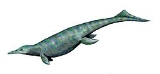
Utatsusaurus is the earliest-known form of an ichthyopterygia
n (the group of marine reptiles that includes the ichthyosaurs), which lived in the early Triassic
period (c. 245-250 millions years ago). Unlike the more advanced ichthyosaurs, Utatsusaurus has no dorsal fin
and has a broad skull
that tapers slowly toward the snout.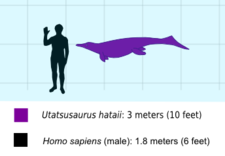 For the size of the skull, the teeth are rather small, and arranged in a primitive groove. Utatsusaurus had small fins, with four toes instead of the usual five found in primitive ichthyosaurs. The tail had a long low fin, suggesting that the animal swam by undulation
, rather than using its paddles and tail. Feeding on a diet of fish
, Utatsusaurus reached a length of three meters (nine feet). Utatsusaurus has been found in Japan
and Canada
.
Ryosuke Motani from the University of California, Berkeley
and Nachio Minoura from Hokkaido University
re-examined the fossils of Utatsusaurus in 1998 using computer imagery to reverse the distortion
of the original skeleton. They found that Utatsusaurus was closely related to the lizard
-like diapsid
reptiles such as Petrolacosaurus
, making ichthyopterygians a distant relative to lizard
s, snake
s and crocodile
s.
Ichthyopterygia
Ichthyopterygia was a designation introduced by Sir Richard Owen in 1840 to designate the Jurassic ichthyosaurs that were known at the time, but the term is now used more often for both true Ichthyosauria and their more primitive early and middle Triassic ancestors.Basal ichthyopterygians were...
n (the group of marine reptiles that includes the ichthyosaurs), which lived in the early Triassic
Triassic
The Triassic is a geologic period and system that extends from about 250 to 200 Mya . As the first period of the Mesozoic Era, the Triassic follows the Permian and is followed by the Jurassic. Both the start and end of the Triassic are marked by major extinction events...
period (c. 245-250 millions years ago). Unlike the more advanced ichthyosaurs, Utatsusaurus has no dorsal fin
Dorsal fin
A dorsal fin is a fin located on the backs of various unrelated marine and freshwater vertebrates, including most fishes, marine mammals , and the ichthyosaurs...
and has a broad skull
Skull
The skull is a bony structure in the head of many animals that supports the structures of the face and forms a cavity for the brain.The skull is composed of two parts: the cranium and the mandible. A skull without a mandible is only a cranium. Animals that have skulls are called craniates...
that tapers slowly toward the snout.
Undulation
Undulation may refer to:* Lateral undulation, the most primitive of vertebrate locomotor patterns* Law of Undulation, an invention of C. S. Lewis* Undulation of the geoid, the separation between the geoid and the reference ellipsoid of the Earth...
, rather than using its paddles and tail. Feeding on a diet of fish
Fish
Fish are a paraphyletic group of organisms that consist of all gill-bearing aquatic vertebrate animals that lack limbs with digits. Included in this definition are the living hagfish, lampreys, and cartilaginous and bony fish, as well as various extinct related groups...
, Utatsusaurus reached a length of three meters (nine feet). Utatsusaurus has been found in Japan
Japan
Japan is an island nation in East Asia. Located in the Pacific Ocean, it lies to the east of the Sea of Japan, China, North Korea, South Korea and Russia, stretching from the Sea of Okhotsk in the north to the East China Sea and Taiwan in the south...
and Canada
Canada
Canada is a North American country consisting of ten provinces and three territories. Located in the northern part of the continent, it extends from the Atlantic Ocean in the east to the Pacific Ocean in the west, and northward into the Arctic Ocean...
.
Ryosuke Motani from the University of California, Berkeley
University of California, Berkeley
The University of California, Berkeley , is a teaching and research university established in 1868 and located in Berkeley, California, USA...
and Nachio Minoura from Hokkaido University
Hokkaido University
Hokkaido University is one of the most prestigious universities in Japan. It can be seen in the several rankings such as shown below.-General Rankings:...
re-examined the fossils of Utatsusaurus in 1998 using computer imagery to reverse the distortion
Distortion
A distortion is the alteration of the original shape of an object, image, sound, waveform or other form of information or representation. Distortion is usually unwanted, and often many methods are employed to minimize it in practice...
of the original skeleton. They found that Utatsusaurus was closely related to the lizard
Lizard
Lizards are a widespread group of squamate reptiles, with nearly 3800 species, ranging across all continents except Antarctica as well as most oceanic island chains...
-like diapsid
Diapsid
Diapsids are a group of reptiles that developed two holes in each side of their skulls, about 300 million years ago during the late Carboniferous period. Living diapsids are extremely diverse, and include all crocodiles, lizards, snakes, and tuatara...
reptiles such as Petrolacosaurus
Petrolacosaurus
Petrolacosaurus was a small, long, reptile, and the earliest diapsid known. It lived during the late Carboniferous period, the Joggins strata where it was found are dated to 302 million years old....
, making ichthyopterygians a distant relative to lizard
Lizard
Lizards are a widespread group of squamate reptiles, with nearly 3800 species, ranging across all continents except Antarctica as well as most oceanic island chains...
s, snake
Snake
Snakes are elongate, legless, carnivorous reptiles of the suborder Serpentes that can be distinguished from legless lizards by their lack of eyelids and external ears. Like all squamates, snakes are ectothermic, amniote vertebrates covered in overlapping scales...
s and crocodile
Crocodile
A crocodile is any species belonging to the family Crocodylidae . The term can also be used more loosely to include all extant members of the order Crocodilia: i.e...
s.