

Twelve Labours

Encyclopedia
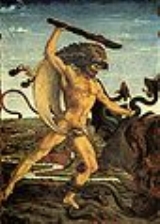
The twelve labours of Hercules or dodekathlon are a series of archaic episodes connected by a later continuous narrative, concerning a penance
carried out by Heracles
, the greatest of the Greek heroes, whose name was later romanised as Hercules
. The establishment of a fixed cycle of twelve labours was attributed by the Greeks to an epic poem, now lost, written by Peisander, dated about 600 BC (Burkert).
, Hercules slew his own six sons. After recovering his sanity, Hercules deeply regretted his actions; he was purified by King Thespius, then traveled to Delphi to inquire how he could atone for his actions. There the oracle Pythoness advised him to reside at Tyrins and serve King Eurystheus
for twelve years, performing whatever labour might beset him; in return, he would be rewarded with immortality. Hercules despaired at this, loathing to serve a man whom he knew to be far inferior to himself, yet afraid to oppose his father Zeus. Eventually he placed himself at Eurystheus's disposal.
Eurystheus ordered Hercules to perform ten labours. Hercules accomplished these tasks, but Eurystheus refused to recognize two: the cleansing of the Augean stables, because Hercules was going to accept pay for the labour; and the killing of the Lernaean Hydra, as Hercules' nephew and charioteer Iolaus
had helped him burn the stumps of the heads. Eurystheus set two more tasks (fetching the Golden Apples of Hesperides and capturing Cerberus
), which Hercules performed successfully, bringing the total number of tasks to twelve.
, culminating with the rededication of Olympia
. Six others took the hero farther afield. In each case, the pattern was the same: Hercules was sent to kill or subdue, or to fetch back for Hera's representative Eurystheus
a magical animal or plant. "The sites selected were all previously strongholds of Hera or the 'Goddess' and were Entrances to the Netherworld".
A famous depiction of the labours in Greek sculpture is found on the metopes
of the Temple of Zeus
at Olympia, which date to the 450s BC.
In his labours, Hercules was sometimes accompanied by a male companion (an eromenos), according to Licymnius
and others, such as Iolaus
, his nephew. Although he was only supposed to perform ten labours, this assistance led to him suffering two more. Eurystheus
didn't count the Hydra, because Iolaus helped him, or the Augean stables, as he received payment for his work, or because the rivers did the work. Several of the labours involved the offspring (by various accounts) of Typhon
and his mate Echidna
, all overcome by Hercules.
A traditional order of the labours found in Apollodorus
is:
As a reward for finishing these twelve treacherous tasks, he was given the gift of immortality after his death by his father Zeus. Hera forgave him and gave him her daughter Hebe
for his bride.
Penance
Penance is repentance of sins as well as the proper name of the Roman Catholic, Orthodox Christian, and Anglican Sacrament of Penance and Reconciliation/Confession. It also plays a part in non-sacramental confession among Lutherans and other Protestants...
carried out by Heracles
Heracles
Heracles ,born Alcaeus or Alcides , was a divine hero in Greek mythology, the son of Zeus and Alcmene, foster son of Amphitryon and great-grandson of Perseus...
, the greatest of the Greek heroes, whose name was later romanised as Hercules
Hercules
Hercules is the Roman name for Greek demigod Heracles, son of Zeus , and the mortal Alcmene...
. The establishment of a fixed cycle of twelve labours was attributed by the Greeks to an epic poem, now lost, written by Peisander, dated about 600 BC (Burkert).
Context
Driven mad by HeraHera
Hera was the wife and one of three sisters of Zeus in the Olympian pantheon of Greek mythology and religion. Her chief function was as the goddess of women and marriage. Her counterpart in the religion of ancient Rome was Juno. The cow and the peacock were sacred to her...
, Hercules slew his own six sons. After recovering his sanity, Hercules deeply regretted his actions; he was purified by King Thespius, then traveled to Delphi to inquire how he could atone for his actions. There the oracle Pythoness advised him to reside at Tyrins and serve King Eurystheus
Eurystheus
In Greek mythology, Eurystheus was king of Tiryns, one of three Mycenaean strongholds in the Argolid, although other authors including Homer and Euripides cast him as ruler of Argos: Sthenelus was his father and the "victorious horsewoman" Nicippe his mother, and he was a grandson of the hero...
for twelve years, performing whatever labour might beset him; in return, he would be rewarded with immortality. Hercules despaired at this, loathing to serve a man whom he knew to be far inferior to himself, yet afraid to oppose his father Zeus. Eventually he placed himself at Eurystheus's disposal.
Eurystheus ordered Hercules to perform ten labours. Hercules accomplished these tasks, but Eurystheus refused to recognize two: the cleansing of the Augean stables, because Hercules was going to accept pay for the labour; and the killing of the Lernaean Hydra, as Hercules' nephew and charioteer Iolaus
Iolaus
In Greek mythology, Iolaus was a Theban divine hero, son of Iphicles, Heracles's brother, and Automedusa.He was famed for being Heracles's nephew and for helping with some of his Labors, and also for being one of the Argonauts...
had helped him burn the stumps of the heads. Eurystheus set two more tasks (fetching the Golden Apples of Hesperides and capturing Cerberus
Cerberus
Cerberus , or Kerberos, in Greek and Roman mythology, is a multi-headed hound which guards the gates of the Underworld, to prevent those who have crossed the river Styx from ever escaping...
), which Hercules performed successfully, bringing the total number of tasks to twelve.
The labours
As they survive, the labours of Hercules are not told in any single place, but must be reassembled from many sources. Ruck and Staples assert that there is no one way to interpret the labours, but that six were located in the PeloponnesePeloponnese
The Peloponnese, Peloponnesos or Peloponnesus , is a large peninsula , located in a region of southern Greece, forming the part of the country south of the Gulf of Corinth...
, culminating with the rededication of Olympia
Olympia, Greece
Olympia , a sanctuary of ancient Greece in Elis, is known for having been the site of the Olympic Games in classical times, comparable in importance to the Pythian Games held in Delphi. Both games were held every Olympiad , the Olympic Games dating back possibly further than 776 BC...
. Six others took the hero farther afield. In each case, the pattern was the same: Hercules was sent to kill or subdue, or to fetch back for Hera's representative Eurystheus
Eurystheus
In Greek mythology, Eurystheus was king of Tiryns, one of three Mycenaean strongholds in the Argolid, although other authors including Homer and Euripides cast him as ruler of Argos: Sthenelus was his father and the "victorious horsewoman" Nicippe his mother, and he was a grandson of the hero...
a magical animal or plant. "The sites selected were all previously strongholds of Hera or the 'Goddess' and were Entrances to the Netherworld".
A famous depiction of the labours in Greek sculpture is found on the metopes
Metope (architecture)
In classical architecture, a metope is a rectangular architectural element that fills the space between two triglyphs in a Doric frieze, which is a decorative band of alternating triglyphs and metopes above the architrave of a building of the Doric order...
of the Temple of Zeus
Zeus
In the ancient Greek religion, Zeus was the "Father of Gods and men" who ruled the Olympians of Mount Olympus as a father ruled the family. He was the god of sky and thunder in Greek mythology. His Roman counterpart is Jupiter and his Etruscan counterpart is Tinia.Zeus was the child of Cronus...
at Olympia, which date to the 450s BC.
In his labours, Hercules was sometimes accompanied by a male companion (an eromenos), according to Licymnius
Licymnius
In Greek mythology, Licymnius was a good friend of Heracles' and an illegitimate son of Electryon, King of Tiryns and Mycenae in the Argolid . His mother is given as Mideia, a Phrygian woman...
and others, such as Iolaus
Iolaus
In Greek mythology, Iolaus was a Theban divine hero, son of Iphicles, Heracles's brother, and Automedusa.He was famed for being Heracles's nephew and for helping with some of his Labors, and also for being one of the Argonauts...
, his nephew. Although he was only supposed to perform ten labours, this assistance led to him suffering two more. Eurystheus
Eurystheus
In Greek mythology, Eurystheus was king of Tiryns, one of three Mycenaean strongholds in the Argolid, although other authors including Homer and Euripides cast him as ruler of Argos: Sthenelus was his father and the "victorious horsewoman" Nicippe his mother, and he was a grandson of the hero...
didn't count the Hydra, because Iolaus helped him, or the Augean stables, as he received payment for his work, or because the rivers did the work. Several of the labours involved the offspring (by various accounts) of Typhon
Typhon
Typhon , also Typhoeus , Typhaon or Typhos was the last son of Gaia, fathered by Tartarus, and the most deadly monster of Greek mythology. He was known as the "Father of all monsters"; his wife Echidna was likewise the "Mother of All Monsters."Typhon was described in pseudo-Apollodorus,...
and his mate Echidna
Echidna (mythology)
In Greek mythology, Echidna was half woman half snake, known as the "Mother of All Monsters" because most of the monsters in Greek myth were mothered by her...
, all overcome by Hercules.
A traditional order of the labours found in Apollodorus
Apollodorus
Apollodorus of Athens son of Asclepiades, was a Greek scholar and grammarian. He was a pupil of Diogenes of Babylon, Panaetius the Stoic, and the grammarian Aristarchus of Samothrace...
is:
- Slay the Nemean LionNemean LionThe Nemean lion was a vicious monster in Greek mythology that lived at Nemea. It was eventually killed by Heracles. It could not be killed with mortal weapons because its golden fur was impervious to attack...
. - Slay the nine-headed Lernaean HydraLernaean HydraIn Greek mythology, the Lernaean Hydra was an ancient nameless serpent-like chthonic water beast, with reptilian traits, that possessed many heads — the poets mention more heads than the vase-painters could paint, and for each head cut off it grew two more — and poisonous breath so virulent even...
. - Capture the Golden Hind of ArtemisCeryneian HindIn Greek mythology, the Ceryneian Hind , also called Cerynitis, was an enormous hind , who lived in Keryneia, Greece. It was sacred to Artemis, the chaste goddess of the hunt, animals and unmarried women. It had golden antlers like a stag and hooves of bronze or brass, and it was said that it could...
. - Capture the Erymanthian BoarErymanthian BoarIn Greek mythology, the Erymanthian Boar is remembered in connection with The Twelve Labours, in which Heracles, the enemy of Hera, visited in turn "all the other sites of the Goddess throughout the world, to conquer every conceivable 'monster' of nature and rededicate the primordial world to its...
. - Clean the AugeanAugeasIn Greek mythology, Augeas , whose name means "bright", was king of Elis and father of Epicaste. Some say that Augeas was one of the Argonauts....
stables in a single day. - Slay the Stymphalian BirdsStymphalian birdsIn Greek mythology, the Stymphalian birds were man-eating birds with beaks of bronze and sharp metallic feathers they could launch at their victims, and were sacred to Ares, the god of war. Furthermore, their dung was highly toxic...
. - Capture the Cretan BullCretan BullIn Greek mythology, the Cretan Bull was either the bull that carried away Europa or the bull Pasiphaë fell in love with, giving birth to the Minotaur.- Origin :...
. - Steal the Mares of DiomedesMares of DiomedesThe Mares of Diomedes, also called the Mares of Thrace, were four man-eating horses in Greek mythology. Magnificent, wild, and uncontrollable, they belonged to the giant Diomedes , king of Thrace, a son of Ares and Cyrene who lived on the shores of the Black Sea...
. - Obtain the girdle of HippolytaHippolytaIn Greek mythology, Hippolyta or Hippolyte is the Amazonian queen who possessed a magical girdle she was given by her father Ares, the god of war. The girdle was a waist belt that signified her authority as queen of the Amazons....
, Queen of the AmazonsAmazonsThe Amazons are a nation of all-female warriors in Greek mythology and Classical antiquity. Herodotus placed them in a region bordering Scythia in Sarmatia...
. - Obtain the cattle of the monster GeryonGeryonIn Greek mythology, Geryon , son of Chrysaor and Callirrhoe and grandson of Medusa, was a fearsome giant who dwelt on the island Erytheia of the mythic Hesperides in the far west of the Mediterranean. A more literal-minded later generation of Greeks associated the region with Tartessos in southern...
. - Steal the apples of the HesperidesHesperidesIn Greek mythology, the Hesperides are nymphs who tend a blissful garden in a far western corner of the world, located near the Atlas mountains in North Africa at the edge of the encircling Oceanus, the world-ocean....
(He had the help of Atlas to pick them after Hercules had slain LadonLadon (mythology)Ladon was the serpent-like dragon that twined and twisted around the tree in the Garden of the Hesperides and guarded the golden apples. He was overcome by Heracles...
). - Capture and bring back CerberusCerberusCerberus , or Kerberos, in Greek and Roman mythology, is a multi-headed hound which guards the gates of the Underworld, to prevent those who have crossed the river Styx from ever escaping...
.
As a reward for finishing these twelve treacherous tasks, he was given the gift of immortality after his death by his father Zeus. Hera forgave him and gave him her daughter Hebe
Hebe (mythology)
In Greek mythology, Hēbē is the goddess of youth . She is the daughter of Zeus and Hera. Hebe was the cupbearer for the gods and goddesses of Mount Olympus, serving their nectar and ambrosia, until she was married to Heracles ; her successor was the young Trojan prince Ganymede...
for his bride.
External links
- Labors of Heracles at the Livius Picture Archive
- The Labors of Hercules at the Perseus Digital Library