

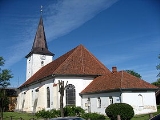
Tukums

Encyclopedia
Tukums is a town
in Latvia
. Three regions of Latvia meet in the vicinity of Tukums – Vidzeme
, Zemgale and Courland
. The city was host to the Cold War
facility Tukums air base
.
. The oldest part is today's Talsi Street that originated at the river named Zvirgzdupite where there used to be a castle mound with a wooden castle. Since 1253 Tukums was ruled by the Livonian Order
. A masonry castle was built on the bank of the Slocene
river in the end of the 13th century. The castle was surrounded by settlements of German
tradesmen and craftsmen. A marketplace was formed in front of the castle and some new streets appeared later running in various directions from the market place.
With the development of trade in the 16th century a new straighter trade route to Prussia was built along a new street that is called Liela (large) Street today. This street had an important role in the life of the settlement. Public buildings, major business, workshops and shops were concentrated in it.
After the disintegration of the Livonian Order a new state, the Duchy of Courland and Semigallia
was established. Like many other settlements Tukums had suffered greatly the numerous feudal wars. Under the rule of Duke Jacob
(1642–1682) Tukums experienced a rapid economic boom. At the time a new trade route from Tukums to Jelgava
, the capital of Duchy of Courland and Semigallia, was opened along today's Jelgavas Street, and another route was made along today's Raudas Street towards it. A dam was built and a lake made near the road to Jelgava. A flour mill and a cooper furnace started functioning there, and cooper was exported to foreign countries. The town, inhabited by only 800 people was quite small. The new adornment of Tukums was the lake. The church spire was another landmark added to the skyline in 1687.
After 1795 Courland was incorporated into the Russian Empire
. In November of the same year the Russian Tsaritsa Katherine
signed a document to divide Courland into regions and to grant regional center rights to several urban settlements, Tukums being one of them.
The town borders were marked in 1800 and the first urban map was made only two years later. The town continued growing. It included 131 private houses, mostly wooden, and 6 pubs. There were 690 male and 832 female inhabitants. The first school was opened in 1806. Street pavement was introduced in 1860 and street lighting started in 1875. A more rapid development of the town was observed after the opening of the Riga-Tukums railway line in 1877 and of another line connecting Tukums with Ventspils
a little later. 24 enterprises were functioning in Tukums in 1897: tanneries, wood carding-mills, a glue plant and also pottery and food production facilities. The two windmills brought out the uniqueness of the townscape.
The town grew with the development of industry. Two new districts appeared. The rich built their houses in the eastern part around Elizabetes, Pils and Baznicas Streets, but the workers settled more to the west, forming an area of small houses surrounded by gardens. This part of Tukums was further developed during the year in 1935. In the beginning of the 1930s there were 8000 inhabitants and 73 functioning industrial enterprises in Tukums.
says, that in the old days, when first people came to this area, which was very flat, people started to build houses, clear woodland
s and cultivate fields
. But it was hard to live because this area were apsest with so many devils. They were living in Gailisu (Cockerel's) forest and every night destroyed everything that people had built during the day. People of this village tried everything to scare them away, but it was impossible. One day they heard that not far from them, in Smardes swamp lived a giant. They went out to meet the giant and asked him for help. Being a very good-natured, giant went with people, stood at the side of the forest and called the devils out. They were sleeping very tight after the prior night's jobs, so it was a very long time before one of them came out and asked to giant why he was yelling. Words led to a fight. Even though the giant was very strong, the devils were many and had horns and nails. The fight lasted till evening. The devils, whining and licking their wounds, disappeared forever. But the giant was hurt. The devil's horns tore his stomach and all his intestines came out. He tried to hold on, but it was useless. Taking a few steps, giant fell and died. Today people say that his grave is "Milzu kalns" (Giant hill), and the smaller hills, which are all around the city are his intestines. From that day on people in this area lived in peace and prosperty, building beautiful houses and gardens.
Another legend tells how one man in this village was very poor. When his wife gave a birth to his child no one wanted to be his godfather. So man decided to go on the road and ask everybody to be for his child's godfather. After a while came an old man who asked him what is the name of the village down there. But the poor man, in fear of losing the chance to have this man as a godfatner, didn't even listen to his words, and just screamed, "You Godfather! You Godfather! ("Tu kums! Tu kums! – in Latvian). So Tukums got its name.
Jaunmoku Palace (1901), 5 km from Tukums, surrounded by the picturesque Courlands hills, hosts an exhibition on forestry. Jaunmoku Palace is a combination of Art-Nouveau elements and Neo-Gothic forms and was built as the country residence of George Armitstead, mayor of Riga (1901–12).
Durbe manor house, rebuilt in 1820, is a classical style palace, surrounded by landscaped park. A stone bridge across the ravine and a rotunda are located near the manor house.
The Schlokenbeck estate ensemble in Milzkalne, dating from the 15th century, is the only fortified manor house in Latvia. A museum on the history of broad building techniques and an exposition of horse gear is set up there.
Zante region is distinguished by unique and interesting objects. Here is the highest peak of Tukums district – Smiltinkalns (153m), in the center of Zante you will find the Red Army tank – evidence of the battles in "Courland Pocket
" in 1944–1945.
The country of Zentene and Seme welcomes the visitors with a traditional northern landscape of Courland – hills, curved roads, unique objects of nature and interesting places of culture history.
The seashore of Tukums district stretches to the length of 50 km, where old fishermen's huts alternate with modern villas, the sandy beaches interchange with rocky shores and meadows.
Kandava
was the capital of an ancient Couronian state named Vanema. In the beginning of the 13th century, German knights build their castle there. Unfortunately, not much has been preserved from that time. In the Middle Ages, Kandava underwent numerous wars, fires and plague epidemics. Tourists are attracted by the surroundings of Kandava hills covered with dense forests and the rapids of the Abava River. Kandava marks the beginning of the most gorgeous run of the Abava Valley
, which was named the "Switzerland of Courland" as early as the 19th century.
Town
A town is a human settlement larger than a village but smaller than a city. The size a settlement must be in order to be called a "town" varies considerably in different parts of the world, so that, for example, many American "small towns" seem to British people to be no more than villages, while...
in Latvia
Latvia
Latvia , officially the Republic of Latvia , is a country in the Baltic region of Northern Europe. It is bordered to the north by Estonia , to the south by Lithuania , to the east by the Russian Federation , to the southeast by Belarus and shares maritime borders to the west with Sweden...
. Three regions of Latvia meet in the vicinity of Tukums – Vidzeme
Vidzeme
Vidzeme is one of the historical and cultural regions of Latvia. Literally meaning "the Middle Land" it is situated in north-central Latvia north of the Daugava River...
, Zemgale and Courland
Courland
Courland is one of the historical and cultural regions of Latvia. The regions of Semigallia and Selonia are sometimes considered as part of Courland.- Geography and climate :...
. The city was host to the Cold War
Cold War
The Cold War was the continuing state from roughly 1946 to 1991 of political conflict, military tension, proxy wars, and economic competition between the Communist World—primarily the Soviet Union and its satellite states and allies—and the powers of the Western world, primarily the United States...
facility Tukums air base
Tukums (air base)
Tukums is an air base located southeast of Tukums, a town in Latvia. It is a spartan military airfield with a single long ramp and reveted area....
.
History
The historical center of Tukums developed between trade routes leading from the mouth of the Daugava River to PrussiaPrussia
Prussia was a German kingdom and historic state originating out of the Duchy of Prussia and the Margraviate of Brandenburg. For centuries, the House of Hohenzollern ruled Prussia, successfully expanding its size by way of an unusually well-organized and effective army. Prussia shaped the history...
. The oldest part is today's Talsi Street that originated at the river named Zvirgzdupite where there used to be a castle mound with a wooden castle. Since 1253 Tukums was ruled by the Livonian Order
Livonian Order
The Livonian Order was an autonomous Livonian branch of the Teutonic Order and a member of the Livonian Confederation from 1435–1561. After being defeated by Samogitians in the 1236 Battle of Schaulen , the remnants of the Livonian Brothers of the Sword were incorporated into the Teutonic Knights...
. A masonry castle was built on the bank of the Slocene
Slocene
Slocene is a river in Zemgale, historical region of Latvia. It flows through the Tukums municipality and Engure municipality into the lake Kaņieris within the territory of the Ķemeri National Park.-References:...
river in the end of the 13th century. The castle was surrounded by settlements of German
Germans
The Germans are a Germanic ethnic group native to Central Europe. The English term Germans has referred to the German-speaking population of the Holy Roman Empire since the Late Middle Ages....
tradesmen and craftsmen. A marketplace was formed in front of the castle and some new streets appeared later running in various directions from the market place.
With the development of trade in the 16th century a new straighter trade route to Prussia was built along a new street that is called Liela (large) Street today. This street had an important role in the life of the settlement. Public buildings, major business, workshops and shops were concentrated in it.
After the disintegration of the Livonian Order a new state, the Duchy of Courland and Semigallia
Duchy of Courland and Semigallia
The Duchy of Courland and Semigallia is the name of a duchy in the Baltic region that existed from 1562 to 1569 as a vassal state of the Grand Duchy of Lithuania and from 1569...
was established. Like many other settlements Tukums had suffered greatly the numerous feudal wars. Under the rule of Duke Jacob
Jacob Kettler
Jacob Kettler was a Baltic German Duke of the Duchy of Courland and Semigallia . Under his rule, the duchy was brought to its greatest peak in wealth and engaged in colonization.- Life :...
(1642–1682) Tukums experienced a rapid economic boom. At the time a new trade route from Tukums to Jelgava
Jelgava
-Sports:The city's main football team, FK Jelgava, plays in the Latvian Higher League and won the 2009/2010 Latvian Football Cup.- Notable people :*August Johann Gottfried Bielenstein - linguist, folklorist, ethnographer...
, the capital of Duchy of Courland and Semigallia, was opened along today's Jelgavas Street, and another route was made along today's Raudas Street towards it. A dam was built and a lake made near the road to Jelgava. A flour mill and a cooper furnace started functioning there, and cooper was exported to foreign countries. The town, inhabited by only 800 people was quite small. The new adornment of Tukums was the lake. The church spire was another landmark added to the skyline in 1687.
After 1795 Courland was incorporated into the Russian Empire
Russian Empire
The Russian Empire was a state that existed from 1721 until the Russian Revolution of 1917. It was the successor to the Tsardom of Russia and the predecessor of the Soviet Union...
. In November of the same year the Russian Tsaritsa Katherine
Catherine II of Russia
Catherine II, also known as Catherine the Great , Empress of Russia, was born in Stettin, Pomerania, Prussia on as Sophie Friederike Auguste von Anhalt-Zerbst-Dornburg...
signed a document to divide Courland into regions and to grant regional center rights to several urban settlements, Tukums being one of them.
The town borders were marked in 1800 and the first urban map was made only two years later. The town continued growing. It included 131 private houses, mostly wooden, and 6 pubs. There were 690 male and 832 female inhabitants. The first school was opened in 1806. Street pavement was introduced in 1860 and street lighting started in 1875. A more rapid development of the town was observed after the opening of the Riga-Tukums railway line in 1877 and of another line connecting Tukums with Ventspils
Ventspils
Ventspils is a city in northwestern Latvia in the Courland historical region of Latvia, the sixth largest city in the country. As of 2006, Ventspils had a population of 43,806. Ventspils is situated on the Venta River and the Baltic Sea, and has an ice-free port...
a little later. 24 enterprises were functioning in Tukums in 1897: tanneries, wood carding-mills, a glue plant and also pottery and food production facilities. The two windmills brought out the uniqueness of the townscape.
The town grew with the development of industry. Two new districts appeared. The rich built their houses in the eastern part around Elizabetes, Pils and Baznicas Streets, but the workers settled more to the west, forming an area of small houses surrounded by gardens. This part of Tukums was further developed during the year in 1935. In the beginning of the 1930s there were 8000 inhabitants and 73 functioning industrial enterprises in Tukums.
Legends of Tukums
LegendLegend
A legend is a narrative of human actions that are perceived both by teller and listeners to take place within human history and to possess certain qualities that give the tale verisimilitude...
says, that in the old days, when first people came to this area, which was very flat, people started to build houses, clear woodland
Woodland
Ecologically, a woodland is a low-density forest forming open habitats with plenty of sunlight and limited shade. Woodlands may support an understory of shrubs and herbaceous plants including grasses. Woodland may form a transition to shrubland under drier conditions or during early stages of...
s and cultivate fields
Field (agriculture)
In agriculture, the word field refers generally to an area of land enclosed or otherwise and used for agricultural purposes such as:* Cultivating crops* Usage as a paddock or, generally, an enclosure of livestock...
. But it was hard to live because this area were apsest with so many devils. They were living in Gailisu (Cockerel's) forest and every night destroyed everything that people had built during the day. People of this village tried everything to scare them away, but it was impossible. One day they heard that not far from them, in Smardes swamp lived a giant. They went out to meet the giant and asked him for help. Being a very good-natured, giant went with people, stood at the side of the forest and called the devils out. They were sleeping very tight after the prior night's jobs, so it was a very long time before one of them came out and asked to giant why he was yelling. Words led to a fight. Even though the giant was very strong, the devils were many and had horns and nails. The fight lasted till evening. The devils, whining and licking their wounds, disappeared forever. But the giant was hurt. The devil's horns tore his stomach and all his intestines came out. He tried to hold on, but it was useless. Taking a few steps, giant fell and died. Today people say that his grave is "Milzu kalns" (Giant hill), and the smaller hills, which are all around the city are his intestines. From that day on people in this area lived in peace and prosperty, building beautiful houses and gardens.
Another legend tells how one man in this village was very poor. When his wife gave a birth to his child no one wanted to be his godfather. So man decided to go on the road and ask everybody to be for his child's godfather. After a while came an old man who asked him what is the name of the village down there. But the poor man, in fear of losing the chance to have this man as a godfatner, didn't even listen to his words, and just screamed, "You Godfather! You Godfather! ("Tu kums! Tu kums! – in Latvian). So Tukums got its name.
Places near Tukums
Jaunpils Castle is the only fortified castle of the Order of Livonia that remains in Latvia. It was built in 1301. An exhibition hall and museum are located there dedicated to the history of the district. Jaunpils Lutheran Church which was built in 1592 is located near the castle.Jaunmoku Palace (1901), 5 km from Tukums, surrounded by the picturesque Courlands hills, hosts an exhibition on forestry. Jaunmoku Palace is a combination of Art-Nouveau elements and Neo-Gothic forms and was built as the country residence of George Armitstead, mayor of Riga (1901–12).
Durbe manor house, rebuilt in 1820, is a classical style palace, surrounded by landscaped park. A stone bridge across the ravine and a rotunda are located near the manor house.
The Schlokenbeck estate ensemble in Milzkalne, dating from the 15th century, is the only fortified manor house in Latvia. A museum on the history of broad building techniques and an exposition of horse gear is set up there.
Zante region is distinguished by unique and interesting objects. Here is the highest peak of Tukums district – Smiltinkalns (153m), in the center of Zante you will find the Red Army tank – evidence of the battles in "Courland Pocket
Courland Pocket
The Courland Pocket referred to the Red Army's blockade or encirclement of Axis forces on the Courland peninsula during the closing months of World War II...
" in 1944–1945.
The country of Zentene and Seme welcomes the visitors with a traditional northern landscape of Courland – hills, curved roads, unique objects of nature and interesting places of culture history.
The seashore of Tukums district stretches to the length of 50 km, where old fishermen's huts alternate with modern villas, the sandy beaches interchange with rocky shores and meadows.
Kandava
Kandava
Kandava is a town in Latvia. As a settlement, it is first mentioned in written sources in 1230.-See also:*List of cities in Latvia...
was the capital of an ancient Couronian state named Vanema. In the beginning of the 13th century, German knights build their castle there. Unfortunately, not much has been preserved from that time. In the Middle Ages, Kandava underwent numerous wars, fires and plague epidemics. Tourists are attracted by the surroundings of Kandava hills covered with dense forests and the rapids of the Abava River. Kandava marks the beginning of the most gorgeous run of the Abava Valley
Abava Valley
The Abava Valley is the valley of the Abava River in Talsi, Tukums, and Kuldīga municipalities, Latvia, in the historical Kurzeme region.On 20 June 1996 the Republic of Latvia designated the Abava Valley the specially protected cultural territory and on 03/01/2005 it was submitted for inclusion in...
, which was named the "Switzerland of Courland" as early as the 19th century.
Museums
- Castle Tower of Tukums – Brivibas square 19a
- Durbe Manor house – M.Parka street 7
- Jaunmokas Palace Museum – Jaunmokas
- Jaunpils Museum – Jaunpils
- Pastariņš Museum – Bisnieki, Zentene
- Slokenbeka Manor – Milzkalne
- Tukums Museum – Harmonijas street 7
Notable people
- Ronalds ArājsRonalds ArajsRonalds Arājs is a Latvian athlete. Arājs is the current Latvian record holder in 100 metres, having a personal best of 10.18 seconds. His personal record in the 200 metres is 20.75 seconds....
, Latvian athlete - Kristaps BlanksKristaps BlanksKristaps Blanks is a football striker from Latvia. His current club is Skonto FC.-Playing career:* - played games and goals-External links:...
, footballFootball (soccer)Association football, more commonly known as football or soccer, is a sport played between two teams of eleven players with a spherical ball...
strikerStrikerForwards, also known as strikers, are the players on a team in association football who play nearest to the opposing team's goal, and are therefore principally responsible for scoring goals...
, Skonto FCSkonto FCSkonto FC is a Latvian football club, founded in 1991. The club plays at the Skonto Stadium in Riga. Skonto won the Virsliga in the first 14 seasons of the league's existence , and often provides the core of the Latvia national football team...
and Latvian national football team player - Ādolfs BļodnieksAdolfs BlodnieksĀdolfs Bļodnieks held the office of Prime Minister of Latvia from 24 March 1933 – 16 March 1934, for the New Farmers' Party.-References:...
, Prime Minister of LatviaPrime Minister of LatviaThe Prime Minister of Latvia is the most powerful member of the Government of the Republic of Latvia, and presides over the Latvian Cabinet of Ministers... - Mārtiņš Egle, Latvian Mixed Martial Artist
- Līga KļaviņaLīga KļaviņaLīga Kļaviņa is a female heptathlete from Latvia, who began her career as a high jumper. She competed for her native Baltic country at the 2000 Summer Olympics in Sydney, Australia.-Achievements:-References:*...
, Latvian heptathlete - Dainis KūlaDainis KulaDainis Kūla is a Latvian former javelin thrower who represented the Soviet Union at the international level for most of his career. He is most famous for controversially winning the gold medal in men's javelin throw at the 1980 Summer Olympics, becoming the second Latvian to achieve this...
, javelin throwJavelin throwThe javelin throw is a track and field athletics throwing event where the object to be thrown is the javelin, a spear approximately 2.5 metres in length. Javelin is an event of both the men's decathlon and the women's heptathlon...
er and 1980 Olympic1980 Summer OlympicsThe 1980 Summer Olympics, officially known as the Games of the XXII Olympiad, was an international multi-sport event celebrated in Moscow in the Soviet Union. In addition, the yachting events were held in Tallinn, and some of the preliminary matches and the quarter-finals of the football tournament...
champion - Jevgēņijs KosmačovsJevgenijs KosmacovsJevgēņijs Kosmačovs is a Latvian footballer who plays for FK Ventspils.He is a midfielder and he has also been capped by Latvia.-Club career:...
, FK VentspilsFK VentspilsFK Ventspils is a Latvian football club, based at Ventspils Olimpiskais Stadions in Ventspils city and is one of the most popular football clubs in the country. FK Ventspils plays in the Latvian Virsliga. They are the current champions of the tournament....
and Latvian national football team midfielder - Joe MagidsohnJoe MagidsohnJoseph "Joe" Magidsohn was an American football player and official. He played halfback for the University of Michigan Wolverines in 1909 and 1910 and was selected as a second-team All-American by Walter Camp in 1909 and a first-team All-American in 1910...
, Football All-American - Viktor TsoiViktor TsoiViktor Robertovich Tsoi ; 21 June 1962 – 15 August 1990) was a Soviet rock musician, leader of the band Kino.He is regarded as one of the pioneers of Russian rock and has many devoted fans across the countries of the former Soviet Union even today...
, Soviet Rock band KinoKinoKino may refer to:In film and theatre:* Kino , a worldwide group of amateur filmmakers* Kino Flo, a manufacturer of lighting equipment for use in motion pictures.* Kino International, a movie theater in Berlin...
leader died near Tukums.