

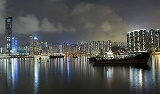
Tsuen Wan

Encyclopedia
Tsuen Wan is a bay
in the Kowloon
area of Hong Kong
, opposite to Tsing Yi Island across Rambler Channel
. The market town of Tsuen Wan emerged for the surrounding villages and fleets of fishing boats in the area. The town is around the present-day Tsuen Wan Station
of the MTR
. It was extended as far as the reclamation
proceeded.
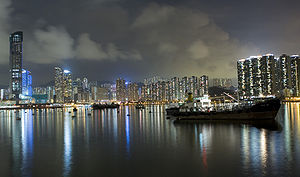
 In earlier days, it was known as Tsin Wan (淺灣) which means shallow bay, and later renamed to Tsuen Wan. Another name Tsak Wan (賊灣, Hakka dialect pronunciation: tshet wan), pirate bay, indicates the presence of pirates nearby long ago. In fact, the area around Rambler Channel
was known as Sam Pak Tsin (三百錢), literally meaning three hundred coins. There was a legend that pirates would collect three hundred coins should one pass through the area.
A museum of a local settlement village is located in Tsuen Wan Town: Sam Tung Uk Museum
. The museum is an effort to preserve one of the heritage villages in Hong Kong. It was restored when Tsuen Wan underwent urban development during the construction of the MTR
.
In the 20th century, factories moved in gradually due to its proximity to Kowloon
. With the construction of Castle Peak Road
, motor vehicles could reach the town in addition to access on foot and by boat. In the 1950s, the Hong Kong Government developed the area with new town
concepts. In the 1970s it was developed as part of Tsuen Wan New Town
. By 1971 the area housed 400,000 residents. It was one of the last areas in Hong Kong to be developed without the "Colony Outline Plan".
, one of Hong Kong's largest shopping centers, is located in the heart of Tsuen Wan Town. There is a goldsmith street there where jewels can be purchased. Other features include Tsuen Wan Shopping Plaza, Tsuen Wan City Landmark
, Citywalk
and L'Hotel, The Sam Tung Uk Museum
, Tin Hau Temple
and The Panda Hotel
, one of the biggest hotels in Hong Kong. The Nina Towers, which include an 80-storey tower, rise over Tsuen Wan.
. It is located on Tsuen King Circuit
, a hilltop at the west of Tsuen Wan. It comprises sixteen towers in four phases, completed between 1978 and 1981.
Bay
A bay is an area of water mostly surrounded by land. Bays generally have calmer waters than the surrounding sea, due to the surrounding land blocking some waves and often reducing winds. Bays also exist as an inlet in a lake or pond. A large bay may be called a gulf, a sea, a sound, or a bight...
in the Kowloon
Kowloon
Kowloon is an urban area in Hong Kong comprising the Kowloon Peninsula and New Kowloon. It is bordered by the Lei Yue Mun strait in the east, Mei Foo Sun Chuen and Stonecutter's Island in the west, Tate's Cairn and Lion Rock in the north, and Victoria Harbour in the south. It had a population of...
area of Hong Kong
Hong Kong
Hong Kong is one of two Special Administrative Regions of the People's Republic of China , the other being Macau. A city-state situated on China's south coast and enclosed by the Pearl River Delta and South China Sea, it is renowned for its expansive skyline and deep natural harbour...
, opposite to Tsing Yi Island across Rambler Channel
Rambler Channel
Rambler Channel is a body of water in Hong Kong that separates Tsing Yi Island from mainland Kowloon Peninsula, namely Tsuen Wan and Kwai Chung in the New Territories...
. The market town of Tsuen Wan emerged for the surrounding villages and fleets of fishing boats in the area. The town is around the present-day Tsuen Wan Station
Tsuen Wan (MTR)
Tsuen Wan is the northern terminus of the MTR Tsuen Wan Line in Hong Kong. It is the only station on the line that is at ground level. It is located at the northern central part of Tsuen Wan New Town, and its next station is Tai Wo Hau....
of the MTR
MTR
Mass Transit Railway is the rapid transit railway system in Hong Kong. Originally opened in 1979, the system now includes 211.6 km of rail with 155 stations, including 86 railway stations and 69 light rail stops...
. It was extended as far as the reclamation
Land reclamation in Hong Kong
Land is in short supply in Hong Kong, and land reclamation has been conducted there since the mid-19th century.-Projects:One of the earliest and famous project was the Praya Reclamation Scheme, which added 50 to of land in 1890 during the second phase of construction...
proceeded.
History
Rambler Channel
Rambler Channel is a body of water in Hong Kong that separates Tsing Yi Island from mainland Kowloon Peninsula, namely Tsuen Wan and Kwai Chung in the New Territories...
was known as Sam Pak Tsin (三百錢), literally meaning three hundred coins. There was a legend that pirates would collect three hundred coins should one pass through the area.
A museum of a local settlement village is located in Tsuen Wan Town: Sam Tung Uk Museum
Sam Tung Uk Museum
The Sam Tung Uk Museum is a museum restored from Sam Tung Uk , a Hakka walled village in Tsuen Wan, Hong Kong.-History:...
. The museum is an effort to preserve one of the heritage villages in Hong Kong. It was restored when Tsuen Wan underwent urban development during the construction of the MTR
MTR
Mass Transit Railway is the rapid transit railway system in Hong Kong. Originally opened in 1979, the system now includes 211.6 km of rail with 155 stations, including 86 railway stations and 69 light rail stops...
.
In the 20th century, factories moved in gradually due to its proximity to Kowloon
Kowloon
Kowloon is an urban area in Hong Kong comprising the Kowloon Peninsula and New Kowloon. It is bordered by the Lei Yue Mun strait in the east, Mei Foo Sun Chuen and Stonecutter's Island in the west, Tate's Cairn and Lion Rock in the north, and Victoria Harbour in the south. It had a population of...
. With the construction of Castle Peak Road
Castle Peak Road
Castle Peak Road is the longest road in Hong Kong. It runs from Tai Po Road in Sham Shui Po, Kowloon to the very north of the New Territories, serving south, west and north New Territories, being one of the most distant roads in early Hong Kong.-Name:...
, motor vehicles could reach the town in addition to access on foot and by boat. In the 1950s, the Hong Kong Government developed the area with new town
New towns of Hong Kong
The area of Hong Kong is very mountainous and many places in the New Territories have limited access to roads. Hong Kong started developing new towns in the 1950s, to accommodate booming populations. In the early days the term "satellite towns" was used. The very first new towns included Tsuen Wan...
concepts. In the 1970s it was developed as part of Tsuen Wan New Town
Tsuen Wan New Town
Tsuen Wan New Town is a new town in Hong Kong. It spans over Tsuen Wan, Kwai Chung and the eastern part of Tsing Yi Island. Traditionally, the officials of Tsuen Wan managed the area of proper Tsuen Wan, Kwai Chung, Tsing Yi Island, Ma Wan and Northeast Lantau Island.In 1982 the Tsuen Wan...
. By 1971 the area housed 400,000 residents. It was one of the last areas in Hong Kong to be developed without the "Colony Outline Plan".
Landmarks
Discovery ParkDiscovery Park (Hong Kong)
Discovery Park is a residential development in Hong Kong, located at 398 Castle Peak Road, Tsuen Wan in the New Territories. The whole estate including the residential flats and the shopping centre spans over ....
, one of Hong Kong's largest shopping centers, is located in the heart of Tsuen Wan Town. There is a goldsmith street there where jewels can be purchased. Other features include Tsuen Wan Shopping Plaza, Tsuen Wan City Landmark
Tsuen Wan City Landmark
Tsuen Wan City Landmark is a private housing estate and shopping mall in Tsuen Wan Town, New Territories, Hong Kong. Its phase 1 and phase 2 are located at Chung On Street and Castle Peak Road respectively, and they were developed by Henderson Land...
, Citywalk
CityWalk, Hong Kong
Citywalk is one of the largest shopping centres in Tsuen Wan, New Territories, Hong Kong. It is located at Yeung Uk Road, beneath Vision City and opposite to Nina Tower, one of the tallest buildings in Hong Kong. It is jointly developed by Sino Land and Urban Renewal Authority...
and L'Hotel, The Sam Tung Uk Museum
Sam Tung Uk Museum
The Sam Tung Uk Museum is a museum restored from Sam Tung Uk , a Hakka walled village in Tsuen Wan, Hong Kong.-History:...
, Tin Hau Temple
Tin Hau temples in Hong Kong
Over 70 temples are dedicated to Tin Hau in Hong Kong. They include:* Tin Hau temple, located at 10 Tin Hau Temple Road, Causeway Bay, east of Victoria Park, in Eastern District, on Hong Kong Island. It is a declared monument. The temple has given its name to the MTR station serving it .* The Tin...
and The Panda Hotel
Panda Hotel
Panda Hotel , formerly Kowloon Panda Hotel , is a four-star hotel in Tsuen Wan, New Territories, Hong Kong, located between MTR Tsuen Wan Station and Tai Wo Hau Station....
, one of the biggest hotels in Hong Kong. The Nina Towers, which include an 80-storey tower, rise over Tsuen Wan.
Private housing estates
Private housing estates in Tsuen Wan include:- Belvedere GardenBelvedere GardenBelvedere Garden is one of the largest-scale private housing estates in Tsuen Wan, New Territories, Hong Kong, located at the seaside of Tsuen Wan West....
- The CairnhillThe CairnhillThe Cairnhill is a private housing estate in Tsuen Wan, New Territories, Hong Kong. Being one of the estates built on the mid-level of the hill of Route Twisk , it consists of 16 low-density blocks divided into 2 phases and completed in 2004 and 2005 respectively, offering a total of 770 units...
- The ClivedenThe ClivedenThe Cliveden is a private housing estate in mid-level of Route Twisk, Tsuen Wan, New Territories, Hong Kong, next to The Cairnhill. It was jointly developed by Kerry Properties and Sino Land in 2002...
- Discovery ParkDiscovery Park (Hong Kong)Discovery Park is a residential development in Hong Kong, located at 398 Castle Peak Road, Tsuen Wan in the New Territories. The whole estate including the residential flats and the shopping centre spans over ....
- The DynastyThe DynastyThe Dynasty , formerly Vision City Phase 2 is a private housing estate in Yeung Uk Road, Tsuen Wan, New Territories, Hong Kong. It is next to Nina Tower and opposite to Vision City and CityWalk . It is jointly developed by Sino Land and Urban Renewal Authority.-External links:*...
- The Westminster TerraceThe Westminster TerraceThe Westminster Terrace is a private housing estate located in Ting Kau, Tsuen Wan, New Territories, Hong Kong.Developed by Grosvenor Group in conjunction with Asia Standard Group, the single residential building consists of 59 four ensuite-bedroom duplex flats ranging from 3,200 to 6,500 sq ft.-...
- Luk Yeung Sun ChuenLuk Yeung Sun ChuenLuk Yeung Sun Chuen , or Luk Yeung Sun Tsuen, is a private housing estate built above the MTR Tsuen Wan Station, Tsuen Wan, New Territories, Hong Kong. It comprises 17 high-rise buildings with a total of 4000 units...
- Riviera GardensRiviera GardensRiviera Gardens is one of the largest private housing estates in Tsuen Wan, New Territories, Hong Kong.The estate is bounded by Tsing Tsuen Road, Wing Shun Street and Rambler Channel. Formerly the Caltex' oil depot, the estate was developed by New World Development and Caltex Petroleum Corporation...
- Serenade CoveSerenade CoveSerenade Cove is a private housing estate in Tsuen Wan West, Tsuen Wan, New Territories, Hong Kong, near Belvedere Garden and Bayview Garden. It consists of 3 high-rise buildings developed by Wharf Holdings in 2001.-References:...
- Skyline PlazaSkyline Plaza (Hong Kong)Skyline Plaza is a private housing estate and shopping mall in Tsuen Wan, New Territories, Hong Kong. It is near Tsuen Wan Town Hall, Tsuen Wan Ferry Pier, Nina Tower and MTR Tsuen Wan West Station. It was developed by Henderson Land Development in 1995....
- Tsuen King GardenTsuen King GardenTsuen King Garden is one of the largest private housing estates in Tsuen Wan, New Territories, Hong Kong, located at Tsuen King Circuit. It comprises 12 high-rise buildings into 2 phases which were completed between 1987 and 1988, and was developed by Sun Hung Kai Properties.-Transport...
- Tsuen Wan CentreTsuen Wan CentreTsuen Wan Centre is one of the largest private housing estates in Tsuen Wan, New Territories, Hong Kong, located at Tsuen King Circuit. It comprises 19 high-rise buildings, with their names of a number of Chinese cities, and a shopping arcade. It was divided into 3 phases which were completed...
- Tsuen Wan City LandmarkTsuen Wan City LandmarkTsuen Wan City Landmark is a private housing estate and shopping mall in Tsuen Wan Town, New Territories, Hong Kong. Its phase 1 and phase 2 are located at Chung On Street and Castle Peak Road respectively, and they were developed by Henderson Land...
- Tsuen Wan PlazaTsuen Wan PlazaTsuen Wan Plaza is a private housing estate and shopping mall in Tsuen Wan, New Territories, Hong Kong, located near the MTR Tsuen Wan West Station, Tsuen Wan Ferry Pier, Nina Tower, Citywalk and Citywalk 2. It is one of the largest shopping malls in the district. Built on the reclaimed land of...
Allway Gardens
Allway Gardens is the earliest and one of the largest private housing estates in Tsuen Wan. It developed by Hopewell HoldingsHopewell Holdings
Hopewell Holdings Limited ,, established on 17 October, 1972], is a Hong Kong-listed infrastructure and property firm headed by Sir Gordon Wu.-History:It was listed on the Stock Exchange of Hong Kong in 1972....
. It is located on Tsuen King Circuit
Tsuen King Circuit
Tsuen King Circuit is a place and a road in Tsuen Wan, New Territories, Hong Kong. It is located at a hill in the northwest of Chai Wan Kok Industrial Area, so it was also called "West Chai Wan Kok"...
, a hilltop at the west of Tsuen Wan. It comprises sixteen towers in four phases, completed between 1978 and 1981.
Schools
- Tsuen Wan Government Secondary SchoolTsuen Wan Government Secondary SchoolTsuen Wan Government Secondary School is an English-language co-education secondary school located at 70 Hoi Pa Street, Tsuen Wan, Hong Kong. The school building consists of the hall, the laboratory wing, the classroom wing, and the new wing . Mr...
- Hoi Pa Street Government Primary SchoolHoi Pa Street Government Primary SchoolHoi Pa Street Government Primary School is an Chinese-language co-education primary school located at 1 Kai Chi Close , Tsuen Wan, Hong Kong...
- Tsuen Wan Government Primary School
- St. Francis Xavier's School Tsuen Wan
- Mary Of Providence Primary School (W.D.)
- Hong Kong Baptist Convention Primary School
- Ho Fung College
See also
- Cable TV TowerCable TV TowerThe Cable TV Tower is a skyscraper located in Tsuen Wan in Hong Kong which was completed in 1993. The large building stands tall with 41 floors of office and industrial space. The skyscraper is also the tallest office / industrial building in the city...
- Chai Wan KokChai Wan KokChai Wan Kok is an area in Tsuen Wan of Hong Kong. It is located at the west end of Tsuen Wan Town. While its southeast is industrial area, its hilly northeast and coastal southwest are residential...
- Concord SquareConcord SquareConcord Square is a shopping centre in Tsuen Wan, New Territories, Hong Kong. Formerly the old buildings and villages in Tai Uk Wai , The Blue Yard and the shopping centre were portions of Tsuen Wan Seven Street Redevelopment Project . It was completed in 2003 and developed by Concord Land...
- Luk Yeung GalleriaLuk Yeung GalleriaLuk Yeung Galleria is one of the largest shopping centres in Tsuen Wan, New Territories, Hong Kong, located in Luk Yeung Sun Chuen, above MTR Tsuen Wan Station. It has a total area of ....
- Nan Fung CentreNan Fung CentreNan Fung Centre is a commercial and shopping centre in Castle Peak Road, Tsuen Wan, New Territories, Hong Kong, located nearby the MTR Tsuen Wan Station and a bus terminus at its ground floor. It was developed by Nan Fung Group in 1983 and it is one of the earliest large-scale commercial centres...
- Panda PlacePanda PlacePanda Place is a shopping arcade in Tsuen Wan, New Territories, Hong Kong located between MTR Tsuen Wan Station and Tai Wo Hau Station. It occupies at the second floor, ground floor and three basement levels beneath Panda Hotel, the largest hotel in Tsuen Wan District...
- Sha TsuiSha TsuiSha Tsui was a headland in Tsuen Wan, Hong Kong. It was situated the west end of the old town of Tseun Wan. The main road, Sha Tsui Road in the town centre of Tsuen Wan New Town is named after it....
- Tai Wo HauTai Wo HauTai Wo Hau is a place in Tsuen Wan across Tsuen Wan District and Kwai Tsing District. Its area mainly includes Tai Wo Hau Estate, Kwai Yin Court, Kwai Yung Court, and private buildings along Texaco Road. It also includes Kwok Shui Road at the north of Castle Peak Road....
- Tsuen Wan Environmental Resource CentreTsuen Wan Environmental Resource CentreTsuen Wan Evironmental Resource Centre is housed in Old House, Hoi Pa Village , in Tak Wah Park, Tak Wah Street, Tsuen Wan, Hong Kong.-History:...
- Tsuen Wan ParkTsuen Wan ParkTsuen Wan Park is a park in Hong Kong. It is located in Wing Shun Street/ Yeung Uk Road near Tsuen Wan Ferry Pier in Tsuen Wan, New Territories. The park was opened to public in 30 October, 1998. It is managed by Leisure and Cultural Services Department....
- Tsuen Wan PierTsuen Wan PierTsuen Wan Pier, Tsuen Wan Ferry or Tsuen Wan Ferry Pier is a public pier at the south of Tsuen Wan, New Territories, Hong Kong, which is adjacent to MTR Tsuen Wan West Station...
- Tsuen Wan Rural CommitteeTsuen Wan Rural CommitteeTsuen Wan Rural Committee is an rural committee representing the interest of villages in Tsuen Wan and Kwai Chung, Hong Kong.Note that Tsing Yi Island and Ma Wan has its own rural committees, Tsing Yi Rural Committee and Ma Wan Rural Committee respectively....
- Tsuen Wan Town HallTsuen Wan Town Hallright|thumb|250px|Tsuen Wan Town Hallright|thumb|250px|Tsuen Wan Town Hallright|thumb|250px|Lobby arearight|thumb|250pxTsuen Wan Town Hall is a town hall in Tsuen Wan, New Territories, Hong Kong. Its construction was part of Tsuen Wan New Town...
- Tsuen Wan WestTsuen Wan WestTsuen Wan West is situated at the west of Tsuen Wan, New Territories, Hong Kong, along Castle Peak Road between Yau Kam Tau and Chai Wan Kok. There are mainly private residential estates, including Belvedere Garden, Bayview Garden, Greenview Court, the Panorama and Serenade Cove, and the largest...
- Yuen Tsuen Ancient TrailYuen Tsuen Ancient TrailYuen Tsuen Ancient Trail , also known as Yuen Tsuen Traditional Footpath, is a trail linking Yuen Long and Tsuen Wan in the New Territories of Hong Kong...