


Traffic flow

Encyclopedia
Traffic flow, in mathematics
and civil engineering
, is the study of interactions between vehicles, drivers, and infrastructure (including highways, signage, and traffic control devices), with the aim of understanding and developing an optimal road network with efficient movement of traffic
and minimal traffic congestion
problems.
first produced an analysis of traffic equilibrium, which was refined into Wardrop's first and second principles
of equilibrium in 1952.
Nonetheless, even with the advent of significant computer processing power, to date there has been no satisfactory general theory that can be consistently applied to real flow conditions. Current traffic models use a mixture of empirical
and theoretical
techniques. These models are then developed into traffic forecasts
, to take account of proposed local or major changes, such as increased vehicle use, changes in land use or changes in mode of transport (with people moving from bus to train or car, for example), and to identify areas of congestion
where the network needs to be adjusted.
s. Due to the individual reactions of human drivers, vehicles do not interact simply following the laws of mechanics, but rather show phenomena of cluster
formation
and shock wave
propagation, both forward and backward, depending on vehicle density
in a given area. Some mathematical models in traffic flow make use of a vertical queue
assumption, where the vehicles along a congested link do not spill back along the length of the link.
In a free flowing network, traffic flow theory refers to the traffic stream variables of speed, flow, and concentration. These relationships are mainly concerned with uninterrupted traffic flow, primarily found on freeways or expressways.
"Optimum density" for U.S. freeways is sometimes described as 40–50 vehicles per mile per lane. As the density reaches the maximum flow rate (or flux
) and exceeds the optimum density, traffic flow becomes unstable, and even a minor incident can result in persistent stop-and-go driving conditions. The term jam density refers to extreme traffic density associated with completely stopped traffic flow, usually in the range of 185–250 vehicles per mile per lane.
However, calculations within congested networks are much more complex and rely more on empirical studies and extrapolations from actual road counts. Because these are often urban or suburban in nature, other factors (such as road-user safety and environmental considerations) also dictate the optimum conditions.
There are common spatiotemporal empirical features of traffic congestion
that are qualitatively the same for different highways in different countries measured during years of traffic observations. Some of these common features of traffic congestion define synchronized flow and wide moving jam traffic phases of congested traffic in Kerner
’s three-phase traffic theory of traffic flow.
There are three main variables to visualize a traffic stream: speed (v), density (k), and flow (q).
The time mean speed is always greater than space mean speed.
In a time-space diagram, the instantaneous velocity, v = dx/dt, of a vehicle is equal to the slope along the vehicle’s trajectory. The average velocity of a vehicle is equal to the slope of the line connecting the trajectory endpoints where a vehicle enters and leaves the roadway segment. The vertical separation (distance) between parallel trajectories is the vehicle spacing (s) between a leading and following vehicle. Similarly, the horizontal separation (time) represents the vehicle headway (h). A time-space diagram is useful for relating headway and spacing to traffic flow and density, respectively.

The density (k) within a length of roadway (L) at a given time (t1) is equal to the inverse of the average spacing of the n vehicles.
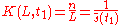
In a time-space diagram, the density may be evaluated in the region A.
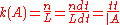
where tt is the total travel time in A


The flow (q) passing a fixed point (x1) during an interval (T) is equal to the inverse of the average headway of the m vehicles.
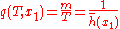
In a time-space diagram, the flow may be evaluated in the region B.

where td is the total distance traveled in B.


where:


Traffic is stationary if all the vehicles trajectories are paralel and equidistant. It is also stationare if it is a superposition of families of trajectories with these properties( eg. fast and slow drivers).
The engineering approach to analysis of highway traffic flow problems is primarily based on empirical analysis (i.e., observation and mathematical curve fitting). One of the major references on this topic used by American planners is the Highway Capacity Manual, published by the Transportation Research Board
, which is part of the United States National Academy of Sciences
. This recommends modelling traffic flows using the whole travel time across a link using a delay/flow function, including the effects of queuing. This technique is used in many U.S. traffic models and the SATURN model in Europe.
In many parts of Europe, a hybrid empirical approach to traffic design is used, combining macro-, micro-, and mesoscopic features. Rather than simulating a steady state of flow for a journey, transient "demand peaks" of congestion are simulated. These are modeled by using small "time slices" across the network throughout the working day or weekend. Typically, the origins and destinations for trips are first estimated and a traffic model is generated before being calibrated by comparing the mathematical model with observed counts of actual traffic flows, classified by type of vehicle. "Matrix estimation" is then applied to the model to achieve a better match to observed link counts before any changes, and the revised model is used to generate a more realistic traffic forecast for any proposed scheme. The model would be run several times (including a current baseline, an "average day" forecast based on a range of economic parameters and supported by sensitivity analysis) in order to understand the implications of temporary blockages or incidents around the network. From the models, it is possible to total the time taken for all drivers of different types of vehicle on the network and thus deduce average fuel consumption and emissions.
Much of UK, Scandinavian, and Dutch authority practice is to use the modelling program CONTRAM for large schemes, which has been developed over several decades under the auspices of the UK's Transport Research Laboratory
, and more recently with the support of the Swedish Road Administration
. By modelling forecasts of the road network for several decades into the future, the economic benefits of changes to the road network can be calculated, using estimates for value of time and other parameters. The output of these models can then be fed into a cost-benefit analysis program.
This cycle is repeated until the solution converges.
There are two main approaches to tackle this problem with the end objectives:
Predictive time delay is based on the concept that the system or the user knows when the congestion point is reached or when the delay of the freeway would be equal to the delay on city streets, and the decision for route assignment is taken in time. On the other hand, reactive time delay is when the system or user waits to experience the point where the delay is observed and the diversion of routes is in reaction to that experience. Predictive delay gives significantly better results as compared to the reactive delay method.
introduced an alternative approach to traffic assignment based on his network breakdown minimization (BM) principle. Rather than an explicit minimization of travel time that is the objective of System Optimum and User Equilibrium, the BM principle minimizes the probability of the occurrence of traffic congestion in a traffic network.
Under a great enough traffic demand, the application of the BM principle should lead to implicit minimization of travel time in the network.
The UK's TRL has developed junction modelling programs for small-scale local schemes that can take account of detailed geometry and sight lines; ARCADY
for roundabouts, PICADY for priority intersections, and OSCADY
and TRANSYT
for signals.
Before capacity is reached, traffic may flow at A vehicles per hour, or a higher B vehicles per hour. In either case, the speed of vehicles is vf, or "free flow," because the roadway is under capacity.
Now, suppose that at a certain location x0, the highway narrows to one lane. The maximum capacity is now limited to D', or half of Q, since only lane of the two is available. D shares the same flowrate as state D', but its vehicular density is higher.
Using a time-space diagram, we may model the bottleneck event. Suppose that at time 0, traffic begins to flow at rate B and speed vf. After time t1, vehicles arrive at the lighter flowrate A.
Before the first vehicles reach location x0, the traffic flow is unimpeded. However, downstream of x0, the roadway narrows, reducing the capacity by half - and to below that of state B. Due to this, vehicles will begin queuing upstream of x0. This is represented by high-density state D. The vehicle speed in this state is the slower vd, as taken from the fundamental diagram. Downstream of the bottleneck, vehicles transition to state D', where they again travel at free-flow speed vf.
Once vehicles arrive at rate A starting at t1, the queue will begin to clear and eventually dissipate. State A has a flowrate below the one-lane capacity of states D and D'.
On the time-space diagram, a sample vehicle trajectory is represented with a dotted arrow line. The diagram can readily represent vehicular delay and queue length. It's a simple matter of taking horizontal and vertical measurements within the region of state D.
State A represents normal approaching traffic flow, again at speed vf. State U, with flowrate qu, corresponds to the queuing upstream of the truck. On the fundamental diagram, vehicle speed vu is slower than vf. But once drivers have navigated around the truck, they can again speed up and transition to downstream state D. While this state travels at free flow, the vehicle density is less because fewer vehicles get around the bottleneck.
Suppose that, at time t, the truck slows from free-flow to v. A queue builds behind the truck, represented by state U. Within the region of state U, vehicles drive slower as indicated by the sample trajectory. Because state U limits to a smaller flow than state A, the queue will back up behind the truck and eventually crowd out the entire highway (slope s is negative). If state U had the higher flow, there would still be a growing queue. However, it would not back up because the slope s would be positive.
Useful books from the physical point of view:
Mathematics
Mathematics is the study of quantity, space, structure, and change. Mathematicians seek out patterns and formulate new conjectures. Mathematicians resolve the truth or falsity of conjectures by mathematical proofs, which are arguments sufficient to convince other mathematicians of their validity...
and civil engineering
Civil engineering
Civil engineering is a professional engineering discipline that deals with the design, construction, and maintenance of the physical and naturally built environment, including works like roads, bridges, canals, dams, and buildings...
, is the study of interactions between vehicles, drivers, and infrastructure (including highways, signage, and traffic control devices), with the aim of understanding and developing an optimal road network with efficient movement of traffic
Traffic
Traffic on roads may consist of pedestrians, ridden or herded animals, vehicles, streetcars and other conveyances, either singly or together, while using the public way for purposes of travel...
and minimal traffic congestion
Traffic congestion
Traffic congestion is a condition on road networks that occurs as use increases, and is characterized by slower speeds, longer trip times, and increased vehicular queueing. The most common example is the physical use of roads by vehicles. When traffic demand is great enough that the interaction...
problems.
History
Attempts to produce a mathematical theory of traffic flow date back to the 1920s, when Frank KnightFrank Knight
Frank Hyneman Knight was an American economist who spent most of his career at the University of Chicago, where he became one of the founders of the Chicago school. Nobel laureates James M. Buchanan, Milton Friedman and George Stigler were all students of Knight at Chicago. Knight supervised...
first produced an analysis of traffic equilibrium, which was refined into Wardrop's first and second principles
John Glen Wardrop
John Glen Wardrop was an English transport analyst who developed Wardrop's first and second principles of equilibrium.The concepts are related to the idea of Nash equilibrium in game theory developed separately...
of equilibrium in 1952.
Nonetheless, even with the advent of significant computer processing power, to date there has been no satisfactory general theory that can be consistently applied to real flow conditions. Current traffic models use a mixture of empirical
Empirical
The word empirical denotes information gained by means of observation or experimentation. Empirical data are data produced by an experiment or observation....
and theoretical
Deductive reasoning
Deductive reasoning, also called deductive logic, is reasoning which constructs or evaluates deductive arguments. Deductive arguments are attempts to show that a conclusion necessarily follows from a set of premises or hypothesis...
techniques. These models are then developed into traffic forecasts
Transportation forecasting
Transportation forecasting is the process of estimating the number of vehicles or people that will use a specific transportation facility in the future. For instance, a forecast may estimate the number of vehicles on a planned road or bridge, the ridership on a railway line, the number of...
, to take account of proposed local or major changes, such as increased vehicle use, changes in land use or changes in mode of transport (with people moving from bus to train or car, for example), and to identify areas of congestion
Traffic congestion
Traffic congestion is a condition on road networks that occurs as use increases, and is characterized by slower speeds, longer trip times, and increased vehicular queueing. The most common example is the physical use of roads by vehicles. When traffic demand is great enough that the interaction...
where the network needs to be adjusted.
Overview
Traffic phenomena are complex and nonlinear, depending on the interactions of a large number of vehicleVehicle
A vehicle is a device that is designed or used to transport people or cargo. Most often vehicles are manufactured, such as bicycles, cars, motorcycles, trains, ships, boats, and aircraft....
s. Due to the individual reactions of human drivers, vehicles do not interact simply following the laws of mechanics, but rather show phenomena of cluster
Cluster
-In science:* Cluster , a small group of atoms or molecules* Cluster chemistry, an array of bound atoms intermediate in character between a molecule and a solid...
formation
Structure formation
Structure formation refers to a fundamental problem in physical cosmology. The universe, as is now known from observations of the cosmic microwave background radiation, began in a hot, dense, nearly uniform state approximately 13.7 Gyr ago...
and shock wave
Shock wave
A shock wave is a type of propagating disturbance. Like an ordinary wave, it carries energy and can propagate through a medium or in some cases in the absence of a material medium, through a field such as the electromagnetic field...
propagation, both forward and backward, depending on vehicle density
Density
The mass density or density of a material is defined as its mass per unit volume. The symbol most often used for density is ρ . In some cases , density is also defined as its weight per unit volume; although, this quantity is more properly called specific weight...
in a given area. Some mathematical models in traffic flow make use of a vertical queue
Vertical Queue
Vertical Queue The concept of a vertical queue is often used in traffic flow studies as a common assumption to simplify analysis problems. Their use enables many calculations to be simplified, allowing researchers to get to the core of their problem, while ignoring the effects of queue buildup on a...
assumption, where the vehicles along a congested link do not spill back along the length of the link.
In a free flowing network, traffic flow theory refers to the traffic stream variables of speed, flow, and concentration. These relationships are mainly concerned with uninterrupted traffic flow, primarily found on freeways or expressways.
"Optimum density" for U.S. freeways is sometimes described as 40–50 vehicles per mile per lane. As the density reaches the maximum flow rate (or flux
Flux
In the various subfields of physics, there exist two common usages of the term flux, both with rigorous mathematical frameworks.* In the study of transport phenomena , flux is defined as flow per unit area, where flow is the movement of some quantity per time...
) and exceeds the optimum density, traffic flow becomes unstable, and even a minor incident can result in persistent stop-and-go driving conditions. The term jam density refers to extreme traffic density associated with completely stopped traffic flow, usually in the range of 185–250 vehicles per mile per lane.
However, calculations within congested networks are much more complex and rely more on empirical studies and extrapolations from actual road counts. Because these are often urban or suburban in nature, other factors (such as road-user safety and environmental considerations) also dictate the optimum conditions.
There are common spatiotemporal empirical features of traffic congestion
Traffic congestion: Reconstruction with Kerner’s three-phase theory
Vehicular traffic can be either free or congested. Traffic occurs in time and space, i.e., it is a spatiotemporal process. However, usually traffic can be measured only at some road locations...
that are qualitatively the same for different highways in different countries measured during years of traffic observations. Some of these common features of traffic congestion define synchronized flow and wide moving jam traffic phases of congested traffic in Kerner
Boris Kerner
Boris S. Kerner is the pioneer of the much-discussed three-phase traffic theory.- Life and work :Boris S. Kerner is a leading expert in intelligent transportation systems and in the theory of pattern formation in dissipative physical, chemical, biological systems. He was born in Moscow, Soviet...
’s three-phase traffic theory of traffic flow.
Traffic stream properties
Traffic flow is generally constrained along a one-dimensional pathway (e.g. a travel lane). A time-space diagram provides a graphical depiction of the flow of vehicles along a pathway over time. Time is measured along the horizontal axis, and distance is measured along the vertical axis. Traffic flow in a time-space diagram is represented by the individual trajectory lines of individual vehicles. Vehicles following each other along a given travel lane will have parallel trajectories, and trajectories will cross when one vehicle passes another. Time-space diagrams are useful tools for displaying and analyzing the traffic flow characteristics of a given roadway segment over time (e.g. analyzing traffic flow congestion).There are three main variables to visualize a traffic stream: speed (v), density (k), and flow (q).
Speed
Speed in traffic flow is defined as the distance covered per unit time. The speed of every individual vehicle is almost impossible to track on a roadway; therefore, in practice, average speed is based on the sampling of vehicles over a period of time or area and is calculated and used in formulas. If speed is measured by keeping time as reference it is called time mean speed, and if it is measured by space reference it is called space mean speed.- Time mean speed is measured by taking a reference area on the roadway over a fixed period of time. In practice, it is measured by the use of loop detectors. Loop detectors, when spread over a reference area, can record the signature of vehicles and can track the speed of each individual vehicle. However, average speed measurements obtained from this method are not accurate because instantaneous speeds averaged among several vehicles can not account for the difference in travel time for the vehicles that are traveling at different speeds over the same distance.
 where m represents the number of vehicles passing the fixed point
 - Space mean speed is the speed measured by taking the whole roadway segment into account. Consecutive pictures or video of a roadway segment track the speed of individual vehicles, and then the average speed is calculated. It is considered more accurate than the time mean speed. The data for space calculating space mean speed may be taken from satellite pictures, a camera, or both.
 ) where n represents the number of vehicles passing the roadway segment
The time mean speed is always greater than space mean speed.
In a time-space diagram, the instantaneous velocity, v = dx/dt, of a vehicle is equal to the slope along the vehicle’s trajectory. The average velocity of a vehicle is equal to the slope of the line connecting the trajectory endpoints where a vehicle enters and leaves the roadway segment. The vertical separation (distance) between parallel trajectories is the vehicle spacing (s) between a leading and following vehicle. Similarly, the horizontal separation (time) represents the vehicle headway (h). A time-space diagram is useful for relating headway and spacing to traffic flow and density, respectively.
Density
Density (k) is defined as the number of vehicles per unit area of the roadway. In traffic flow, the two most important densities are the critical density (kc) and jam density (kj). The maximum density achievable under free flow is kc, while kj is minimum density achieved under congestion. In general, jam density is seven times the critical density. Inverse of density is spacing (s), which is the distance between two vehicles.The density (k) within a length of roadway (L) at a given time (t1) is equal to the inverse of the average spacing of the n vehicles.
In a time-space diagram, the density may be evaluated in the region A.
where tt is the total travel time in A
Flow
Flow (q) is the number of vehicles passing a reference point per unit of time, and is measured in vehicles per hour. The inverse of flow is headway (h), which is the time that elapses between the ith vehicle passing a reference point in space and the i+1 vehicle. In congestion, h remains constant. As a traffic jam forms, h approaches infinity.The flow (q) passing a fixed point (x1) during an interval (T) is equal to the inverse of the average headway of the m vehicles.
In a time-space diagram, the flow may be evaluated in the region B.
where td is the total distance traveled in B.
Generalized Density and Flow in Time-Space Diagram
A more general definition of the flow and density in a time-space diagram is illustrated by region C:where:
Congestion Shockwave
In addition to providing information on the speed, flow, and density of traffic streams, time-space diagrams may also illustrate the propagation of congestion upstream from a traffic bottleneck (shockwave). Congestion shockwaves will vary in propagation length, depending upon the upstream traffic flow and density. However, shockwaves will generally travel upstream at a rate of approximately 20 km/h.Stationary traffic
We say that traffic on a long strech of road is stationary during a period of observation if you cannot get any clues as to what time it is or where you are by inspecting the time-space diagram through a small window in a template.Traffic is stationary if all the vehicles trajectories are paralel and equidistant. It is also stationare if it is a superposition of families of trajectories with these properties( eg. fast and slow drivers).
Methods of analysis
Scientists approach the problem in three main ways, corresponding to the three main scales of observation in physics.- Microscopic scale: At the most basic level, every vehicle is considered as an individual. An equation can be written for each, usually an ordinary differential equation (ODE)Ordinary differential equationIn mathematics, an ordinary differential equation is a relation that contains functions of only one independent variable, and one or more of their derivatives with respect to that variable....
. Cellular automation models can also be used, where the road is discretised into cells which each contain a car moving with some speed, or are empty. The Nagel-Schreckenberg modelNagel-Schreckenberg modelThe Nagel-Schreckenberg model is a theoretical model for the simulation of freeway traffic. The model was developed in the early 90s by the German physicists Kai Nagel and Michael Schreckenberg...
is a simple example of a such a model. As the cars interact it can model collective phenomena such as traffic jams. - Macroscopic scale: Similar to models of fluid dynamicsFluid dynamicsIn physics, fluid dynamics is a sub-discipline of fluid mechanics that deals with fluid flow—the natural science of fluids in motion. It has several subdisciplines itself, including aerodynamics and hydrodynamics...
, it is considered useful to employ a system of partial differential equations, which balance laws for some gross quantities of interest; e.g., the density of vehicles or their mean velocity. - Mesoscopic (kinetic) scale: A third, intermediate possibility, is to define a function
 which expresses the probability of having a vehicle at time
  in position
  which runs with velocity
  . This function, following methods of statistical mechanicsStatistical mechanicsStatistical mechanics or statistical thermodynamicsThe terms statistical mechanics and statistical thermodynamics are used interchangeably...
, can be computed using an integro-differential equation, such as the Boltzmann equationBoltzmann equationThe Boltzmann equation, also often known as the Boltzmann transport equation, devised by Ludwig Boltzmann, describes the statistical distribution of one particle in rarefied gas...
.
The engineering approach to analysis of highway traffic flow problems is primarily based on empirical analysis (i.e., observation and mathematical curve fitting). One of the major references on this topic used by American planners is the Highway Capacity Manual, published by the Transportation Research Board
Transportation Research Board
The Transportation Research Board is a division of the National Research Council, which serves as an independent adviser to the President, the Congress and federal agencies on scientific and technical questions of national importance...
, which is part of the United States National Academy of Sciences
United States National Academy of Sciences
The National Academy of Sciences is a corporation in the United States whose members serve pro bono as "advisers to the nation on science, engineering, and medicine." As a national academy, new members of the organization are elected annually by current members, based on their distinguished and...
. This recommends modelling traffic flows using the whole travel time across a link using a delay/flow function, including the effects of queuing. This technique is used in many U.S. traffic models and the SATURN model in Europe.
In many parts of Europe, a hybrid empirical approach to traffic design is used, combining macro-, micro-, and mesoscopic features. Rather than simulating a steady state of flow for a journey, transient "demand peaks" of congestion are simulated. These are modeled by using small "time slices" across the network throughout the working day or weekend. Typically, the origins and destinations for trips are first estimated and a traffic model is generated before being calibrated by comparing the mathematical model with observed counts of actual traffic flows, classified by type of vehicle. "Matrix estimation" is then applied to the model to achieve a better match to observed link counts before any changes, and the revised model is used to generate a more realistic traffic forecast for any proposed scheme. The model would be run several times (including a current baseline, an "average day" forecast based on a range of economic parameters and supported by sensitivity analysis) in order to understand the implications of temporary blockages or incidents around the network. From the models, it is possible to total the time taken for all drivers of different types of vehicle on the network and thus deduce average fuel consumption and emissions.
Much of UK, Scandinavian, and Dutch authority practice is to use the modelling program CONTRAM for large schemes, which has been developed over several decades under the auspices of the UK's Transport Research Laboratory
Transport Research Laboratory
TRL is a British transport consultancy and research organisation based at Wokingham Berkshire with approximately 500 staff. TRL is owned by the Transport Research Foundation , which is overseen by 80 sector members from the transport industry. TRL also own small UK regional offices situated in...
, and more recently with the support of the Swedish Road Administration
Swedish Road Administration
The Swedish Road Administration was a government agency in Sweden. Its primary responsibility was to organise building and maintenance of the road network in Sweden.Its headquarters were located in Borlänge.-History:...
. By modelling forecasts of the road network for several decades into the future, the economic benefits of changes to the road network can be calculated, using estimates for value of time and other parameters. The output of these models can then be fed into a cost-benefit analysis program.
Traffic assignment
The ultimate aim of traffic flow is to create and implement a model which would enable vehicles to reach their destination in the shortest possible time using the maximum roadway capacity. This is a four step process:- Generation: In this step the program estimates how many trips would be generated. For this, the program needs the statistical data of residence areas by population, location of workplaces etc.
- Distribution: After generation it makes the different Origin-Destination (OD) pairs between the location found in step 1.
- Model Split/Mode Choice: The system has to decide how much percentage of the population would be split between the difference modes of available transport, e.g. cars, buses, rails, etc.
- Route Assignment: Finally, routes are assigned to the vehicles based on minimum criterion rules.
This cycle is repeated until the solution converges.
There are two main approaches to tackle this problem with the end objectives:
- System Optimum
- User Equilibrium
System optimum
System Optimum is based on the assumption that routes of all vehicles would be controlled by the system, and that rerouting would be based on maximum utilization of resources and minimum travel time. Hence, in a System Optimum routing algorithm, all routes between a given OD pair have the same marginal travel time. The method always gives a better routing solution, but it is difficult to implement. The system that controls traffic has the knowledge of roadway capacity, and so it can limit traffic before the road turns into a congestion state. The individuals in vehicles are without the knowledge of roadway capacity and when they would see free flow traffic ahead, they are not likely to follow system.User equilibrium
This process assumes that every user chooses his or her own route towards his or her destination. It is different from System Optimum because here the users wait until the travel time using a certain freeway equal to the travel time using city streets, and hence an equilibrium is reached, called User Equilibrium or Nash Equilibrium. Therefore, it can be stated that in User Equilibrium all used routes between a given OD pair have the same travel time.Time delay
Both User Optimum and System Optimum can be further subdivided into two categories on the basis of the approach of time delay taken for their solution:- Predictive Time Delay
- Reactive Time Delay
Predictive time delay is based on the concept that the system or the user knows when the congestion point is reached or when the delay of the freeway would be equal to the delay on city streets, and the decision for route assignment is taken in time. On the other hand, reactive time delay is when the system or user waits to experience the point where the delay is observed and the diversion of routes is in reaction to that experience. Predictive delay gives significantly better results as compared to the reactive delay method.
Kerner’s network breakdown minimization (BM) principle
KernerBoris Kerner
Boris S. Kerner is the pioneer of the much-discussed three-phase traffic theory.- Life and work :Boris S. Kerner is a leading expert in intelligent transportation systems and in the theory of pattern formation in dissipative physical, chemical, biological systems. He was born in Moscow, Soviet...
introduced an alternative approach to traffic assignment based on his network breakdown minimization (BM) principle. Rather than an explicit minimization of travel time that is the objective of System Optimum and User Equilibrium, the BM principle minimizes the probability of the occurrence of traffic congestion in a traffic network.
Under a great enough traffic demand, the application of the BM principle should lead to implicit minimization of travel time in the network.
Variable speed limit assignment
This is an upcoming approach of eliminating shockwave and increasing safety for the vehicles. The concept is based on the fact that the risk of accident on a roadway increases with speed differential between the upstream and downstream vehicles. The two types of crash risk which can be reduced from VSL implementation are the rear end crash risk and the lane change crash risk. Different approaches have been implemented by researchers to build a suitable VSL algorithm.Road junctions
A major consideration in road capacity relates to the design of junctions. By allowing long "weaving sections" on gently curving roads at graded intersections, vehicles can often move across lanes without causing significant interference to the flow. However, this is expensive and takes up a large amount of land, so other patterns are often used, particularly in urban or very rural areas. Most large models use crude simulations for intersections, but computer simulations are available to model specific sets of traffic lights, roundabouts, and other scenarios where flow is interrupted or shared with other types of road users or pedestrians. A well-designed junction can enable significantly more traffic flow at a range of traffic densities during the day. By matching such a model to an "Intelligent Transport System", traffic can be sent in uninterrupted "packets" of vehicles at predetermined speeds through a series of phased traffic lights.The UK's TRL has developed junction modelling programs for small-scale local schemes that can take account of detailed geometry and sight lines; ARCADY
Arcady
ARCADY is the acronym for . This software, produced by the Transport Research Laboratory , provides information on traffic flow including modelling capacity queues and delays at roundabouts...
for roundabouts, PICADY for priority intersections, and OSCADY
OSCADY
OSCADY is a software package developed in the UK by the Transport Research Laboratory. The more recent phase-based version of the software is developed by Transport Research Laboratory in collaboration with UCL...
and TRANSYT
Transyt
TRANSYT is a software package developed in the UK by the Transport Research Laboratory. TRANSYT is the acronym for TRAffic Network StudY Tool.It is used to assess and optimise the performance of networks of road junctions by assigning costs to vehicle stops and delays...
for signals.
Stationary bottleneck
Consider a stretch of highway with two lanes in one direction. Suppose that the fundamental diagram is modeled as shown here. The highway has a peak capacity of Q vehicles per hour, corresponding to a density of kc vehicles per mile. The highway normally becomes jammed at kj vehicles per mile.Before capacity is reached, traffic may flow at A vehicles per hour, or a higher B vehicles per hour. In either case, the speed of vehicles is vf, or "free flow," because the roadway is under capacity.
Now, suppose that at a certain location x0, the highway narrows to one lane. The maximum capacity is now limited to D', or half of Q, since only lane of the two is available. D shares the same flowrate as state D', but its vehicular density is higher.
Using a time-space diagram, we may model the bottleneck event. Suppose that at time 0, traffic begins to flow at rate B and speed vf. After time t1, vehicles arrive at the lighter flowrate A.
Before the first vehicles reach location x0, the traffic flow is unimpeded. However, downstream of x0, the roadway narrows, reducing the capacity by half - and to below that of state B. Due to this, vehicles will begin queuing upstream of x0. This is represented by high-density state D. The vehicle speed in this state is the slower vd, as taken from the fundamental diagram. Downstream of the bottleneck, vehicles transition to state D', where they again travel at free-flow speed vf.
Once vehicles arrive at rate A starting at t1, the queue will begin to clear and eventually dissipate. State A has a flowrate below the one-lane capacity of states D and D'.
On the time-space diagram, a sample vehicle trajectory is represented with a dotted arrow line. The diagram can readily represent vehicular delay and queue length. It's a simple matter of taking horizontal and vertical measurements within the region of state D.
Moving bottleneck
For this example, consider three lanes of traffic in one direction. Assume that a truck starts traveling at speed v, slower than the free flow speed vf. As shown on the fundamental diagram below, qu represents the reduced capacity (2/3 of Q, or 2 of 3 lanes available) around the truck.State A represents normal approaching traffic flow, again at speed vf. State U, with flowrate qu, corresponds to the queuing upstream of the truck. On the fundamental diagram, vehicle speed vu is slower than vf. But once drivers have navigated around the truck, they can again speed up and transition to downstream state D. While this state travels at free flow, the vehicle density is less because fewer vehicles get around the bottleneck.
Suppose that, at time t, the truck slows from free-flow to v. A queue builds behind the truck, represented by state U. Within the region of state U, vehicles drive slower as indicated by the sample trajectory. Because state U limits to a smaller flow than state A, the queue will back up behind the truck and eventually crowd out the entire highway (slope s is negative). If state U had the higher flow, there would still be a growing queue. However, it would not back up because the slope s would be positive.
See also
- Data flow
- Dijkstra's algorithmDijkstra's algorithmDijkstra's algorithm, conceived by Dutch computer scientist Edsger Dijkstra in 1956 and published in 1959, is a graph search algorithm that solves the single-source shortest path problem for a graph with nonnegative edge path costs, producing a shortest path tree...
- Flow (computer networking)Flow (computer networking)In packet switching networks, traffic flow, packet flow or network flow is a sequence of packets from a source computer to a destination, which may be another host, a multicast group, or a broadcast domain...
- Fundamental diagram of traffic flowFundamental diagram of traffic flowThe fundamental diagram of traffic flow is a diagram that gives a relation between the traffic flux and the traffic density . A macroscopic traffic model involving traffic flux, traffic density and velocity forms the basis of the fundamental diagram...
- Journal of Transport and Land UseJournal of Transport and Land UseThe Journal of Transport and Land Use is an open access peer-reviewed academic journal covering the interaction of transport and land use that was established in 2008. As of August 2011, it is the official journal of the World Society on Transport and Land Use Research...
- Microscopic traffic flow modelMicroscopic traffic flow modelMicroscopic traffic flow models are a class of scientific models of vehicular traffic dynamics.In contrast to macroscopic models, microscopic traffic flow models simulate single vehicle-driver units, thus the dynamic variables of the models represent microscopic properties like the position and...
- MicrosimulationMicrosimulation-Introduction:Microsimulation is a category of computerized analytical tools that perform highly detailed analysis of activities such as highway traffic flowing through an intersection, financial transactions, or pathogens spreading disease through a population...
- Newell's Car Following ModelNewell's Car Following ModelIn traffic flow theory, Newell’s Car-Following Model is a method used to determine how vehicles follow one another on a roadway. The main idea of this model is that a vehicle will maintain a minimum space and time gap between it and the vehicle that precedes it...
- Newell-Daganzo Merge ModelNewell-Daganzo Merge ModelIn traffic flow theory, the Newell-Daganzo merge model describes a simple procedure on how to determine the flows exiting two branch roadways and merging to flow through a single roadway. The model is simple in that it does not consider the actual merging process between vehicles as the two branch...
- Truck Lane RestrictionTruck Lane RestrictionIn traffic flow theory, the impact of freeway truck lane restrictions is an interesting topic. Intuitively, slow vehicles will cause queues behind them, but how it relates to the kinematic wave theory was not revealed until Newell . Leclercq et al did a complete review of Newell's theory...
- Road traffic control
- Rule 184Rule 184Rule 184 is a one-dimensional binary cellular automaton rule, notable for solving the majority problem as well as for its ability to simultaneously describe several, seemingly quite different, particle systems:...
- Three-phase traffic theory
- Three-detector problem and Newell's methodThree-detector problem and Newell's methodThe Three-detector problem is a problem in traffic flow theory. Given is a homogeneous freeway and the vehicle counts at two detector stations. We seek the vehicle counts at some intermediate location. The method can be applied to incident detection and diagnosis by comparing the observed and...
- TIRTLTIRTLThe Infra-Red Traffic Logger, more commonly known simply by the acronym TIRTL, is a multi-purpose traffic sensor that can be used as a traffic counter, speed sensor, red light camera sensor, heavy vehicle tracker, overheight vehicle sensor, rail crossing sensor and network management system...
- Traffic bottleneckTraffic bottleneckA traffic bottleneck is a localized disruption of vehicular traffic on a street, road or highway. As opposed to a traffic jam, a bottleneck is a result of a specific, often temporary, physical condition.- Causes :...
- Traffic waveTraffic waveTraffic waves, also called stop waves or traffic shocks, are travelling disturbances in the distribution of cars on a highway. Traffic waves usually travel backwards in relation to the motion of the cars themselves, or "upstream". The waves can also travel downstream, however, more commonly become...
- Traffic counter
- Traffic congestion: Reconstruction with Kerner’s three-phase theoryTraffic congestion: Reconstruction with Kerner’s three-phase theoryVehicular traffic can be either free or congested. Traffic occurs in time and space, i.e., it is a spatiotemporal process. However, usually traffic can be measured only at some road locations...
- Turning movement countersTurning movement countersIn order to assess intersections turning movement counters are used to quantify the movement of vehicles through the area.These TMC's are square shaped boxes that have buttons for each direction of traffic flow. For example, east bound traffic entering an intersection has a button for those...
Further reading
A survey about the state of art in traffic flow modelling:- N. Bellomo, V. Coscia, M. Delitala, On the Mathematical Theory of Vehicular Traffic Flow I. Fluid Dynamic and Kinetic Modelling, Math. Mod. Meth. App. Sc., Vol. 12, No. 12 (2002) 1801–1843
- S. Maerivoet, Modelling Traffic on Motorways: State-of-the-Art, Numerical Data Analysis, and Dynamic Traffic Assignment, Katholieke Universiteit Leuven, 2006
- M. Garavello and B. Piccoli, Traffic Flow on Networks, American Institute of Mathematical Sciences (AIMS), Springfield, MO, 2006. pp xvi+243 ISBN 978-1-60133-000-0
- Carlos F.Daganzo, "Fundamentals of Transportation and Traffic Operations.",Pergamon-Elsevier, Oxford, U.K. (1997)
- B.S. Kerner, Introduction to Modern Traffic Flow Theory and Control: The Long Road to Three-Phase Traffic Theory, Springer, Berlin, New York 2009
Useful books from the physical point of view:
- B.S. Kerner, The Physics of Traffic, Springer, Berlin, New York 2004
- Traffic flow on arxiv.org
- May, Adolf. Traffic Flow Fundamentals. Prentice Hall, Englewood Cliffs, NJ, 1990.
- Taylor, Nicholas. The Contram dynamic traffic assignment model TRLTransport Research LaboratoryTRL is a British transport consultancy and research organisation based at Wokingham Berkshire with approximately 500 staff. TRL is owned by the Transport Research Foundation , which is overseen by 80 sector members from the transport industry. TRL also own small UK regional offices situated in...
2003