In
mathematicsMathematics is the study of quantity, space, structure, and change. Mathematicians seek out patterns and formulate new conjectures. Mathematicians resolve the truth or falsity of conjectures by mathematical proofs, which are arguments sufficient to convince other mathematicians of their validity...
, an
ordinary differential equation (or
ODE) is a relation that contains functions of only one
independent variableThe terms "dependent variable" and "independent variable" are used in similar but subtly different ways in mathematics and statistics as part of the standard terminology in those subjects...
, and one or more of their
derivativeIn calculus, a branch of mathematics, the derivative is a measure of how a function changes as its input changes. Loosely speaking, a derivative can be thought of as how much one quantity is changing in response to changes in some other quantity; for example, the derivative of the position of a...
s with respect to that variable.
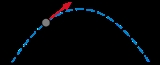
A simple example is Newton's second law of motion, which leads to the
differential equationA differential equation is a mathematical equation for an unknown function of one or several variables that relates the values of the function itself and its derivatives of various orders...
for the motion of a particle of constant mass m. In general, the force F depends upon the position x(t) of the particle at time t,
and thus the unknown function x(t) appears on both sides of the differential equation, as is indicated in the notation F(x(t)).
Ordinary differential equations are distinguished from
partial differential equationIn mathematics, partial differential equations are a type of differential equation, i.e., a relation involving an unknown function of several independent variables and their partial derivatives with respect to those variables...
s, which involve
partial derivativeIn mathematics, a partial derivative of a function of several variables is its derivative with respect to one of those variables, with the others held constant...
s of functions of several variables.
Ordinary differential equations arise in many different contexts including geometry, mechanics, astronomy and population modelling. Many mathematicians have studied differential equations and contributed to the field, including
NewtonSir Isaac Newton PRS was an English physicist, mathematician, astronomer, natural philosopher, alchemist, and theologian, who has been "considered by many to be the greatest and most influential scientist who ever lived."...
,
LeibnizGottfried Wilhelm Leibniz was a German philosopher and mathematician. He wrote in different languages, primarily in Latin , French and German ....
, the Bernoulli family, Riccati, Clairaut, d'Alembert and Euler.
Much study has been devoted to the solution of ordinary differential equations.
In the case where the equation is
linearIn mathematics, a linear map, linear mapping, linear transformation, or linear operator is a function between two vector spaces that preserves the operations of vector addition and scalar multiplication. As a result, it always maps straight lines to straight lines or 0...
, it can be solved by analytical methods. Unfortunately, most of the interesting differential equations are non-linear and, with a few exceptions, cannot be solved exactly. Approximate solutions are arrived at using computer approximations (see
numerical ordinary differential equationsNumerical ordinary differential equations is the part of numerical analysis which studies the numerical solution of ordinary differential equations...
).
Ordinary differential equation
Let y be an unknown function
in x with

the nth
derivativeIn calculus, a branch of mathematics, the derivative is a measure of how a function changes as its input changes. Loosely speaking, a derivative can be thought of as how much one quantity is changing in response to changes in some other quantity; for example, the derivative of the position of a...
of y, and let F be a given function
then an equation of the form
is called an
ordinary differential equation (ODE) of
order n. If y is an unknown vector valued function

,
it is called a
system of ordinary differential equations of
dimension m (in this case, F : ℝ
mn+1→ ℝ
m).
More generally, an
implicit ordinary differential equation of order n has the form

where F : ℝ
n+2→ ℝ depends on y
(n). To distinguish the above case from this one, an equation of the form

is called an
explicit differential equation.
A differential equation not depending on x is called
autonomousIn mathematics, an autonomous system or autonomous differential equation is a system of ordinary differential equations which does not explicitly depend on the independent variable...
.
A differential equation is said to be
linearLinear differential equations are of the formwhere the differential operator L is a linear operator, y is the unknown function , and the right hand side ƒ is a given function of the same nature as y...
if F can be written as a
linear combinationIn mathematics, a linear combination is an expression constructed from a set of terms by multiplying each term by a constant and adding the results...
of the derivatives of y together with a constant term, all possibly depending on x:
with a
i(x) and r(x) continuous functions in x. The function r(x) is called the
source term; if r(x)=0 then the linear differential equation is called
homogeneous, otherwise it is called
non-homogeneous or
inhomogeneous.
Solutions
Given a differential equation

a function is called the
solution or
integral curveIn mathematics, an integral curve is a parametric curve that represents a specific solution to an ordinary differential equation or system of equations...
for F, if u is n-times differentiable on I, and
Given two solutions and , u is called an
extension of v if and

A solution which has no extension is called a
global solution.
A
general solution of an n-th order equation is a solution containing n arbitrary variables, corresponding to n constants of integration. A
particular solution is derived from the general solution by setting the constants to particular values, often chosen to fulfill set '
initial conditionsIn mathematics, in the field of differential equations, an initial value problem is an ordinary differential equation together with a specified value, called the initial condition, of the unknown function at a given point in the domain of the solution...
or
boundary conditionsIn mathematics, in the field of differential equations, a boundary value problem is a differential equation together with a set of additional restraints, called the boundary conditions...
'. A
singular solutionA singular solution ys of an ordinary differential equation is a solution that is singular or one for which the initial value problem fails to have a unique solution at some point on the solution. The set on which a solution is singular may be as small as a single point or as large as the full...
is a solution that can't be derived from the general solution.
Existence and uniqueness of solutions
There are several theorems that establish existence and uniqueness of solutions to initial value problems involving ODEs both locally and globally. The two main theorems are the
Picard–Lindelöf theoremIn mathematics, in the study of differential equations, the Picard–Lindelöf theorem, Picard's existence theorem or Cauchy–Lipschitz theorem is an important theorem on existence and uniqueness of solutions to first-order equations with given initial conditions.The theorem is named after Charles...
and the
Peano existence theoremIn mathematics, specifically in the study of ordinary differential equations, the Peano existence theorem, Peano theorem or Cauchy-Peano theorem, named after Giuseppe Peano and Augustin Louis Cauchy, is a fundamental theorem which guarantees the existence of solutions to certain initial value...
.
Reduction to a first order system
Any differential equation of order n can be written as a system of n first-order differential equations.
Given an explicit ordinary differential equation of order n (and dimension 1),
define a new family of unknown functions
for i from 1 to n.
The original differential equation can be rewritten as the system of differential equations with order 1 and dimension n given by
which can be written concisely in vector notation as
with
and
Linear ordinary differential equations
A well understood particular class of differential equations is linear differential equations. We can always reduce an explicit linear differential equation of any order to a system of differential equations of order 1
which we can write concisely using matrix and vector notation as
with


Homogeneous equations
The set of solutions for a system of homogeneous linear differential equations of order 1 and dimension n
forms an n-dimensional
vector spaceA vector space is a mathematical structure formed by a collection of vectors: objects that may be added together and multiplied by numbers, called scalars in this context. Scalars are often taken to be real numbers, but one may also consider vector spaces with scalar multiplication by complex...
. Given a basis for this vector space

, which is called a
fundamental system, every solution

can be written as
The n × n matrix
is called
fundamental matrix. In general there is no method to explicitly construct a fundamental system, but if one solution is known d'Alembert reduction can be used to reduce the dimension of the differential equation by one.
Nonhomogeneous equations
The set of solutions for a system of inhomogeneous linear differential equations of order 1 and dimension n
can be constructed by finding the fundamental system

to the corresponding homogeneous equation and one particular solution

to the inhomogeneous equation. Every solution

to nonhomogeneous equation can then be written as
A particular solution to the nonhomogeneous equation can be found by the
method of undetermined coefficientsIn mathematics, the method of undetermined coefficients, also known as the lucky guess method, is an approach to finding a particular solution to certain inhomogeneous ordinary differential equations and recurrence relations...
or the
method of variation of parametersIn mathematics, variation of parameters, also known as variation of constants, is a general method to solve inhomogeneous linear ordinary differential equations...
.
Concerning second order linear ordinary differential equations, it is well known that

So, if

is a solution of:

, then

such that:
So, if

is a solution of:

; then a particular solution

of

, is given by:

.
Fundamental systems for homogeneous equations with constant coefficients
If a system of homogeneous linear differential equations has constant coefficients
then we can explicitly construct a fundamental system. The fundamental system can be written as a
matrix differential equationA differential equation is a mathematical equation for an unknown function of one or several variables that relates the values of the function itself and of its derivatives of various orders...
with solution as a
matrix exponentialIn mathematics, the matrix exponential is a matrix function on square matrices analogous to the ordinary exponential function. Abstractly, the matrix exponential gives the connection between a matrix Lie algebra and the corresponding Lie group....
which is a fundamental matrix for the original differential equation. To explicitly calculate this expression we first transform
A into
Jordan normal formIn linear algebra, a Jordan normal form of a linear operator on a finite-dimensional vector space is an upper triangular matrix of a particular form called Jordan matrix, representing the operator on some basis...
and then evaluate the Jordan blocks

of J separately as
General Case
To solve
- y'(x) = A(x)y(x)+b(x) with y(x0) = y0 (here y(x) is a vector or matrix, and A(x) is a matrix),
let U(
x) be the solution of
y'(
x) = A(
x)
y(x) with U(x
0) = I (the identity matrix). After substituting
y(
x) = U(
x)
z(
x), the equation
y'(
x) = A(
x)
y(
x)+
b(
x) simplifies to U(
x)z'(
x) = B(
x). Thus,
If A(x
1) commutes with A(x
2) for all x
1 and x
2, then

(and thus

), but in the general case there is no closed form solution, and an approximation method such as
Magnus expansionIn mathematics and physics, the Magnus expansion, named after Wilhelm Magnus , provides an exponential representation of the solution of a first order linear homogeneous differential equation for a linear operator. In particular it furnishes the fundamental matrix of a system of linear ordinary...
may have to be used.
Singular solutions
The theory of
singular solutionA singular solution ys of an ordinary differential equation is a solution that is singular or one for which the initial value problem fails to have a unique solution at some point on the solution. The set on which a solution is singular may be as small as a single point or as large as the full...
s of ordinary and partial
differential equations was a subject of research from the time
of Leibniz, but only since the middle of the nineteenth century did it
receive special attention. A valuable but little-known work on the
subject is that of Houtain (1854).
DarbouxJean-Gaston Darboux was a French mathematician.-Life:Darboux made several important contributions to geometry and mathematical analysis . He was a biographer of Henri Poincaré and he edited the Selected Works of Joseph Fourier.Darboux received his Ph.D...
(starting in 1873) was a
leader in the theory, and in the geometric interpretation of these
solutions he opened a field which was worked by various
writers, notably
CasoratiFelice Casorati was an Italian mathematician best known for the Casorati-Weierstrass theorem in complex analysis...
and
CayleyArthur Cayley F.R.S. was a British mathematician. He helped found the modern British school of pure mathematics....
. To the latter is due (1872)
the theory of singular solutions of differential equations of the
first order as accepted circa 1900.
Reduction to quadratures
The primitive attempt in dealing with differential equations had in view a reduction to
quadratureQuadrature — historical mathematical term which means calculating of the area. Quadrature problems have served as one of the main sources of mathematical analysis.- History :...
s. As it had been the hope of eighteenth-century algebraists to find a method for solving the general equation of the

th degree, so it was the hope of analysts to find a general method for integrating any differential equation.
GaussJohann Carl Friedrich Gauss was a German mathematician and scientist who contributed significantly to many fields, including number theory, statistics, analysis, differential geometry, geodesy, geophysics, electrostatics, astronomy and optics.Sometimes referred to as the Princeps mathematicorum...
(1799) showed, however, that the differential equation meets its limitations very soon unless
complex numberA complex number is a number consisting of a real part and an imaginary part. Complex numbers extend the idea of the one-dimensional number line to the two-dimensional complex plane by using the number line for the real part and adding a vertical axis to plot the imaginary part...
s are introduced. Hence analysts began to substitute the study of functions, thus opening a new and fertile field. Cauchy was the first to appreciate the importance of this view. Thereafter the real question was to be, not whether a solution is possible by means of known functions or their integrals, but whether a given differential equation suffices for the definition of a function of the
independent variable or variables, and if so, what are the characteristic properties of this function.
Fuchsian theory
Two memoirs by
FuchsLazarus Immanuel Fuchs was a German mathematician who contributed important research in the field of linear differential equations...
(Crelle, 1866, 1868), inspired a novel approach, subsequently elaborated by Thomé and
FrobeniusFerdinand Georg Frobenius was a German mathematician, best known for his contributions to the theory of differential equations and to group theory...
. Collet was a prominent contributor beginning in 1869, although his method for integrating a
non-linear system was communicated to Bertrand in 1868.
ClebschRudolf Friedrich Alfred Clebsch was a German mathematician who made important contributions to algebraic geometry and invariant theory. He attended the University of Königsberg and was habilitated at Berlin. He subsequently taught in Berlin and Karlsruhe...
(1873) attacked
the theory along lines parallel to those followed in his theory of
Abelian integrals. As the latter can be classified according to the
properties of the fundamental curve which remains unchanged under a
rational transformation, so Clebsch proposed to classify the
transcendent functions defined by the differential equations
according to the invariant properties of the corresponding surfaces
f = 0 under rational one-to-one transformations.
Lie's theory
From 1870
Sophus LieMarius Sophus Lie was a Norwegian mathematician. He largely created the theory of continuous symmetry, and applied it to the study of geometry and differential equations.- Biography :...
's work put the theory of differential equations
on a more satisfactory foundation. He showed that the integration
theories of the older mathematicians can, by the introduction of what are now called
Lie groupIn mathematics, a Lie group is a group which is also a differentiable manifold, with the property that the group operations are compatible with the smooth structure...
s, be referred to a common source; and that
ordinary differential equations which admit the same
infinitesimal transformationIn mathematics, an infinitesimal transformation is a limiting form of small transformation. For example one may talk about an infinitesimal rotation of a rigid body, in three-dimensional space. This is conventionally represented by a 3×3 skew-symmetric matrix A...
s present comparable difficulties of integration. He
also emphasized the subject of transformations of contact.
A general approach to solve DE's uses the symmetry property of differential equations, the continuous
infinitesimal transformationIn mathematics, an infinitesimal transformation is a limiting form of small transformation. For example one may talk about an infinitesimal rotation of a rigid body, in three-dimensional space. This is conventionally represented by a 3×3 skew-symmetric matrix A...
s of solutions to solutions (
Lie theoryLie theory is an area of mathematics, developed initially by Sophus Lie.Early expressions of Lie theory are found in books composed by Lie with Friedrich Engel and Georg Scheffers from 1888 to 1896....
). Continuous
group theoryIn mathematics and abstract algebra, group theory studies the algebraic structures known as groups.The concept of a group is central to abstract algebra: other well-known algebraic structures, such as rings, fields, and vector spaces can all be seen as groups endowed with additional operations and...
, Lie algebras and differential geometry are used to understand the structure of linear and nonlinear (partial) differential equations for generating integrable equations, to find its
Lax pairIn mathematics, in the theory of integrable systems, a Lax pair is a pair of time-dependent matrices or operators that describe the corresponding differential equations. They were introduced by Peter Lax to discuss solitons in continuous media...
s, recursion operators,
Bäcklund transformIn mathematics, Bäcklund transforms or Bäcklund transformations relate partial differential equations and their solutions. They are an important tool in soliton theory and integrable systems...
and finally finding exact analytic solutions to the DE.
Symmetry methods have been recognized to study differential equations arising in mathematics, physics, engineering, and many other disciplines.
Sturm–Liouville theory
Sturm–Liouville theory is a theory of eigenvalues and eigenfunctions of linear
operators defined in terms of second-order homogeneous linear equations, and is useful
in the analysis of certain partial differential equations.
See also
External links
(includes a list of software for solving differential equations).