
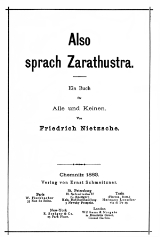
Thus Spoke Zarathustra: A Book for All and None is a
philosophical novelPhilosophical fiction refers to works of fiction in which a significant proportion of the work is devoted to a discussion of the sort of questions normally addressed in discursive philosophy. These might include the function and role of society, the purpose of life, ethics or morals, the role of...
by German philosopher
Friedrich NietzscheFriedrich Wilhelm Nietzsche was a 19th-century German philosopher, poet, composer and classical philologist...
, composed in four parts between 1883 and 1885. Much of the work deals with ideas such as the "eternal recurrence of the same", the parable on the "
death of God"God is dead" is a widely-quoted statement by German philosopher Friedrich Nietzsche. It first appears in The Gay Science , in sections 108 , 125 , and for a third time in section 343...
", and the "prophecy" of the
ÜbermenschThe Übermensch is a concept in the philosophy of Friedrich Nietzsche. Nietzsche posited the Übermensch as a goal for humanity to set for itself in his 1883 book Thus Spoke Zarathustra ....
, which were first introduced in
The Gay ScienceThe Gay Science is a book written by Friedrich Nietzsche, first published in 1882 and followed by a second edition, which was published after the completion of Thus Spoke Zarathustra and Beyond Good and Evil, in 1887. This substantial expansion includes a fifth book and an appendix of songs...
.
Described by Nietzsche himself as "the deepest ever written," the book is a dense and esoteric treatise on philosophy and morality, featuring as protagonist a fictionalized prophet descending from his mountain retreat to mankind,
ZarathustraZoroaster , also known as Zarathustra , was a prophet and the founder of Zoroastrianism who was either born in North Western or Eastern Iran. He is credited with the authorship of the Yasna Haptanghaiti as well as the Gathas, hymns which are at the liturgical core of Zoroastrianism...
. A central irony of the text is that Nietzsche mimics the style of the Bible in order to present ideas which fundamentally oppose
ChristianChristianity is a monotheistic religion based on the life and teachings of Jesus as presented in canonical gospels and other New Testament writings...
and
JewishJudaism ) is the "religion, philosophy, and way of life" of the Jewish people...
morality and tradition.
Genesis
Thus Spoke Zarathustra was conceived while Nietzsche was writing
The Gay ScienceThe Gay Science is a book written by Friedrich Nietzsche, first published in 1882 and followed by a second edition, which was published after the completion of Thus Spoke Zarathustra and Beyond Good and Evil, in 1887. This substantial expansion includes a fifth book and an appendix of songs...
; he made a small note, reading "6,000 feet beyond man and time," as evidence of this. More specifically, this note related to the concept of the
eternal recurrenceEternal return is a concept which posits that the universe has been recurring, and will continue to recur, in a self-similar form an infinite number of times across infinite time or space. The concept initially inherent in Indian philosophy was later found in ancient Egypt, and was subsequently...
, which is, by Nietzsche's admission, the central idea of
Zarathustra; this idea occurred to him by a "pyramidal block of stone" on the shores of
Lake SilvaplanaLake Silvaplana is a lake in the Upper-Engadine valley of Grisons, Switzerland. It takes its name from the village of Silvaplana. The lake is also connected to the nearby Lej da Champfèr....
in the
Upper EngadineThe Engadin or Engadine is a long valley in the Swiss Alps located in the canton of Graubünden in southeast Switzerland. It follows the route of the Inn River from its headwaters at Maloja Pass running northeast until the Inn flows into Austria one hundred kilometers downstream...
, a high alpine region whose valley floor is at 6,000 ft. Nietzsche planned to write the book in three parts over several years. He wrote that the ideas for
Zarathustra first came to him while walking on two roads surrounding
RapalloRapallo is a municipality in the province of Genoa, in Liguria, northern Italy. As of 2007 it counts approximately 34,000 inhabitants, it is part of the Tigullio Gulf and is located in between Portofino and Chiavari....
, according to
Elisabeth Förster-NietzscheTherese Elisabeth Alexandra Förster-Nietzsche , who went by her second name, was the sister of philosopher Friedrich Nietzsche and the creator of the Nietzsche Archive in 1894....
in the introduction of
Thomas CommonThomas Common was a translator and critic, who translated several books by Nietzsche into English. There is little information about him biographically, though indications are that he was a very well-educated and literate scholar, who lived in the area of Corstorphine, Scotland.In the mid-1890s,...
's early translation of the book.
Although Part Three was originally planned to be the end of the book, and ends with a strong
climaxThe Climax is the point in the story where the main character's point of view changes, or the most exciting/action filled part of the story. It also known has the main turning point in the story...
, Nietzsche subsequently decided to write an additional three parts; ultimately, however, he composed only the fourth part, which is viewed to constitute an
intermezzoIn music, an intermezzo , in the most general sense, is a composition which fits between other musical or dramatic entities, such as acts of a play or movements of a larger musical work...
.
Nietzsche commented in
Ecce HomoEcce Homo: How One Becomes What One Is is the title of the last original book written by philosopher Friedrich Nietzsche before his final years of insanity that spanned until his death in 1900...
that for the completion of each part: "Ten days sufficed; in no case, neither for the first nor for the third and last, did I require more" (trans. Kaufmann). The first three parts were first published separately, and were subsequently published in a single volume in 1887. The fourth part remained private after Nietzsche wrote it in 1885; a scant forty copies were all that were printed, apart from seven others that were distributed to Nietzsche's close friends. In March 1892, the four parts were finally reprinted as a single volume. Since then, the version most commonly produced has included all four parts.
The original text contains a great deal of word-play. An example of this is the use of words beginning
über ("over" or "above") and
unter ("down" or "below"), often paired to emphasise the contrast, which is not always possible to bring out in translation, except by coinages. An example is
Untergang, literally "down-going" but used in German to mean "setting" (as of the sun), which Nietzsche pairs with its opposite
Übergang (going over or across). Another example is
Übermensch (overman or superman), discussed later in this article.
Synopsis
The book chronicles the fictitious travels and
pedagogyPedagogy is the study of being a teacher or the process of teaching. The term generally refers to strategies of instruction, or a style of instruction....
of Zarathustra. The name of this character is taken from the ancient
prophetIn religion, a prophet, from the Greek word προφήτης profitis meaning "foreteller", is an individual who is claimed to have been contacted by the supernatural or the divine, and serves as an intermediary with humanity, delivering this newfound knowledge from the supernatural entity to other people...
usually known in English as
ZoroasterZoroaster , also known as Zarathustra , was a prophet and the founder of Zoroastrianism who was either born in North Western or Eastern Iran. He is credited with the authorship of the Yasna Haptanghaiti as well as the Gathas, hymns which are at the liturgical core of Zoroastrianism...
, the
PersianThe Persian people are part of the Iranian peoples who speak the modern Persian language and closely akin Iranian dialects and languages. The origin of the ethnic Iranian/Persian peoples are traced to the Ancient Iranian peoples, who were part of the ancient Indo-Iranians and themselves part of...
founder of
ZoroastrianismZoroastrianism is a religion and philosophy based on the teachings of prophet Zoroaster and was formerly among the world's largest religions. It was probably founded some time before the 6th century BCE in Greater Iran.In Zoroastrianism, the Creator Ahura Mazda is all good, and no evil...
. Nietzsche is clearly portraying a "new" or "different" Zarathustra, one who
turns traditional morality on its headThe revaluation of all values or the transvaluation of all values is a concept from the philosophy of Friedrich Nietzsche.Elaborating the concept in The Antichrist, Nietzsche asserts that Christianity, not merely as a religion but also as the predominant moral system of the Western world, in fact...
. He goes on to characterize "what the name of Zarathustra means in my mouth, the mouth of the first immoralist:"
Zarathustra has a simple characterisation and plot, narrated sporadically throughout the text. It possesses a unique experimental style, one that is, for instance, evident in newly invented "
dithyrambThe dithyramb was an ancient Greek hymn sung and danced in honour of Dionysus, the god of wine and fertility; the term was also used as an epithet of the god: Plato, in The Laws, while discussing various kinds of music mentions "the birth of Dionysos, called, I think, the dithyramb." Plato also...
s" narrated or sung by Zarathustra. Likewise, the separate
Dithyrambs of Dionysus was written in autumn 1888, and printed with the full volume in 1892, as the corollaries of Zarathustra's "abundance".
Some speculate that Nietzsche intended to write about final acts of creation and destruction brought about by Zarathustra. However, the book lacks a
finale to match that description; its actual ending focuses more on Zarathustra recognizing that his legacy is beginning to perpetuate, and consequently choosing to leave the higher men to their own devices in carrying his legacy forth.
Zarathustra also contains the famous dictum "
God is dead"God is dead" is a widely-quoted statement by German philosopher Friedrich Nietzsche. It first appears in The Gay Science , in sections 108 , 125 , and for a third time in section 343...
", which had appeared earlier in
The Gay ScienceThe Gay Science is a book written by Friedrich Nietzsche, first published in 1882 and followed by a second edition, which was published after the completion of Thus Spoke Zarathustra and Beyond Good and Evil, in 1887. This substantial expansion includes a fifth book and an appendix of songs...
. In his autobiographical work
Ecce Homo, Nietzsche states that the book's underlying concept is discussed within "the penultimate section of the fourth book" of The Gay Science (
Ecce HomoEcce Homo: How One Becomes What One Is is the title of the last original book written by philosopher Friedrich Nietzsche before his final years of insanity that spanned until his death in 1900...
, Kaufmann). It is the
eternal recurrence of the same eventsEternal return is a concept which posits that the universe has been recurring, and will continue to recur, in a self-similar form an infinite number of times across infinite time or space. The concept initially inherent in Indian philosophy was later found in ancient Egypt, and was subsequently...
.
This concept first occurred to Nietzsche while he was walking in Switzerland through the woods along the lake of
SilvaplanaSilvaplana is a municipality in the district of Maloja in the Swiss canton of Graubünden and the name of a lake in the municipality.-History:...
(close to
SurlejSurlej is a village in Graubünden, Switzerland. Its located close to Sankt Moritz and Silvaplana....
); he was inspired by the sight of a gigantic, towering, pyramidal rock. Before
Zarathustra, Nietzsche had mentioned the concept in the fourth book of
The Gay ScienceThe Gay Science is a book written by Friedrich Nietzsche, first published in 1882 and followed by a second edition, which was published after the completion of Thus Spoke Zarathustra and Beyond Good and Evil, in 1887. This substantial expansion includes a fifth book and an appendix of songs...
(e.g., sect. 341); this was the first public proclamation of the notion by him. Apart from its salient presence in
Zarathustra, it is also echoed throughout Nietzsche's work. At any rate, it is by Zarathustra's transfiguration that he embraces eternity, that he at last ascertains "the supreme will to power". This inspiration finds its expression with
Zarathustra's roundelayZarathustra's Roundelay is a philosophical poem that features as a central motif in the book Thus Spoke Zarathustra by Friedrich Nietzsche. The roundelay first appears in "Chapter 59: The Second Dance-Song", as a mysterious revelation that precedes "Chapter 60: The Seven Seals", a conclusion and...
, featured twice in the book, once near the story's close:
Another singular feature of
Zarathustra, first presented in the prologue, is the designation of human beings as a transition between apes and the "
ÜbermenschThe Übermensch is a concept in the philosophy of Friedrich Nietzsche. Nietzsche posited the Übermensch as a goal for humanity to set for itself in his 1883 book Thus Spoke Zarathustra ....
" (in English, either the "overman" or "superman"; or,
superhuman or
overhuman. English translators Thomas Common and R. J. Hollingdale use
superman, while Kaufmann uses
overman, and Parkes uses
overhuman. Martin has opted to leave the nearly universally understood term as
Übermensch in his new translation). The
Übermensch is one of the many interconnecting, interdependent themes of the story, and is represented through several different metaphors. Examples include: the lightning that is portended by the silence and raindrops of a travelling storm cloud; or the sun's rise and culmination at its midday zenith; or a man traversing a rope stationed above an abyss, moving away from his uncultivated animality and towards the
Übermensch.
The symbol of the
Übermensch also alludes to Nietzsche's notions of "self-mastery", "self-cultivation", "self-direction", and "self-overcoming". Expounding these concepts, Zarathustra declares:
The book embodies a number of innovative poetical and rhetorical methods of expression. It serves as a parallel and supplement to the various philosophical ideas present in Nietzsche's body of work. He has, however, said that "among my writings my
Zarathustra stands to my mind by itself" (
Ecce Homo, Preface, sec. 4, Kaufmann). Emphasizing its centrality and its status as his
magnum opusMasterpiece in modern usage refers to a creation that has been given much critical praise, especially one that is considered the greatest work of a person's career or to a work of outstanding creativity, skill or workmanship....
, it is stated by Nietzsche that:
Since, as stated, many of the book's ideas are also present in his other works,
Zarathustra is seen to have served as a precursor to his later philosophical thought. With the book, Nietzsche embraced a distinct aesthetic assiduity. He later reformulated many of his ideas, in his book
Beyond Good and EvilBeyond Good and Evil is a book by the philosopher Friedrich Nietzsche, first published in 1886.It takes up and expands on the ideas of his previous work, Thus Spoke Zarathustra, but approached from a more critical, polemical direction....
and various other writings that he composed thereafter. He continued to emphasize his philosophical concerns; generally, his intention was to show an alternative to repressive moral codes and to avert "
nihilismNihilism is the philosophical doctrine suggesting the negation of one or more putatively meaningful aspects of life. Most commonly, nihilism is presented in the form of existential nihilism which argues that life is without objective meaning, purpose, or intrinsic value...
" in all of its varied forms.
Other aspects of
Thus Spoke Zarathustra relate to Nietzsche's proposed "
Transvaluation of All ValuesThe revaluation of all values or the transvaluation of all values is a concept from the philosophy of Friedrich Nietzsche.Elaborating the concept in The Antichrist, Nietzsche asserts that Christianity, not merely as a religion but also as the predominant moral system of the Western world, in fact...
". This incomplete project began with
The AntichristThe Antichrist is a book by the philosopher Friedrich Nietzsche, originally published in 1895. Although it was written in 1888, its controversial content made Franz Overbeck and Heinrich Köselitz delay its publication, along with Ecce Homo...
.
Themes
Nietzsche injects myriad ideas into the book, but there are a few recurring themes. The overman (Übermensch), a self-mastered individual who has achieved his full power, is an almost omnipresent idea in
Thus Spoke Zarathustra. Man as a race is merely a bridge between animals and the overman. Nietzsche also makes a point that the overman is not an end result for a person, but more the journey toward self-mastery.
The eternal recurrence, found elsewhere in Nietzsche's writing, is also mentioned. The eternal recurrence is the idea that all events that have happened will happen again, infinitely many times. Such a reality can serve as the litmus test for an overman. Faced with the knowledge that he would repeat every action that he has taken, an overman would be elated as he has no regrets and loves life.
The
will to powerThe will to power is widely seen as a prominent concept in the philosophy of Friedrich Nietzsche. The will to power describes what Nietzsche may have believed to be the main driving force in man; achievement, ambition, the striving to reach the highest possible position in life; these are all...
is the fundamental component of human nature. Everything we do is an expression of the will to power. The will to power is a psychological analysis of all human action and is accentuated by self-overcoming and self-enhancement. Contrasted with living for procreation, pleasure, or happiness, the will to power is the summary of all man's struggle against his surrounding environment as well as his reason for living in it.
The book in several passages expresses loathing for sentiments of human
pityPity originally means feeling for others, particularly feelings of sadness or sorrow, and was once used in a comparable sense to the more modern words "sympathy" and "empathy"...
,
compassionCompassion is a virtue — one in which the emotional capacities of empathy and sympathy are regarded as a part of love itself, and a cornerstone of greater social interconnection and humanism — foundational to the highest principles in philosophy, society, and personhood.There is an aspect of...
,
indulgenceIn Catholic theology, an indulgence is the full or partial remission of temporal punishment due for sins which have already been forgiven. The indulgence is granted by the Catholic Church after the sinner has confessed and received absolution...
and
mercyMercy is broad term that refers to benevolence, forgiveness and kindness in a variety of ethical, religious, social and legal contexts.The concept of a "Merciful God" appears in various religions from Christianity to...
towards a victim, which are regarded as the greatest
sinIn religion, sin is the violation or deviation of an eternal divine law or standard. The term sin may also refer to the state of having committed such a violation. Christians believe the moral code of conduct is decreed by God In religion, sin (also called peccancy) is the violation or deviation...
and most insidious danger. Part of Nietzsche's
reactionaryThe term reactionary refers to viewpoints that seek to return to a previous state in a society. The term is meant to describe one end of a political spectrum whose opposite pole is "radical". While it has not been generally considered a term of praise it has been adopted as a self-description by...
thought is also that the creature he most sincerely loathes is the spirit of
revolutionA revolution is a fundamental change in power or organizational structures that takes place in a relatively short period of time.Aristotle described two types of political revolution:...
, and its hatred for the anarchist and rebel.
Many criticisms of
ChristianityChristianity is a monotheistic religion based on the life and teachings of Jesus as presented in canonical gospels and other New Testament writings...
can be found in
Thus Spoke Zarathustra, in particular Christian values of good and evil and its belief in an afterlife. Nietzsche sees the complacency of Christian values as fetters to the achievement of overman as well as on the human spirit.
Style
Noteworthy for its format, the book comprises a philosophical work of fiction whose style often lightheartedly imitates that of the
New TestamentThe New Testament is the second major division of the Christian biblical canon, the first such division being the much longer Old Testament....
and of the Platonic dialogues, at times resembling pre-Socratic works in tone and in its use of natural phenomena as rhetorical and explanatory devices. It also features frequent references to the Western literary and philosophical traditions, implicitly offering an interpretation of these traditions and of their problems. Nietzsche achieves all of this through the character of
ZarathustraZoroaster , also known as Zarathustra , was a prophet and the founder of Zoroastrianism who was either born in North Western or Eastern Iran. He is credited with the authorship of the Yasna Haptanghaiti as well as the Gathas, hymns which are at the liturgical core of Zoroastrianism...
(referring to the traditional prophet of
ZoroastrianismZoroastrianism is a religion and philosophy based on the teachings of prophet Zoroaster and was formerly among the world's largest religions. It was probably founded some time before the 6th century BCE in Greater Iran.In Zoroastrianism, the Creator Ahura Mazda is all good, and no evil...
), who makes speeches on philosophic topics as he moves along a loose plotline marking his development and the reception of his ideas. One can view this characteristic (following the genre of the
bildungsromanIn literary criticism, bildungsroman or coming-of-age story is a literary genre which focuses on the psychological and moral growth of the protagonist from youth to adulthood , and in which character change is thus extremely important...
) as an inline commentary on Zarathustra's (and Nietzsche's) philosophy. All this, along with the book's ambiguity and paradoxical nature, has helped its eventual enthusiastic reception by the reading public, but has frustrated academic attempts at analysis (as Nietzsche may have intended).
Thus Spoke Zarathustra remained unpopular as a topic for scholars (especially those in the Anglo-American
analytic traditionAnalytic philosophy is a generic term for a style of philosophy that came to dominate English-speaking countries in the 20th century...
) until the second half of the twentieth century brought widespread interest in Nietzsche and his unconventional style that does not distinguish between philosophy and literature. It offers formulations of eternal recurrence, and Nietzsche for the first time speaks of the
Übermensch: themes that would dominate his books from this point onwards.
A vulnerability of Nietzsche's style is that his nuances and shades of meaning are very easily lost — and all too easily gained — in translation. The
ÜbermenschThe Übermensch is a concept in the philosophy of Friedrich Nietzsche. Nietzsche posited the Übermensch as a goal for humanity to set for itself in his 1883 book Thus Spoke Zarathustra ....
is particularly problematic: the equivalent "Superman" found in dictionaries and in the translations by Thomas Common and R.J. Hollingdale may create an unfortunate association with the heroic comic-character "
SupermanSuperman is a fictional comic book superhero appearing in publications by DC Comics, widely considered to be an American cultural icon. Created by American writer Jerry Siegel and Canadian-born American artist Joe Shuster in 1932 while both were living in Cleveland, Ohio, and sold to Detective...
", while simultaneously detracting from Nietzsche's repeated play on "über" as well as losing the gender-neutrality of the German.
The "
Übermensch" is the being that overcomes the "great nausea" associated with
nihilismNihilism is the philosophical doctrine suggesting the negation of one or more putatively meaningful aspects of life. Most commonly, nihilism is presented in the form of existential nihilism which argues that life is without objective meaning, purpose, or intrinsic value...
; that overcomes that most "abysmal" realization of the eternal return. He is the being that "sails over morality", and that dances over gravity (the "spirit of gravity" is Zarathustra's devil and archenemy). He is a "harvester" and a "celebrant" who endlessly affirms his existence, thereby becoming the transfigurer of his consciousness and life, aesthetically. He is initially a destructive force, excising and annihilating the insidious "truths" of the herd, and consequently reclaiming the chaos from which pure creativity is born. It is this creative force exemplified by the
Übermensch that justifies suffering without displacing it in some "afterworld". It must also be noted that although the word has been thought to have connotations of racial superiority, especially by the Nazis, there is no evidence that Nietzsche intended it to mean anything other than a generic "higher being".
Translations
English translations of
Zarathustra differ according to the sentiments of each translators. The
Thomas CommonThomas Common was a translator and critic, who translated several books by Nietzsche into English. There is little information about him biographically, though indications are that he was a very well-educated and literate scholar, who lived in the area of Corstorphine, Scotland.In the mid-1890s,...
translation favors a classic English approach, in the
styleEarly Modern English is the stage of the English language used from about the end of the Middle English period to 1650. Thus, the first edition of the King James Bible and the works of William Shakespeare both belong to the late phase of Early Modern English...
of Shakespeare or the King James Version of the
BibleThe Bible refers to any one of the collections of the primary religious texts of Judaism and Christianity. There is no common version of the Bible, as the individual books , their contents and their order vary among denominations...
. Common's poetic interpretation of the text, which renders the title
Thus Spake Zarathustra, received wide acclaim for its lambent portrayal. Common reasoned that because the original German was written in a pseudo-
LutherThe Luther Bible is a German Bible translation by Martin Luther, first printed with both testaments in 1534. This translation became a force in shaping the Modern High German language. The project absorbed Luther's later years. The new translation was very widely disseminated thanks to the printing...
-Biblical style, a pseudo-King-James-Biblical style would be fitting in the English translation.
The Common translation, which improved on Alexander Tille's earlier attempt, remained widely accepted until the more critical translations, titled
Thus Spoke Zarathustra, separately by R.J. Hollingdale and Walter Kaufmann, which are considered to convey more accurately the German text than the Common version. Kaufmann's introduction to his own translation included a blistering critique of Common's version; he notes that in one instance, Common has taken the German "most evil" and rendered it "baddest", a particularly unfortunate error not merely for his having coined the term "baddest", but also because Nietzsche dedicated a third of
The Genealogy of Morals to the difference between "bad" and "evil". This and other errors led Kaufmann to wonder whether Common "had little German and less English". The translations of Kaufmann and Hollingdale render the text in a far more familiar, less archaic, style of language, than that of Common.
Clancy Martin's 2005 translation opens with criticism and praise for these three seminal translators, Common, Hollingdale, and Kaufmann. He notes that the German text available to Common was considerably flawed, and that the German text from which Hollingdale and Kaufmann worked was itself untrue to Nietzsche's own work in some ways. Martin criticizes Kaufmann for changing punctuation, altering literal and philosophical meanings, and dampening some of Nietzsche's more controversial metaphors. Kaufmann's version, which has become the most widely available, features a translator's note suggesting that Nietzsche's text would have benefited from an editor; Martin suggests that Kaufmann "took it upon himself to become his [Nietzsche's] editor".
Graham Parkes describes his own 2005 translation as trying "above all to convey the musicality of the text (which was not a priority for Walter Kaufmann or R.J. Hollingdale, authors of the best English translations so far)."
Musical and Literary Adaptations
The book inspired
Richard StraussRichard Georg Strauss was a leading German composer of the late Romantic and early modern eras. He is known for his operas, which include Der Rosenkavalier and Salome; his Lieder, especially his Four Last Songs; and his tone poems and orchestral works, such as Death and Transfiguration, Till...
to compose the tone poem
Also sprach Zarathustra, which he designated "freely based on Friedrich Nietzsche."
Zarathustra's roundelayZarathustra's Roundelay is a philosophical poem that features as a central motif in the book Thus Spoke Zarathustra by Friedrich Nietzsche. The roundelay first appears in "Chapter 59: The Second Dance-Song", as a mysterious revelation that precedes "Chapter 60: The Seven Seals", a conclusion and...
is set as part of
Gustav MahlerGustav Mahler was a late-Romantic Austrian composer and one of the leading conductors of his generation. He was born in the village of Kalischt, Bohemia, in what was then Austria-Hungary, now Kaliště in the Czech Republic...
's
Third SymphonyThe Symphony No. 3 by Gustav Mahler was written between 1893 and 1896. It is his longest piece and is the longest symphony in the standard repertoire, with a typical performance lasting around ninety to one hundred minutes.- Structure :...
(1895-6), originally under the title
What Man Tells Me, or alternatively
What the Night tells me (of Man).
Frederick DeliusFrederick Theodore Albert Delius, CH was an English composer. Born in the north of England to a prosperous mercantile family of German extraction, he resisted attempts to recruit him to commerce...
based his major choral-orchestral work
A Mass of LifeA Mass of Life is a choral piece of music by English composer Frederick Delius, based on the German text of Also Sprach Zarathustra by Nietzsche...
(1904-5) on texts from
Thus Spoke Zarathustra. The work ends with a setting of
Zarathustra's roundelayZarathustra's Roundelay is a philosophical poem that features as a central motif in the book Thus Spoke Zarathustra by Friedrich Nietzsche. The roundelay first appears in "Chapter 59: The Second Dance-Song", as a mysterious revelation that precedes "Chapter 60: The Seven Seals", a conclusion and...
which Delius had composed earlier, in 1898, as a separate work.
Carl OrffCarl Orff was a 20th-century German composer, best known for his cantata Carmina Burana . In addition to his career as a composer, Orff developed an influential method of music education for children.-Early life:...
also composed a three-movement setting of part of Nietzsche's text as a teenager, but this work remains unpublished.
Latin American writer
Giannina BraschiGiannina Braschi is a Puerto Rican writer. She is credited with writing the first Spanglish novel YO-YO BOING! and the poetry trilogy Empire of Dreams , which chronicles the Latin American immigrant's experiences in the United States...
wrote the philosophical novel "United States of Banana" based on Walter Kaufman's translation of "Thus Spoke Zarathustra"; in it, Zarathustra and Hamlet philosophize about the liberty of modern in a capitalist society." Italian progressive rock Museo Rosenbach released in 1973 the album "Zarathustra", with lyrics referring to the book.
Editions
- Thus Spake Zarathustra, translated by Alexander Tille, Macmillan, New York and London, 1896.
- Thus Spake Zarathustra, translated by Thomas Common, T.N. Foulis, Edinbugh and London, 1909.
- Also sprach Zarathustra, edited by Giorgio Colli
Giorgio Colli was an Italian philosopher, philologist and historian. A native of Turin, taught ancient philosophy at Pisa's university for thirty years; he edited and translated Aristotle's Organon and the first complete edition of Nietzsche's work , together with his friend Mazzino Montinari...
and Mazzino MontinariMazzino Montinari was an Italian scholar of Germanistics. A native of Lucca, he became regarded as one of the most distinguished researchers on Friedrich Nietzsche, and harshly criticized the edition of The Will to Power, which he regarded as a forgery, in his book The will to power does not...
, Munich: Deutscher Taschenbuch Verlag (study edition of the standard German Nietzsche edition)
- Thus Spoke Zarathustra, translated by Walter Kaufmann, New York: Random House; reprinted in The Portable Nietzsche, New York: The Viking Press, 1954 and Harmondsworth: Penguin Books
Penguin Books is a publisher founded in 1935 by Sir Allen Lane and V.K. Krishna Menon. Penguin revolutionised publishing in the 1930s through its high quality, inexpensive paperbacks, sold through Woolworths and other high street stores for sixpence. Penguin's success demonstrated that large...
, 1976
- Thus Spoke Zarathustra, translated by R. J. Hollingdale
Reginald John Hollingdale was best known as a biographer and a translator of German philosophy and literature, especially the works of Friedrich Nietzsche, Goethe, E.T.A. Hoffmann, G. C. Lichtenberg, and Schopenhauer. Hollingdale was also elected president of The Friedrich Nietzsche Society in 1989...
, Harmondsworth: Penguin Books, 1961
- Thus Spake Zarathustra, translated by Thomas Common
Thomas Common was a translator and critic, who translated several books by Nietzsche into English. There is little information about him biographically, though indications are that he was a very well-educated and literate scholar, who lived in the area of Corstorphine, Scotland.In the mid-1890s,...
, Wordsworth Classics of World Literature, 1997
- Thus Spoke Zarathustra, translated by Graham Parkes, Oxford: Oxford World's Classics, 2005
- Thus Spoke Zarathustra, translated by Adrian del Caro and edited by Robert Pippin, Cambridge: Cambridge University Press
Cambridge University Press is the publishing business of the University of Cambridge. Granted letters patent by Henry VIII in 1534, it is the world's oldest publishing house, and the second largest university press in the world...
, 2006
- Thus Spoke Zarathustra, translated by Clancy Martin, Barnes and Noble: Barnes and Noble Books, 2005
- Also sprach Zarathustra, edited by Institut of Philosophy of Russian Academy of Sciences, Moscow, 2004. Bilingual Edition (German and Russian) with 20 oil paintings of Lena Hades
Lena Hades is a Russian artist, writer and art theorist.She has created more than 40 works, all oil paintings and watercolors dedicated to Nietzsche's book Also Sprach Zarathustra....
. ISBN 5-9540-0019-0
Commentaries
- Gustav Naumann 1899-1901 Zarathustra-Commentar, 4 volumes. Leipzig : Haessel
- Osho(Bhagwan Shree Rajneesh); 1987. Zarathustra:A God That Can Dance.
- Higgins, Kathleen
Kathleen Marie Higgins is Professor of Philosophy at The University of Texas at Austin where she has been teaching for over 20 years. She earned her B.A...
. 1990. Nietzsche's Zarathustra. Philadelphia: Temple University PressTemple University Press is a university press publishing house that is part of Temple University, Philadelphia, Pennsylvania.The press was founded in 1969....
.
- Lampert, Laurence
Laurence Lampert is a leading academic on Nietzsche studies. Lampert completed his doctorate from Northwestern University in 1971 and is currently professor emeritus of Philosophy at Indiana University-Purdue University Indianapolis.-Books:...
. 1989. Nietzsche's Teaching: An Interpretation of Thus Spoke Zarathustra. New Haven: Yale University PressYale University Press is a book publisher founded in 1908 by George Parmly Day. It became an official department of Yale University in 1961, but remains financially and operationally autonomous....
.
- Rosen, Stanley
Stanley Rosen is an American philosopher. Born in Cleveland, Ohio, he is currently Professor Emeritus at Boston University. His wide range of research includes metaphysics, political philosophy, and history of western philosophy....
. 2004. The Mask of Enlightenment: Nietzsche's Zarathustra. New Haven: Yale University PressYale University Press is a book publisher founded in 1908 by George Parmly Day. It became an official department of Yale University in 1961, but remains financially and operationally autonomous....
.
- Seung, T. K.
T. K. Seung is a Korean American philosopher and literary critic. His academic interests cut across diverse philosophical and literary subjects, including ethics, political philosophy, philosophy of law, cultural hermeneutics, and ancient Chinese philosophy....
2005. Nietzsche's Epic of the Soul: Thus Spoke Zarathustra. Lanham, MD: Lexington Books.
Introductions
- Rüdiger Schmidt Nietzsche für Anfänger: Also sprach Zarathustra - Eine Lese-Einführung (introduction in German to the work)
Essay collections
- Essays on Thus Spoke Zarathustra: Before Sunrise, edited by James Luchte, London: Continuum International Publishing Group
The Continuum International Publishing Group is a publisher of books, with its editorial offices in London and New York City. It had been owned by Nova Capital Management since 2005...
, 2008. ISBN 1847062210
External links