


Theodorus Lector

Encyclopedia
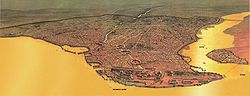

Hagia Sophia
Hagia Sophia is a former Orthodox patriarchal basilica, later a mosque, and now a museum in Istanbul, Turkey...
in Constantinople
Constantinople
Constantinople was the capital of the Roman, Eastern Roman, Byzantine, Latin, and Ottoman Empires. Throughout most of the Middle Ages, Constantinople was Europe's largest and wealthiest city.-Names:...
during the early sixth century. He wrote two works of history; one is a collection of sources which relates events beginning in 313, during Constantine's early reign, down to 439, in the reign Theodosius II
Theodosius II
Theodosius II , commonly surnamed Theodosius the Younger, or Theodosius the Calligrapher, was Byzantine Emperor from 408 to 450. He is mostly known for promulgating the Theodosian law code, and for the construction of the Theodosian Walls of Constantinople...
. The other is Theodorus' own work, retelling events from the death of Theodosius II in 450 to the beginning of Justin I
Justin I
Justin I was Byzantine Emperor from 518 to 527. He rose through the ranks of the army and ultimately became its Emperor, in spite of the fact he was illiterate and almost 70 years old at the time of accession...
's reign in 518. The former work is important to scholars editing the authors quoted by Theodorus; the latter exists only in fragment and owes its importance more to the "scantiness of our information concerning the period it treats rather than its merits."
Historia Tripartita
While a lector at Hagia Sophia, Theodorus collected the works of the fifth century historians Socrates ScholasticusSocrates Scholasticus
Socrates of Constantinople, also known as Socrates Scholasticus, not to be confused with the Greek philosopher Socrates, was a Greek Christian church historian, a contemporary of Sozomen and Theodoret, who used his work; he was born at Constantinople c. 380: the date of his death is unknown...
, Sozomen
Sozomen
Salminius Hermias Sozomenus was a historian of the Christian church.-Family and Home:He was born around 400 in Bethelia, a small town near Gaza, into a wealthy Christian family of Palestine....
, and Theodoret of Cyrrhus
Theodoret
Theodoret of Cyrus or Cyrrhus was an influential author, theologian, and Christian bishop of Cyrrhus, Syria . He played a pivotal role in many early Byzantine church controversies that led to various ecumenical acts and schisms...
to create a chronicle of church history from Constantine to Theodosius II. The resulting work, "Selections from Church History", known better by its Latin title Historia Tripartita, is a single narrative in four books which gives Theodorus' preferred reading for each section of history related, with notes and comparisons in the margins.
Historia Ecclesiastica
Theodorus later continued his chronicle, using other available sources to write his Church History from the death of Theodosius II down to 518. The date of composition is not known, though it was probably finished before 543, as it can be conjectured that Theodorus would not have spoken of the "holy memory" of Theodoret following the onset of the Three-Chapter ControversyThree-Chapter Controversy
The Three-Chapter Controversy, a phase in the Chalcedonian controversy, was an attempt to reconcile the Non-Chalcedonian Christians of Syria and Egypt with Chalcedonian Eastern Orthodoxy, following the failure of the Henotikon...
. The chronicle has not survived; excerpts exist in other chronicles, and it is also quoted in a tract by John of Damascus
John of Damascus
Saint John of Damascus was a Syrian monk and priest...
, and by the acts of the Second Council of Nicaea
Second Council of Nicaea
The Second Council of Nicaea is regarded as the Seventh Ecumenical Council by Roman Catholics, Eastern Orthodox, Eastern Catholic Churches and various other Western Christian groups...
.
External links
- Theodorus Lector - Catholic EncyclopediaCatholic EncyclopediaThe Catholic Encyclopedia, also referred to as the Old Catholic Encyclopedia and the Original Catholic Encyclopedia, is an English-language encyclopedia published in the United States. The first volume appeared in March 1907 and the last three volumes appeared in 1912, followed by a master index...
article - Theodorus Lector - Dictionary of Christian Biography and Literature to the End of the Sixth Century A.D (at CCEL)
- (In Greek) Theodorus Lector in MigneJacques Paul MigneJacques Paul Migne was a French priest who published inexpensive and widely-distributed editions of theological works, encyclopedias and the texts of the Church Fathers, with the goal of providing a universal library for the Catholic priesthood.He was born at Saint-Flour, Cantal and studied...
, Patrologia GraecaPatrologia GraecaThe Patrologia Graeca is an edited collection of writings by the Christian Church Fathers and various secular writers, in the ancient Koine or medieval variants of the Greek language. It consists of 161 volumes produced in 1857–1866 by J. P. Migne's Imprimerie Catholique...
, vol. 86a View online.