
| |
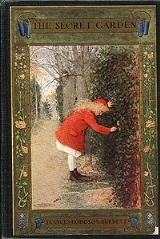
The Secret Garden is a novel by Frances Hodgson Burnett, first published in 1911. Its working title was Mistress Mary, in reference to the English nursery rhyme Mary, Mary, Quite Contrary. It is one of Burnett's most popular novels, and is now considered a classic of children's literature.
Lennox is a sickly, sour-faced little girl born in India to wealthy British parents who have very little interest in her, leaving her in the care of an Ayah from birth.

Discussion
Ask a question about 'The Secret Garden'
Start a new discussion about 'The Secret Garden'
Answer questions from other users
|
Recent Posts

Quotations
Ben: You and me are a good bit alike. We're neither of us good lookin', and we're both as sour as we look.
Archie: And this, my lovely child, is your garden.

Encyclopedia
The Secret Garden is a novel by Frances Hodgson Burnett, first published in 1911. Its working title was Mistress Mary, in reference to the English nursery rhyme Mary, Mary, Quite Contrary. It is one of Burnett's most popular novels, and is now considered a classic of children's literature.
Plot summary
Mary Lennox is a sickly, sour-faced little girl born in India to wealthy British parents who have very little interest in her, leaving her in the care of an Ayah from birth. Orphaned by an outbreak of cholera, she is sent back to England to the legal guardianship of her only remaining relative: her father's brother-in-law, Archibald Craven, a reclusive widower.
Craven still mourns the death of his beautiful young wife, Lilias, from ten years ago. To escape his sad memories, he constantly travels abroad, leaving Mary and the manor under the supervision of his housekeeper, Mrs. Medlock. The only person who has any time for the little girl is the chambermaid Martha Sowerby, who tells Mary about a walled garden that was the late Mrs. Craven's favorite. No one has entered the garden since she died because Archibald locked its entrance and buried the key in an unknown location.
After Mary finds the key to the secret garden, a robin shows her where the door is hidden by overgrown ivy. Once inside, she discovers that although the roses seem lifeless, some of the other flowers have survived. She resolves to tend the garden herself. Although she wants to keep it a secret, she recruits Martha's brother Dickon, who has a way with plants and wild animals. Mary gives him money to buy gardening implements and he shows her that the roses, though neglected, are not dead. When Mary's uncle visits the house briefly for the first time since she arrived, Mary asks him for a bit of earth to make a flower garden, and he agrees. Thanks to the invigorating Yorkshire air and her new-found fascination with the garden, Mary herself begins to blossom, and loses her sickly look and unpleasant manner.
On several occasions, Mary hears someone weeping in another part of the house. When she asks questions, the servants become evasive; they tell her that she is hearing things, or blame the sound on ordinary sources such as the wind or a servant with a toothache. Shortly after her uncle's visit, she goes exploring and discovers her uncle's son, Colin, a lonely, bedridden boy as petulant and disagreeable as Mary used to be. His father shuns him because the child closely resembles his mother. Mr. Craven is a mild hunch back, and both he and Colin are morbidly convinced that the boy will develop the same condition. The servants have been keeping Mary and Colin a secret from one another because Colin doesn't like strangers staring at him and is prone to terrible tantrums. Colin, however, accepts Mary and insists on her visiting him often.
As spring approaches, Colin becomes jealous because Mary is spending more time out in the garden with Dickon than indoors with him. One day he voices his resentment and, when Mary resists, he throws a tantrum. To the surprise and amusement of the servants, Mary continues to stand her ground. That evening, Colin has a hysterical fit, brought on by his fear of dying young. Mary goes to him and, again taking a firm, no-nonsense stance with him, slaps him in the face to shock him out of his hysteria; to the servants' surprise, when Mary screams back at him, he doesn't object.
When Colin asks if he can visit the garden with her, she agrees, as she and Dickon had been planning to suggest it themselves, feeling that it would do Colin good. Colin's doctor, who is Mr. Craven's cousin, agrees to let Dickon and Mary take Colin outside in a wheelchair. To maintain their secret, Colin orders everyone else to stay out of the gardens on those occasions. Colin is delighted with his mother's garden, and visits it with Mary and Dickon whenever the weather allows. As the garden revives and flourishes, so does he.
The first adult to discover what the children are doing is the old gardener, Ben Weatherstaff, who was a favorite of Colin's mother. After her death, he visited the locked garden once or twice a year by secretly scaling the wall with a ladder. When he visits the garden for the first time since Mary's arrival (having had to miss several visits because of rheumatism), he is angry with the children until he sees how improved both the garden and Colin are. Colin orders him not to tell anybody, and he agrees. Colin resolves that the next time his father returns from abroad he will be able to walk and run like a normal boy. He accomplishes this through a combination of simple physical exercise taught by Dickon and positive thinking. He refuses to think of himself as crippled, and he invents a kind of mantra to keep himself in the right, or "magic," frame of mind. He makes great progress, but keeps it hidden from everyone but Mary, Dickon, and Ben, wanting it to be a surprise.
Mr. Craven has been traveling throughout Europe, but is inspired to rush home after seeing a vision of his dead wife in a dream and receiving a letter from Mrs. Sowerby (Martha's and Dickon's mother, who also knows the secret) telling him, "I think your lady would ask you to come if she was here". He arrives while the children are outdoors. He goes out to see Colin for himself, and finds himself drawn to the secret garden, where he is astonished to hear children's voices and then to find Colin not only racing Mary and Dickon around the garden, but winning. They take Mr. Craven into the secret garden to tell him everything. Afterwards they walk back to the house, where the servants are astonished to see two miracles: Colin walking and his father looking happy again.
Major themes
The author, Frances Hodgson Burnett, was a practitioner of Christian Science due to the premature death of her son as well as personal illness. As a result, The Secret Garden espouses the concepts of New Thought and theosophy as well as ideas about the healing powers of the mind.
The garden is the book's central symbol. The secret garden at Misselthwaite Manner is the site of both the near-destruction and the subsequent regeneration of a family Using the garden motif, Burnett explores the healing power inherent in living things.
Maytham Hall in Kent, England, where Burnett lived for a number of years during her marriage to Stephen Townesend, is often cited as the inspiration for the book's setting. Burnett kept an extensive garden, including an impressive rose garden. However, it has been noted that besides the garden, Maytham Hall and Misselthwaite Manor are physically very different.
Publication History & Popularity
The Secret Garden first appeared to the public in serial format aimed at adults in 1910, one year prior to its release in book format. Marketing to both adult and juvenile audiences may have had an effect on its early reception; the book was not as celebrated as Burnett's previous works during her lifetime.
The Secret Garden paled in comparison to the popularity of Burnett's other works for a long period. Tracing the book's revival from almost complete eclipse at the time of Burnett's death in 1924, Anne H. Lundin noted that the author's obituary notices all remarked on Little Lord Fauntleroy and passed over The Secret Garden in silence.
With the rise of scholarly work in children's literature over the past quarter century, The Secret Garden has steadily risen to prominence, and is now arguably Burnett's best known work. The book is often noted as one of the best children's books of the twentieth century
Dramatic adaptations
The Secret Garden has been adapted many times for other media.
Live-action
Films
The first filmed version was made in 1919 by the Famous Players-Lasky Corporation with 17 year old Lila Lee as Mary and Paul Willis as Dickon, but the film is considered lost.
In 1949, MGM filmed the second adaptation with Margaret O'Brien. This version was mostly in black-and-white, but the sequences set in the restored garden were filmed in Technicolor.
The most acclaimed film adaptation is American Zoetrope's 1993 production. It was directed by Agnieszka Holland and starred Kate Maberly as Mary, Heydon Prowse as Colin, Andrew Knott as Dickon and Dame Maggie Smith as Mrs. Medlock.
Television
Dorothea Brooking adapted the book into several different television serials for the BBC: an eight-part serial in 1952, a six-part serial in 1960 (starring Colin Spaull as Dickon), and a three-part serial in 1975.
In 1987, Hallmark Hall of Fame filmed a TV adaptation of the novel starring Gennie James as Mary, Barret Oliver as Dickon, and Jadrien Steele as Colin. Derek Jacobi plays the role of Archibald Craven, with Alison Doody appearing in flashbacks and visions as Lilias; a young Colin Firth also makes a brief appearance as the adult Colin Craven.
Stage
Stage adaptations of the book have also been created. One notable adaptation is a musical with music by Lucy Simon and book and lyrics by Marsha Norman, which opened on Broadway in 1991. The production was nominated for seven Tony Awards, winning Best Book of a Musical and Best Featured Actress in a Musical (Daisy Eagan as Mary, at eleven years old is the youngest person ever to win a Tony).
In 2007 the Orlando Shakespeare Theater commissioned April-Dawn Gladu to create an adaptation for their Theater For Young Audiences series. This version's unique qualities include an actress silently playing The Garden Tree, which was the tree that Lilias fell from years ago. As the children work secretly in the garden to bring it to life, the living tree wakes up, flourishes and blooms.
Oakland Ballet has produced The Secret Garden set to music by Sir Edward Elgar.
The Secret Garden has also been made into an opera by Clover Loehr & Conan McLemore, and will be presented by Northwest Children's Opera in June of 2009.
Animation
In 1991, a Japanese animated version of The Secret Garden was made, entitled Himitsu no Hanazono.
As part of the "ABC Weekend Special" series, another animated version was made in 1995, with Derek Jacobi as the voice of Archibald Craven.
Another anime movie, Soko no Strain (2006), based on another Frances Hodgson Burnett novel, A Little Princess, draws some elements from The Secret Garden, mostly the names of Colin, Mary, Martha and Dickon.
Sequels
Written works
Noel Streatfeild's 1949 novel The Painted Garden (U.S. title Movie Shoes) has as its central story the filming of The Secret Garden in Hollywood. A novel about the adult lives of Mary, Colin, and Dickon was written by Susan Moody in 1995 and published under two different titles: Misselthwaite: The Sequel to the Secret Garden and Return to the Secret Garden. The New York Times also published a brief parodic sequel in 1995. A different sequel novel, Till All the Seas Run Dry, was written by Susan Webb and published in 1998.
Dramatic media
A 2000 sequel entitled Return to the Secret Garden was directed by Scott Featherstone and won the Director's Gold Award at the 2001 Santa Clarita International Film Festival.
In 2001, the TV movie Back to the Secret Garden, directed by Michael Tuchner, shows Mary and Colin as married adults who have made Craven Manor into a shelter for orphans. It starred Joan Plowright as Martha and George Baker as Will Weatherstaff (a younger relative of Ben Weatherstaff), with Camilla Belle as an American orphan, Lizzie.
External links
- , available at Internet Archive. New York : F. A. Stokes, 1911 (color scanned book).
- , available at Librivox (audiobook).
- (PDF, PDB and LIT formats).
-
|