

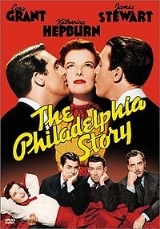
The Philadelphia Story

Overview
George Cukor
George Dewey Cukor was an American film director. He mainly concentrated on comedies and literary adaptations. His career flourished at RKO and later MGM, where he directed What Price Hollywood? , A Bill of Divorcement , Dinner at Eight , Little Women , David Copperfield , Romeo and Juliet and...
and starring Cary Grant
Cary Grant
Archibald Alexander Leach , better known by his stage name Cary Grant, was an English actor who later took U.S. citizenship...
, Katharine Hepburn
Katharine Hepburn
Katharine Houghton Hepburn was an American actress of film, stage, and television. In a career that spanned 62 years as a leading lady, she was best known for playing strong-willed, sophisticated women in both dramas and comedies...
, and James Stewart
James Stewart (actor)
James Maitland Stewart was an American film and stage actor, known for his distinctive voice and his everyman persona. Over the course of his career, he starred in many films widely considered classics and was nominated for five Academy Awards, winning one in competition and receiving one Lifetime...
. Based on the Broadway
Broadway theatre
Broadway theatre, commonly called simply Broadway, refers to theatrical performances presented in one of the 40 professional theatres with 500 or more seats located in the Theatre District centered along Broadway, and in Lincoln Center, in Manhattan in New York City...
play of the same name
The Philadelphia Story (play)
The Philadelphia Story is a 1939 American comic play by Philip Barry. It tells the story of a socialite whose wedding plans are complicated by the simultaneous arrival of her ex-husband and an attractive journalist.-Production:...
by Philip Barry
Philip Barry
Philip James Quinn Barry was an American playwright born in Rochester, New York.-Early life:Philip Barry was born on June 18, 1896 in Rochester, New York to James Corbett Barry and Mary Agnes Quinn Barry. James would die from appendicitis a year after Philip's birth, and his father's marble and...
, the film is about a socialite (Hepburn) whose wedding plans are complicated by the simultaneous arrival of her ex-husband (Grant) and a tabloid magazine journalist (Stewart). Written for the screen by Donald Ogden Stewart
Donald Ogden Stewart
Donald Ogden Stewart was an American author and screenwriter.-Life:His hometown was Columbus, Ohio. He graduated from Yale University, where he became a brother to the Delta Kappa Epsilon fraternity , in 1916 and was in the Naval Reserves in World War I.After the war he started to write and found...
and an uncredited Waldo Salt
Waldo Salt
Waldo Miller Salt was an American screenwriter who was blacklisted by the Hollywood movie studio bosses during the era of McCarthyism.-Early life and career:...
, it is considered one of the best examples of a comedy of remarriage
Comedy of remarriage
The comedy of remarriage is a subgenre of American cinematic comedy from the 1930s and 1940s. At the time, the Production Code banned any explicit references to or attempts to justify adultery and illicit sex. The comedy of remarriage enabled filmmakers to evade this provision of the Code...
, a genre popular in the 1930s and 1940s, in which a couple divorce, flirt with outsiders and then remarry – a useful story-telling ploy at a time when the depiction of extramarital affairs was blocked by the Production Code.
The film was Hepburn's first big hit following several flops, which had led to her being included on a list that movie theater owners compiled of actors they considered to be "box office poison." She acquired the film rights to the play, which she had also starred in, with the help of Howard Hughes
Howard Hughes
Howard Robard Hughes, Jr. was an American business magnate, investor, aviator, engineer, film producer, director, and philanthropist. He was one of the wealthiest people in the world...
, in order to control it as a vehicle for her movie comeback.
The Philadelphia Story was nominated for six Academy Awards
Academy Awards
An Academy Award, also known as an Oscar, is an accolade bestowed by the American Academy of Motion Picture Arts and Sciences to recognize excellence of professionals in the film industry, including directors, actors, and writers...
, winning two: Stewart for Best Actor
Academy Award for Best Actor
Performance by an Actor in a Leading Role is one of the Academy Awards of Merit presented annually by the Academy of Motion Picture Arts and Sciences to recognize an actor who has delivered an outstanding performance while working within the film industry...
and Donald Ogden Stewart
Donald Ogden Stewart
Donald Ogden Stewart was an American author and screenwriter.-Life:His hometown was Columbus, Ohio. He graduated from Yale University, where he became a brother to the Delta Kappa Epsilon fraternity , in 1916 and was in the Naval Reserves in World War I.After the war he started to write and found...
for Best Adapted Screenplay
Academy Award for Writing Adapted Screenplay
The Academy Award for Writing Adapted Screenplay is one of the Academy Awards, the most prominent film awards in the United States. It is awarded each year to the writer of a screenplay adapted from another source...
.
Quotations
Uncle Leo's bedtime story for you older tots! The things they do among the playful rich — Oh, boy!

Broadway's howling year-run comedy hit of the snooty society beauty who slipped and fell — IN LOVE!