

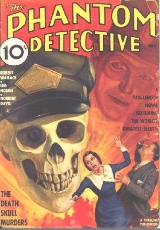
The Phantom Detective

Encyclopedia
The Phantom Detective was the second pulp hero character published, after The Shadow
. The first issue was released in February of 1933, a month before Doc Savage
, which was released in March of 1933. The title continued to be released until 1953, with a total 170 issues. This is the third highest number of issues for a character pulp, after The Shadow, which had 325 issues, and Doc Savage, which had 181. In western titles, Texas Rangers would have around 212 issues of their main character, known as the Lone Wolf.
The series was published by Ned Pines
' Thrilling
(also known as Better or Standard) Publishing. Ned Pines had a comic book imprint, which collectors usually refer to as Nedor Comics
, and The Phantom Detective had a series in their title Thrilling Comics
.
Stories were credited to several pseudonyms. The first eleven Phantom Detective stories were published under the Better house pseudonym of "G. Wayman Jones", and were largely written by D. L. Champion, a.k.a Jack D'arcy. The rest were published under the pseudonym "Robert Wallace". These were largely written by Edwin V. Burkholder, Norman Daniels(36+), Anatole F. Feldman, Charles Greenberg, George A. MacDonald, Laurence Donovan and C. S. Montanye. Lesser contributors included Paul Chadwick
, Norvell W. Page
, Paul Ernst
, Emile C. Tepperman, Henry Kuttner
, Ray Cummings, Ralph Oppenheim and others. Ryerson Johnson is credited with #46, The Silent Death.
There have been several reprints of Phantom Detective stories over the years. Soft porn publisher Corinth Books released the most, with 20 titles.
The Phantom (as he was called in the stories) was actually the wealthy Richard Curtis Van Loan. In the first few issues of the title, The Phantom was introduced as a world-famous detective, whose true identity was only known by one man. That man was Frank Havens, the publisher of the Clarion newspaper. Richard Curtis Van Loan was orphaned at an early age, but inherited wealth. Before the Great War he was an idle playboy, but during the war he became a pilot and downed many German planes.
After the war Richard had a difficult time returning to his idle playboy life. At the suggestion of his father's friend, Havens, Richard set out to solve a crime that had stumped the police. After solving it, Richard decided he'd found his calling, where he could have a life of adventure and danger.
He trained himself in all facets of detection and forensics. He became a master of disguise and escape. And then he made a name for himself as the Phantom, whom all police agencies around the world knew and respected. When dealing with law-enforcement officials he carried a platinum badge in the shape of a domino mask
as proof of his true identity. The initial stories were less about a detective than an adventurer using disguise and lucky escapes to conclude his cases.
In one issue, Havens installed a red beacon on the roof of the Clarion building, which he'd turn on when he needed to see the Phantom. Batman's Bat-Signal may have been inspired by this signal device. Two early Batman editors, Jack Schiff and Mort Weisinger
, got their start editing The Phantom Detective under Thrilling editor-in-chief Leo Margulies
.
Other people in Richard's life were Muriel Havens, Frank Havens' daughter, with whom he was in love, but wouldn't get involved with because of the danger in his life, and Clarion reporter Steve Huston. Laurence Donovan introduced a kid sidekick named Chip Dorlan in the 1939 novel, The Sampan Murders. After Pearl Harbor, Chip joined the Army as an Intelligence officer, returning briefly to the series after the war. Van Loan's former WWI mechanic and pilot, Jerry Lannigan, assisted him in several cases, as did others from time to time.
The Phantom employed several alternate identities, including Lester Cornwell and Dr.
Paul Bendix, a chemist.
The Phantom Detective is not to be confused with Lee Falk
's comic strip creation The Phantom
.
The pseudonym "Robert Wallace" was coined to evoke popular British thriller novelist Edgar Wallace, and was used on short stories and novelettes not featuring the Phantom.
In 2006 Wildside Press LLC printed the "first new Phantom Story in 50 years": The Phantom's Phantom, which takes place in 1953 after the original pulp series ends. Interestingly enough it was written in the first person which allows an in-depth study of the Phantom's personality that never occurred in the pulps!
For the last several years, Adventure House has been reprinting the stories of The Phantom Detective. More than 20 full length stories have seen the light of day through this endeavor.
The Shadow
The Shadow is a collection of serialized dramas, originally in pulp magazines, then on 1930s radio and then in a wide variety of media, that follow the exploits of the title character, a crime-fighting vigilante in the pulps, which carried over to the airwaves as a "wealthy, young man about town"...
. The first issue was released in February of 1933, a month before Doc Savage
Doc Savage
Doc Savage is a fictional character originally published in American pulp magazines during the 1930s and 1940s. He was created by publisher Henry W. Ralston and editor John L...
, which was released in March of 1933. The title continued to be released until 1953, with a total 170 issues. This is the third highest number of issues for a character pulp, after The Shadow, which had 325 issues, and Doc Savage, which had 181. In western titles, Texas Rangers would have around 212 issues of their main character, known as the Lone Wolf.
The series was published by Ned Pines
Ned Pines
Ned L. Pines was a New York publisher. He died in Paris, and lived in Paris, Manhattan and East Hampton NY. He was married to the former Maxine Firestone, has two daughters, two stepsons, and one granddaughter....
' Thrilling
Thrilling Publications
Thrilling Publications, aka Beacon Magazines , Better Publications and Standard Magazines , was a pulp magazine publisher run by Ned Pines, publishing such titles as Startling Stories and Thrilling Wonder Stories.A native of Malden, Massachusetts, Pines became the president of Pines Publications...
(also known as Better or Standard) Publishing. Ned Pines had a comic book imprint, which collectors usually refer to as Nedor Comics
Nedor Comics
Nedor Publishing was a comic book imprint of publisher Ned Pines, who also published pulp magazines under a variety of company names that he also used for the comics...
, and The Phantom Detective had a series in their title Thrilling Comics
Thrilling Comics
Thrilling Comics is the title of a comic book series published by Standard Comics for 80 issues from 1940 and 1951.It was used again in 1999 by DC Comics as the title of one of the issues of the Justice Society Returns storyline.-Characters:...
.
Stories were credited to several pseudonyms. The first eleven Phantom Detective stories were published under the Better house pseudonym of "G. Wayman Jones", and were largely written by D. L. Champion, a.k.a Jack D'arcy. The rest were published under the pseudonym "Robert Wallace". These were largely written by Edwin V. Burkholder, Norman Daniels(36+), Anatole F. Feldman, Charles Greenberg, George A. MacDonald, Laurence Donovan and C. S. Montanye. Lesser contributors included Paul Chadwick
Paul Chadwick
Paul Chadwick is an American comic book creator best known for his series Concrete about a normal man trapped in a rock-hard body....
, Norvell W. Page
Norvell W. Page
Norvell Wordsworth Page was an American pulp fiction writer, journalist and editor who later became a government intelligence worker. He is best known as the author of the majority of the adventures of the ruthless vigilante hero The Spider, which he and a handful of other writers wrote under the...
, Paul Ernst
Paul Ernst
Paul Ernst may refer to:* Karl Friedrich Paul Ernst , commonly known as Paul Ernst, German writer* Paul Ernst , American Pulp Fiction writerSee also*Paul Ernest, philosophy of mathematics...
, Emile C. Tepperman, Henry Kuttner
Henry Kuttner
Henry Kuttner was an American author of science fiction, fantasy and horror.-Early life:Henry Kuttner was born in Los Angeles, California in 1915...
, Ray Cummings, Ralph Oppenheim and others. Ryerson Johnson is credited with #46, The Silent Death.
There have been several reprints of Phantom Detective stories over the years. Soft porn publisher Corinth Books released the most, with 20 titles.
The Phantom (as he was called in the stories) was actually the wealthy Richard Curtis Van Loan. In the first few issues of the title, The Phantom was introduced as a world-famous detective, whose true identity was only known by one man. That man was Frank Havens, the publisher of the Clarion newspaper. Richard Curtis Van Loan was orphaned at an early age, but inherited wealth. Before the Great War he was an idle playboy, but during the war he became a pilot and downed many German planes.
After the war Richard had a difficult time returning to his idle playboy life. At the suggestion of his father's friend, Havens, Richard set out to solve a crime that had stumped the police. After solving it, Richard decided he'd found his calling, where he could have a life of adventure and danger.
He trained himself in all facets of detection and forensics. He became a master of disguise and escape. And then he made a name for himself as the Phantom, whom all police agencies around the world knew and respected. When dealing with law-enforcement officials he carried a platinum badge in the shape of a domino mask
Domino mask
A domino mask is a small, rounded mask covering only the eyes and the space between them. Since the 18th century, the domino mask is worn during carnival. Venetian Carnival masks were known as domini because they resembled French priests' winter hoods, being black on the outside and white on the...
as proof of his true identity. The initial stories were less about a detective than an adventurer using disguise and lucky escapes to conclude his cases.
In one issue, Havens installed a red beacon on the roof of the Clarion building, which he'd turn on when he needed to see the Phantom. Batman's Bat-Signal may have been inspired by this signal device. Two early Batman editors, Jack Schiff and Mort Weisinger
Mort Weisinger
Mortimer Weisinger was an American magazine and comic book editor best known for editing DC Comics' Superman during the mid-1950s to 1960s, in the Silver Age of comic books...
, got their start editing The Phantom Detective under Thrilling editor-in-chief Leo Margulies
Leo Margulies
Leo Margulies was an American editor and publisher of science fiction and fantasy pulp magazines.- Career :...
.
Other people in Richard's life were Muriel Havens, Frank Havens' daughter, with whom he was in love, but wouldn't get involved with because of the danger in his life, and Clarion reporter Steve Huston. Laurence Donovan introduced a kid sidekick named Chip Dorlan in the 1939 novel, The Sampan Murders. After Pearl Harbor, Chip joined the Army as an Intelligence officer, returning briefly to the series after the war. Van Loan's former WWI mechanic and pilot, Jerry Lannigan, assisted him in several cases, as did others from time to time.
The Phantom employed several alternate identities, including Lester Cornwell and Dr.
Paul Bendix, a chemist.
The Phantom Detective is not to be confused with Lee Falk
Lee Falk
Lee Falk, born Leon Harrison Gross , was an American writer, theater director, and producer, best known as the creator of the popular comic strip superheroes The Phantom and Mandrake the Magician, who at the height of their popularity attracted over a hundred million readers every day...
's comic strip creation The Phantom
The Phantom
The Phantom is an American adventure comic strip created by Lee Falk, also creator of Mandrake the Magician. A popular feature adapted into many media, including television, film and video games, it stars a costumed crimefighter operating from the fictional African country Bengalla.The Phantom is...
.
The pseudonym "Robert Wallace" was coined to evoke popular British thriller novelist Edgar Wallace, and was used on short stories and novelettes not featuring the Phantom.
Cultural references
The early episodes of Lee Falk's Phantom newspaper strip strongly resemble the Thrilling Phantom. Abruptly, Falk abandoned this tack for the exotic adventure approach, abandoning his Manhattan locale and the Phantom's original identity of playboy Jimmy Wells.In 2006 Wildside Press LLC printed the "first new Phantom Story in 50 years": The Phantom's Phantom, which takes place in 1953 after the original pulp series ends. Interestingly enough it was written in the first person which allows an in-depth study of the Phantom's personality that never occurred in the pulps!
For the last several years, Adventure House has been reprinting the stories of The Phantom Detective. More than 20 full length stories have seen the light of day through this endeavor.