

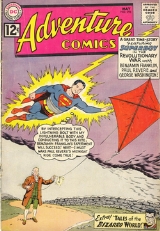
Mort Weisinger

Encyclopedia
Mortimer Weisinger was an American magazine and comic book editor best known for editing DC Comics
' Superman
during the mid-1950s to 1960s, in the Silver Age of comic books
. He also co-created such features as Aquaman
, Green Arrow
, and Johnny Quick
, served as story editor for the Adventures of Superman
television series, and compiled the often-revised paperback 1001 Valuable Things You Can Get Free.
section of New York City
, New York
and raised in the Bronx as the son of a Jewish businessman in the garment trade. At 13, he was introduced to science fiction by means of a borrowed copy of the August 1928 issue of Amazing Stories
(featuring Buck Rogers
and The Skylark of Space
). By 1930, Weisinger was active in some of the earliest SF fan club
s and fanzine
s, including The Planet. In 1931, Weisinger hosted a meeting of pioneer SF fan club "The Scienceers," which was attended by a young Julius Schwartz
, who recalled that the two became "very friendly... [and] got along well together." A year later, Weisinger, Schwartz and Allen Glasser joined fellow-future professional editor Forrest J. Ackerman in founding The Time Traveller
, which they styled "Science Fiction's Only Fan Magazine". The claim was more than mere youthful bravado, according to SF historian Sam Moskowitz
, who described the 'zine as the first devoted entirely to science fiction. Drawing on information they had gleaned from writing letters to the SF magazines and authors of the day, the young fans published interviews with, and short pieces by, established SF writers, and in the process gained increasing familiarity with the personalities and situations of the genre in that era. The first issue featured "a one-page biography of Edward 'Doc' Smith
... [and] some news items."
, Weisinger attended New York University
, where he worked as editor of the college's newspaper and magazine, but left before graduating. With Schwartz, he approached the editor of Amazing Stories
(T. Connor Sloane) and "sold his first story": 'The Price of Peace'. In late 1934, Weisinger suggested that he and Schwartz "ought to go into the agency business," noting (according to Schwartz) that the duo had
Schwartz concurred, and they formed the Solar Sales Service ("We always believed in alliteration
," noted Schwartz), the first literary agency to specialize in the related genres of SF, horror, and fantasy. Edmond Hamilton
was the agency's first client, and Otto Binder
soon followed. Solar Sales eventually represented many prominent SF and fantasy writers, including John Russell Fearn
, Alfred Bester
, Stanley Weinbaum, H. P. Lovecraft
, and Ray Bradbury
. But while Schwartz continued the agency into the early 1940s, Weisinger moved on; he took a job with the Standard Magazine chain, publisher of a range of pulp magazines. Standard had acquired writer-publisher Hugo Gernsback
's defunct Wonder Stories
and added it to Standard series of "Thrilling" publications (Thrilling Detective Stories, Thrilling Western Stories, and others). Weisinger became the editor of Thrilling Wonder Stories, and bought stories by Hamilton and others from his former partner Schwartz. Weisinger was soon editing a range of other pulps by Standard, including Startling Stories
and Captain Future
, and "was in charge of no fewer than 40 titles" by 1940.
) primarily as editor of the Superman
and Batman
titles. Among his earliest jobs, however, was the task of "dream[ing] up some new characters" - these resulted in the line-up of More Fun #73, and took the form of Aquaman
, Green Arrow
and Johnny Quick
. Weisinger's fledgling career was soon interrupted by his World War II
military service, during which he served as a sergeant
in Special Services. Stationed at Yale
(and rooming with Broderick Crawford
and William Holden
), he wrote scripts for a U.S. Army "radio show called 'I Sustain the Wings' " in New York City.
He met and married (Sept. 27, 1943) his wife, the former Thelma Rudnick. They would have two children, a daughter, Joyce, and son, Hendrie.
 Weisinger returned to his job at National after his discharge from military service in 1946, and resumed his editorship of the Superman comics, the Batman titles and others. His tenure was marked by the introduction of a variety of new concepts and supporting characters, including Supergirl
, Krypto the Super Dog
, the Phantom Zone
, the bottle city of Kandor
, the Legion of Super-Heroes
, and a variety of types of kryptonite
. Attempting to rationalize Superman's powers, it was under Weisinger's watch that the "concept that in a world circling a yellow sun [as opposed to Krypton's red sun] his [Superman's] powers are multiplied" came to be introduced to the Superman mythology. Realising that "Batman was my favorite [character]," Weisinger realised that the crucial difference was that "Batman can get hurt." In order to better allow the reader to identify with the invulnerable Man of Steel, Weisinger's stories frequently featured stories in which "Superman lost his powers and had to survive on his natural wits." Pitted against Superman's wits was Lois Lane
, and under Weisinger's editorship stories in which she sought to prove that Superman was Clark Kent abounded. Weisinger "enjoyed surprising the readers," and to that end introduced a number of "live personalities... real people" into the comics, including Candid Camera
' s Alan Funt, This is Your Life
' s Ralph Edwards
, Steve Allen
, Ann Blyth
and Pat Boone
among others. Weisinger was particularly "proud of having dreamed up the "imaginary story" gimmick to motivate otherwise impossible stories," (non-canonical 'what if...?' scenarios not bound to series or character continuity, timeframe or logic), and for "having conceived the idea of DC's first giant anthology - The Superman Annual."
. . . to work as story editor for the Superman TV series." Weisinger recalled in 1975 about this experience that
Through Weisinger's previous "experience with television," Reeves landed "a guest star spot, "Big Red S" and all, on the I Love Lucy
show."
Weisinger's influences on up-and-coming writers in SF and comics also extended, by these means, to television. Jackson Gillis
was shepherded from his work on The Adventures of Superman to Perry Mason
and Colombo
(alongside many, many other credits). Weisinger also highlights David Chantler, William Woolfolk and Leigh Brackett
as "examples of proteges and associates who have surpassed him in term of success."
while unaware of the writer's age, and hiring him for a popular run on "The Legion of Super-Heroes
" even after discovering that he was only 14 years old.
Weisinger encouraged a static picture book
style of illustration in his stories, and was known for reusing previously published stories as new story ideas. A noted example of this is a 1950s story featuring Superman encountering an alien being he thought might have been his long-lost brother; this was reused in the early 1960s as a Superboy
story introducing Mon-El
.
Over time, Weisinger found himself growing disenchanted, and even embarrassed to reveal his primary job, saying "When people asked me what I did for a living, I would suppress the fact that I was editing Superman. I'd tell people that I wrote for Collier's or The Saturday Evening Post." He recalls that he attempted to get himself removed from his editorial position by "asking for bigger and bigger raises," but instead found his demands met - even to the extent that he was given "generous stock options" and "made a vice president of public relations for the company." He did eventually leave, and bought himself a white Cadillac
to "bolster my ego."
attitude and a heavy-handed, overbearing treatment of his writers and artists. Criticism has been levelled at Weisinger for dominating his writers and quashing creativity by dictating storylines. He countered such criticism, however, noting that
Flipping his earlier reasoning for founding the Solar Sales Service on its head, he noted that with magazine articles, time spent developing an article need not be wasted because there are other avenues (titles) in which to sell such products.
One concept Weisinger brought to comics from the pulps was creating a story "around a pre-drawn cover," a concept taken up across the industry, most notably by colleague Julius Schwartz. During Weisinger's reign, the Superman comics maintained a reasonably tight internal continuity, but related little to the rest of the DC Universe
. Weisinger was succeeded in 1970 by his childhood friend and longtime colleague Julius Schwartz
. Weisinger was later immortalized within the Superman comics "as a bust in Clark Kent's apartment."
, Collier's, The Saturday Evening Post
... [and] Parade
." His articles ranged from one on the Comics Code for Better Homes and Gardens
to an article entitled "How Ralph Edwards Fools 'Em" for which he "accompanied Edwards on several This is Your Life escapades to get the story of how the clever impressario suckered the celebrities whom he was to honor on his popular '50s show."
Weisinger had a particular interest in Beauty contest
s, writing an article for Parade on "why certain finalists in the Miss America pageant can never win the crown," as well as a "best-selling novel" entitled The Contest (published in hardback by World, and in paperback by New American Library
). Weisinger had once been a "judge in a preliminary Miss America contest," through which he "learned the inside story," later travelling to Europe with the then-"world-famous host of the real-life contest," a friend of Weisinger's at the time who refused to talk to him again after reading the resulting novel. For the author, however, The Contest netted a $125,000 movie option and "printings in several foreign languages."
Weisinger's best known book was "a compendium of freebies available to anyone" entitled 1001 Valuable Things You Can Get For Free, first published in 1955 and which (as of 1975) had "gone through 41 paperback printings and sold over three million copies." Weisinger's book was praised by Abbie Hoffman
in Steal This Book
, and earned its author a place in "Who's Who".
, and stayed there until his death. He was survived by his wife and children. In 1985, he was posthumously named as one of the honorees by DC Comics in the company's 50th anniversary publication Fifty Who Made DC Great
.
DC Comics
DC Comics, Inc. is one of the largest and most successful companies operating in the market for American comic books and related media. It is the publishing unit of DC Entertainment a company of Warner Bros. Entertainment, which itself is owned by Time Warner...
' Superman
Superman
Superman is a fictional comic book superhero appearing in publications by DC Comics, widely considered to be an American cultural icon. Created by American writer Jerry Siegel and Canadian-born American artist Joe Shuster in 1932 while both were living in Cleveland, Ohio, and sold to Detective...
during the mid-1950s to 1960s, in the Silver Age of comic books
Silver Age of Comic Books
The Silver Age of Comic Books was a period of artistic advancement and commercial success in mainstream American comic books, predominantly those in the superhero genre. Following the Golden Age of Comic Books and an interregnum in the early to mid-1950s, the Silver Age is considered to cover the...
. He also co-created such features as Aquaman
Aquaman
Aquaman is a fictional superhero who appears in comic books published by DC Comics. Created by Paul Norris and Mort Weisinger, the character debuted in More Fun Comics #73 . Initially a backup feature in DC's anthology titles, Aquaman later starred in several volumes of a solo title...
, Green Arrow
Green Arrow
Green Arrow is a fictional superhero that appears in comic books published by DC Comics. Created by Mort Weisinger and George Papp, he first appeared in More Fun Comics #73 in November 1941. His secret identity is Oliver Queen, billionaire and former mayor of fictional Star City...
, and Johnny Quick
Johnny Quick
Johnny Quick is the name of two DC Comics characters, each with the power of superhuman speed. The first was a superhero who appeared mostly in More Fun Comics during the Golden Age...
, served as story editor for the Adventures of Superman
Adventures of Superman (TV series)
Adventures of Superman is an American television series based on comic book characters and concepts created in 1938 by Jerry Siegel and Joe Shuster. The show is the first television series to feature Superman and began filming in 1951 in California...
television series, and compiled the often-revised paperback 1001 Valuable Things You Can Get Free.
Early life and SF fandom
Weisinger was born in the Washington HeightsWashington Heights, Manhattan
Washington Heights is a New York City neighborhood in the northern reaches of the borough of Manhattan. It is named for Fort Washington, a fortification constructed at the highest point on Manhattan island by Continental Army troops during the American Revolutionary War, to defend the area from the...
section of New York City
New York City
New York is the most populous city in the United States and the center of the New York Metropolitan Area, one of the most populous metropolitan areas in the world. New York exerts a significant impact upon global commerce, finance, media, art, fashion, research, technology, education, and...
, New York
New York
New York is a state in the Northeastern region of the United States. It is the nation's third most populous state. New York is bordered by New Jersey and Pennsylvania to the south, and by Connecticut, Massachusetts and Vermont to the east...
and raised in the Bronx as the son of a Jewish businessman in the garment trade. At 13, he was introduced to science fiction by means of a borrowed copy of the August 1928 issue of Amazing Stories
Amazing Stories
Amazing Stories was an American science fiction magazine launched in April 1926 by Hugo Gernsback's Experimenter Publishing. It was the first magazine devoted solely to science fiction...
(featuring Buck Rogers
Buck Rogers
Anthony Rogers is a fictional character that first appeared in Armageddon 2419 A.D. by Philip Francis Nowlan in the August 1928 issue of the pulp magazine Amazing Stories. A sequel, The Airlords of Han, was published in the March 1929 issue....
and The Skylark of Space
The Skylark of Space
The Skylark of Space by Edward E. "Doc" Smith was written between 1915 and 1921 while Smith was working on his doctorate. Though the original idea for the novel was Smith's, he co-wrote the first part of the novel with Lee Hawkins Garby, the wife of his college classmate and later neighbor Carl Garby...
). By 1930, Weisinger was active in some of the earliest SF fan club
Fan club
A fan club is a group that is dedicated to a well-known person, group, idea or sometimes even an inanimate object . Most fan clubs are run by fans who devote considerable time and resources to supporting them. There are also "official" fan clubs that are run by someone associated with the person...
s and fanzine
Fanzine
A fanzine is a nonprofessional and nonofficial publication produced by fans of a particular cultural phenomenon for the pleasure of others who share their interest...
s, including The Planet. In 1931, Weisinger hosted a meeting of pioneer SF fan club "The Scienceers," which was attended by a young Julius Schwartz
Julius Schwartz
Julius "Julie" Schwartz was a comic book and pulp magazine editor, and a science fiction agent and prominent fan. He was born in the Bronx, New York...
, who recalled that the two became "very friendly... [and] got along well together." A year later, Weisinger, Schwartz and Allen Glasser joined fellow-future professional editor Forrest J. Ackerman in founding The Time Traveller
The Time Traveller (fanzine)
The Time Traveller was one of the earliest science fiction fanzines, started in 1932. It grew out of a New York City fan club called the Scienceers and was started by Mort Weisinger, Julius Schwartz, Allen Glasser, and Forrest J Ackerman...
, which they styled "Science Fiction's Only Fan Magazine". The claim was more than mere youthful bravado, according to SF historian Sam Moskowitz
Sam Moskowitz
Sam Moskowitz was an early fan and organizer of interest in science fiction and, later, a writer, critic, and historian of the field.-Biography:...
, who described the 'zine as the first devoted entirely to science fiction. Drawing on information they had gleaned from writing letters to the SF magazines and authors of the day, the young fans published interviews with, and short pieces by, established SF writers, and in the process gained increasing familiarity with the personalities and situations of the genre in that era. The first issue featured "a one-page biography of Edward 'Doc' Smith
E. E. Smith
Edward Elmer Smith, Ph.D., also, E. E. Smith, E. E. "Doc" Smith, Doc Smith, "Skylark" Smith, and Ted was a food engineer and early science fiction author who wrote the Lensman series and the Skylark series, among others...
... [and] some news items."
Early career
After high schoolHigh school
High school is a term used in parts of the English speaking world to describe institutions which provide all or part of secondary education. The term is often incorporated into the name of such institutions....
, Weisinger attended New York University
New York University
New York University is a private, nonsectarian research university based in New York City. NYU's main campus is situated in the Greenwich Village section of Manhattan...
, where he worked as editor of the college's newspaper and magazine, but left before graduating. With Schwartz, he approached the editor of Amazing Stories
Amazing Stories
Amazing Stories was an American science fiction magazine launched in April 1926 by Hugo Gernsback's Experimenter Publishing. It was the first magazine devoted solely to science fiction...
(T. Connor Sloane) and "sold his first story": 'The Price of Peace'. In late 1934, Weisinger suggested that he and Schwartz "ought to go into the agency business," noting (according to Schwartz) that the duo had
Schwartz concurred, and they formed the Solar Sales Service ("We always believed in alliteration
Alliteration
In language, alliteration refers to the repetition of a particular sound in the first syllables of Three or more words or phrases. Alliteration has historically developed largely through poetry, in which it more narrowly refers to the repetition of a consonant in any syllables that, according to...
," noted Schwartz), the first literary agency to specialize in the related genres of SF, horror, and fantasy. Edmond Hamilton
Edmond Hamilton
Edmond Moore Hamilton was an American author of science fiction stories and novels during the mid-twentieth century. Born in Youngstown, Ohio, he was raised there and in nearby New Castle, Pennsylvania...
was the agency's first client, and Otto Binder
Otto Binder
Otto Oscar Binder was an American author of science fiction and non-fiction books and stories, and comic books...
soon followed. Solar Sales eventually represented many prominent SF and fantasy writers, including John Russell Fearn
John Russell Fearn
John Russell Fearn was a British author and one of the first British writers to appear in American pulp science fiction magazines.-Career:...
, Alfred Bester
Alfred Bester
Alfred Bester was an American science fiction author, TV and radio scriptwriter, magazine editor and scripter for comic strips and comic books...
, Stanley Weinbaum, H. P. Lovecraft
H. P. Lovecraft
Howard Phillips Lovecraft --often credited as H.P. Lovecraft — was an American author of horror, fantasy and science fiction, especially the subgenre known as weird fiction....
, and Ray Bradbury
Ray Bradbury
Ray Douglas Bradbury is an American fantasy, horror, science fiction, and mystery writer. Best known for his dystopian novel Fahrenheit 451 and for the science fiction stories gathered together as The Martian Chronicles and The Illustrated Man , Bradbury is one of the most celebrated among 20th...
. But while Schwartz continued the agency into the early 1940s, Weisinger moved on; he took a job with the Standard Magazine chain, publisher of a range of pulp magazines. Standard had acquired writer-publisher Hugo Gernsback
Hugo Gernsback
Hugo Gernsback , born Hugo Gernsbacher, was a Luxembourgian American inventor, writer, editor, and magazine publisher, best remembered for publications that included the first science fiction magazine. His contributions to the genre as publisher were so significant that, along with H. G...
's defunct Wonder Stories
Wonder Stories
Wonder Stories was an early American science fiction magazine which was published under several titles from 1929 to 1955. It was founded by Hugo Gernsback in 1929 after he had lost control of his first science fiction magazine, Amazing Stories, when his media company Experimenter Publishing went...
and added it to Standard series of "Thrilling" publications (Thrilling Detective Stories, Thrilling Western Stories, and others). Weisinger became the editor of Thrilling Wonder Stories, and bought stories by Hamilton and others from his former partner Schwartz. Weisinger was soon editing a range of other pulps by Standard, including Startling Stories
Startling Stories
Startling Stories was an American pulp science fiction magazine, published from 1939 to 1955 by Standard Magazines. It was initially edited by Mort Weisinger, who was also the editor of Thrilling Wonder Stories, Standard's other science fiction title. Startling ran a lead novel in every issue;...
and Captain Future
Captain Future
Captain Future is a science fictional hero pulp character originally published in self-titled American pulp magazines during the 1940s and early 50s.-Origins:...
, and "was in charge of no fewer than 40 titles" by 1940.
Army service
In March 1941, Weisinger moved from Standard Magazines to National Periodicals (later DC ComicsDC Comics
DC Comics, Inc. is one of the largest and most successful companies operating in the market for American comic books and related media. It is the publishing unit of DC Entertainment a company of Warner Bros. Entertainment, which itself is owned by Time Warner...
) primarily as editor of the Superman
Superman
Superman is a fictional comic book superhero appearing in publications by DC Comics, widely considered to be an American cultural icon. Created by American writer Jerry Siegel and Canadian-born American artist Joe Shuster in 1932 while both were living in Cleveland, Ohio, and sold to Detective...
and Batman
Batman
Batman is a fictional character created by the artist Bob Kane and writer Bill Finger. A comic book superhero, Batman first appeared in Detective Comics #27 , and since then has appeared primarily in publications by DC Comics...
titles. Among his earliest jobs, however, was the task of "dream[ing] up some new characters" - these resulted in the line-up of More Fun #73, and took the form of Aquaman
Aquaman
Aquaman is a fictional superhero who appears in comic books published by DC Comics. Created by Paul Norris and Mort Weisinger, the character debuted in More Fun Comics #73 . Initially a backup feature in DC's anthology titles, Aquaman later starred in several volumes of a solo title...
, Green Arrow
Green Arrow
Green Arrow is a fictional superhero that appears in comic books published by DC Comics. Created by Mort Weisinger and George Papp, he first appeared in More Fun Comics #73 in November 1941. His secret identity is Oliver Queen, billionaire and former mayor of fictional Star City...
and Johnny Quick
Johnny Quick
Johnny Quick is the name of two DC Comics characters, each with the power of superhuman speed. The first was a superhero who appeared mostly in More Fun Comics during the Golden Age...
. Weisinger's fledgling career was soon interrupted by his World War II
World War II
World War II, or the Second World War , was a global conflict lasting from 1939 to 1945, involving most of the world's nations—including all of the great powers—eventually forming two opposing military alliances: the Allies and the Axis...
military service, during which he served as a sergeant
Sergeant
Sergeant is a rank used in some form by most militaries, police forces, and other uniformed organizations around the world. Its origins are the Latin serviens, "one who serves", through the French term Sergent....
in Special Services. Stationed at Yale
YALE
RapidMiner, formerly YALE , is an environment for machine learning, data mining, text mining, predictive analytics, and business analytics. It is used for research, education, training, rapid prototyping, application development, and industrial applications...
(and rooming with Broderick Crawford
Broderick Crawford
Broderick Crawford was an Academy Award-winning American stage, film, radio and TV actor, often cast in tough-guy roles and best known for his starring role in the television series "Highway Patrol."-Early life:...
and William Holden
William Holden
William Holden was an American actor. Holden won the Academy Award for Best Actor in 1954 and the Emmy Award for Best Actor in 1974...
), he wrote scripts for a U.S. Army "radio show called 'I Sustain the Wings' " in New York City.
He met and married (Sept. 27, 1943) his wife, the former Thelma Rudnick. They would have two children, a daughter, Joyce, and son, Hendrie.
Superman innovations
Supergirl
Supergirl is a female counterpart to the DC Comics Superman. As his cousin, she shares his super powers and vulnerability to Kryptonite. She was created by writer Otto Binder and designed by artist Al Plastino in 1959. She first appeared in the Action Comics comic book series and later branched out...
, Krypto the Super Dog
Krypto
Krypto, also known as Krypto the Superdog, is a fictional character. He is Superman's pet dog in the various Superman comic books published by DC Comics. Krypto's first appearance was in a Superboy story in Adventure Comics #210 in March 1955...
, the Phantom Zone
Phantom Zone
The Phantom Zone is a fictional prison dimension featured in the Superman comic books and related media published by DC Comics. It first appeared in Adventure Comics #283 , and was created by Robert Bernstein and George Papp...
, the bottle city of Kandor
Kandor
Kandor is the name of the former capital city of the fictional planet Krypton in the DC Universe. It is best known for being stolen and miniaturized by the supervillain Brainiac...
, the Legion of Super-Heroes
Legion of Super-Heroes
The Legion of Super-Heroes is a fictional superhero team in the 30th and 31st centuries of the . The team first appears in Adventure Comics #247 , and was created by Otto Binder and Al Plastino....
, and a variety of types of kryptonite
Kryptonite
Kryptonite is a fictional material from the Superman mythos —the ore form of a radioactive element from Superman's home planet of Krypton. It is famous for being the ultimate physical weakness of Superman, and the word kryptonite has since become synonymous with an Achilles' heel —the one weakness...
. Attempting to rationalize Superman's powers, it was under Weisinger's watch that the "concept that in a world circling a yellow sun [as opposed to Krypton's red sun] his [Superman's] powers are multiplied" came to be introduced to the Superman mythology. Realising that "Batman was my favorite [character]," Weisinger realised that the crucial difference was that "Batman can get hurt." In order to better allow the reader to identify with the invulnerable Man of Steel, Weisinger's stories frequently featured stories in which "Superman lost his powers and had to survive on his natural wits." Pitted against Superman's wits was Lois Lane
Lois Lane
Lois Lane is a fictional character, the primary love interest of Superman in the comic books of DC Comics. Created by writer Jerry Siegel and artist Joe Shuster, she first appeared in Action Comics #1 ....
, and under Weisinger's editorship stories in which she sought to prove that Superman was Clark Kent abounded. Weisinger "enjoyed surprising the readers," and to that end introduced a number of "live personalities... real people" into the comics, including Candid Camera
Candid Camera
Candid Camera is a hidden camera/practical joke reality television series created and produced by Allen Funt, which initially began on radio as Candid Microphone June 28, 1947...
This Is Your Life
This Is Your Life is an American television documentary series broadcast on NBC, originally hosted by its producer, Ralph Edwards from 1952 to 1961. In the show, the host surprises a guest, and proceeds to take them through their life in front of an audience including friends and family.Edwards...
Ralph Edwards
Ralph Livingstone Edwards was an American radio and television host and television producer.-Early career:Born in Merino, Colorado , Edwards worked for KROW-AM in Oakland, California while he was still in high school...
, Steve Allen
Steve Allen
Steve Allen may refer to:*Steve Allen , American musician, comedian, and writer*Steve Allen , presenter on the London-based talk radio station LBC 97.3...
, Ann Blyth
Ann Blyth
Ann Marie Blyth is an American actress and singer, often cast in Hollywood musicals, but also successful in dramatic roles. Her performance as Veda Pierce in the 1945 film Mildred Pierce was nominated for an Academy Award for Best Supporting Actress.-Life and career:Blyth was born in Mount Kisco,...
and Pat Boone
Pat Boone
Charles Eugene "Pat" Boone is an American singer, actor and writer who has been a successful pop singer in the United States during the 1950s and early 1960s. He covered black artists' songs and sold more copies than his black counterparts...
among others. Weisinger was particularly "proud of having dreamed up the "imaginary story" gimmick to motivate otherwise impossible stories," (non-canonical 'what if...?' scenarios not bound to series or character continuity, timeframe or logic), and for "having conceived the idea of DC's first giant anthology - The Superman Annual."
The Adventures of Superman
Weisinger "eventually gave up editorship of Batman and many of the other magazines and concentrated on the #1 superhero," both in the comics and elsewhere. In the early 1950s, he was "called out to California by Whitney EllsworthWhitney Ellsworth
Fredric Whitney Ellsworth was an American comic book editor, and sometime writer and artist for DC Comics during the period known to historians and fans as the Golden Age of Comic Books...
. . . to work as story editor for the Superman TV series." Weisinger recalled in 1975 about this experience that
Through Weisinger's previous "experience with television," Reeves landed "a guest star spot, "Big Red S" and all, on the I Love Lucy
I Love Lucy
I Love Lucy is an American television sitcom starring Lucille Ball, Desi Arnaz, Vivian Vance, and William Frawley. The black-and-white series originally ran from October 15, 1951, to May 6, 1957, on the Columbia Broadcasting System...
show."
Weisinger's influences on up-and-coming writers in SF and comics also extended, by these means, to television. Jackson Gillis
Jackson Gillis
Jackson Clark Gillis was an American radio and television scriptwriter whose career spanned more than 40 years and encompassed a wide range of genres....
was shepherded from his work on The Adventures of Superman to Perry Mason
Perry Mason
Perry Mason is a fictional character, a defense attorney who was the main character in works of detective fiction authored by Erle Stanley Gardner. Perry Mason was featured in more than 80 novels and short stories, most of which had a plot involving his client's murder trial...
and Colombo
Colombo
Colombo is the largest city of Sri Lanka. It is located on the west coast of the island and adjacent to Sri Jayawardenapura Kotte, the capital of Sri Lanka. Colombo is often referred to as the capital of the country, since Sri Jayawardenapura Kotte is a satellite city of Colombo...
(alongside many, many other credits). Weisinger also highlights David Chantler, William Woolfolk and Leigh Brackett
Leigh Brackett
Leigh Douglass Brackett was an American author, particularly of science fiction. She was also a screenwriter, known for her work on famous films such as The Big Sleep , Rio Bravo , The Long Goodbye and The Empire Strikes Back .-Life:Leigh Brackett was born and grew up in Los Angeles, California...
as "examples of proteges and associates who have surpassed him in term of success."
Superman editorship
Many of Weisinger's ideas were in direct response to his having "talked to kids" in his neighborhood, asking them what they wanted to see, and then attempting to riff on those ideas. Such talks inspired him to create the Lois Lane and Jimmy Olsen spin-off titles "over a lot of opposition" from the management who "protested that the characters weren't strong enough." Weisinger certainly wasn't averse to tapping ideas wherever he found them, later buying a story from Jim ShooterJim Shooter
James Shooter is an American writer, occasional fill-in artist, editor, and publisher for various comic books. Although he started professionally in the medium at the extraordinarily young age of 14, he is most notable for his successful and controversial run as Marvel Comics' ninth...
while unaware of the writer's age, and hiring him for a popular run on "The Legion of Super-Heroes
Legion of Super-Heroes
The Legion of Super-Heroes is a fictional superhero team in the 30th and 31st centuries of the . The team first appears in Adventure Comics #247 , and was created by Otto Binder and Al Plastino....
" even after discovering that he was only 14 years old.
Weisinger encouraged a static picture book
Picture book
A picture book combines visual and verbal narratives in a book format, most often aimed at young children. The images in picture books use a range of media such as oil paints, acrylics, watercolor and pencil.Two of the earliest books with something like the format picture books still retain now...
style of illustration in his stories, and was known for reusing previously published stories as new story ideas. A noted example of this is a 1950s story featuring Superman encountering an alien being he thought might have been his long-lost brother; this was reused in the early 1960s as a Superboy
Superboy (Kal-El)
The original Superboy is a fictional superhero who appears in DC Comics. The name of Superman as a boy, Superboy has adventures that occur in the relative past to those of Superman and take place predominantly in his hometown of Smallville...
story introducing Mon-El
Lar Gand
Lar Gand, known primarily as Mon-El , is a fictional character in DC Comics' universe who is associated with the Legion of Super-Heroes, Superboy, and Superman...
.
Over time, Weisinger found himself growing disenchanted, and even embarrassed to reveal his primary job, saying "When people asked me what I did for a living, I would suppress the fact that I was editing Superman. I'd tell people that I wrote for Collier's or The Saturday Evening Post." He recalls that he attempted to get himself removed from his editorial position by "asking for bigger and bigger raises," but instead found his demands met - even to the extent that he was given "generous stock options" and "made a vice president of public relations for the company." He did eventually leave, and bought himself a white Cadillac
Cadillac
Cadillac is an American luxury vehicle marque owned by General Motors . Cadillac vehicles are sold in over 50 countries and territories, but mostly in North America. Cadillac is currently the second oldest American automobile manufacturer behind fellow GM marque Buick and is among the oldest...
to "bolster my ego."
Style and criticism
Weisinger was noted by some for having a micromanagingMicromanagement
In business management, micromanagement is a management style where a manager closely observes or controls the work of her or his subordinates or employees...
attitude and a heavy-handed, overbearing treatment of his writers and artists. Criticism has been levelled at Weisinger for dominating his writers and quashing creativity by dictating storylines. He countered such criticism, however, noting that
Flipping his earlier reasoning for founding the Solar Sales Service on its head, he noted that with magazine articles, time spent developing an article need not be wasted because there are other avenues (titles) in which to sell such products.
One concept Weisinger brought to comics from the pulps was creating a story "around a pre-drawn cover," a concept taken up across the industry, most notably by colleague Julius Schwartz. During Weisinger's reign, the Superman comics maintained a reasonably tight internal continuity, but related little to the rest of the DC Universe
DC Universe
The DC Universe is the shared universe where most of the comic stories published by DC Comics take place. The fictional characters Superman, Batman and Wonder Woman are well-known superheroes from this universe. Note that in context, "DC Universe" is usually used to refer to the main DC continuity...
. Weisinger was succeeded in 1970 by his childhood friend and longtime colleague Julius Schwartz
Julius Schwartz
Julius "Julie" Schwartz was a comic book and pulp magazine editor, and a science fiction agent and prominent fan. He was born in the Bronx, New York...
. Weisinger was later immortalized within the Superman comics "as a bust in Clark Kent's apartment."
Articles and books
In addition to his SF agency and extensive editorial work for DC Comics, Weisinger found time - particularly after his retirement from DC - to write a considerable number of articles for a wide variety of magazines. Weisinger was reported, in 1975, as having "had articles in The Journal of the AMA, Reader's DigestReader's Digest
Reader's Digest is a general interest family magazine, published ten times annually. Formerly based in Chappaqua, New York, its headquarters is now in New York City. It was founded in 1922, by DeWitt Wallace and Lila Bell Wallace...
, Collier's, The Saturday Evening Post
The Saturday Evening Post
The Saturday Evening Post is a bimonthly American magazine. It was published weekly under this title from 1897 until 1969, and quarterly and then bimonthly from 1971.-History:...
... [and] Parade
Parade (magazine)
Parade is an American nationwide Sunday newspaper magazine, distributed in more than 500 newspapers in the United States. It was founded in 1941 and is owned by Advance Publications. The most widely read magazine in the U.S., Parade has a circulation of 32.2 million and a readership of nearly 70...
." His articles ranged from one on the Comics Code for Better Homes and Gardens
Better Homes and Gardens (magazine)
Better Homes and Gardens is the fourth best selling magazine in the United States. The editor in Chief is Gayle Butler. Better Homes and Gardens focuses on interests regarding homes, cooking, gardening, crafts, healthy living, decorating, and entertaining. The magazine is published 12 times per...
to an article entitled "How Ralph Edwards Fools 'Em" for which he "accompanied Edwards on several This is Your Life escapades to get the story of how the clever impressario suckered the celebrities whom he was to honor on his popular '50s show."
Weisinger had a particular interest in Beauty contest
Beauty contest
A beauty pageant or beauty contest, is a competition that mainly focuses on the physical beauty of its contestants, although such contests often incorporate personality, talent, and answers to judges' questions as judged criteria...
s, writing an article for Parade on "why certain finalists in the Miss America pageant can never win the crown," as well as a "best-selling novel" entitled The Contest (published in hardback by World, and in paperback by New American Library
New American Library
New American Library is an American publisher based in New York, founded in 1948; it produced affordable paperback reprints of classics and scholarly works, as well as popular, pulp, and "hard-boiled" fiction. Non-fiction, original, and hardcopy issues were also produced.Victor Weybright and Kurt...
). Weisinger had once been a "judge in a preliminary Miss America contest," through which he "learned the inside story," later travelling to Europe with the then-"world-famous host of the real-life contest," a friend of Weisinger's at the time who refused to talk to him again after reading the resulting novel. For the author, however, The Contest netted a $125,000 movie option and "printings in several foreign languages."
Weisinger's best known book was "a compendium of freebies available to anyone" entitled 1001 Valuable Things You Can Get For Free, first published in 1955 and which (as of 1975) had "gone through 41 paperback printings and sold over three million copies." Weisinger's book was praised by Abbie Hoffman
Abbie Hoffman
Abbot Howard "Abbie" Hoffman was a political and social activist who co-founded the Youth International Party ....
in Steal This Book
Steal This Book
-Advice on dissidence:The book includes advice on such topics as growing cannabis, starting a pirate radio station, living in a commune, stealing food, shoplifting, stealing credit cards, preparing a legal defense, making pipe bombs, and obtaining a free buffalo from the Department of the Interior...
, and earned its author a place in "Who's Who".
Later life
Weisinger lived for much of his life in Great Neck, New YorkGreat Neck, New York
The term Great Neck is commonly applied to a peninsula on the North Shore of Long Island, which includes the village of Great Neck, the village of Great Neck Estates, the village of Great Neck Plaza, and others, as well as an area south of the peninsula near Lake Success and the border of Queens...
, and stayed there until his death. He was survived by his wife and children. In 1985, he was posthumously named as one of the honorees by DC Comics in the company's 50th anniversary publication Fifty Who Made DC Great
Fifty Who Made DC Great
Fifty Who Made DC Great is a one shot published by DC Comics to commemorate the company's 50th anniversary in 1985. It was published in comic book format but contained text articles with photographs and background caricatures...
.