
All Topics  
The Shadow

 
The Shadow

   Email Print
   Bookmark   Link


The Shadow


The Shadow is a collection of serialized dramas, originally on 1930s radio and then in a wide variety of media, that follow the exploits of fictional vigilante
Vigilante

A vigilante is a person who violates the law in order to exact what they believe to be justice from criminals, because they think that the criminal will not be caught or will not be sufficiently punished by the legal system....
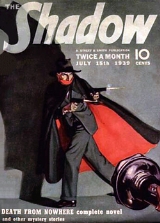
 The Shadow. One of the most famous pulp heroes of the 20th century, The Shadow has been featured in comic book
Comic book

A comic book is a magazine or book of narrative artwork and dialog and descriptive prose. The style was introduced in 1934. Despite the term, comic books do not necessarily feature humorous subject-matter; in fact, it is often serious and action-oriented....
s, comic strips, television
Television

Television is a widely used telecommunication mass-media for transmitting and receiving moving , either monochrome or color, usually accompanied by sound....
, video games, and at least seven motion pictures. The radio drama
Radio drama

File:Opname van een hoorspel Recording a radio play.jpgRadio drama is a form of audio storytelling broadcast on radio broadcasting. With no visual component, radio drama depends on dialogue, music and sound effects to help the listener imagination the story....
 is well-remembered for those episodes voiced by Orson Welles
Orson Welles

George Orson Welles , better known as Orson Welles, was an Academy Award-winning United States actor, director, writer and producer, who worked extensively in film, theatre, television, and radio....
.

Introduced as a mysterious radio narrator by David Chrisman, William Sweets, and Harry Engman Charlot for Street and Smith Publications, The Shadow was fully developed and transformed into a pop culture icon by legendary pulp writer Walter Gibson
Walter Gibson

Walter Gibson may refer to:*Walter B. Gibson , American author and magician*Walter M. Gibson , English adventurer, Mormon missionary, and government official in the Kingdom of Hawaii...
.

The Shadow debuted
First appearance

In comic books and other stories with a long history, first appearance refers to the first occurrence to feature a Character ....
 on July 31, 1930, as the mysterious narrator of the Street & Smith radio program Detective Story Hour. After gaining popularity among the show's listeners, the narrator became the star of The Shadow Magazine on April 1, 1931; a pulp series
Pulp magazine

Pulp magazines were inexpensive fiction magazines. They were widely published from the 1920s through the 1950s. The term pulp fiction can also refer to mass market paperbacks since the 1950s....
 created and primarily written by the prolific Gibson.

As the years passed, the character evolved.


Discussion
Ask a question about 'The Shadow'
Start a new discussion about 'The Shadow'
Answer questions from other users
Full Discussion Forum


Quotations


I saved your life, Roy Tam. It now belongs to me.

"The Shadow" (1994)

The weed of crime bears bitter fruit.

"The Shadow" (1994)


Encyclopedia


The Shadow is a collection of serialized dramas, originally on 1930s radio and then in a wide variety of media, that follow the exploits of fictional vigilante
Vigilante

A vigilante is a person who violates the law in order to exact what they believe to be justice from criminals, because they think that the criminal will not be caught or will not be sufficiently punished by the legal system....
 The Shadow. One of the most famous pulp heroes of the 20th century, The Shadow has been featured in comic book
Comic book

A comic book is a magazine or book of narrative artwork and dialog and descriptive prose. The style was introduced in 1934. Despite the term, comic books do not necessarily feature humorous subject-matter; in fact, it is often serious and action-oriented....
s, comic strips, television
Television

Television is a widely used telecommunication mass-media for transmitting and receiving moving , either monochrome or color, usually accompanied by sound....
, video games, and at least seven motion pictures. The radio drama
Radio drama

File:Opname van een hoorspel Recording a radio play.jpgRadio drama is a form of audio storytelling broadcast on radio broadcasting. With no visual component, radio drama depends on dialogue, music and sound effects to help the listener imagination the story....
 is well-remembered for those episodes voiced by Orson Welles
Orson Welles

George Orson Welles , better known as Orson Welles, was an Academy Award-winning United States actor, director, writer and producer, who worked extensively in film, theatre, television, and radio....
.

Introduced as a mysterious radio narrator by David Chrisman, William Sweets, and Harry Engman Charlot for Street and Smith Publications, The Shadow was fully developed and transformed into a pop culture icon by legendary pulp writer Walter Gibson
Walter Gibson

Walter Gibson may refer to:*Walter B. Gibson , American author and magician*Walter M. Gibson , English adventurer, Mormon missionary, and government official in the Kingdom of Hawaii...
.

The Shadow debuted
First appearance

In comic books and other stories with a long history, first appearance refers to the first occurrence to feature a Character ....
 on July 31, 1930, as the mysterious narrator of the Street & Smith radio program Detective Story Hour. After gaining popularity among the show's listeners, the narrator became the star of The Shadow Magazine on April 1, 1931; a pulp series
Pulp magazine

Pulp magazines were inexpensive fiction magazines. They were widely published from the 1920s through the 1950s. The term pulp fiction can also refer to mass market paperbacks since the 1950s....
 created and primarily written by the prolific Gibson.

As the years passed, the character evolved. On September 26, 1937, The Shadow radio drama
Radio drama

File:Opname van een hoorspel Recording a radio play.jpgRadio drama is a form of audio storytelling broadcast on radio broadcasting. With no visual component, radio drama depends on dialogue, music and sound effects to help the listener imagination the story....
 officially premiered with the story "The Deathhouse Rescue" and imbued the character with "the power to cloud men's minds" — the ability to become completely invisible
Invisibility

Invisibility is the state of an object which cannot be Visual perception. An object in this state is said to be invisible . The term is usually used as a fantasy/science fiction term, where objects are literally made unseeable by Magic or Technology means; however, its effects can also be seen in the real world, particularly in physic...
 — a trait associated with the character for years after the show ended. Even after decades, the unmistakable introduction from The Shadow radio program, intoned by actor Frank Readick Jr., has earned a place in the American
American English

PhonologyIn many ways, compared to English language in England, North American English is conservative in its phonology. Some distinctive accents can be found on the East Coast of the United States , partly because these areas were in contact with England, and imitated prestigious varieties of English English at a time when those varieties we...
 idiom
Idiom

An idiom is a phrase whose meaning cannot be determined by the literal definition of the phrase itself, but refers instead to a figurative language meaning that is known only through common use....
: "Who knows what evil lurks in the hearts of men? Heh-heh-heh-heh-heh-heh-heh! The Shadow knows ... " These words were accompanied by a haunting theme song, Le Rouet d'Omphale, composed by Saint-Saëns
Camille Saint-Saëns

Charles-Camille Saint-Sa?ns was a French composer, organist, Conductor , and pianist, known especially for The Carnival of the Animals, Danse Macabre , Samson and Delilah , Havanaise , Introduction and Rondo capriccioso , and his Symphony No....
.

Publication history


Detective Story Hour

In order to boost the sales of their Detective Story Magazine
Detective Story Magazine

Detective Story Magazine was an United States magazine published by Street & Smith. It was the publishing house's first pulp magazine and was originally a dime novel entitled Nick Carter Weekly....
,
Street & Smith Publications hired David Chrisman of the Ruthrauff & Ryan advertising agency and writer-director William Sweets to adapt the magazine's stories into a radio series. Chrisman and Sweets felt the upcoming series should be narrated by a mysterious storyteller with a sinister voice, and began searching for a suitable name. One of their scriptwriters, Harry Engman Charlot, suggested various possibilities, such as "The Inspector" or "The Sleuth." Charlot then proposed the ideal name for the phantom announcer: " ... The Shadow."

Thus, beginning on July 31, 1930, "The Shadow" was the name given to the mysterious narrator of the Detective Story Hour. The narrator was voiced by James LaCurto and, later, Frank Readick. The episodes were drawn from the Detective Story Magazine issued by Street & Smith, "the nation's oldest and largest publisher of pulp magazines." Although the latter company had hoped the radio broadcasts would boost the declining sales of the Detective Story Magazine, the result was quite different. Listeners found the sinister announcer far more compelling than the unrelated stories. They soon began asking newsdealers for copies of "that Shadow detective magazine," even though it did not exist.

Development

Recognizing the demand and responding promptly, circulation manager Henry William Ralston of Street & Smith Publications commissioned magician
Magician

A magician is a person skilled in the mysterious and hidden art of magic , the ability to attain objectives, acquire knowledge, or perform works of wonder using supernatural or nonrational means....
 Walter B. Gibson
Walter B. Gibson

Walter Brown Gibson was an United States author and a professional magic best known for his work on The Shadow. Gibson, under the pen-name Maxwell Grant, wrote Shadow stories at an amazing rate to satisfy public demand during the character's golden age in the 1930s and 1940s....
 to begin writing stories about "The Shadow." Using the pen name
Pen name

A pen name, nom de plume, or literary double, is a pseudonym adopted by an author. A pen name may be used to make the author's name more distinctive, to disguise his or her gender, to distance an author from some or all of his or her works, to protect the author from retribution for his or her writings, or for any of a number of...
 of Maxwell Grant
Maxwell Grant

Maxwell Grant was a pen name used by the authors of "The Shadow."Street and Smith Publications, the publishers of the Shadow pulp magazine, asked Walter B....
, Gibson wrote 282 out of 325 tales over the next 20 years: a novel-length story twice a month (1st and 15th). The first story produced was "The Living Shadow
The Living Shadow

"The Living Shadow" was the first pulp magazine story to feature The Shadow. Written by Walter B. Gibson, it was submitted for publication as "Murder in the Next Room" on January 23, 1931, and published as "The Living Shadow" in the April 1, 1931 issue of "The Shadow Magazine"....
," published April 1, 1931.

Gibson initially fashioned the character as a man with villainous characteristics, who used them to battle crime. Clad in black, The Shadow operated predominantly after dark, burglarizing in the name of justice, and terrifying criminals into vulnerability before he or someone else gunned them down. The character was a noirish
Film noir

Film noir is a film term used primarily to describe stylish cinema of the United States Crime film, particularly those that emphasize moral ambiguity and sexual motivation....
 anti-hero
Anti-hero

In fiction, an antihero is a protagonist whose character or goals are antithetical to traditional hero. The term dates to 1714, although literary criticism identifies the trope in earlier literature....
 in every sense, likely inspired by mentalist Joseph Dunninger
Joseph Dunninger

Joseph Dunninger , known as "The Amazing Dunninger" was one of the most famous and proficient mentalists of all time. He was one of the pioneer performers of Magic on radio and television....
 and illusionist Howard Thurston
Howard Thurston

Howard Thurston was a stage Magician from Columbus, Ohio....
, both close friends of Gibson. Gibson himself claimed the literary inspirations for The Shadow were Bram Stoker
Bram Stoker

Abraham "Bram" Stoker was an Ireland novelist and short story writer, best known today for his 1897 Horror fiction novel Dracula. During his lifetime, he was better known as the personal assistant of actor Henry Irving and business manager of the Lyceum Theatre, London in London, which Irving owned....
's Dracula
Dracula

Dracula is an 1897 in literature novel by Irish people author Bram Stoker, featuring as its primary antagonist the vampire Count Dracula.Dracula has been attributed to many literary genres including vampire literature, horror fiction, the gothic novel and invasion literature....
 and Edward Bulwer-Lytton's The House and the Brain.

Because of the strenuous effort involved in writing two full-length novels every month, several guest writers were hired to write occasional installments in order to lighten Gibson's work load. These guest writers included Lester Dent
Lester Dent

Lester Dent was a prolific pulp magazine author of numerous stories, best known as the main author of the series of stories about the superhuman scientist and adventurer, Doc Savage....
 — who penned the Doc Savage
Doc Savage

Doc Savage is a fictional character, one of the pulp heroes of the 1930s and 1940s. He was created by writer Lester Dent....
 stories — and Theodore Tinsley
Theodore Tinsley

Theodore Tinsley was an United States author who wrote primarily Mystery fiction stories. Tinsley wrote 27 stories featuring The Shadow for "The Shadow Magazine" pulp magazine....
. In the late 1940s, mystery novelist Bruce Elliott would temporarily — and disastrously — replace Gibson as the primary author of the pulp series.

The Shadow Magazine ended with the Summer 1949 issue. Gibson wrote three new "official" stories between 1963 and 1980. He later began a short series of updated Shadow novels for Belmont Books starting with Return of The Shadow under his own name. This novel was followed by The Shadow Strikes, Beware Shadow, Cry Shadow, The Shadow's Revenge, Mark of The Shadow, Shadow Go Mad, Night of The Shadow, and Destination: Moon, all of which were written by Dennis Lynds
Michael Collins (author)

Michael Collins is the best-known pseudonym of Dennis Lynds , an United States author who primarily wrote mystery fiction.Over four decades Lynds published some 80 novels and 200 short story, in both mystery and literary themes....
 under the "Maxwell Grant" byline. The Shadow was given mental powers in these later books, including the radio character's ability "to cloud men's minds" so that he effectively became invisible.

Character development

The character of The Shadow gradually evolved over his lengthy fictional existence.

In the pulps written by Gibson, The Shadow wore a slouch hat
Slouch hat

A slouch hat is a wide-brimmed felt hat with a chinstrap most commonly worn as part of a military uniform. It is a survivor of the felt hats worn by eighteenth century armies....
 and a black, crimson-lined cloak with an upturned collar (in the later comic books and the 1994 film he wore a crimson scarf around the lower part of his face). He skulked in the shadows, using his skill at concealing himself.

However, in the radio drama
Radio drama

File:Opname van een hoorspel Recording a radio play.jpgRadio drama is a form of audio storytelling broadcast on radio broadcasting. With no visual component, radio drama depends on dialogue, music and sound effects to help the listener imagination the story....
 which debuted in 1937, The Shadow became an invisible avenger who had learned "the mysterious power to cloud men's minds, so they could not see him" while "traveling through East Asia
Asia

Asia is the world's largest and most populous continent. It covers 8.6% of the Earth's total surface area and, with over 4 billion people, it contains more than 60% of the world's current human population....
." This revision of the character was born out of necessity: Time constraints of 1930s radio made it difficult to explain to listeners where The Shadow was hiding and how he was remaining concealed. As such, the character was given the power of complete invisibility.

In order to explain this power, The Shadow was described as a master of hypnotism
Hypnosis

Hypnosis is a mental state or set of attitudes usually induced by a procedure known as a hypnotic induction, which is commonly composed of a series of preliminary instructions and suggestions....
, as explicitly stated in several radio episodes.

Background


In print, The Shadow's secret identity
Secret identity

A secret identity is an Fiction#Elements of fiction wherein a character develops a separate persona , while keeping their true identity hidden. The character also may wear a disguise ....
 was Kent Allard, a famed aviator. During World War I
World War I

World War I, or the First World War , was a global military conflict which involved the Great powers, organized into two opposing military alliances: the Allies of World War I and the Central Powers....
, Allard was both a flying ace and a spy who fought for the French. He was known by the alias of The Black Eagle ("The Shadow's Shadow," 1933), although later stories revised this alias as The Dark Eagle ("The Shadow Unmasks," 1937). After the war, Allard sought a new challenge and decided to wage war on criminals. Allard faked his death in the South America
South America

South America is the southern continent of the Americas, situated entirely in the Western Hemisphere and mostly in the Southern Hemisphere, with a relatively small portion in the Northern Hemisphere....
n jungles, then returned to the United States. Arriving in New York City
New York City

The City of New York is the List of United States cities by population in the United States, while the New York metropolitan area ranks among the List of urban areas by population....
, he adopted numerous identities to conceal his existence.

One of these identities was Lamont Cranston, a "wealthy young man about town." In the pulps, Cranston was a separate character; Allard frequently disguised himself as Cranston and adopted his identity ("The Shadow Laughs," 1931). While Cranston traveled the world, Allard assumed his identity in New York. In their first meeting, Allard/The Shadow threatens Cranston, saying that he has arranged to switch signatures on various documents and other means that will allow him to take over the Lamont Cranston identity entirely unless Cranston agrees to allow Allard to impersonate him when he is abroad. Cranston agrees. The two men sometimes met in order to impersonate each other ("Crime over Miami," 1940). Apparently, the disguise worked well because Allard and Cranston bore something of a resemblance to each other ("Dictator of Crime," 1941).

His other disguises included businessman Henry Arnaud, elderly gentleman Isaac Twambley, and Fritz, a doddering old janitor who works at Police Headquarters in order to listen in on conversations.

For the first half of The Shadow's tenure in the pulps, The Shadow's past and identity were ambiguous, supposedly an intentional decision on Walter Gibson's part. There were numerous hints throughout the early pulps, long before Gibson created The Shadow's Kent Allard identity, that The Shadow was hideously disfigured. In "The Living Shadow
The Living Shadow

"The Living Shadow" was the first pulp magazine story to feature The Shadow. Written by Walter B. Gibson, it was submitted for publication as "Murder in the Next Room" on January 23, 1931, and published as "The Living Shadow" in the April 1, 1931 issue of "The Shadow Magazine"....
," a thug claims to have seen The Shadow's face, and thought he saw "a piece of white that looked like a bandage." In "The Black Master" and "The Shadow's Shadow," the villains both managed to see The Shadow's true face, and they both remarked that The Shadow was a man of many faces with no face of his own. It was not until the August 1937 issue of The Shadow, "The Shadow Unmasks," that The Shadow's true identity of Kent Allard was revealed.

In the radio drama, the Allard secret identity
Secret identity

A secret identity is an Fiction#Elements of fiction wherein a character develops a separate persona , while keeping their true identity hidden. The character also may wear a disguise ....
 was dropped for simplicity's sake. On the radio, the Shadow was only Lamont Cranston; he had no other aliases or disguises.

Supporting characters

The Shadow had a network of agents who assisted him in his crusade against crime. These included:

Penelope Margo Lane
  • Harry Vincent, an operative whose life he saved when Vincent tried to commit suicide;
  • Moe Shrevnitz (aka "Shrevy"), a cab driver who doubled as his chauffeur;
  • Margo Lane
    Margo Lane

    Margo Lane is a fictional character in The Shadow stories. Her first appearance was in The Thunder King, a story in the April 1941 issue of The Shadow Magazine....
    , a wealthy socialite; the character was created for the radio drama and, four years later, was introduced into the pulp novels. Her sudden appearance in the pulps annoyed readers and generated a flurry of hate mail
    Hate mail

    Hate mail is a form of harassment, usually consisting of invective and potentially intimidating or threatening comments towards the recipient. Hate mail often contains exceptionally abusive, foul or otherwise hurtful language....
     printed in The Shadow Magazines letters page.
  • Clyde Burke, a newspaper reporter;
  • Burbank, a radio operator who maintained contact between The Shadow and his agents;
  • Cliff Marsland, a wrongly-convicted ex-con who infiltrated gangs using his crooked reputation;
  • Dr. Rupert Sayre, The Shadow's personal physician;
  • Jericho Druke, a giant, immensely-strong black man;
  • Slade Farrow, who worked with The Shadow to rehabilitate criminals;
  • Miles Crofton, who sometimes piloted The Shadow's autogyro
    Autogyro

    An autogyro is a type of rotorcraft invented by Juan de la Cierva in 1919, making its first successful flight on 9 January 1923, at Cuatro Vientos Airfield in Madrid....
    ;
  • Rutledge Mann, a stock-broker who would collect information;
  • Claude Fellows, the only agent of The Shadow ever to be killed ("Gangdom's Doom," 1931);
  • Hawkeye, a reformed underworld snoop used to trail gangsters and other criminals;
  • Myra Reldon, a female operative who used the alias of Ming Dwan when in Chinatown
    Chinatown

    A Chinatown is a section of an urban area with a large number of overseas Chinese residents, usually outside of Greater China. Chinatowns are present throughout the world, including those in East Asia, Southeast Asia, North America, South America, Australasia, and Europe....
    .


Though initially wanted by the police, The Shadow also worked with them and through them, notably gleaning information from his many chats with Commissioners Ralph Weston and Wainright Barth at the Cobalt Club (unlike the 1994 film, Barth and Cranston were not related in the pulps). Weston believed that Cranston was a rich playboy who dabbled in detective work. Another police contact was Detective Joe Cardona, who was a key character in many Shadow novels and a capable officer.

In contrast to the pulps,
The Shadow radio drama
Radio drama

File:Opname van een hoorspel Recording a radio play.jpgRadio drama is a form of audio storytelling broadcast on radio broadcasting. With no visual component, radio drama depends on dialogue, music and sound effects to help the listener imagination the story....
 limited the cast of major characters to The Shadow, Commissioner Weston and Margo Lane (created specifically for the radio series) as it was believed the abundance of agents would make it difficult to distinguish between characters. Clyde Burke and Moe Shrevnitz (identified only as "Shrevvy") made occasional appearances, but not as agents of The Shadow. Shrevvy was merely an acquaintance of Cranston and Lane.

Enemies

The Shadow also faced a wide variety of enemies, ranging from kingpin
Kingpin

Kingpin may refer to:* Kingpin , the pivot in the steering mechanism* Kingpin , archenemy of Daredevil , and one of the main enemies of Spider-Man in the Marvel Universe...
s and mad scientist
Mad scientist

A mad scientist is a stock character of Genre fiction, specifically science fiction. The mad scientist may be villainous, benign or neutral, and whether psychosis, eccentricity , or simply bumbling, mad scientists often work with fictional technology in order to forward their schemes, if they even have a coherent scheme....
s to international spies and supervillain
Supervillain

A supervillain or supervillainess is a variant of the villain fictional character type, commonly found in comic books, action movies and science fiction in various mediums....
s, many of which were predecessors to the rogues galleries
Rogues gallery

A rogues gallery is a police collection of pictures or photographs of crimes and suspects kept for identification purposes. The term is also used figuratively by extension for any group of shady characters or the line-up of 'mugshot' photographs that might be displayed in the halls of a dormitory or workplace....
 of comic super-heroes. Among The Shadow's recurring foes were Shiwan Khan, The Voodoo Master, The Prince of Evil, and The Wasp.

Some of the numerous one-shot villains The Shadow fought included: The Red Envoy, The Death Giver, Gray Fist, The Black Dragon, Silver Skull, The Red Blot, The Black Falcon, The Cobra, Zemba, The Black Master, Five-face, The Gray Ghost, and Dr.Z

The Shadow also battled collectives of criminals, such as: The Silent Seven, The Hand, The Brothers of Doom, and The Hydra.

Radio program

Orson Welles 1937
In early 1930, Street & Smith Publications hired David Chrisman and Bill Sweets to adapt the
Detective Story Magazine

Detective Story Magazine was an United States magazine published by Street & Smith. It was the publishing house's first pulp magazine and was originally a dime novel entitled Nick Carter Weekly....
to radio format. Chrisman and Sweets felt the program should be introduced by a mysterious storyteller. A young scriptwriter, Harry Charlot, suggested the name of "The Shadow." Thus, "The Shadow" premiered over CBS
CBS

CBS Broadcasting Inc. is an American radio network and television network. The name is derived from the initials of Columbia Broadcasting System, its former legal name....
 airwaves on July 31, 1930, as the host of the
Detective Story Hour, narrating "tales of mystery and suspense from the pages of the premier detective fiction magazine
Detective Story Magazine

Detective Story Magazine was an United States magazine published by Street & Smith. It was the publishing house's first pulp magazine and was originally a dime novel entitled Nick Carter Weekly....
." The narrator was first voiced by James LaCurto, but became a national sensation when radio veteran Frank Readick, Jr. assumed the role and gave it "a hauntingly sibilant quality that thrilled radio listeners."

Early years

Following a brief tenure as narrator of Street & Smith's
Detective Story Hour, "The Shadow" character was used to host segments of The Blue Coal Radio Revue, playing on Sundays at 5:30 p.m. Eastern Standard Time. This marked the beginning of a long association between the radio persona and sponsor Blue Coal.

While functioning as a narrator of
The Blue Coal Radio Revue, the character was recycled by Street & Smith in October 1931, to oddly serve as the storyteller of Love Story Hour.

In October 1932, the radio persona temporarily moved to NBC. Frank Readick again played the role of the sinister-voiced host on Mondays and Wednesdays, both at 6:30 p.m., with LaCurto taking occasional turns as the title character.

Readick returned as The Shadow to host a final CBS mystery anthology that fall. The series disappeared from CBS airwaves on March 27, 1935, due to Street & Smith's insistence the radio storyteller be completely replaced by the master crime-fighter described in Walter B. Gibson's ongoing pulps.

Radio drama

Street & Smith entered into a new broadcasting agreement with Blue Coal in 1937, and that summer Walter B. Gibson teamed with scriptwriter Edward Hale Bierstadt to develop the new series. As such, The Shadow returned to network airwaves on September 26, 1937, over the new Mutual Broadcasting System. Thus began the "official" radio drama
Radio drama

File:Opname van een hoorspel Recording a radio play.jpgRadio drama is a form of audio storytelling broadcast on radio broadcasting. With no visual component, radio drama depends on dialogue, music and sound effects to help the listener imagination the story....
 that many Shadow fans know and love, with 22-year-old Orson Welles starring as Lamont Cranston, a "wealthy young man about town." Once
The Shadow joined Mutual as a half-hour series on Sunday evenings, the program did not leave the air until December 26, 1954.

Welles did not speak the signature line of "Who knows what evil lurks in the hearts of men?" Instead, Readick did, using a water glass next to his mouth for the echo effect. The famous catch phrase was accompanied by the strains of an excerpt from Opus 31 of the Camille Saint-Saëns
Camille Saint-Saëns

Charles-Camille Saint-Sa?ns was a French composer, organist, Conductor , and pianist, known especially for The Carnival of the Animals, Danse Macabre , Samson and Delilah , Havanaise , Introduction and Rondo capriccioso , and his Symphony No....
 classical composition,
Le Rouet d'Omphale.

Welles did make a credible Shadow, two years before his notoriety as the mastermind of Mercury Theatre on the Air
Mercury Theatre

The Mercury Theatre was a theatre company founded in New York City in 1937 by Orson Welles and John Houseman. After initial success in live theatrical productions, in 1938 the Mercury Theatre progressed into their their best-known period as The Mercury Theatre on the Air, a radio drama series that included one of the most notable an...
's production of
War of the Worlds
The War of the Worlds (radio)

The War of the Worlds was an episode of the American radio drama anthology series Mercury Theatre. It was performed as a Halloween episode of the series on October 30, 1938 and aired over the CBS Radio Network radio network....
. After Welles departed the show in 1938, Bill Johnstone was chosen to replace him and voiced the character of The Shadow for five seasons. Following Johnstone's departure, The Shadow was portrayed by such noted actors as Bret Morrison
Bret Morrison

Bret Morrison was an United States actor best known as the voice of The Shadow, old-time radio's mysterious crusader for law and order.He was born in Chicago, Illinois....
 (the longest tenure, with ten years in two separate runs), John Archer
John Archer

John Archer may refer to:People:*John Archer , British politician, first person of African descent elected to public office*John Archer , former U.S....
, and Steve Courtleigh as Lamont Cranston/The Shadow.

Margo Lane

The radio drama also introduced female characters into The Shadow's realm, most notably Margo Lane
Margo Lane

Margo Lane is a fictional character in The Shadow stories. Her first appearance was in The Thunder King, a story in the April 1941 issue of The Shadow Magazine....
 (played by Agnes Moorehead
Agnes Moorehead

Agnes Robertson Moorehead was an American actress. Although she began with the Mercury Theatre, appeared in more than seventy films beginning with Citizen Kane and on dozens of television shows during a career that spanned more than thirty years, Moorehead is most widely known to modern audiences for her role as the witch Endora in the t...
 among others) as Cranston's love interest and crime-solving partner — the character was eventually integrated into Gibson's pulp novels. She was first introduced in 1936, in the Shadow comic book. Many fans were outraged by this because no explanation to her sudden appearance was offered.

Lane was described as Cranston's "friend and companion" in later episodes, although the exact nature of their relationship was unclear. In the early scripts of the radio drama the character's name was spelled "Margot." The name itself was originally inspired by Margot Stevenson the famous Broadway ingénue who would later be chosen to voice Lane opposite Welles' Shadow during "the 1938 Goodrich summer season of the radio drama."

Comic strips and comic books

The Shadow has been depicted in comics several times, beginning with a 1938 newspaper comic strip
Comic strip

A comic strip is a sequence of drawings that tells a story.Currently in the Western world, most comic strips are written and drawn by a comics artist or cartoonist, and many such strips are published on a recurring basis in newspapers and on the Internet....
 drawn by Vernon Greene
Vernon Greene

File:Shadowverngreene1.jpgVernon Van Atta Greene was a prolific cartoonist and illustrator best known for his artwork on various comic strips, notably Bringing Up Father....
.

Street & Smith
Street & Smith

Street & Smith or Street & Smith Publications, Inc. was a New York City publisher specializing in inexpensive paperbacks and magazines referred to as pulp fiction and dime novels....
 published 101 issues of the comic book
Shadow Comics from #1 - vol. 9, #5 (March 1940 - Sept. 1949)

Archie Comics
Archie Comics

Archie Comics is an United States of America comic book publisher, known for its many series featuring the fictional teenager Archie Andrews , Betty Cooper, Veronica Lodge, Reggie Mantle and Jughead Jones characters by publisher/editor John L....
 published an eight-issue series,
The Shadow (Aug. 1964 - Sept. 1965) under the company's Mighty Comics
Mighty Comics

Mighty Comics Group, sometimes referred to as Archie Adventure Series and Radio Comics, refer to the attempt by Archie Comics to revamp and publish superhero comics in the mid-1960s....
 imprint
Imprint

In the publishing industry, an imprint can refer to two different things:* It can mean a brand name under which a work is published. One single publishing company may have multiple imprints; the different imprints are used by the publisher to marketing the work to different demographic consumer market segment....
. At first, The Shadow depicted was loosely based on the radio version, but with blonde hair. In issue #2 (Sept. 1964), the character was transformed into a campy superhero by writer Robert Bernstein
Robert Bernstein

Robert Bernstein , sometimes credited as "R. Berns", is an United States comic book writer active from at least 1946. He is best known for his work on several titles in DC Comics' Superman line, and for establishing the origin and most of the mythos of the superhero Aquaman....
 and artist John Rosenberger
John Rosenberger

John Francis Rosenberger , also credited as John Diehl or simply John R., was an United States comic book artist from after the World War II until the mid-70s....
.

In the mid-1970s, DC Comics
DC Comics

DC Comics is one of the largest and most popular American comic book and related media companies, along with Marvel Comics. A subsidiary of Warner Bros....
 published a critically acclaimed, 12-issue series (Nov. 1973 - Sept. 1975) written by Dennis O'Neil
Dennis O'Neil

Dennis O'Neil is a comic book writer and editing, principally for Marvel Comics and DC Comics in the 1970s, 1980s, and 1990s, and Group Editor for the Batman family of books until his retirement....
 and initially drawn by Michael William Kaluta
Michael William Kaluta

Michael William Kaluta, sometimes credited as Mike Kaluta or Michael Wm. Kaluta , is an American comic book artist.Born in Guatemala to U.S....
 (#1-4 & 6). Faithful to the pulp-magazine and radio-drama character, the series guest-starred fellow pulp fiction hero The Avenger
The Avenger

The Avenger is a fictional character whose original adventures appeared between September 1939 and September 1942 in the pulp magazine The Avenger, published by Street and Smith Publications....
 in issue #11. The Shadow appeared in DC's
Batman
Batman

Batman is a Character , a comic book superhero co-created by artist Bob Kane and writer Bill Finger , appearing in publications by DC Comics. The character first appeared in Detective Comics #27 in May 1939....
#253 (Nov. 1973), in which Batman teams with an aging Shadow and reveals The Shadow as his "greatest inspiration". In Batman #259 (Dec. 1974), Batman again meets The Shadow, and we learn The Shadow saved Bruce Wayne's life when the future Batman was a boy.

Theshadowcomic01
In the late 1980s, another DC reincarnation was created by Howard Chaykin
Howard Chaykin

Howard Victor Chaykin is an American Comic book creator famous for his innovative storytelling and sometimes controversial material. Chaykin?s main influences are the mid-20th Century book illustrators Robert Fawcett, Al Parker , and others, along with a love for jazz, which is often reflected in his work....
, Andy Helfer
Andy Helfer

Andrew "Andy" Helfer is an award-winning comic book creator best known for his work as an editor and writer at DC Comics; in this position, he founded the Paradox Press imprint....
, Bill Sienkiewicz
Bill Sienkiewicz

Bill Sienkiewicz is an Eisner Award-winning United States artist best known for his comic books, primarily Marvel Comics' The New Mutants and Elektra: Assassin....
, and Kyle Baker
Kyle Baker

'Kyle Baker' is an United States cartoonist, comic book writer and artist, and animator, as well as the self-publisher of two anthologies, Cartoonist and Cartoonist Vol....
. This version brought The Shadow to modern-day New York. While initially successful, this version was not popular with traditional Shadow fans because it depicted The Shadow using Uzi submachine guns and rocket launchers, as well as featuring a strong strain of black comedy throughout. It was canceled after an issue in which The Shadow's head was transplanted onto a robot body.

In 1988, O'Neil and Kaluta, with inker Russ Heath, returned to The Shadow with the Marvel Comics
Marvel Comics

Marvel Comics is an American comic book and related media company owned by Marvel Publishing, Inc., a subsidiary of Marvel Entertainment, Inc. Marvel counts among as its List of Marvel Comics characters such well-known properties as Captain America, the Fantastic Four, the Hulk , Iron Man, Spider-Man, the X-Men, and many others....
 graphic novel
Graphic novel

A graphic novel is a type of comic book, usually with a lengthy and complex storyline similar to those of novels. The term also encompasses comic short story anthologies, and in some cases bound collections of previously published comic book series ....
 
Hitler's Astrologer, set in 1941.

From 1989 to 1992, DC published a new series,
The Shadow Strikes, written by Gerard Jones
Gerard Jones

Gerard Jones is an award-winning American author and comic book writer....
 and Eduardo Barreto
Eduardo Barreto

Eduardo Barreto is an artist from Uruguay who has worked in the comic book industry....
. This series was set in the 1930s, and returned The Shadow to his pulp origins. The series featured The Shadow's first team-up with Doc Savage
Doc Savage

Doc Savage is a fictional character, one of the pulp heroes of the 1930s and 1940s. He was created by writer Lester Dent....
, another popular pulp hero. The stories in this series often led The Shadow into encounters with well-known celebrities of the 1930s, such as Albert Einstein
Albert Einstein

Albert Einstein was a Germany-born theoretical physics. He is best known for his theory of relativity and specifically mass?energy equivalence, expressed by the equation E = mc2....
, Amelia Earhart
Amelia Earhart

Amelia Mary Earhart ; was a noted United States aviation pioneer, and author. Earhart was the first woman to receive the Distinguished Flying Cross , awarded for becoming the first aviator to fly solo across the Atlantic Ocean....
, Charles Lindbergh
Charles Lindbergh

Charles Augustus Lindbergh was an United States aviator, author, inventor and explorer.On May 20?21, 1927, Lindbergh emerged instantaneously from virtual obscurity to world fame as the result of his Orteig Prize-winning solo non-stop flight from Roosevelt Field, Long Island in New York City to Paris - Le Bourget Airport in Paris in the s...
, union organizer John L. Lewis
John L. Lewis

John Llewellyn Lewis was an American leader of Labor unions in the United States who served as president of the United Mine Workers of America from 1920 to 1960....
, and Chicago gangsters Frank Nitti
Frank Nitti

Francesco Raffaele Nitto, better known as "Frank 'The Enforcer' Nitti" was an Italy-United States gangster, one of the top henchmen of Al Capone and later the front man for the mob Capone created, the Chicago Outfit....
 and Jake Guzik
Jake Guzik

Jake "Greasy Thumb" Guzik was the financial and legal advisor, and later political ?greaser?, for the Chicago Outfit....
. In issue #11, The Shadow meets a radio announcer named Grover Mills — a character based on the young Orson Welles
Orson Welles

George Orson Welles , better known as Orson Welles, was an Academy Award-winning United States actor, director, writer and producer, who worked extensively in film, theatre, television, and radio....
 — who has been impersonating The Shadow on the radio. The character's name is taken from Grover's Mill, New Jersey — the name of the town where the Martians land in Welles' 1938 radio broadcast of
The War of the Worlds
The War of the Worlds (radio)

The War of the Worlds was an episode of the American radio drama anthology series Mercury Theatre. It was performed as a Halloween episode of the series on October 30, 1938 and aired over the CBS Radio Network radio network....
.

Dark Horse Comics
Dark Horse Comics

Dark Horse Comics is one of the largest independent United States comic book publishers, behind dominant publishers Marvel Comics and DC Comics....
 published two miniseries
Miniseries

A miniseries , in a serial storytelling medium, is a production which tells a story in a pre-planned limited number of episodes....
 based on The Shadow. "In the Coils of Leviathan" was published in 1993. "Hell's Heat Wave" was published in 1995. Both were written by Joel Goss and Michael Kaluta, and drawn by Gary Gianni. A stand-alone collection was published in 1994 as "The Shadow and the Mysterious Three," again written by Joel Goss and Michael Kaluta with Stan Manoukian and Vince Roucher taking over the drawing chores over Kaluta's layouts. A two-issue adaptation of the 1994 film, The Shadow, was adapted from a script by Goss and Kaluta and drawn by Kaluta from cover to cover. Dark Horse also published a team-up between The Shadow and Doc Savage in 1995.

Films

The character has been adapted for film numerous times.

The Shadow Strikes (1937)

The film The Shadow Strikes was released in 1937, starring Rod La Rocque
Rod La Rocque

Rod La Rocque was an American actor.He was born Rodrique la Rocque de la Rour in Chicago, Illinois of French and Irish descent. He began appearing in stock theater at the age of seven and eventually ended up at the Essanay Studios in Chicago where he found steady work until the studios closed....
 in the title role. Lamont Cranston assumes the secret identity of "The Shadow" in order to thwart an attempted robbery at an attorney's office. Both
The Shadow Strikes (1937) and its sequel, International Crime (1938), were released by Grand National Pictures.

International Crime (1938)

Rod La Rocque
Rod La Rocque

Rod La Rocque was an American actor.He was born Rodrique la Rocque de la Rour in Chicago, Illinois of French and Irish descent. He began appearing in stock theater at the age of seven and eventually ended up at the Essanay Studios in Chicago where he found steady work until the studios closed....
 returned the following year in
International Crime. In this version, reporter Lamont Cranston is an amateur criminologist and detective who uses the name of "The Shadow" as a radio gimmick. Thomas Jackson portrayed Police Commissioner Weston, and Astrid Allwyn was cast as Phoebe Lane, Cranston's assistant.

The Shadow (1940)

A serial
Serial (film)

|}Serials, more specifically known as Movie serials or Film serials, were short subjects originally shown in theaters in conjunction with a feature film that were related to pulp magazine Serial ....
 produced by Columbia Studios starring Victor Jory
Victor Jory

Victor Jory was a Canada actor.He was born in Dawson City, Yukon, Yukon, Canada. He was the boxing and wrestling champion of the Coast Guard during his military service, and he kept his burly physique....
 premiered in 1940. The Black Tiger is a criminal mastermind who is sabotaging rail lines and factories across America, and Lamont Cranston must become his shadowy alter ego to uncover the fiend and halt his schemes.

The Shadow Returns (1946)

Low-budget motion picture studio Monogram produced a trio of films in 1946 starring Kane Richmond
Kane Richmond

Kane Richmond was an American film actor of the 1930s and 1940s, mostly appearing in cliffhangers and serials. He is best known today for his portrayal of the character Lamont Cranston in The Shadow films in addition to his leading role in the successful serials Spy Smasher and Brick Bradford ....
:
The Shadow Returns, Behind the Mask and The Missing Lady. Richmond's Shadow, in fact, wore a black face-mask similar to the type worn by the serial hero The Masked Marvel
The Masked Marvel

The Masked Marvel was a 12-chapter Serial created by Republic Pictures, who produced many of the best known of the serials. It was Republic's thirty-first serial, of the sixty-six they produced....
.

The Shadow (1994)

Shadowpost
In 1994, the character was adapted once again into a feature film,
The Shadow, starring Alec Baldwin
Alec Baldwin

Alexander Rae Baldwin III is an United States film and television actor. Working as Alec Baldwin, he has appeared in prominent films such as Beetlejuice, as Jack Ryan in The Hunt for Red October , in the Martin Scorsese films The Aviator and The Departed....
 as Yin-Ko/Lamont Cranston/The Shadow and Penelope Ann Miller
Penelope Ann Miller

Penelope Ann Miller , sometimes credited as Penelope Miller, is a Golden Globe nominated United States actor. She starred in several major Hollywood films during the 1990s, and has continued appearing in supporting roles in both film and television....
 as Margo Lane
Margo Lane

Margo Lane is a fictional character in The Shadow stories. Her first appearance was in The Thunder King, a story in the April 1941 issue of The Shadow Magazine....
. Cranston was depicted as a brutal warlord
Warlord

A warlord is a person with power who has military dictatorship over a subnational area due to armed forces loyal to the warlord and not to a central authority....
 and opium
Opium

Opium is a narcotic formed from the latex released by lacerating the immature seed pods of Opium poppy . It contains up to 12% morphine, an opiate alkaloid, which is most frequently processed chemically to produce heroin for the illegal drug trade....
 smuggler. He was kidnapped by a Tibet
Tibet

Tibet is a Tibetan Plateau in Asia, north of the Himalayas, and the home to the indigenous Tibetan people and its related ethnic groups. With an average elevation of 4,900 metres , it is the highest region on Earth and has in recent decades increasingly been referred to as the "Roof of the World"....
an order of monks and brought to their monastery
Monastery

Monastery , a term derived from the Greek language word ???ast?????, neut. of ???ast????? - monasterios denotes the building, or complex of buildings, that houses a room reserved for prayer as well as the domestic quarters and workplace of Monk, whether monks or nuns, and whether living in Cenobium or alone ....
. A tulku
Tulku

A tulku is a Tibetan Buddhism lama who has, through phowa and siddhi, consciously determined to be reincarnation, often many times, in order to continue his Bodhisattva vow....
, their leader, recognizing the power of harnessing Cranston's inner darkness, reformed and trained him to use that darkness against evil rather than for it. Yin-Ko then learned how to confuse and control the minds of others, particularly how to become invisible except for his shadow. His nemesis in the film was an evil warlord and fellow telepath named Shiwan Khan, the last descendant of Genghis Khan
Genghis Khan

Genghis Khan , born , was the founder, Khan and Khagan of the Mongol Empire, the World's largest empires contiguous empire in history....
, played by John Lone
John Lone

John Lone is an American actor....
. Their struggle eventually ended when Cranston threw a mirror shard into Khan's head; surgery saved his life, but it removed a small but critical piece of the frontal lobe
Frontal lobe

The frontal lobe is an area in the brain of mammals. It is located at the front of each cerebral hemisphere and positioned anterior to the parietal lobes and above and anterior to the temporal lobes....
 of his brain, and thus the source of his telepathic powers. This movie combined the two versions of The Shadow (the radio and pulp novel versions) into one, with the aforementioned ability to cloud minds combined with the trench coat, slouch hat, and dual .45s.

Upcoming film

On December 11, 2006, the website SuperHero Hype reported that director Sam Raimi
Sam Raimi

Samuel Marshall "Sam" Raimi is an American film director, film producer, actor and screenwriter.He is best known for directing the cult classic horror film The Evil Dead and the Blockbuster Spider-Man film series....
 and Michael Uslan
Michael Uslan

Michael E. Uslan is the originator of the Batman movies and was the first professor to teach "Comic Book Folklore" at an accredited university....
 will co-produce a new
Shadow film for Columbia Pictures
Columbia Pictures

Columbia Pictures Industries, Inc. is an United States film production company and distribution company. It was one of the so-called studio system among the eight major film studios of Hollywood Cinema of the United States#Golden Age of Hollywood....
. Siavash Farahani will write the screenplay. Raimi tried (and failed) to gain the rights in the late 1980s, which resulted in his now-famous 1990 feature film
Feature film

In the film industry, a feature film is a film made for initial Film distributor in Movie theater and being the "main attraction" of the screening ....
,
Darkman
Darkman

Darkman is a 1990 in film superhero film action film directed by Sam Raimi that was based on a short story he wrote that paid homage to Universal Studios horror films of the 1930s in film....
.

On October 16, 2007, Sam Raimi stated that: "I don't have any news on 'The Shadow' at this time, except that the company that I have with Josh Donen, my producing partner, we've got the rights to 'The Shadow.' I love the character very much and we're trying to work on a story that'll do justice to the character."

TV series

Two attempts were made to make a television series based on the character. The first in 1954 was called
The Shadow, starring Tom Helmore
Tom Helmore

Tom Helmore was an England film actor. He appeared in over 50 films between 1927 in film and 1972 in film, including three films directed by Alfred Hitchcock....
 as Lamont Cranston.

The second attempt in 1958 was called
The Invisible Avenger, which compiled the first two unaired episodes and was released theatrically instead. This film was later re-released in 1962 as Bourbon Street Shadows, with additional footage meant to appeal to "adult" audiences. Starring Richard Derr
Richard Derr

Richard Derr was an United States film and television actor....
 as The Shadow,
The Invisible Avenger centers upon Lamont Cranston investigating the murder of a New Orleans bandleader. The film is notable as the second directorial effort of James Wong Howe
James Wong Howe

James Wong Howe, A.S.C. is considered one of the greatest United States cinematographers. He has over 130 films to his credit. A master at the use of shadow, he was one of the first to use deep focus, photography in which both foreground and distant planes remain in focus....
, one of the greatest cinematographer
Cinematographer

A cinematographer is one photography with a motion picture camera . The title is generally equivalent to director of photography , used to designate a chief over the camera and lighting film crews working on a film, responsible for achieving artistic and technical decisions related to the image....
s in film history.

Influence

  • Some assert that The Shadow originated much of the concept we have come to know as the modern superhero
    Superhero

    A superhero is a Character "of unprecedented physical prowess dedicated to act of derring-do in the public interest". Since the debut of the prototype superhero Superman in 1938, stories of superheroes?ranging from brief episodic adventures to continuing years-long sagas?have dominated American comic books and crossed over into other mass...
    : Characters such as Batman
    Batman

    Batman is a Character , a comic book superhero co-created by artist Bob Kane and writer Bill Finger , appearing in publications by DC Comics. The character first appeared in Detective Comics #27 in May 1939....
     and The Green Hornet
    The Green Hornet

    The Green Hornet is a masked fictional crime fighter. Originally created by George W. Trendle and Fran Striker for an United States old-time radio in the 1930s, the character has appeared in other media as well, including Serial films in the 1940s, a network television program in the 1960s, and multiple comic book series from the 1940s to th...
     reference Lamont Cranston's alter ego
    Alter ego

    An alter ego is a 2 Self , a second Personality psychology or persona within a person. It was coined in the early nineteenth century when schizophrenia was first described by early psychologists....
    . Both characters operate mostly by night, and the Green Hornet in particular operates outside the law, insinuating himself into criminal plots in order to put an end to the activities of master criminals. But whereas The Shadow carries a real gun, the Green Hornet carries only a lightweight pistol that fired non-lethal gas.


  • When Bob Kane
    Bob Kane

    Bob Kane was a Jewish American comic book artist and writer, credited as the creator of the DC Comics superhero Batman....
     and Bill Finger
    Bill Finger

    William "Bill" Finger was a Jewish-American comic strip and comic book Comic book creator best known as the uncredited co-creator, with Bob Kane, of the DC Comics character Batman, as well as the co-architect of the series' development....
     first conceived "the Bat-Man
    Batman

    Batman is a Character , a comic book superhero co-created by artist Bob Kane and writer Bill Finger , appearing in publications by DC Comics. The character first appeared in Detective Comics #27 in May 1939....
    ", Finger suggested they pattern the character after pulp mystery men such as The Shadow. Finger then used "Partners of Peril
    List of The Shadow stories

    Pulp Magazine NovelsA list of pulp magazine novels featuring The Shadow. All of these novels were written by Walter B. Gibson, unless otherwise noted, and originally appeared in The Shadow Magazine and its variants, published by Street and Smith....
    " — a Shadow pulp written by Theodore Tinsley
    Theodore Tinsley

    Theodore Tinsley was an United States author who wrote primarily Mystery fiction stories. Tinsley wrote 27 stories featuring The Shadow for "The Shadow Magazine" pulp magazine....
     — as the basis for Batman's debut story, "The Case of the Chemical Syndicate." Finger later publicly acknowledged that "my first [Batman] script was a take-off on a Shadow story" and that "Batman was originally written in the style of the pulps." This influence was further evident with Batman showing little remorse over killing or maiming criminals and was not above using firearms.


  • The Shadow later inspired another radio hit, The Whistler
    The Whistler

    The Whistler was one of United States radio's most popular mystery dramas, with a 13-year run from May 16, 1942 until September 22, 1955.The Whistler was the most popular West Coast of the United States-originated program with its listeners for many years....
    , whose protagonist
    Protagonist

    A protagonist is the main Character of a drama or Narrative. The word "protagonist" derives from the Greek language p??ta????st?? , "one who plays the first part, chief actor." In the theatre of Ancient Greece, three actors played all of the main dramatic roles in a tragedy; the leading role was played by the protagonist, while the othe...
     likewise knew "many things, for I walk by night. I know many strange tales, many secrets hidden in the hearts of men and women who have stepped into the shadows. Yes, I know the nameless terrors of which they dare not speak," and whose calling card — a short, almost macabre whistle — was at least as familiar as
    The Shadow's famous opening line.


  • The Laughing Man, a 1949 short story by J. D. Salinger
    J. D. Salinger

    Jerome David "J. D." Salinger is an American author, best known for his 1951 novel The Catcher in the Rye, as well as his reclusive nature....
    , reprinted in his 1953 collection
    Nine Stories
    Nine Stories

    Nine Stories is the title of a number of books, including:* Nine Stories by Vladimir Nabokov* Nine Stories by J. D. SalingerNine Stories is also the name of singer-songwriter Lisa Loeb's band, named after Salinger's Nine Stories....
    , is based on the episodic nature of The Shadow radio show and draws upon references to the character's famous laugh and red mask.


  • Alan Moore
    Alan Moore

    Alan Moore is an English writer most famous for his influential work in comics, including the acclaimed graphic novels Watchmen, V for Vendetta and From Hell....
     listed
    The Shadow as one of the key influences for "V," the title character in V for Vendetta
    V for Vendetta

    V for Vendetta is a ten-issue comic book series written by Alan Moore and illustrated mostly by David Lloyd , set in a dystopian future United Kingdom imagined from the 1980s about the 1990s....
    .


  • Science fiction
    Science fiction

    Science fiction is a broad genre of fiction that often involves speculations based on current or future science or technology. Science fiction is found in books, art, television, films, games, theatre, and other media....
     writer Philip José Farmer
    Philip José Farmer

    Philip Jos? Farmer was an United States author, principally known for his science fiction and fantasy fiction novels and short story.Farmer is best known for his Riverworld series and the earlier World of Tiers series....
     depicted The Shadow as part of his Wold Newton family
    Wold Newton family

    The Wold Newton family is a literary concept derived from a form of Fictional crossovers developed by the science fiction writer Philip Jos? Farmer....
     of interrelated fictional characters.


  • In Mad Magazine in the 1950s, The Shadow was spoofed as "The Shadow'" (the apostrophe because the name was short for "Lamont Shadowskeedeeboomboom"). In the story "Margo Pain" gets The Shadow' into predicaments — fights with gangsters, musical instruments (including a piano) dropped on him, etc. At the end of the story The Shadow' tricks Margo into going into an outhouse
    Outhouse

    The term outhouse usually refers to a type of toilet in a small structure separate from the main building which does not have a Flush toilet and is not attached to a Sanitary sewer....
     surrounded by dynamite
    Dynamite

    Dynamite is an Explosive material based on the explosive potential of nitroglycerin, initially using diatomaceous earth or another absorbent substance such as sawdust as an adsorbent....
     — and, outside, he pushes the plunger down.


See also

  • List of The Shadow stories
    List of The Shadow stories

    Pulp Magazine NovelsA list of pulp magazine novels featuring The Shadow. All of these novels were written by Walter B. Gibson, unless otherwise noted, and originally appeared in The Shadow Magazine and its variants, published by Street and Smith....
  • List of The Shadow episodes
    List of The Shadow episodes

    This is an episode list for the adventure radio drama The Shadow. The series, inspired by an announcer character on earlier anthology series, premiered on the Mutual Broadcasting System on September 26, 1937 and ended on December 26, 1954....
  • Condé Nast Publications
    Condé Nast Publications

    Cond? Nast Publications, Inc. is a worldwide magazine publishing company. Their main offices are located in New York City, London, Milan, Paris, Madrid and Tokyo....
    , owner of The Shadow intellectual property


Footnotes


External links


  • (fan site)
  • (fan site)