

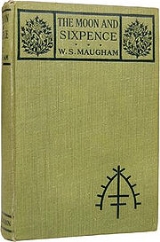
The Moon and Sixpence

Encyclopedia
The Moon and Sixpence is a novel by W. Somerset Maugham
, told in episodic form by the first-person narrator as a series of glimpses into the mind and soul of the central character, Charles Strickland, a middle-aged English stockbroker who abandons his wife and children abruptly to pursue his desire to become an artist.
The story is said to be loosely based on the life of the painter Paul Gauguin
.
Strickland is a well-off, middle-class stockbroker in London some time in the late 19th or early 20th century. Early in the novel, he leaves his wife and children and goes to Paris, living a destitute but defiantly content life there as an artist (specifically a painter), lodging in run-down hotels and falling prey to both illness and hunger. Strickland, in his drive to express through his art what appears to continually possess and compel him inside, cares nothing for physical comfort and is generally indifferent to his surroundings, but is generously supported while in Paris by a commercially successful but hackneyed Dutch painter, Dirk Stroeve, a friend of the narrator's, who immediately recognizes Strickland's genius. After helping Strickland recover from a life-threatening condition, Stroeve is repaid by having his wife, Blanche, abandon him for Strickland. Strickland later discards the wife (all he really sought from Blanche was a model to paint, not serious companionship, and it is hinted in the novel's dialogue that he indicated this to her and she took the risk anyway), who then commits suicide - yet another human casualty (the first ones being his own established life and those of his wife and children) in Strickland's single-minded pursuit of Art
and Beauty
.
After the Paris episode, the story continues in Tahiti
. Strickland has already died, and the narrator attempts to piece together his life there from the recollections of others. He finds that Strickland had taken up with a native woman, had two children by her (one of whom dies) and started painting profusely. We learn that Strickland had settled for a short while in the French port of Marseilles before traveling to Tahiti, where he lived for a few years before finally dying of leprosy
. Strickland left behind numerous paintings, but his magnum opus
, which he painted on the walls of his hut before losing his sight to leprosy, was burnt down after his death by his wife by his dying orders.
, is considered to be the founder of primitivism
in art. The main differences between Gauguin and Strickland are that Gauguin was French rather than English, and whilst Maugham describes the character of Strickland as being largely ignorant of his contemporaries in Modern art (as well as largely ignorant of other artists in general), Gauguin
himself was well acquainted with and exhibited with the Impressionists in the 1880s and lived for awhile with Van Gogh in southern France.
in which the novel's protagonist
, Philip Carey, is described as "so busy yearning for the moon that he never saw the sixpence at his feet." According to a 1956 letter from Maugham, "If you look on the ground in search of a sixpence, you don't look up, and so miss the moon."
directed and written by Albert Lewin
. Released in 1942, the film stars George Sanders
as Charles Strickland.
The novel served as the basis for an opera, also titled The Moon and Sixpence, by John Gardner
to a libretto by Patrick Terry; it was premiered at Covent Garden
in 1958.
Writer S Lee Pogostin adapted it for American TV in 1959. It starred Laurence Olivier
.
's cinematic adaptation of Fahrenheit 451
, several firemen are preparing books for burning. In the crowd of onlookers is a little boy who picks up one of the books and thumbs through it before his father takes it from him and throws it on the pile with the rest. That book is The Moon and Sixpence.
The book was mentioned in Agatha Christie's mystery (Hercule Poirot series) novel "Five Little Pigs", when Poirot asks one of the suspects if she read the book at the time the crime was committed.
The book was also mentioned in Stephen King's 1998 novel Bag of Bones.
's 2003 novel The Way to Paradise
is also based on Paul Gauguin
's life.
W. Somerset Maugham
William Somerset Maugham , CH was an English playwright, novelist and short story writer. He was among the most popular writers of his era and, reputedly, the highest paid author during the 1930s.-Childhood and education:...
, told in episodic form by the first-person narrator as a series of glimpses into the mind and soul of the central character, Charles Strickland, a middle-aged English stockbroker who abandons his wife and children abruptly to pursue his desire to become an artist.
The story is said to be loosely based on the life of the painter Paul Gauguin
Paul Gauguin
Eugène Henri Paul Gauguin was a leading French Post-Impressionist artist. He was an important figure in the Symbolist movement as a painter, sculptor, print-maker, ceramist, and writer...
.
Plot summary
The novel is written largely from the point of view of the narrator, who is first introduced to the character of Strickland through his (Strickland's) wife and strikes him (the narrator) as unremarkable. Certain chapters are entirely composed of the stories or narrations of others which the narrator himself is recalling from memory (selectively editing or elaborating on certain aspects of dialogue, particularly Strickland's, as Strickland is said by the narrator to be limited in his use of verbiage and tended to use gestures in his expression).Strickland is a well-off, middle-class stockbroker in London some time in the late 19th or early 20th century. Early in the novel, he leaves his wife and children and goes to Paris, living a destitute but defiantly content life there as an artist (specifically a painter), lodging in run-down hotels and falling prey to both illness and hunger. Strickland, in his drive to express through his art what appears to continually possess and compel him inside, cares nothing for physical comfort and is generally indifferent to his surroundings, but is generously supported while in Paris by a commercially successful but hackneyed Dutch painter, Dirk Stroeve, a friend of the narrator's, who immediately recognizes Strickland's genius. After helping Strickland recover from a life-threatening condition, Stroeve is repaid by having his wife, Blanche, abandon him for Strickland. Strickland later discards the wife (all he really sought from Blanche was a model to paint, not serious companionship, and it is hinted in the novel's dialogue that he indicated this to her and she took the risk anyway), who then commits suicide - yet another human casualty (the first ones being his own established life and those of his wife and children) in Strickland's single-minded pursuit of Art
Art
Art is the product or process of deliberately arranging items in a way that influences and affects one or more of the senses, emotions, and intellect....
and Beauty
Beauty
Beauty is a characteristic of a person, animal, place, object, or idea that provides a perceptual experience of pleasure, meaning, or satisfaction. Beauty is studied as part of aesthetics, sociology, social psychology, and culture...
.
After the Paris episode, the story continues in Tahiti
Tahiti
Tahiti is the largest island in the Windward group of French Polynesia, located in the archipelago of the Society Islands in the southern Pacific Ocean. It is the economic, cultural and political centre of French Polynesia. The island was formed from volcanic activity and is high and mountainous...
. Strickland has already died, and the narrator attempts to piece together his life there from the recollections of others. He finds that Strickland had taken up with a native woman, had two children by her (one of whom dies) and started painting profusely. We learn that Strickland had settled for a short while in the French port of Marseilles before traveling to Tahiti, where he lived for a few years before finally dying of leprosy
Leprosy
Leprosy or Hansen's disease is a chronic disease caused by the bacteria Mycobacterium leprae and Mycobacterium lepromatosis. Named after physician Gerhard Armauer Hansen, leprosy is primarily a granulomatous disease of the peripheral nerves and mucosa of the upper respiratory tract; skin lesions...
. Strickland left behind numerous paintings, but his magnum opus
Masterpiece
Masterpiece in modern usage refers to a creation that has been given much critical praise, especially one that is considered the greatest work of a person's career or to a work of outstanding creativity, skill or workmanship....
, which he painted on the walls of his hut before losing his sight to leprosy, was burnt down after his death by his wife by his dying orders.
Inspiration
The inspiration for this story, GauguinPaul Gauguin
Eugène Henri Paul Gauguin was a leading French Post-Impressionist artist. He was an important figure in the Symbolist movement as a painter, sculptor, print-maker, ceramist, and writer...
, is considered to be the founder of primitivism
Primitivism
Primitivism is a Western art movement that borrows visual forms from non-Western or prehistoric peoples, such as Paul Gauguin's inclusion of Tahitian motifs in paintings and ceramics...
in art. The main differences between Gauguin and Strickland are that Gauguin was French rather than English, and whilst Maugham describes the character of Strickland as being largely ignorant of his contemporaries in Modern art (as well as largely ignorant of other artists in general), Gauguin
Paul Gauguin
Eugène Henri Paul Gauguin was a leading French Post-Impressionist artist. He was an important figure in the Symbolist movement as a painter, sculptor, print-maker, ceramist, and writer...
himself was well acquainted with and exhibited with the Impressionists in the 1880s and lived for awhile with Van Gogh in southern France.
About the title
According to some sources, the title, the meaning of which is not explicitly revealed in the book, was taken from a review of Of Human BondageOf Human Bondage
Of Human Bondage is a novel by W. Somerset Maugham. It is generally agreed to be his masterpiece and to be strongly autobiographical in nature, although Maugham stated, "This is a novel, not an autobiography, though much in it is autobiographical, more is pure invention." Maugham, who had...
in which the novel's protagonist
Protagonist
A protagonist is the main character of a literary, theatrical, cinematic, or musical narrative, around whom the events of the narrative's plot revolve and with whom the audience is intended to most identify...
, Philip Carey, is described as "so busy yearning for the moon that he never saw the sixpence at his feet." According to a 1956 letter from Maugham, "If you look on the ground in search of a sixpence, you don't look up, and so miss the moon."
Adaptations
The book was made into a film of the same nameThe Moon and Sixpence (film)
The Moon and Sixpence is a 1942 film adaptation of W. Somerset Maugham's novel of the same name. George Sanders stars as a London stockbroker who gives up his career, wife and children to become a painter...
directed and written by Albert Lewin
Albert Lewin
Albert Lewin was an American film director, producer, and screenwriter.He was born in Brooklyn, New York on September 23, 1894 and raised in Newark, New Jersey. He earned a Master's degree at Harvard and taught English at the University of Missouri...
. Released in 1942, the film stars George Sanders
George Sanders
George Sanders was a British actor.George Sanders may also refer to:*George Sanders , Victoria Cross recipient in World War I...
as Charles Strickland.
The novel served as the basis for an opera, also titled The Moon and Sixpence, by John Gardner
John Gardner (composer)
John Linton Gardner, CBE is an English composer of classical music.-Biography:Gardner was born in Manchester, England and brought up in Ilfracombe, North Devon. His father Alfred Linton Gardner was a local GP and amateur composer who was killed in action in the last months of the First World War....
to a libretto by Patrick Terry; it was premiered at Covent Garden
Covent Garden
Covent Garden is a district in London on the eastern fringes of the West End, between St. Martin's Lane and Drury Lane. It is associated with the former fruit and vegetable market in the central square, now a popular shopping and tourist site, and the Royal Opera House, which is also known as...
in 1958.
Writer S Lee Pogostin adapted it for American TV in 1959. It starred Laurence Olivier
Laurence Olivier
Laurence Kerr Olivier, Baron Olivier, OM was an English actor, director, and producer. He was one of the most famous and revered actors of the 20th century. He married three times, to fellow actors Jill Esmond, Vivien Leigh, and Joan Plowright...
.
In popular culture
In the opening scene of François TruffautFrançois Truffaut
François Roland Truffaut was an influential film critic and filmmaker and one of the founders of the French New Wave. In a film career lasting over a quarter of a century, he remains an icon of the French film industry. He was also a screenwriter, producer, and actor working on over twenty-five...
's cinematic adaptation of Fahrenheit 451
Fahrenheit 451 (1966 film)
Fahrenheit 451 is a 1966 film directed by François Truffaut, in his first colour film as well as his only English-language film. It is based on the novel of the same name by Ray Bradbury....
, several firemen are preparing books for burning. In the crowd of onlookers is a little boy who picks up one of the books and thumbs through it before his father takes it from him and throws it on the pile with the rest. That book is The Moon and Sixpence.
The book was mentioned in Agatha Christie's mystery (Hercule Poirot series) novel "Five Little Pigs", when Poirot asks one of the suspects if she read the book at the time the crime was committed.
The book was also mentioned in Stephen King's 1998 novel Bag of Bones.
See also
Mario Vargas LlosaMario Vargas Llosa
Jorge Mario Pedro Vargas Llosa, 1st Marquis of Vargas Llosa is a Peruvian-Spanish writer, politician, journalist, essayist, and Nobel Prize laureate. Vargas Llosa is one of Latin America's most significant novelists and essayists, and one of the leading authors of his generation...
's 2003 novel The Way to Paradise
The Way to Paradise
The Way to Paradise is a novel published by Mario Vargas Llosa in 2003.The novel is a historical double biography of Post-Impressionist painter Paul Gauguin and his grandmother Flora Tristan, one of the founders of feminism. The book is divided into 11 chapters, each alternating narratives of...
is also based on Paul Gauguin
Paul Gauguin
Eugène Henri Paul Gauguin was a leading French Post-Impressionist artist. He was an important figure in the Symbolist movement as a painter, sculptor, print-maker, ceramist, and writer...
's life.
External links
- The Moon and Sixpence (film) at the Internet Movie DatabaseInternet Movie DatabaseInternet Movie Database is an online database of information related to movies, television shows, actors, production crew personnel, video games and fictional characters featured in visual entertainment media. It is one of the most popular online entertainment destinations, with over 100 million...
- The Moon and Sixpence (audio) at LibriVoxLibriVoxLibriVox is an online digital library of free public domain audiobooks, read by volunteers and is probably, since 2007, the world's most prolific audiobook publisher...