

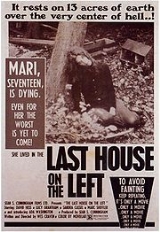
The Last House on the Left

Encyclopedia
The Last House on the Left is a 1972 horror film
written and directed by Wes Craven
and produced by Sean S. Cunningham
.
The story is inspired by the 1960 Swedish film The Virgin Spring
, directed by Ingmar Bergman
, which in turn is based on the 13th century Swedish ballad "Töres döttrar i Wänge". The film was remade into a 2009 film of the same name
.
) plans to celebrate her 17th birthday by attending a concert with her friend, Phyllis Stone (Lucy Grantham
). Her parents (Richard Towers
and Cynthia Carr
) express concern both at the band and Mari's friendship with Phyllis. They let her go, giving her a peace symbol necklace as a gift before she leaves.
Phyllis and Mari go to the city for the concert. On the way, they hear a news report on the car radio of a recent prison escape, involving criminals Krug Stillo (David A. Hess
), a rapist
and serial killer
, his son Junior (Marc Sheffler), Sadie (Jeramie Rain
), a psychopath and sadist
, and Fred "Weasel" Podowski (Fred Lincoln
) a child molester, peeping tom
, and murderer. Before the concert, Mari and Phyllis stroll the streets, seeking someone who might sell them marijuana. They find Junior, who leads them back to an apartment, where they are immediately trapped by the criminals. Phyllis tries to escape, then tries to reason with the criminals to let her go, but their captors subdue and rape her. Meanwhile, Mari's unsuspecting parents prepare a surprise party for her.
The next morning, the girls are locked in a car trunk and taken to the countryside as the gang intends to leave the state. The villains' vehicle malfunctions right in front of Mari's house while police are in her home talking to Mari's parents about her disappearance. Removed from the trunk, Phyllis is beaten as Mari realizes that they are near her own home while she is dragged to the woods. In the woods, the girls are untied and Phyllis is forced to urinate on herself by the gang. Mari and Phyllis are forced to have sex with each other and then Sadie performs oral sex
on a weeping Mari. Phyllis runs away to distract the kidnappers and offer Mari an opportunity to escape. She is chased by Sadie and Weasel, while Junior stays behind to guard Mari, who tries to convince Junior that her father can help him, and she gives him her peace symbol necklace as a symbol of her trust. Phyllis manages to hit Sadie in the face with a rock and runs. She is then cornered, and Weasel stabs her in the back. She crawls away and manages to lean against a tree. Phyllis is then stabbed numerous times until Sadie can reach into her wounds and pull out her insides. Krug and Weasel amputate her hand and half of her forearm.
Mari eventually convinces Junior to let her go, but they are immediately halted by Krug. Sadie and Weasel present Phyllis' severed hand and half forearm and Krug proceeds to carve his name into Mari's chest. Krug then pulls down Mari's pants and rapes her. Soon after this act, Mari vomits. At this point, the gang very briefly feel pangs of conscience. Mari quietly says a prayer then walks into a nearby lake. Krug shoots Mari and she floats on the top of the lake. Krug, Sadie, and Weasel wash and change out of their bloody clothes.
In their new attire, the gang go to the Collingwoods' home, masquerading as traveling salesmen. Mari's parents agree to let them stay overnight. Junior exposes their identity when Mari's mother, Estelle, sees Mari's peace symbol necklace dangling around his neck. Later that night she listens in to the gang while they are spending the night in Mari's bedroom and finds blood-soaked clothing in their luggage. She and Dr. Collingwood rush out into the woods, where they find Mari on the bank of the lake. They carry Mari's body back to the house then exact revenge against the crooks.
Outside, Estelle dupes Weasel into a sex game, then performs fellatio on him. Without warning, she bites off his penis and leaves him to bleed to death. Inside the house, Dr. Collingwood carries his shotgun into his daughter's bedroom, where two of the criminals are sleeping. Krug escapes into the living room and overpowers the doctor, but the criminal is then confronted by his own son, who now brandishes a firearm. Junior threatens to kill his father. Krug psychologically manipulates the already troubled young man, and Junior commits suicide with the weapon. Then Krug finds out the doctor has disappeared.
Sadie rushes outside where she is tackled by Estelle. The two of them wrestle and fight on the ground. Sadie punches Estelle and runs away but then trips and falls into the pool. Estelle grabs a knife and pulls Sadie up and cuts her throat open. Sadie dies of the wound. The doctor kills Krug with the chainsaw and the couple meet each other again in the living room as the police come.
(director of Friday the 13th) made his directorial debut with the white coater film, The Art of Marriage
. His film grossed $100,000 and attracted the company Hallmark Releasing (unaffiliated with Hallmark Cards Inc.). Cunningham made the film Together
as a "better version" of film. Wes Craven
who had no money and a life built off of virtually nothing was put on the job of synchronizing dailies for Cunningham's four-day re-shoot. He soon began editing the film with Cunningham and they became good friends. Hallmark Releasing bought the film for $10,000 and it was considered a "hit". Hallmark Releasing wanted them to do another film with a bigger budget and gave them $90,000 to shoot a horror movie.
Cunningham served as producer and Craven served as writer and director.
's 1964 splatter film Color Me Blood Red
, and then in William Castle
's Strait-Jacket
the following year.) The film under the Last House... title proved to be a massive hit. Stories as to where the advertising campaign originated vary somewhat. Sean Cunningham claims that the person giving the idea for it was watching a cut of the film with his wife, who continually covered her eyes, prompting him to tell her that it was 'Only a movie...'. Other origins have been suggested, however. The tagline was so successful that many other exploitation films later used it, sometimes with own spin. The title was sometimes imitated, as in the case of Last House on Dead End Street
.
' film, with all actors and crew being committed to filming it as such. However, after shooting began, the hard decision was made to edit down to a much softer film. This script, written as Night of Vengeance has never been released; only a brief glimpse is visible in the featurette Celluloid Crime of the Century, and a sample is available in the UK DVD release.
, who also played the main antagonist Krug. It is particularly notable for being heavily contrasted with the events on screen. For example, as the gang drives the two girls out into the countryside, the upbeat, almost comical, tune "Baddies Theme" plays and, after the rape scene, a soothing ballad plays. This counterpointing was also used elsewhere in the film, with the slapstick antics of the two police officers occurring in between scenes of torture. The soundtrack was released commercially around the same time as the film.
recorded and released an instrumental song entitled "Last House on the Left", inspired by the original film.
The Dangerfields
recorded a song entitled "Last House on the Left" on their 2005 album, Born to Rock
. Written by drummer/vocalist Andrew Griswold, it references events and lyrics from the original film, while the CD booklet features a pastiche of the movie poster.
Deathcore band Last House on the Left draws their name from the film.
.
The film was nominated for AFI's 100 Years...100 Thrills.
in many countries, and was particularly controversial in the United Kingdom
. The film was refused a certificate for cinema release by the BBFC in 1974 due to scenes of sadism and violence. During the early 1980s home video boom, the film was released uncut (save for an incidental, gore-free scene with the comedy cops, and the end credit roll) as a video that did not fall under their remit at the time. This changed when the "video nasty
" scare which started in 1982 led to the Video Recordings Act 1984
. This in turn banned the film as one of the Department of Public Prosecutions list of "video nasties".
The film remained banned throughout the remainder of the 1980s and into the 1990s. However it had built a cult reputation in the UK
, plus critics such as Mark Kermode
began to laud the film as an important piece of work. In 2000, the film was again presented to the BBFC for certification and it was again refused. Blue Underground toured an uncut print around Britain without a BBFC certificate, with Southampton City Council granting the uncut version its own 18 certificate. It was granted a license for a one-off showing in Leicester
in June 2000, after which the BBFC again declared that the film would not receive any form of certification.
In June 2002 the BBFC won against an appeal made to the Video Appeals Committee by video distributor Blue Underground Limited. The BBFC had required 16 seconds of cuts to scenes of sexual violence before the video could be given an ‘18’ certificate. Blue Underground Limited refused to make the cuts, and the BBFC therefore rejected the video. The distributor then appealed to the VAC, who upheld the BBFC's decision. During the appeal, film critic Mark Kermode was called in as a horror expert to make a case for the film's historical importance. However, after his report, the committee not only upheld the cuts but doubled them.
The film was eventually given an 18 certificate with 31 seconds of cuts on July 17, 2002 and was released in the UK on DVD in May 2003. The cut scenes were viewable as a slideshow extra on the disc, and there was a weblink to a website where the cut scenes could be viewed.
The BBFC classified the film uncut for video release on March 17, 2008.
finalized a deal to remake
The Last House on the Left with original writer and director Wes Craven
as a producer. The company intended to preserve the storyline of the original film. Craven described his involvement with the remake: "I'm far enough removed from these films that the remakes are a little like having grandchildren. The story, about the painful side effects of revenge, is an evergreen. The headlines are full of people and nations taking revenge and getting caught up in endless cycles of violence." Craven formed Midnight Pictures, a shingle of Rogue Pictures, to remake The Last House on the Left as its first project. Production was slated for early 2007. Screenwriter Adam Alleca was hired to write the script for the remake.
In May 2007, Rogue Pictures entered negotiations with director Dennis Iliadis to direct the film. The film was released to theaters in the US and Canada on March 13, 2009.
Horror film
Horror films seek to elicit a negative emotional reaction from viewers by playing on the audience's most primal fears. They often feature scenes that startle the viewer through the means of macabre and the supernatural, thus frequently overlapping with the fantasy and science fiction genres...
written and directed by Wes Craven
Wes Craven
Wesley Earl "Wes" Craven is an American actor, film director, writer, producer, perhaps best known as the director of many horror films, particularly slasher films, including the famed A Nightmare on Elm Street and Wes Craven's New Nightmare, featuring the iconic Freddy Krueger character, the...
and produced by Sean S. Cunningham
Sean S. Cunningham
Sean Sexton Cunningham is an American film director, producer, and writer. He is best known for creating the Friday the 13th series of horror films, which introduced the fictional killer Jason Voorhees...
.
The story is inspired by the 1960 Swedish film The Virgin Spring
The Virgin Spring
The Virgin Spring is a 1960 Swedish drama film directed by Ingmar Bergman. Set in medieval Sweden, it is a revenge tale about a father's merciless response to the rape and murder of his young daughter. The story was adapted by screenwriter Ulla Isaksson from a 13th century Swedish ballad, "Töres...
, directed by Ingmar Bergman
Ingmar Bergman
Ernst Ingmar Bergman was a Swedish director, writer and producer for film, stage and television. Described by Woody Allen as "probably the greatest film artist, all things considered, since the invention of the motion picture camera", he is recognized as one of the most accomplished and...
, which in turn is based on the 13th century Swedish ballad "Töres döttrar i Wänge". The film was remade into a 2009 film of the same name
The Last House on the Left (2009 film)
The Last House on the Left is a 2009 American film directed by Dennis Iliadis and written by Carl Ellsworth and Adam Alleca. It is a remake of the 1972 film of the same name, and stars Monica Potter, Tony Goldwyn, Garret Dillahunt, and Sara Paxton...
.
Plot
Mari Collingwood (Sandra CasselSandra Cassel
Sandra Cassel is an American actress. She acted in a number of low-budget soft-core and exploitation films between the early to mid 70's. Her most memorable role was in the 1972 film The Last House on the Left...
) plans to celebrate her 17th birthday by attending a concert with her friend, Phyllis Stone (Lucy Grantham
Lucy Grantham
-Career:She is best known for her role as Phyllis Stone in the controversial film The Last House on the Left, which is the only film credit to her name. In 2002, Grantham appeared in the documentary It's Only a Movie: The Making of Last House on the Left to mark the films 30th Anniversary, through...
). Her parents (Richard Towers
Richard Towers
Richard Towers is a undefeated British heavyweight boxer based in Sheffield, Yorkshire, United Kingdom...
and Cynthia Carr
Cynthia Carr
Cynthia Carr is a writer and cultural critic who worked in New York in the 1980s and 1990s. She had various roles including staff writer for The Village Voice. She also wrote about performance art and culture for ArtForum, LA Weekly, Interview and Mirabella...
) express concern both at the band and Mari's friendship with Phyllis. They let her go, giving her a peace symbol necklace as a gift before she leaves.
Phyllis and Mari go to the city for the concert. On the way, they hear a news report on the car radio of a recent prison escape, involving criminals Krug Stillo (David A. Hess
David Hess
David Alexander Hess was an American actor, singer, and songwriter.-Music career:In 1956, Hess recorded the original version of the Otis Blackwell composition "All Shook Up" under the stage name David Hill...
), a rapist
Rape
Rape is a type of sexual assault usually involving sexual intercourse, which is initiated by one or more persons against another person without that person's consent. The act may be carried out by physical force, coercion, abuse of authority or with a person who is incapable of valid consent. The...
and serial killer
Serial killer
A serial killer, as typically defined, is an individual who has murdered three or more people over a period of more than a month, with down time between the murders, and whose motivation for killing is usually based on psychological gratification...
, his son Junior (Marc Sheffler), Sadie (Jeramie Rain
Jeramie Rain
-Life and career:Rain is perhaps most notable for playing the character of "Sadie" in the Wes Craven film The Last House on the Left. Her other credits include The Abductors and Preacherman. Rain also had a distinguished career as a writer/producer at NBC...
), a psychopath and sadist
Sadist
Someone who obtains pleasure from inflicting pain on others.Not to be confused with masochists who derive pleasure from having pain inflicted on themselves .Some subjects sadist could represent are:...
, and Fred "Weasel" Podowski (Fred Lincoln
Fred J. Lincoln
Fred J. Lincoln is an American actor, director, and producer of pornographic films.- Biography :Lincoln grew up in the Hell's Kitchen neighborhood of New York City. His career in adult film and video has been a prolific one. His filmography at the Internet Movie Database credits him as the...
) a child molester, peeping tom
Voyeurism
In clinical psychology, voyeurism is the sexual interest in or practice of spying on people engaged in intimate behaviors, such as undressing, sexual activity, or other activity usually considered to be of a private nature....
, and murderer. Before the concert, Mari and Phyllis stroll the streets, seeking someone who might sell them marijuana. They find Junior, who leads them back to an apartment, where they are immediately trapped by the criminals. Phyllis tries to escape, then tries to reason with the criminals to let her go, but their captors subdue and rape her. Meanwhile, Mari's unsuspecting parents prepare a surprise party for her.
The next morning, the girls are locked in a car trunk and taken to the countryside as the gang intends to leave the state. The villains' vehicle malfunctions right in front of Mari's house while police are in her home talking to Mari's parents about her disappearance. Removed from the trunk, Phyllis is beaten as Mari realizes that they are near her own home while she is dragged to the woods. In the woods, the girls are untied and Phyllis is forced to urinate on herself by the gang. Mari and Phyllis are forced to have sex with each other and then Sadie performs oral sex
Oral sex
Oral sex is sexual activity involving the stimulation of the genitalia of a sex partner by the use of the mouth, tongue, teeth or throat. Cunnilingus refers to oral sex performed on females while fellatio refer to oral sex performed on males. Anilingus refers to oral stimulation of a person's anus...
on a weeping Mari. Phyllis runs away to distract the kidnappers and offer Mari an opportunity to escape. She is chased by Sadie and Weasel, while Junior stays behind to guard Mari, who tries to convince Junior that her father can help him, and she gives him her peace symbol necklace as a symbol of her trust. Phyllis manages to hit Sadie in the face with a rock and runs. She is then cornered, and Weasel stabs her in the back. She crawls away and manages to lean against a tree. Phyllis is then stabbed numerous times until Sadie can reach into her wounds and pull out her insides. Krug and Weasel amputate her hand and half of her forearm.
Mari eventually convinces Junior to let her go, but they are immediately halted by Krug. Sadie and Weasel present Phyllis' severed hand and half forearm and Krug proceeds to carve his name into Mari's chest. Krug then pulls down Mari's pants and rapes her. Soon after this act, Mari vomits. At this point, the gang very briefly feel pangs of conscience. Mari quietly says a prayer then walks into a nearby lake. Krug shoots Mari and she floats on the top of the lake. Krug, Sadie, and Weasel wash and change out of their bloody clothes.
In their new attire, the gang go to the Collingwoods' home, masquerading as traveling salesmen. Mari's parents agree to let them stay overnight. Junior exposes their identity when Mari's mother, Estelle, sees Mari's peace symbol necklace dangling around his neck. Later that night she listens in to the gang while they are spending the night in Mari's bedroom and finds blood-soaked clothing in their luggage. She and Dr. Collingwood rush out into the woods, where they find Mari on the bank of the lake. They carry Mari's body back to the house then exact revenge against the crooks.
Outside, Estelle dupes Weasel into a sex game, then performs fellatio on him. Without warning, she bites off his penis and leaves him to bleed to death. Inside the house, Dr. Collingwood carries his shotgun into his daughter's bedroom, where two of the criminals are sleeping. Krug escapes into the living room and overpowers the doctor, but the criminal is then confronted by his own son, who now brandishes a firearm. Junior threatens to kill his father. Krug psychologically manipulates the already troubled young man, and Junior commits suicide with the weapon. Then Krug finds out the doctor has disappeared.
Sadie rushes outside where she is tackled by Estelle. The two of them wrestle and fight on the ground. Sadie punches Estelle and runs away but then trips and falls into the pool. Estelle grabs a knife and pulls Sadie up and cuts her throat open. Sadie dies of the wound. The doctor kills Krug with the chainsaw and the couple meet each other again in the living room as the police come.
Cast
- Sandra CasselSandra CasselSandra Cassel is an American actress. She acted in a number of low-budget soft-core and exploitation films between the early to mid 70's. Her most memorable role was in the 1972 film The Last House on the Left...
as Mari Collingwood - Lucy Grantham as Phyllis Stone
- David A. HessDavid HessDavid Alexander Hess was an American actor, singer, and songwriter.-Music career:In 1956, Hess recorded the original version of the Otis Blackwell composition "All Shook Up" under the stage name David Hill...
as Krug Stillo - Fred LincolnFred J. LincolnFred J. Lincoln is an American actor, director, and producer of pornographic films.- Biography :Lincoln grew up in the Hell's Kitchen neighborhood of New York City. His career in adult film and video has been a prolific one. His filmography at the Internet Movie Database credits him as the...
as Fred "Weasel" Podowski - Jeramie RainJeramie Rain-Life and career:Rain is perhaps most notable for playing the character of "Sadie" in the Wes Craven film The Last House on the Left. Her other credits include The Abductors and Preacherman. Rain also had a distinguished career as a writer/producer at NBC...
as Sadie - Marc Sheffler as Junior Stillo
- Cynthia CarrCynthia CarrCynthia Carr is a writer and cultural critic who worked in New York in the 1980s and 1990s. She had various roles including staff writer for The Village Voice. She also wrote about performance art and culture for ArtForum, LA Weekly, Interview and Mirabella...
as Estelle Collingwood - Gaylord St. James as Dr. John Collingwood
- Marshall Anker as Sheriff
- Martin KoveMartin KoveMartin Kove is an American actor who has appeared in feature films and television series.-Film appearances:His best-known roles may have been on the 1980s hit CBS television series Cagney & Lacey as Detective Victor Isbecki and in the 1984 hit film The Karate Kid as Cobra Kai Sensei John Kreese...
as Deputy - Ada Washington as Ada
Production
Sean S. CunninghamSean S. Cunningham
Sean Sexton Cunningham is an American film director, producer, and writer. He is best known for creating the Friday the 13th series of horror films, which introduced the fictional killer Jason Voorhees...
(director of Friday the 13th) made his directorial debut with the white coater film, The Art of Marriage
The Art of Marriage
The Art of Marriage is a 1970 American white coater. It was the cinematic directorial debut of Sean S. Cunningham.-Production:Sean Cunningham, a Broadway director, went into the film business in 1969. He gathered three crew members, and with a budget of $3,500, he shot The Art of Marriage. He said...
. His film grossed $100,000 and attracted the company Hallmark Releasing (unaffiliated with Hallmark Cards Inc.). Cunningham made the film Together
Together (1971 film)
Together is a 1971 film directed by Sean S. Cunningham. Cunningham's first film attracted Wes Craven who wanted to be in the film business. This was Craven's first credit. Cunningham and Craven would later work on The Last House on the Left.-Production:...
as a "better version" of film. Wes Craven
Wes Craven
Wesley Earl "Wes" Craven is an American actor, film director, writer, producer, perhaps best known as the director of many horror films, particularly slasher films, including the famed A Nightmare on Elm Street and Wes Craven's New Nightmare, featuring the iconic Freddy Krueger character, the...
who had no money and a life built off of virtually nothing was put on the job of synchronizing dailies for Cunningham's four-day re-shoot. He soon began editing the film with Cunningham and they became good friends. Hallmark Releasing bought the film for $10,000 and it was considered a "hit". Hallmark Releasing wanted them to do another film with a bigger budget and gave them $90,000 to shoot a horror movie.
Cunningham served as producer and Craven served as writer and director.
Advertising campaign
One of the more memorable aspects of the film is the advertising campaign. The film underwent many name changes, including Sex Crime of the Century (from the characters' dialogue in the car ride scene), Krug and Company (a version included on the DVD release), and The Men's Room (simply because one poster showed a men's bathroom). None of these names were particularly successful. Someone then came up with the title The Last House on the Left, along with the infamous "To avoid fainting, keep repeating-it's only a movie..." advertising campaign. (In actuality, it had been used twice before: first in gore-meister H.G. LewisHerschell Gordon Lewis
Herschell Gordon Lewis is an American filmmaker, best known for creating the "splatter film" subgenre of horror...
's 1964 splatter film Color Me Blood Red
Color Me Blood Red
Color Me Blood Red is a low budget 1965 horror film directed and written by Herschell Gordon Lewis. Color Me Blood Red is the third part of what the director's fans have dubbed "The Blood Trilogy", including Blood Feast and Two Thousand Maniacs! .-Film synopsis:An eccentric artist is criticized by...
, and then in William Castle
William Castle
William Castle was an American film director, producer, screenwriter, and actor. Castle was known for directing films with many gimmicks which were ambitiously promoted, despite being reasonably low budget B-movies....
's Strait-Jacket
Strait-Jacket
Strait-Jacket is a 1964 American thriller film starring Joan Crawford and Diane Baker in a macabre mother and daughter tale about a series of axe-murders. Released by Columbia Pictures, the film was directed and produced by William Castle, and co-produced by Dona Holloway...
the following year.) The film under the Last House... title proved to be a massive hit. Stories as to where the advertising campaign originated vary somewhat. Sean Cunningham claims that the person giving the idea for it was watching a cut of the film with his wife, who continually covered her eyes, prompting him to tell her that it was 'Only a movie...'. Other origins have been suggested, however. The tagline was so successful that many other exploitation films later used it, sometimes with own spin. The title was sometimes imitated, as in the case of Last House on Dead End Street
Last House on Dead End Street
Last House on Dead End Street is a horror film released in 1977 about a disgruntled man, recently released from prison, who takes out his anguish by making snuff films....
.
Script
Written by Wes Craven in 1971, the original script was intended to be a graphic 'HardcoreHardcore pornography
Hardcore pornography is a form of pornography that features explicit sexual acts. The term was coined in the second half of the 20th century to distinguish it from softcore pornography. It usually takes the form of photographs, often displayed in magazines or on the Internet, or films. It can also...
' film, with all actors and crew being committed to filming it as such. However, after shooting began, the hard decision was made to edit down to a much softer film. This script, written as Night of Vengeance has never been released; only a brief glimpse is visible in the featurette Celluloid Crime of the Century, and a sample is available in the UK DVD release.
Music
The film's soundtrack was written—and partially sung—by David HessDavid Hess
David Alexander Hess was an American actor, singer, and songwriter.-Music career:In 1956, Hess recorded the original version of the Otis Blackwell composition "All Shook Up" under the stage name David Hill...
, who also played the main antagonist Krug. It is particularly notable for being heavily contrasted with the events on screen. For example, as the gang drives the two girls out into the countryside, the upbeat, almost comical, tune "Baddies Theme" plays and, after the rape scene, a soothing ballad plays. This counterpointing was also used elsewhere in the film, with the slapstick antics of the two police officers occurring in between scenes of torture. The soundtrack was released commercially around the same time as the film.
In popular culture
The RiptidesThe Riptides (Canadian band)
-History:The Riptides were formed in Ottawa, Ontario Canada in February 1998. The original lineup included Andy Vandal Bob Goblin , Johnny Dangerously , and Steve Ransom and the band released the cassette-only Harelip record...
recorded and released an instrumental song entitled "Last House on the Left", inspired by the original film.
The Dangerfields
The Dangerfields
The Dangerfields is a punk rock/rock 'n' roll man based in Belfast, Northern Ireland, formed in March 2000. Led by drummer and lead vocalist Andrew Griswold, they have released one album and four EPs, and have played more than 850 live gigs...
recorded a song entitled "Last House on the Left" on their 2005 album, Born to Rock
Born To Rock
Born to Rock is a 2006 novel by Gordon Korman.-Plot:This book centers on the life of 18 year old Leo Caraway, a member of the "Young Republicans" group at his school. He discovers that his biological father is a punk rocker named King Maggot . Leo's scholarship to Harvard University is revoked...
. Written by drummer/vocalist Andrew Griswold, it references events and lyrics from the original film, while the CD booklet features a pastiche of the movie poster.
Deathcore band Last House on the Left draws their name from the film.
Reception
The film currently has a 65% rating at Rotten TomatoesRotten Tomatoes
Rotten Tomatoes is a website devoted to reviews, information, and news of films—widely known as a film review aggregator. Its name derives from the cliché of audiences throwing tomatoes and other vegetables at a poor stage performance...
.
The film was nominated for AFI's 100 Years...100 Thrills.
Controversy
The film was censoredCensorship
thumb|[[Book burning]] following the [[1973 Chilean coup d'état|1973 coup]] that installed the [[Military government of Chile |Pinochet regime]] in Chile...
in many countries, and was particularly controversial in the United Kingdom
United Kingdom
The United Kingdom of Great Britain and Northern IrelandIn the United Kingdom and Dependencies, other languages have been officially recognised as legitimate autochthonous languages under the European Charter for Regional or Minority Languages...
. The film was refused a certificate for cinema release by the BBFC in 1974 due to scenes of sadism and violence. During the early 1980s home video boom, the film was released uncut (save for an incidental, gore-free scene with the comedy cops, and the end credit roll) as a video that did not fall under their remit at the time. This changed when the "video nasty
Video nasty
"Video nasty" was a colloquial term coined in the United Kingdom by 1982 which originally applied to a number of films distributed on video cassette that were criticized for their violent content by the press, commentators such as Mary Whitehouse and various religious organizations.While violence...
" scare which started in 1982 led to the Video Recordings Act 1984
Video Recordings Act 1984
The Video Recordings Act 1984 is an Act of the Parliament of the United Kingdom that was passed in 1984. It states that commercial video recordings offered for sale or for hire within the UK must carry a classification that has been agreed upon by an authority designated by the Home Office...
. This in turn banned the film as one of the Department of Public Prosecutions list of "video nasties".
The film remained banned throughout the remainder of the 1980s and into the 1990s. However it had built a cult reputation in the UK
United Kingdom
The United Kingdom of Great Britain and Northern IrelandIn the United Kingdom and Dependencies, other languages have been officially recognised as legitimate autochthonous languages under the European Charter for Regional or Minority Languages...
, plus critics such as Mark Kermode
Mark Kermode
Mark Kermode is an English film critic, musician and a member of the British Academy of Film and Television Arts. He contributes to Sight and Sound magazine, The Observer newspaper and BBC Radio 5 Live, where he presents Kermode and Mayo's Film Reviews with Simon Mayo on Friday afternoons...
began to laud the film as an important piece of work. In 2000, the film was again presented to the BBFC for certification and it was again refused. Blue Underground toured an uncut print around Britain without a BBFC certificate, with Southampton City Council granting the uncut version its own 18 certificate. It was granted a license for a one-off showing in Leicester
Leicester
Leicester is a city and unitary authority in the East Midlands of England, and the county town of Leicestershire. The city lies on the River Soar and at the edge of the National Forest...
in June 2000, after which the BBFC again declared that the film would not receive any form of certification.
In June 2002 the BBFC won against an appeal made to the Video Appeals Committee by video distributor Blue Underground Limited. The BBFC had required 16 seconds of cuts to scenes of sexual violence before the video could be given an ‘18’ certificate. Blue Underground Limited refused to make the cuts, and the BBFC therefore rejected the video. The distributor then appealed to the VAC, who upheld the BBFC's decision. During the appeal, film critic Mark Kermode was called in as a horror expert to make a case for the film's historical importance. However, after his report, the committee not only upheld the cuts but doubled them.
The film was eventually given an 18 certificate with 31 seconds of cuts on July 17, 2002 and was released in the UK on DVD in May 2003. The cut scenes were viewable as a slideshow extra on the disc, and there was a weblink to a website where the cut scenes could be viewed.
The BBFC classified the film uncut for video release on March 17, 2008.
Rare or lost scenes
Some small cuts from the original, completely uncut, 91-minute film are still rare today and many different versions exists on both DVD and VHS releases with different cuts in many of them from different countries. To get a completely uncut version is difficult as even some cinema machinists themselves cut scenes out from the movie before showing it in theaters and drive-ins during the 1970s; many copies were cut or "hacked to pieces" and because of this some scenes have become rarities. According to Wes Craven, some people who were offended by movie even stole copies of the original film and burned them. Some incomplete scenes are:- Lesbian rape scene - One scene long-thought lost, except as a photographic still, is the two female victims forced to commit sexual acts on each other in the woods. This forced lesbian rape scene was found as an outtake with no sound to it on the Metrodome Three-Disc DVD Ultimate Edition as well as the 2011 Blu-ray release.
- Mari in her room - Photographic stills exists showing a nude Mari in her room in the beginning of the movie where she is reading birthday cards, the shot scenes of this no longer exists.
- Mari raped by Sadie - Short cuts showing Sadie committing sexual acts against Mari in the woods is often cut out, even from some DVDs that have been labeled as "uncut". These short clips do, however, exist even if they are rare.
Remake
In August 2006, Rogue PicturesRogue Pictures
Rogue is a subsidiary of Relativity Media. The company has about 25 titles in its library.- Background :In 1997, Rogue Pictures was formed as a division of PolyGram Pictures but the name was dropped in 2000 after Universal Pictures bought PolyGram...
finalized a deal to remake
Remake
A remake is a piece of media based primarily on an earlier work of the same medium.-Film:The term "remake" is generally used in reference to a movie which uses an earlier movie as the main source material, rather than in reference to a second, later movie based on the same source...
The Last House on the Left with original writer and director Wes Craven
Wes Craven
Wesley Earl "Wes" Craven is an American actor, film director, writer, producer, perhaps best known as the director of many horror films, particularly slasher films, including the famed A Nightmare on Elm Street and Wes Craven's New Nightmare, featuring the iconic Freddy Krueger character, the...
as a producer. The company intended to preserve the storyline of the original film. Craven described his involvement with the remake: "I'm far enough removed from these films that the remakes are a little like having grandchildren. The story, about the painful side effects of revenge, is an evergreen. The headlines are full of people and nations taking revenge and getting caught up in endless cycles of violence." Craven formed Midnight Pictures, a shingle of Rogue Pictures, to remake The Last House on the Left as its first project. Production was slated for early 2007. Screenwriter Adam Alleca was hired to write the script for the remake.
In May 2007, Rogue Pictures entered negotiations with director Dennis Iliadis to direct the film. The film was released to theaters in the US and Canada on March 13, 2009.