


The Final Cartridge III

Encyclopedia
Commodore 64
The Commodore 64 is an 8-bit home computer introduced by Commodore International in January 1982.Volume production started in the spring of 1982, with machines being released on to the market in August at a price of US$595...
and Commodore 128
Commodore 128
The Commodore 128 home/personal computer was the last 8-bit machine commercially released by Commodore Business Machines...
, produced by Riska B.V. Home & Personal Computers. It offered a fast loader, increasing the speeds of the disk drive, and a freezer, allowing the program execution to be stopped to be resumed later.
The cartridge featured a "reset" button and a "freeze" button, as well as a LED
Light-emitting diode
A light-emitting diode is a semiconductor light source. LEDs are used as indicator lamps in many devices and are increasingly used for other lighting...
that indicated whether or not the module was active. The cartridge featured a "Final Kill" option (accessible through the desktop, freezer or BASIC) which disabled the cartridge's functionality and booted the computer to unexpanded state. This was needed as some software, particularly games, were incompatible with fast-loaders; disabling the cartridge meant it never needed to be removed.
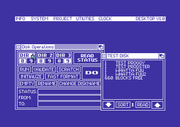
One of the unique features of the cartridge was its GUI
Graphical user interface
In computing, a graphical user interface is a type of user interface that allows users to interact with electronic devices with images rather than text commands. GUIs can be used in computers, hand-held devices such as MP3 players, portable media players or gaming devices, household appliances and...
, even when its usefulness remained quite limited compared to other GUI environments for Commodore 64. Unless RUN/STOP key was held down during power-on or reset, the cartridge presented a graphical WIMP
WIMP (computing)
In human–computer interaction, WIMP stands for "windows, icons, menus and pointers", denoting a style of interaction using these elements. It was coined by Merzouga Wilberts in 1980...
desktop. The graphical look of the desktop was borrowed from AmigaOS
AmigaOS
AmigaOS is the default native operating system of the Amiga personal computer. It was developed first by Commodore International, and initially introduced in 1985 with the Amiga 1000...
1.x. It was possible to load new GUI-based utilities from disk or tape, though these remained rare. Of the tools in the cartridge ROM, the most useful were a text editor
Text editor
A text editor is a type of program used for editing plain text files.Text editors are often provided with operating systems or software development packages, and can be used to change configuration files and programming language source code....
, a disk file management utility, a calculator, and an alarm clock.
A big selling point was the disk and tape turbo feature, which was available for most commands; this accelerated loading things from disk or tape considerably. However, the biggest strength of this particular cartridge for the Commodore 64 lies in the built-in machine code monitor program, which is capable of the widest range of features, such as text and sprite dump, as well as text and sprite editing.
The cartridge provided an extension to the Commodore BASIC
Commodore BASIC
Commodore BASIC, also known as PET BASIC, is the dialect of the BASIC programming language used in Commodore International's 8-bit home computer line, stretching from the PET of 1977 to the C128 of 1985...
, which contained several new BASIC programming aids, such as RENUMBER, and several utility commands, one of the most notable of which was DOS" which can be used to give Commodore DOS
Commodore DOS
Commodore DOS, aka CBM DOS, was the disk operating system used with Commodore's 8-bit computers. Unlike most other DOS systems before or since—which are booted from disk into the main computer's own RAM at startup, and executed there—CBM DOS was executed internally in the drive: the DOS...
commands (e.g. DOS"S0:UNDESIRED FILE to delete a file), read the error status of the drive (plain DOS") or display the disk directory without overwriting the BASIC program in the memory (DOS"$). The BASIC commands also allowed to return to the GUI desktop mode, or start the machine-language monitor.
The freezer feature allowed to save the memory contents to disk to be resumed at later point (this allowed for convenient copying of single-load games, for example). It also allowed the use of some rudimentary game cheating functionality (disabling sprite collision detection, for example), and printing a copy of the screen image to the printer. The freezer also allowed access to the machine-language monitor.