


Dessert spoon

Encyclopedia
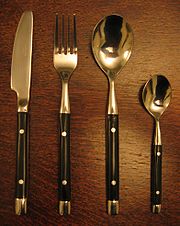
Soup spoon
A soup spoon is a type of spoon with a large or rounded bowl, used for eating soup. The term either can either refer to the Western soup spoon or the Chinese spoon.-Chinese:...
(intermediate between a teaspoon
Teaspoon
A teaspoon, an item of cutlery, is a small spoon, commonly part of a silverware place setting, suitable for stirring and sipping the contents of a cup of tea or coffee...
and a tablespoon
Tablespoon
A tablespoon is a type of large spoon usually used for serving. A tablespoonful, the capacity of one tablespoon, is commonly used as a measure of volume in cooking...
) but with an oval rather than round bowl, it typically has a capacity around twice that of a teaspoon.
The use of dessert spoons around the world varies greatly; in some areas, they are very common while in other places the use of the dessert spoon is almost unheard of—with diners using forks or teaspoons for their desserts instead.
In most traditional table setting
Table setting
Table setting or place setting refers to the way to set a table with tableware—such as eating utensils and dishes for serving and eating. The arrangement for a single diner is called a place setting...
s, the dessert spoon is placed above the plate or bowl, separated from the rest of the cutlery, or it may be brought in with the dessert.
As a unit of measure, a level dessertspoon (abbreviation: dstspn) equals two teaspoon
Teaspoon
A teaspoon, an item of cutlery, is a small spoon, commonly part of a silverware place setting, suitable for stirring and sipping the contents of a cup of tea or coffee...
s or 10 milliliters (about 3 fluidrams
Dram (unit)
The dram was historically both a coin and a weight. Currently it is both a small mass in the Apothecaries' system of weights and a small unit of volume...
). For dry ingredients, a rounded or heaped spoonful is often specified instead.
External links
- Silver place settings, from Butler's Guild