

Tapinocephalidae

Encyclopedia
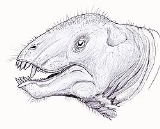
Tapinocephalidae is an advanced family of tapinocephalia
ns. They were all herbivores. They were giants of their time, weighing from 500 to 1000 kg and possibly over 1 or 2 tonnes in weight. They are known from South Africa
and Russia
. The tapinocephalid skull is very thick, probably used for head-butting, probably for mating or territory, and they were dome
-shaped. The thick, dome-shaped skull is reminiscent of the pachycephalosauria
n dinosaur
s. They probably lived in swamps or dry uplands (desert
s), or in wetland
s. The last tapinocephalid went extinct by the Late Permian, possibly because of reduced vegetation in the drying, hot world, or due to the causes of the Permian-Triassic extinction event.
Tapinocephalia
The tapinocephalians are one of the major groups of dinocephalian therapsids. Unlike anteosaurs and estemmenosuchids, tapinocephalians are mainly from Africa and only one species is found in the north - Ulemosaurus from Russia. The tapinocephalians are divided into three clades, Styracocephalidae,...
ns. They were all herbivores. They were giants of their time, weighing from 500 to 1000 kg and possibly over 1 or 2 tonnes in weight. They are known from South Africa
South Africa
The Republic of South Africa is a country in southern Africa. Located at the southern tip of Africa, it is divided into nine provinces, with of coastline on the Atlantic and Indian oceans...
and Russia
Russia
Russia or , officially known as both Russia and the Russian Federation , is a country in northern Eurasia. It is a federal semi-presidential republic, comprising 83 federal subjects...
. The tapinocephalid skull is very thick, probably used for head-butting, probably for mating or territory, and they were dome
Dome
A dome is a structural element of architecture that resembles the hollow upper half of a sphere. Dome structures made of various materials have a long architectural lineage extending into prehistory....
-shaped. The thick, dome-shaped skull is reminiscent of the pachycephalosauria
Pachycephalosauria
Pachycephalosauria is a clade of ornithischian dinosaurs. Well-known genera include Pachycephalosaurus, Stegoceras, Stygimoloch, and Dracorex. Most lived during the Late Cretaceous Period, in what is now North America and Asia. They were all bipedal, herbivorous/omnivorous animals with thick skulls...
n dinosaur
Dinosaur
Dinosaurs are a diverse group of animals of the clade and superorder Dinosauria. They were the dominant terrestrial vertebrates for over 160 million years, from the late Triassic period until the end of the Cretaceous , when the Cretaceous–Paleogene extinction event led to the extinction of...
s. They probably lived in swamps or dry uplands (desert
Desert
A desert is a landscape or region that receives an extremely low amount of precipitation, less than enough to support growth of most plants. Most deserts have an average annual precipitation of less than...
s), or in wetland
Wetland
A wetland is an area of land whose soil is saturated with water either permanently or seasonally. Wetlands are categorised by their characteristic vegetation, which is adapted to these unique soil conditions....
s. The last tapinocephalid went extinct by the Late Permian, possibly because of reduced vegetation in the drying, hot world, or due to the causes of the Permian-Triassic extinction event.
Taxonomy
- Suborder DinocephaliaDinocephaliaDinocephalia are a clade of large early therapsids that flourished during the Middle Permian, but became extinct leaving no descendants.-Description:...
- Infraorder TapinocephaliaTapinocephaliaThe tapinocephalians are one of the major groups of dinocephalian therapsids. Unlike anteosaurs and estemmenosuchids, tapinocephalians are mainly from Africa and only one species is found in the north - Ulemosaurus from Russia. The tapinocephalians are divided into three clades, Styracocephalidae,...
- FAMILY TAPINOCEPHALIDAE
- AvenantiaAvenantiaAvenantia is an extinct genus of Tapinocephalidae. Its fossils have been found in South Africa. It was first named by Lieuwe Dirk Boonstra in 1952, and contains one species, A. kruisvleiensis.-References:...
- DelphinognathusDelphinognathusDelphinognathus is an extinct genus of Tapinocephalidae. Its fossils have been found in the Karoo Beds in Cape Colony, South Africa. It was first named by Professor Harry G. Seeley in 1892, and contains one species, D. conocephalus. Seeley described the animal on account of a skull specimen, which...
- KeratocephalusKeratocephalusKeratocephalus is an extinct genus of Tapinocephalia from the middle Permian of South Africa. Lower and Middle Tapinocephalus Zone, Karoo deposits, Lower Beaufort Beds; Beaufort West. It has a 2.5 to 3 m long ; 700 to 1000 kg; with a variable snout length; variable pachyostosis; nasofrontal...
- MormosaurusMormosaurusMormosaurus is an extinct genus of Tapinocephalidae. It was first named by Watson in 1914, and contains one species, M. Seeleyi. Mormosaurus had a long skull.-External links:* in the Paleobiology Database...
- MoschopsMoschopsMoschops is an extinct genus of therapsid that lived in the Late Permian, around 255 million years ago. Therapsids were proto-mammals , which were the dominant land animals. Five metres long, Moschops was the largest land animal of its time, a herbivore preyed on by other therapsids...
- MoschosaurusMoschosaurusMoschosaurus is an extinct genus of non-mammalian synapsid.-References:*...
- PhocosaurusPhocosaurusPhocosaurus is an extinct genus of non-mammalian synapsid.-References:*...
- RiebeeckosaurusRiebeeckosaurusRiebeeckosaurus is an extinct genus of non-mammalian synapsid from the Middle Permian of South Africa. Middle Tapinocephalus Zone, Karoo deposits, lower Beaufort Beds, Beaufort West, Boonstra 1952b. It was a herbivorous medium-sized dinocephalia, it has a very long, slender snout and a narrow...
- StruthiocephalusStruthiocephalusStruthiocephalus is an extinct genus of dinocephalian therapsid from the Permian of South Africa.-Sources:*Dinosaur Encyclopedia by Jayne Parsons*The Origin and Evolution of Mammals by T. S...
- TapinocaninusTapinocaninusTapinocaninus is an extinct genus of the family Tapinocephalidae....
- TapinocephalusTapinocephalusTapinocephalus is a genus of large herbivorous dinocephalian that lived during the Middle Permian Period. These stocky, barrel-bodied animals were characterised by a massive bony skull roof and short weak snout...
- UlemosaurusUlemosaurusUlemosaurus svijagensis was a dinocephalian synapsid that lived 250 million years ago, at Isheevo in Russian Tatarstan.Only several partial skeletons and skulls have been found. The skull bones are extremely dense: about 10 cm at its thickest. This thickening is possibly related to...
- Avenantia
- FAMILY TAPINOCEPHALIDAE
- Infraorder Tapinocephalia